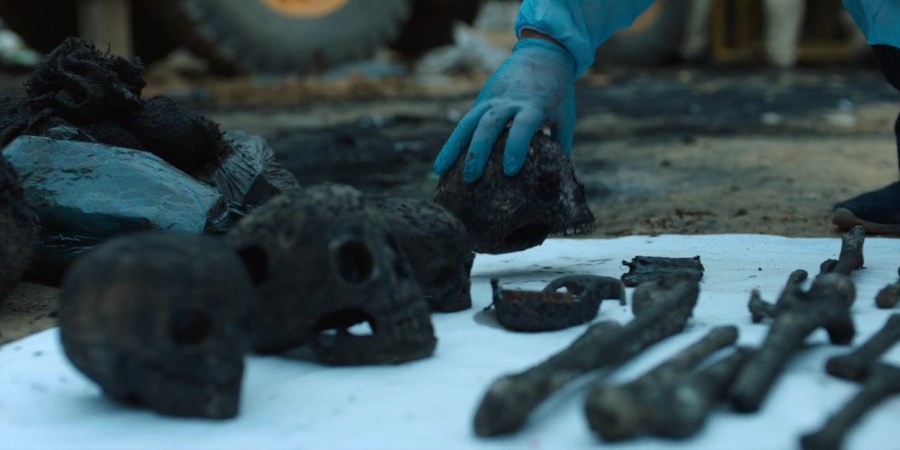
Children wandering door to door, sometimes unsupervised, is often likely to end in tears. In this film Sector 36, immigrant parents, struggling to survive, have not the time to keep a watchful eye on the kids, resulting in sexual abuse, murder, organ trafficking, and cannibalism.
The words “inspired by true events” allow for all sorts of poetic licence, offering the fascination of actual criminality without the need to prove the veracity of each scene. This one is fairly close to the facts, being based on the 2006 Noida serial murders, in which over thirty children disappeared from a town in Uttar Pradesh in northern India. Evidence was presented, in the trial of the two alleged perpetrators, that the children had been sexually abused and murdered, had their organs sold to traffickers, and in some cases were eaten. The charges included abduction, rape, murder, criminal conspiracy and trafficking. The two men involved, a rich man and his servant, were found guilty of murder in 2009 and sentenced to death but were later (2023) acquitted of all charges against them due to insufficient and largely circumstantial evidence, despite the servant’s recorded confessions, which included admissions of cannibalism.
Before the acquittals, the BBC released a documentary called The Slumdog Cannibal, which tried to examine the motivations of the servant who had admitted to the crimes. The legal position becomes a lot more complicated once convictions are quashed, so in the two-hour Netflix special Sector 36, the original names have been changed, and various details are embellished for dramatic effect. The twists and turns of the plot at the end are completely fictitious. But the direction is sure and never intrusive, the plot is taut and engrossing, and the acting excellent, from the smallest victim to the extraordinary interactions of the two main characters, Prem and Ram.
We start by meeting the hungry servant, in this case called Prem Singh (played by Vikrant Massey), who is looking after the house of his boss, Balbir Singh Bassi (Akash Khurana). He calls his family, tenderly tells his wife he loves her, and then goes off to a storeroom where he starts chopping up a dead woman.

We then we meet a policeman, Ram Charan Pandey (played by Deepak Dobriyal) who is also a loving family man, driving his daughter to school on his scooter, but he turns out to be corrupt and lazy at work, not bothering to investigate the reports of the many small children who have gone missing in the town. They’ll turn up, he tells the distraught parents. He believes it too, until Prem tries to abduct his daughter. Then he takes the cases seriously, only to be hindered and suspended by his superior officer who is a friend or perhaps employee of the rich man, Bassi. When the father of one of the abducted girls appears at Bassi’s house screaming about murder and rape, Bassi reveals that the father was the girl’s pimp.
But then, a child from a wealthy family is taken, a nationwide manhunt is launched, and the child is found almost immediately. One cop tells his colleagues that while Gandhi freed the country, the picture of Gandhi’s face on Indian banknotes will free this rich child. Eventually, Ram’s new superior officer reinstates him and lets him arrest Prem, but only because he wants his temporary posting in Delhi to become permanent.

Is everyone corrupt in this story? The theme, stated at the beginning, is Isaac Newton’s third law of thermodynamic: for every action there is an equal and opposite reaction, which has become in social interactions a “system”. The system means that when a crook gives Pandey a box of cash, he is allowed to leave, while others who have no funds are beaten up and incarcerated. When a rotting child’s hand is found in a sewer, Pandey declares it is a monkey’s paw and gives a reward to the boy who found it.

This boy is then captured by Prem who has his own system, capturing little kids to be abused and then slaughtered for their flesh and organs. Prem tells the boy that the police will forget about him after a few days, and even his parents will eventually just replace him. But someone else, someone rich and worthy, will live longer through the appropriation of his organs.
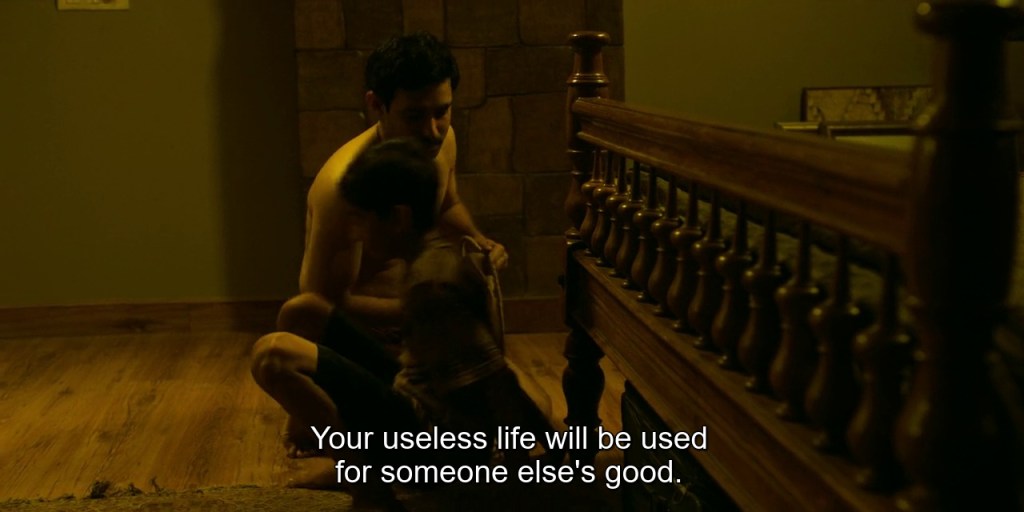
Why, we wonder, is he like this? We have a flashback to Prem’s early life – he is working in his uncle’s butcher shop, chopping up goats and “servicing” his uncle, who enjoys raping little boys. We see him fight back, killing the uncle and then chopping him up, presumably getting rid of the evidence by bundling it up with the goat flesh, and eating his uncle’s liver, raw.
I cut that fucker up and fed him to the dogs. Had a few pieces myself!

As an adult, he has no scruples doing the same thing to kids (human ones), for his own pleasure and profit. Ram, the policeman, arrests Prem who immediately confesses, boasts, that he kidnaps kids, rapes them, chops them up after killing them, eats some of the meat, disposes of the rest, and sells their organs. His “business” involved all the missing children that the police have been ignoring. He tells the police,
Sir, the thing is that after killing Uncle, I got a taste for human flesh. I used to crave it. I needed it every couple of months…. I avoided it for a year, I tried to quit. But that craving wouldn’t go away.

He admits to abducting Ram’s daughter, but says it was an accident. He just didn’t know her father was a cop. Ram asks, “what’s the difference between them and my child?” Prem is outraged – there is no comparison, the kids he kidnapped and slaughtered were nobodies, who would never amount to anything.

While Prem is a bit naïve (one might say stupid), his question is real. No one cares about the sheep, goats or chickens that he chopped up in his Uncle’s shop as a child, nor would they be able to tell the difference if he added Uncle to the mince. Prem’s argument that he became addicted to human flesh is just an excuse – those who have tried the meat of humans report it is hard to distinguish from veal or pork. But poverty, homelessness and alienation is real, and if we can utterly disregard the moral value of any sentient being, we can do the same to those humans who seem, to criminals and authorities alike, outside our scope of care. Those whose lives don’t matter become disposable, and ultimately edible.

 The Cannibal Guy