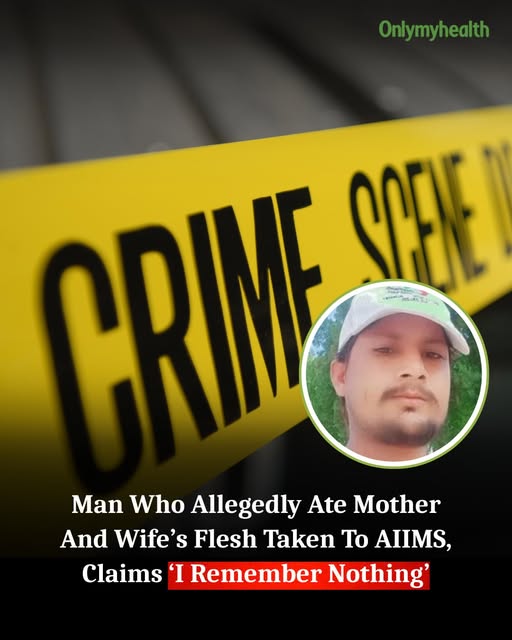
Screams, smashed skulls, flying flesh were not what villagers of an Uttar Pradesh village expected on a quiet Monday morning when a 30-year-old labourer brutally murdered his wife and mother on the rooftop of his house and then chewed flesh from their smashed skulls as his neighbours watched.
A 30-year-old man was arrested on 12 January 2026 in Kushinagar’s Parsa village for the double murder of his mother and wife. The suspect, who has been identified as Sikandar Gupta, had returned to the village about a month previously after working as a labourer in Mumbai. According to police reports, the victims were identified as his wife, Priyanka (28), and his mother, Runa Devi (60). Gupta initially attacked the victims with wooden sticks, and then with cement bricks, causing fatal head injuries to them.
Local residents rushed to the scene as the screams of the women echoed through the neighbourhood. Witnesses reported seeing Gupta mutilate the bodies and consume portions of the remains. When the crowd attempted to stop him, Gupta began throwing pieces of debris and human flesh at them, which caused widespread panic until the Ahirauli police arrived to detain him.
Kushinagar Superintendent of Police, Keshav Mishra, said that,
“a case of double murder was registered, and police are also examining the accused’s mental condition as part of the investigation.”
Neighbours informed police that Gupta had a history of substance abuse involving alcohol and cannabis and was known for frequent domestic disputes. The accused remains in custody pending a formal psychiatric evaluation to determine if he is fit to stand trial or if the murders were the result of a total psychological collapse.
Gupta has been admitted to the Psychiatry Department at AIIMS (All India Institutes of Medical Sciences) under police custody. According to reports, Gupta is speaking incoherently, at times claiming he was drunk during the incident and at other times saying he does not remember anything at all. Doctors have sedated him due to aggressive behaviour and are closely monitoring his condition.
Experts suggest the violence points to deep-seated psychological issues. Dr. PK Khattri, a senior clinical psychologist in Lucknow, said that Gupta’s agitated and non-communicative behaviour “points toward a severe psychotic break” that led to cannibalism.
As Dr Watson used to say, “No shit, Sherlock!”
Ashok Srivastava, an independent criminologist and an associate of the National Forensic Sciences University (NFSU), said that such extreme acts often stem from a
“desire for total domination”
He added that this type of behaviour represents an “ultimate expression of control, often triggered by internal frustrations or extreme psychopathology.”
Which could be said of human societies generally. From bullying in school to sexual abuse to war atrocities to the commercially pressured obsession with eating the flesh of other animals, appetites are driven by this “desire for total domination”, of territory, of food, and of the bodies of others. Anthropocentrism, sometimes called speciesism, is maintained by the practice of killing other animals in ever increasing numbers, to prove our superiority and deny our own animality and mortality. The French philosopher Jacques Derrida called that “carnivorous virility”, the sacrificial slaughter and consumption of “inferior” animals by the rational, patriarchal civilised meat-eater.
What happens when the lust to dominate or kill outruns the limits of anthropocentrism and is instead turned back on fellow humans? The biological fact is that humans are animals, and animals are made of meat. When a society reaches a point where the old ethical agreements are disintegrating, it can either forge new ones or dissolve into chaos, war and, yes, cannibalism. The psychopath, such as the one in this case who allegedly started his brutal rampage with domestic violence before turning to murder and flesh eating, seems to understand this better than most ‘sane’ people.
A man was arrested on Friday March 22 in Kern County (north of Los Angeles in the San Joaquin Valley) and charged with the “removal of human remains from other than a cemetary” (sic) according to the Sheriff’s office.
Construction workers in Wasco reported seeing the man near the Amtrak station.
“I’m not sure from where, but he walked this way and he was waving a person’s leg. And he started chewing on it over there, he was biting it and he was hitting it against the wall and everything.”
It seems a pedestrian (unidentified so far, some reports say male, others female) was killed by a train on Friday morning near 7th and G streets in Wasco. According to eyewitnesses, a man was subsequently seen eating a human leg that had been torn off in the accident.
The video shows the man in a red hoodie and black pants bending over something. He turns around and laughs at the person taking the video and then walks away. Shortly afterwards, the video shows the police responding and the man waving the leg at the officers.
A voice can be heard on the video saying, “He’s eating that shit!” in English and then in Spanish. Most of the news reports edit out the parts where it looks like he might be eating the leg.
Other news footage from KERO-TV showed what appeared to be bloodstains on the sidewalk at the scene of the incident. Some reports say he was charged with mutilating the body, supporting claims that he had consumed some of the limb.
The sheriff’s office later confirmed that they had arrested the man and identified him as 27-year-old Resendo Tellez. He was charged with six offences including possession of controlled substance paraphernalia.
Social media commentary varied from reflecting on drugs, homelessness and poverty to accusations of demonic possession and culture war accusations against California liberals allowing a “breakdown of societal norms”. One headline stated, “Cannibals Are Alive and Well in Newsom’s California.”
JUST IN: California man arrested for allegedly eating a severed leg that he took from a pedestrian who was struck by a train.
The incident happened in Wasco, California.
According to police, 27-year-old Resendo Tellez removed a leg from an Amtrak Station.
News footage of the story often contains warnings of “distressing material” and in most cases blur the leg when showing the video. Is there something weird about all this shock and horror?
If the same person had not been hit by a train, it would have been perfectly normal to show that person’s leg in a program on, say, beach holidays. On a porn site, the leg would have been the least of what we might have seen. Yet once detached from the torso, a human limb becomes so abject it must be blurred, and even then, warnings issued. The reason seems to be that we are terrified to admit our animality. We can go to a supermarket and push a trolley around containing the leg of a cow or a lamb, with the overt understanding that we will be eating it later, just as Tellez allegedly did with what he identified as a piece of meat lying on the ground. Yet because it is a human body part, it becomes obscene, repulsive, horrifying, because it reminds us that we, too, are mortal, edible animals, made of meat.
On May 17, 2023, The Indiana Supreme Court in Indianapolis upheld the life sentence without parole for a 41-year-old Indiana man convicted of killing his ex-girlfriend and dismembering her body before partially eating several of her internal organs.
Joseph Oberhansley was convicted in September 2020 of murder and burglary in the slaying of 46-year-old Tammy Jo Blanton in Jeffersonville in September 2014. Clark Circuit Judge Vicki Carmichael sentenced Oberhansley to life in prison without parole, based on the jury’s recommendation.
Oberhansley’s legal team filed a brief for an appeal in June 2022. It is available at this link. His attorney, Victoria Casanova, argued before the court in April 2023 that her client’s mental health was not taken into consideration and that the jury did not return a proper verdict form in weighing aggravating and mitigating circumstances.
The opinion, written by Justice Christopher Goff, said the jury made “the necessary weighing determination.” Three other justices concurred and Justice Geoffrey Slaughter agreed in part.
The body of Blanton, 46, was found at her home the morning of Sept. 11, 2014, badly mutilated with more than 25 sharp force injuries and multiple blunt force injuries.
Jeffersonville Police reported that at approximately 9:30 a.m. on the morning of Sept. 11, 2014, officers responded to a call requesting a welfare check at Blanton’s home. Several hours earlier, Blanton had called 911 because an angry Oberhansley was upset about the end of their relationship—refusing to leave her home until ordered by several police officers.
Upon arriving at Blanton’s home, officers knocked on the door and Oberhansley answered. A detective on the scene noticed a cut on Oberhansley’s hand and searched him, finding in his pocket a brass knuckle and a knife that appeared to have hair and blood on it.
Investigators obtained a warrant for the home and inside the bathroom found a “big bloody mound of something in the bathtub.” It was Blanton’s body. She had been stabbed 25 times in the head, neck, and chest.
The body had also been extensively mutilated. The front portion of her skull, a portion of her brain, lung, and most of her heart had been removed. Further investigation revealed that parts of her organs were found on a dinner plate next to a frying pan, bloody knives, and a pair of tongs that had blood on them.
During a subsequent interview with police, Oberhansley “revealed to the detectives that he ate Tammy’s brain” and that he also “tried to pull the ‘third eye’ out with tongs,” police wrote. He also admitted to eating the organs that he removed from Blanton. Oberhansley was originally charged with murder, abuse of a corpse (because cannibalism is not a crime in 49 US states) and breaking and entering.
Oberhansley testified that two men had been at the victim’s home when he arrived around 4 a.m. that morning and said they were responsible for Blanton’s death. He said the men had knocked him out and that he awoke when police arrived.
Clark County Prosecutor Jeremy Mull told jurors Wednesday during opening statements in Oberhansley’s murder trial:
“Joseph Oberhansley butchered Tammy Blanton like you wouldn’t kill a livestock animal. But this lady died with dignity.”
Mull said Blanton locked herself in a bathroom before Oberhansley kicked a door down and attacked her — just one week after holding her captive and raping her. Oberhansley told police during a videotaped interview that Blanton “really wasn’t all that scared, surprisingly,” as if she knew she was about to die, Mull recalled. “In her last moments, she wasn’t going to give him the pleasure of seeing her scared,” the prosecutor said.
A psychologist testified at trial that Oberhansley was “the most severely mentally ill person whose case she had reviewed,” Oberhansley’s defence attorney Cara Schaefer Wieneke wrote:
“It would be easy to look at the horrors visited upon Tammy and conclude they were simply the actions of a monster. But doing so would be reductive, and this Court’s 7(B) review must look deeper. This Court must consider his actions in the context of his profound mental illness. There is also no question that Oberhansley was suffering from a severe mental illness when he committed this crime. What there is a question about, however, is whether Tammy would be alive today if Oberhansley were not so severely mentally ill. There are reasons to believe that she would. Because of that, Oberhansley asks this Court to find his sentence of life without parole is inappropriate.”
Oberhansley’s mental state was a recurring complication in the court process, in which he was found at different times competent and incompetent. For example, in 2017, his defence wrote that their client believed they were working for the devil, according to The Courier-Journal.
The case was originally declared a mistrial after witness testimony put forth information about Oberhansley’s past that parties had stipulated would not be introduced during the proceedings. For example, it was not specified in court that the defendant had spent a 12-year stint in a Utah prison for manslaughter because—while he was jealous and high on meth—he shot and killed his girlfriend Sabrina Elder, and shot his own mother (who later forgave him).
Oberhansley’s sister had grabbed his and Elder’s infant son. He shot at them, but missed. Then Oberhansley shot himself in the head. He survived, but a psychiatrist wrote he’d given himself a “partial lobotomy.” He pleaded guilty to a manslaughter charge, down from murder. His family was reluctant to take the stand, prosecutors said.
In his first trial over Blanton’s death, Oberhansley’s defence asserted that their client’s mental state was a major factor. Lawyer Bart Betteau cited horrifying details of the murder, saying that jurors would hear that Oberhansley believed Blanton was going to kill him and that she could hear his thoughts.
“Think about the process and say to yourself, is this someone who’s thinking right? His thought was that someone was after him.”
Oberhansley’s attorneys couldn’t mount an insanity defence, however. They lost their ability to do so in return for the state declining to seek the death penalty. The attorneys’ previous attempt to lodge an insanity defence was thwarted when Oberhansley filed a motion to withdraw it. He denied living with a mental illness.
Oberhansley is incarcerated at the New Castle Psychiatric Unit of the Indiana Department of Correction.
The most interesting part of this extended legal battle (nine years) from the point of view of Cannibal Studies is the statement from the prosecutor about the victim being “butchered… like you wouldn’t kill a livestock animal.” Philosophers struggle with the inconsistency of our social customs – we cherish dogs and cats, protect whales, but accept the butchery in mind-boggling numbers of cattle, sheep, pigs, chickens, and others. We know about the horrendous suffering in the slaughterhouse, but close our minds to it. We know that on top of its appalling cruelty, the meat industry is one of the largest sources of greenhouse emissions as well as a cause of several severe human health problems such as hypertension and colon cancer. Yet the meat industry remains exempt from much of the environmental and health debate that surrounds other issues. Stanley Cavell states that becoming part of a social contract requires becoming “conspirators”, agreeing implicitly what will be acceptable, disregarding its ethical conundrums. Such “perpetual failure of justice invites the threat of madness”.
Cannibals are routinely described as insane, as if their capricious psychotic episodes fully explain both their choices and the appalled revulsion of the rest of society. Oberhansley’s appeal described him as “detached from reality”. But the persistent portrayal of cannibalism as unthinkable and cannibals as insane relates to their refusal of the fissure between reality and the language able to describe it. The cannibal personifies ruthless attempts to satisfy voracious human appetites, while realising the animality of fellow humans; he puts the unthinkable into reality through the flesh and blood of his victim. His madness arises in the gap between the carefully expurgated language of the social contract and the reality of the world as a giant slaughterhouse.





 The Cannibal Guy