The revenge of nature: WENDIGO (Larry Fessenden, 2001)

Wendigo is a film written, directed and edited by Larry Fessenden, who would, a few years later, make an episode of the TV horror series Fear Itself called SKIN AND BONES, which was about a guy who disappears on a hunting trip with friends and returns cold, thin and desperately hungry. He has, we quickly discover, become a Wendigo! In this, the earlier film, there are also crazy hunters led by Otis (John Speredakos), who are mad with our protagonists for driving into a stag (the traditional symbol of the Wendigo) who they have been tracking and, worst of all, breaking his antlers, which are apparently very valuable. The Wendigo is already there in their cabin as a “dark presence”, so we just need to be introduced.

First, the really good cast – George (the Dad) is played by Jake Weber, from the 2004 remake of Dawn of the Dead and Meet Joe Black. He is a super-stressed New York photographer, and the last thing he needs is a run-in with a bunch of redneck hunters. Kim, the Mom, is played by the wonderful Patricia Clarkson (most recently starring in Gray) and the kid, Miles, is played by Erik Per Sullivan, who was Dewey in Malcolm in the Middle.

George is more disturbed by the rednecks than he is willing to let on, telling Kim, who is a psychologist, that he is distressed by the “abyss” between him and them, with no possibility of communication. She tells him that:

“It’s very archetypical for the civilised man to feel threatened by the man of the country.”

George is utterly divorced from nature, seeing it as alien and menacing. So, the other last thing he needs to meet is a Wendigo, a figure on the front line of the human war on nature.

They head into town to buy curry (as you do in small towns) and Miles meets in the store a Native American Elder who tells him about the Wendigo, a small carving of which Miles is drawn to.

“The Wendigo is a mighty powerful spirit… it can take on many forms, part wind, part tree, part man, part beast. Shape shifting between them… It can fly at you, like a sudden storm, without warning, and consume you with its ferocious appetite. The Wendigo is hungry, always hungry. The more it eats, the bigger it gets, and the bigger it gets, the hungrier it gets, and we are hopeless in the face of it. We are consumed, devoured…. There are spirits that are angry. Nobody believes in spirits anymore. Doesn’t mean they’re not there.”

The Wendigo is a figure from the mythology of the Algonquin people of North America. They lived in a land of long winters where the competition for food would have been intense and cannibalism of the dead probably not unusual. Myths help to spell out behaviours that societies need to discourage – cannibalism could decimate small, isolated communities. That myth, of the voracious monster whose hunger only grows with feeding, was later applied to the invaders, the colonists who took their land, their produce and often their lives. In such a struggle, the Wendigo, as an original figure of their culture, could take almost a vengeful role, eating the technologically superior invaders. George inadvertently confirms this, telling Miles “the Wendigo only goes after bad guys.”

The Elder tells Miles he can keep the figure, but there is no sign of him when Kim is subsequently asked to pay for it. He is presumably one of those spirits, not angry but advisory.  He warns Miles about the “cry of the Wendigo”. The Wendigo is clearly (to the audience) imbued into that carving.

Then the Wendigo strikes. Or is it the rednecks? Did the Wendigo knock George off his sled, or did it carry him home after Otis shot him? Was it the revenge of nature, or society? When the Wendigo later demands of Otis “Give me my liver!” it voices the cry of revenge of every animal, human and otherwise, killed for fun or profit. When Otis meets justice, Miles awakes with his Wendigo figure in his hand.

It’s a great cast, with an absorbing plot, although it gets a bit lost at the end. But the questions it asks are compelling.  The New York Times critic wrote:

“Mr. Fessenden carefully blurs the line between psychology and the supernatural, suggesting that each is strongly implicated in the other. The rampaging Wendigo may be a manifestation of Miles’s incipient Oedipal rage, but at the same time it is a force embedded in nature and history.”

The Wendigo carries so much symbolism, besides the horror trope in which he seems so regularly to find himself, such as in Fear Itself or the classic Wendigo film, Ravenous, which was made a couple of years before this film. He expresses the anger that rages within George, the father who cannot show interest in his son’s curiosity because of his own issues brought with him from the city, frustration and fear of failure. And we can infer (as the NYT does) that Miles himself feels an Oedipal rage toward his father who, Freud tells us, is the child’s rival for sexual possession of the mother throughout childhood. The voracious hunger comes from an even earlier stage, what Freud called the “cannibalistic stage” of babyhood, where the infant wants to own the breast, consume it so it will always remain in his possession. George’s playacting the cannibal, attacking and pretending to eat Miles, is a common parent/child game, but is also deeply revealing of these forces hidden deep in the unconscious.

At yet another level, the Wendigo represents the revenge of nature on the civilised, those whose insatiable hunger for growth decimates the land and finds sport in killing its inhabitants, be they human, deer or any ‘other’. The antler is a weapon used by the stag, a normally shy and timorous animal who becomes a formidable fighter in the mating season, and the size and strength of its antlers represents both its sexual and fighting prowess. In the hybrid shape of a human and a stag, the Wendigo recasts humans from hunters to hunted, from predator to prey. This is precisely why Hannibal Lecter is shown in Wendigo form throughout much of the three seasons of the television series Hannibal. Hannibal is the civilised, rational, erudite man of science, a psychiatrist who knows of the dark forces inside the human psyche, and has determined that the human is just another animal, no more deserving of respect or inedibility than any other species, and even less if he happens to be rude. Who judges that – the supernatural force, the inhuman, the less-than-human or, in Hannibal’s opinion, the more-than-human? Whichever you choose, it appears as the Wendigo.

“FERAL” (American Horror Stories, episode 6 – August 2021)

Last week’s blog was not a film or TV story but a real event, the account of displaced people being kidnapped for ransom by Mexican cartels, and chopped up for their meat if the money was not found. This segues nicely into this week’s blog, in which a boy disappears and the parents suspect a cartel kidnapping, but in fact (spoiler alert) he has joined a group of feral cannibals.

The response to news of cartels, kidnapping and cannibalism is to shake our heads and ask how people can DO such things. The assumption behind such a question is that we have ‘progressed’ and, while cannibalism may have been a part of our savage past, it should have been left behind in today’s enlightened civilisation. Yet we are aware that cannibalism continues to exist, and that it can reappear when food is short, as in the siege of Leningrad, or for revenge like the man who killed and ate up to thirty women because he resented their rejection of him, or sexual attraction and desire to keep the person with us (or within us) like Jeffrey Dahmer and Armin Meiwes, or just for fun and profit, like Fritz Haarmann.

Sigmund Freud wrote of an ORAL SADISTIC or CANNIBALISTIC STAGE, which coincides with the time babies’ teeth start to erupt. We recognise our mother’s breast as external to us, and wish to retain ownership, by biting and swallowing it. At the same time, the aggression is tempered or sometimes instead magnified by anxiety at the potential loss of the other (mothers don’t like to be bitten) or fear that the much stronger parent will instead choose to devour the child. Our first instance of logical reasoning – if I can bite her, she can surely bite me harder. These early influences may sink into the sludge at the bottom of our unconscious minds as we grow up, but they remain there, and can reappear at any time in different forms.

It is tempting, therefore, to see acts of cannibalism as simply throwbacks – to our earlier social models (savagery) or to psychotic deviance dredged up from tortured unconscious memories. Civilisation, we think, can conquer such eruptions. But not always, and not in this episode of American Horror Stories, another episode of which we considered recently.

This one is set in, and against, nature. A man, woman and three-year-old boy are driving into Kern Canyon National Park in California for a camping trip. The father wants to return to nature, get them out of their comfort zone. The mother points out that “out of the comfort zone” is equivalent to “uncomfortable”, and the little boy wants a TV. A phone call on the way tells us that the father is a lawyer defending a “greedy-ass corporation” – the type that exploits and destroys the environment for profit. This is going to be about nature, red in tooth and claw, and revenge.

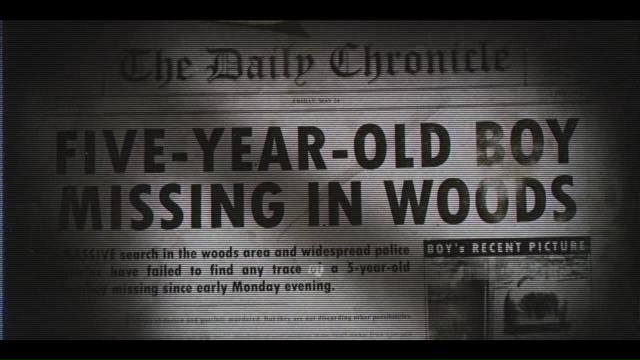
The boy, Jacob, disappears while camping with his family. Ten years later, his father, Jay, is approached by a hunter who tells him that he believes Jacob is alive, kidnapped by a drug cartel running pot farms in the park. The hunter leads Jay and Jacob’s mother, Addy, into the woods to look for him. The Park Ranger, who for some reason is Australian, warns then not to go, but of course they head off and, like last week’s Mexican abduction, it’s a trap.

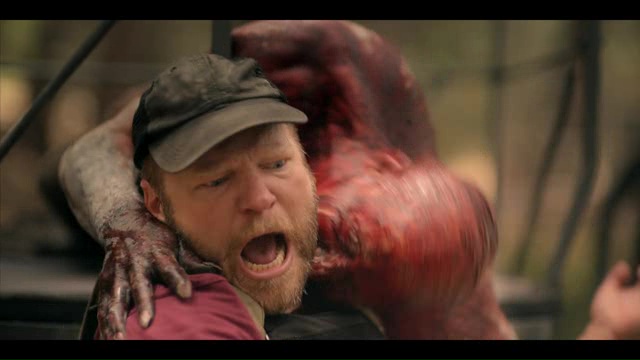
Deep in the woods, they are attacked by wild, human-like creatures, who eat their abductor. Jay and Addy seek refuge at the Park Ranger’s station, where the Ranger tells them that the National Park Service was created by the government

“…to keep Americans from things that would kill and eat them.”

These are feral humans, he says, possibly descendants of Vikings, or of mountain men who never came down from the mountains, or maybe Civil War soldiers who never surrendered. Or people who just checked out, had enough of the world. In any case, they have gone back to nature, gone feral, and so are a threat to the civilised, cultured humans who use and abuse the natural world. The Ranger tells them there are are tribes of ferals in every National Park – over 2,000 people have vanished from the parks over the years. There are certainly people living off the grid in the wild areas of the world, but not necessarily feral cannibals. Why is it kept top secret?

“Governments need their citizens to believe they are in control. Plus, the National Parks generate billions of dollars in revenue every year. Capitalism, baby! If people knew there were feral cannibals running around, attendance might drop off.”

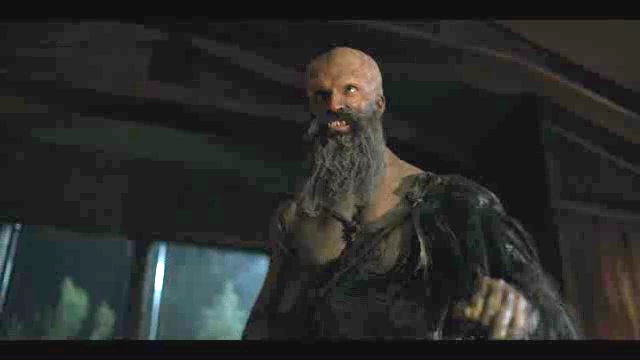
The Station is attacked by the feral cannibals, and the ranger is killed. Jay and Addy are taken to the leader of the creatures, seated on a throne of skulls, looking remarkably like a Renaissance Jesus.

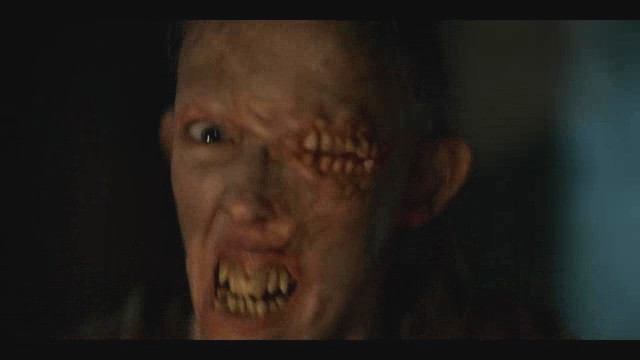
Of course it is Jacob (speculation is already mounting that Jacob, the cannibal king, might get his own spin-off series). Jacob seems to recognise his parents, but when one of the creatures asks Jacob who they are he answers, “dinner“. Freud would have enjoyed the feast that follows: the “primal hordes” overthrowing and eating the father; Jacob, frozen in his infantile cannibalistic phase, tasting his parents’ blood.

This episode is also a study in what Georgio Agamben calls the “anthropological machine”, a paradigm that we use to separate ourselves from other animals. In the pre-modern machine, non-humans were depicted as human-like to draw the distinction – we spoke of werewolves, minotaurs and cyclops; in this episode they evoke Bigfoot or the Australian equivalent, the Yowie. But the modern anthropological machine instead declares certain humans to be less than human or else inhuman – race, ability, gender or social status may be used to divide us into human and “other”. The ferals are inhuman because they have regressed to savagery, chosen nature over civilisation. For hundreds of thousands of years, we existed in small clans, and anyone outside the immediate family was assumed inhuman. We need to fear, and sometimes eat, the outsider, because we evolved to do so.

We like to think that this is all ancient history. But our sanguine belief in social progress lulls us into supposing that that acts of cannibalism (as depicted in this blog thecannibalguy.com, for example), are simply aberrations, throwbacks to a savage past, or unfortunate outbursts by deranged or psychopathic individuals. What this confident diagnosis ignores is the inherent violence of the human species.

As sociologist Zygmunt Bauman points out, the civilising process has simply presented a “redeployment of violence”. Instead of hunting animals or, more recently, slaughtering them in the street in what used to be called “the shambles”, we now mass produce death in huge factories called abattoirs, which are placed away from residential areas and surrounded by high walls and sophisticated security systems. Violence against our fellow humans has been similarly redeployed, with drones and smart bombs replacing hand to hand conflict. Fear of social sanctions or maybe divine punishment keep us in control of our internalised aggressive drives against our fellow citizens, at least some of the time. But at any moment, for reasons usually unclear, we can loose this violence, together with the voracious appetite that characterises consumerism, and redeploy it against adversaries. Call it feral, as per this episode, or perhaps, instead, call it authentic, cannibalistic humanity.