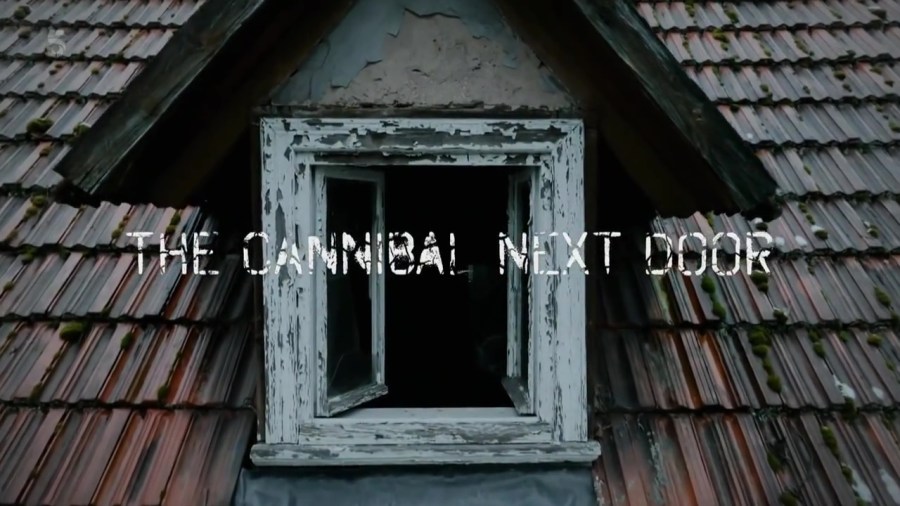
I did it Meiwes – “THE CANNIBAL NEXT DOOR”

December 1, the date on which I am writing this blog, is the birthday of perhaps the most famous living cannibal, the German named Armin Meiwes. He became famous around the globe when he was arrested in December 2002 for killing and eating a willing volunteer he had met on the Internet in 2001, a man named Bernd-Jürgen Brandes, who had helped sever and cook his own penis before being finished off and filleted by Meiwes. Movies have been made based on the events, from reenactments like Dora’s Cannibal to fantasies like Weisz’s Grimm Love. Songs have been written about him and sensationalised retellings haunt our documentaries, often inexplicably comparing him to Hannibal Lecter.

Meiwes was born in Essen in 1961, and was raised by his stern and controlling mother after his father and half-brother moved out, not unlike the story of Ed Gein, who tried to resurrect his severe and hard-hearted mother by killing and eating the genitals of local women in Plainfield Wisconsin. Armin Meiwes, hopelessly devoted to his late mother as he brooded in his thirty-room house, sometimes dressing in her clothes and impersonating her voice, was not dissimilar to Norman Bates in Hitchcock’s film Psycho, which was based on the Gein murders. Many have tried to pin his later conduct on his childhood feelings of abandonment and helplessness although, if that were the case, we would expect millions of similar cases around the world. Maybe there are, but they don’t get caught?

At any rate, young Meiwes developed a taste for cannibalism (sometimes called vorarephilia) from reading fairy tales, particularly the Grimm Brothers’ Hansel and Gretel, in which abandoned children almost get eaten by a witch. The witch, we might note, was the only adult to show them any affection, even though her ulterior motives were clear, at least to the children who were reading the story. The Grimms wrote their fairy tales near Rotenburg, where Meiwes killed and butchered his friend. You may also remember (at least, Fannibals will) that Hannibal Lecter referred to this fairy-tale when he was serving up dinner to Abel Gideon; Gideon’s own leg, smoked in candy apples and thyme, glazed, and served on a sugar cane quill.

Meiwes fantasy of eating and incorporating a brother culminated in 2001 in him advertising on a fetish website called The Cannibal Café for “a well-built 18 to 30-year-old to be slaughtered and then consumed”. The only reply that seemed sincere, indeed eager, was from Brandes, who was not really well-built or 18-30, but fitted the bill because he was determined to be eaten.

They got together and, after getting to know each other (which included slicing off Brandes’ penis and cooking it), Meiwes left his friend to bleed out in the bath, and then proceeded to butcher his carcass and eat the meat, in a variety of cuts, over several months.

In case there are still a few psychologists and journalists who haven’t yet pontificated on Meiwes and Brandes, this week we consider a 2023 UK Channel 5 documentary called The Cannibal Next Door, directed by Calum Farmer. This is quite a good reenactment of the events, although like many others, it relies too heavily on brooding, portentous music and opinions from experts, all of whom are universally repulsed by the cannibalism, a repulsion that Meiwes and many of his correspondents clearly did not share.  

“It had broken humanity’s last great taboo.”

Trigger warning: the real Meiwes (seeing it’s his birthday): This website claims it has actual leaked stills from Meiwes’ video. If you don’t like pictures of chopped up humans, maybe skip the link. They look fake to me, but this Reddit reader swears they are real.

Meiwes is still in jail in Germany, not for cannibalism, which is still not a crime, but for murder, which is absurd since Brandes wanted to die, and was in fact obsessed with being slaughtered and eaten. If anything, Meiwes is guilty of assisting a suicide. There was no law in Germany against eating a human.

We know so much about the case because Meiwes was very open in describing what happened, even videotaping the whole process of slaughtering and butchering. The jury in his case watched this video, and reportedly turned quite green, but it seems likely that they would have also done so had they been made to watch some of the horror clips of cruelty and killing in abattoirs that are abundant on YouTube. His lawyer argued:

“We say it is neither murder or manslaughter, but killing on demand. My client is not a monster.”

As it was clearly not murder and there was no law against eating a corpse, Meiwes was sentenced for manslaughter and given an 8½ year sentence. Public outrage resulted in a retrial which then found him guilty of murder, on the devious premise that Brandes had been mentally incapacitated by depression, and therefore open for manipulation by his killer. He was sentenced to life, which in Germany requires a minimum of fifteen years imprisonment. Meiwes has already served more than that.

Meiwes believed that he did nothing wrong. It seems that the only thing he can see as a moral failing is not the fact that he ate human meat, but that he ate any meat; he subsequently became an environmentalist and a vegetarian, both of which would obviate eating any flesh, including human. His simple claim in his defence was that, unlike pigs, sheep, cows, chickens and other animals, here was a willing victim who consented to, indeed demanded, his own slaughter and consumption. Is it not clearly more ethical to eat an animal who wants to be eaten, whatever the species, than one who does not?

The cannibal weeping demon: Akira Kurosawa’s DREAMS (1990)

Dreams (夢, Yume) is a 1990 magical realist anthology of eight stories, written and directed by Akira Kurosawa, inspired by his recurring dreams. An international co-production of Japan and the United States, Dreams was made with assistance from George Lucas and Steven Spielberg.

Akira Kurosawa (Japanese: 黒澤 明, March 23, 1910 – September 6, 1998) was a Japanese filmmaker and painter who directed thirty films in a career over fifty years. Kurosawa directed around one film per year throughout the 1950s and early 1960s, including a number of classics which were often adapted by other directors. These included Rashomon (1950), Ikiru (1952), Seven Samurai (1954) – which was remade in 1960 by John Sturges as The Magnificent Seven, Throne of Blood (1957), Yojimbo (1961) and High and Low (1963). He is widely considered one of the most important and influential filmmakers in the history of cinema.

Kurosawa’s bold, dynamic style was strongly influenced by Western cinema, yet distinct. In 1990, the year Dreams was released, he accepted the Academy Award for Lifetime Achievement.

Dreams is his most personal work, taken from his own life and unconscious mind. He addresses themes such as childhood, spirituality, art, death, and the mistakes and transgressions made by humans against nature. The episodes within Dreams do not have a single narrative, but are the fragmentary adventures of a “surrogate Kurosawa” (often recognizable by the character wearing Kurosawa’s trademark hat) through eight different segments, or “dreams”, each one with a title. Each is more a fairy tale than a dream in the filmic sense.

A child sees a forbidden fox wedding ceremony and is told he must suicide, another weeps as he witnesses the spirits of a peach orchard that has been cut down by his family, reflecting the human war on nature.

The fear of nature fighting back is a bleak dream of men struggling through a mountain blizzard. The horror of war is demonstrated as a Japanese officer is confronted by the ghosts of his annihilated platoon.

Our understanding of nature is questioned in “Crows”, the only dream not made in Japanese, where Vincent van Gogh is portrayed by American filmmaker Martin Scorsese, with a broad New York accent, and the protagonist travels through the images that fill van Gogh’s tortured imagination.

Our abuse of nature comes to its logical conclusion as we see nuclear power points explode behind Mount Fuji, human ingenuity able to create but not control these forces; in the end, all they can do is colour the toxic pollution so people know what is killing them.

The Weeping Demon” is the seventh dream, and of particular interest in Cannibal Studies. It shows the aftermath of nuclear devastation, a fear that has haunted us all for eighty years, particularly the Japanese, who were the first and only people to experience nuclear weapon attacks.

A man is wandering around a misty, bleak mountainous terrain. He meets an oni (demon or ogre), who is a mutated human with a single horn on his head. Oni are known for indulging in murder and cannibalism when they get the chance. They are typically portrayed as hulking figures with one or more horns growing out of their heads, massive teeth, and occasionally a third eye in the centre of the forehead.

The demon tells him that there was a nuclear conflagration, which resulted in the destruction of nature and animals, the growth of dandelions taller than humans, and horns sprouting on the heads of those humans left. The horns cause them to feel excruciating pain each evening; but they cannot die, so they howl in agony all night. Many of these demons were formerly millionaires and government officials, who are now suffering through a hell befitting their sins.

Even in this apocalyptic post-war world, the social hierarchies continue to oppress – the demons with two or three horns eat those with only one.

“There’s no food! We feed on ourselves. The weak ones go first. It’s about my turn now. Even here we have grades. One-horn demons like myself always get eaten by those who have two or three horns. Before they were powerful and pretentious. And now they still throw their weight around as demons.

The demon that the man meets is waiting to be eaten, seeing this as an escape from his agony and nagging hunger, but also as a punishment – before the wars, he was a farmer who poured milk into the river and buried vegetables to maintain market prices. He warns the man to flee, but when the man asks where he should go, the demon just asks if he too wants to become a demon. The terrified man runs away with the demon in pursuit.

The film finishes with a meditation on death, the final and irrevocable return to nature. Laying down our technology, our appetites and our bodies is celebrated – peace at last.

Condemned as disjointed by some critics, the film has a logic to it, a dream logic, in which things are out of place yet seem quite natural. It starts with a little boy witnessing the wedding procession of the foxes, a slow funereal procession that is forbidden for human viewing, and finishes in a village that has spurned technology and progress in favour of clean air and water and long, peaceful lives, where we witness a funeral procession that is pure colourful celebration.

Dreams is a sumptuous, thoughtful, dramatic, film from which I found it hard to look away. Although it is one of Kurosawa’s last films, it shows him at the height of his power and creativity, and offers a glimpse into his mind, just as he glimpses the mind of van Gogh.

Dreams is now a classic, as are all Kurosawa’s works, but it currently has only 66% fresh rating on Rotten Tomatoes, proving that a lot of people can’t be bothered listening to (or even watching) other people’s dreams. The New York Times critic called it:

“…a collection of short, sometimes fragmentary films that are less like dreams than fairy tales of past, present and future”

But dreams, like the evening news, are always fragmentary – narratives jump from tragedy to kitsch to humour. Dreams often reflect and amplify our repressed emotions and fears, and fairy tales are mythic versions of dreams. Many, perhaps most, fairy tales include cannibalistic giants, wicked step-parents, witches and ogres, such as Little Red Riding Hood, Hansel and Gretel or The Juniper Tree. Children wander, lost and hungry, through brooding forests and come across strange and fantastic creatures. Dreams reveal our repressed fears about the human attacks on nature and each other, the struggles and conflicts that lead to monsters or demons.

In dreams, we lose our rational sense of causality – anything can happen. We get lost, like in fairy tales, in forests or snowstorms or in the mind of Vincent van Gogh, seeing the world the way he had to, consuming it and reimagining it before he could paint it. We meet ghosts of people who don’t know they are dead. Nuclear power plants explode, a fear on everyone’s mind in 1990, four years after The Chernobyl disaster. In dreams, ethics become aesthetics, to quote from Hannibal.  Dreams, like fairy tales, are episodic and disjointed, and the film captures this brilliantly.

Although fairy tales date back centuries, they remain ever popular, with new versions or completely new stories released to reflect the fears of each historical period. In our modern period, the growing and changing presence of media makes us all aware of the bloodshed on the battlefields and in the death camps and slaughterhouses of modern industrial societies, images that we desperately try to forget or repress. It is no wonder that dreams are full of cannibals.