If you by any chance have watched any of the videos of the influencer Israel dos Santos Assis, better known online as Pinguim (Penguin), you may not have guessed that anything controversial was being shown. The Brazilian, from São Francisco do Conde, a city in the metropolitan area of Salvador in Bahiahad, had been gaining more and more followers on social media over the months before his arrest on July 23 2024, when he was apprehended after being caught desecrating graves in the cemetery of San Francisco the Count, in the Salvador Metropolitan Region, and stealing human bones.
Not just bones. The 22-year-old influencer used human flesh from the corpses to cook his most popular dish: feijoada, a bean stew usually involved simmering beans with beef or pork. Both of which have been reported as tasting very similar to human flesh.
One of Pinguim’s videos, which went viral on social media, explained the secrets of adding meat to beans — and how to get the most out of the final dish.
“Treat and throw it in the beans. But you can’t eat it, no, you just chew it and then throw it away. You don’t swallow it, you just chew it and throw it away, you just taste it, it’s sweet.”
The remains were not only for use in his recipes. After being arrested, Israel led the local police to a mangrove swamp where he had hidden numerous bags of bones. He had been sending these to Salvador, the state capital, to be used in satanic rituals.
The suspect was caught after families of buried people reported that graves had been violated and several bones had been stolen.
Pinguim made a video confession to police which was later released to the media. He reported that he had spent hours at the cemetery to see which graves were the most recent; those with the freshest human flesh. He told police he had fried a piece of a person’s leg and seasoned it with lemon and vinegar before chewing on it.
Local reports say he told police that he stole the body parts to order, in exchange for a payment equivalent to about $US50 from three people who wanted to use the bones as part of a black magic ceremony. He used the money to buy shoes and sandwiches, as well as getting his hair cut.
Surprisingly, Pinguim was released on bail pending an ongoing investigation into charges of desecrating a tomb. His lawyer, Luan Santos, told local media his client suffered from mental health issues and was taking anti-depressants. He added that he would be demanding psychiatric tests to ascertain whether the accused was fully aware of what he was doing.
Pinguim’s social media accounts have been deleted.
Brazil has always been a fascinating area for students of cannibalism. One of the most famous tribes was the Tupinamba, who captured a German soldier and explorer named Hans Staden in the sixteenth century. He claimed to have witnessed their cannibalistic rituals and did very nicely from his subsequent writings, illustrated by the graphic woodcuts of Theodor de Bry. As a result, the Portuguese came to save the ‘savages’ from their sins, and through enslavement, assimilation, extermination and the introduction of Smallpox, managed to wipe them out completely.
The classic cannibalism film How Tasty Was My Little Frenchman (Como Era Gostoso o Meu Francês) is set in this period of imperial invasion, and tries to give a new perspective on the way colonialism used cannibalism as its pretext.
More recently, modern Brazilians have been involved in some of the more interesting cannibalism stories that have graced our news cycles, including the “Cartel” who sold pastries made from human flesh to unwitting customers, and the Brazilian who was arrested in Lisbon for eating a man who had tried to help him. Like most cannibalism films, the ones set in Brazil vary between seeing it as something savages naturally do, such as Emanuelle and the Cannibals, and those that see it as typifying the exploitation of the poor by the rich, such as The Cannibal Club.
The Brazilian anthropologist Eduardo Viveiros de Castro proposed a ‘post-structural anthropology’ in his book Cannibal Metaphysics. De Castro sought to ‘decolonise’ anthropology by challenging the increasingly familiar view that it was ‘exoticist and primitivist from birth’, denying that cannibalism even existed, and so transferred the conquered peoples from the cannibalistic villains of the West into mere fictions of colonialism. This alternative view of Amerindian culture rejects the automatic assumption of the repugnance of cannibalism, which serves to either confront it or deny its existence. Accepting those parts of colonial culture that are useful (they speak Portuguese for example) can be seen as a form of reverse, cultural cannibalism.
But Pinguim demonstrates that even Brazilians have not fully embraced this philosophy, particularly when it involves digging up their relatives.
Long Pigs is a 2007 “found footage” movie, in which two desperate filmmakers come across a cannibal, ask him if they can document his eating habits, and then are shocked when he starts killing people and eating them. It is presented as a documentary, with all the usual warnings about graphic scenes etc.
Bit silly, and found footage has rather been done to death, but it has some interesting ideas, particularly the sympathetic approach to the main character, even as he commits his crimes. Look, it seems to say, everyone needs a hobby and, to this cannibal, killing and eating people is no more ethically questionable than hunting or fishing. Stalk, catch, kill (as quickly and painlessly as possible) and then enjoy. He does his best to keep the movie interesting, with a patter of jokes, historical facts and philosophical observations as he slices and dices.
The cannibal is played by Anthony Alviano (Headcase, A Matter of Justice), and he presents the cannibal, also called Anthony, as a boy-next-door persona, one who kills and guts people. Like a farmer of animals, he starts the film explaining that it’s bad to frighten the victims, not for ethical reasons, but because the adrenaline ruins the taste of the meat. The filming starts as he drives around looking for a “certain kind of woman”, because he wants to make “long pig stew”. “Long pig” is a term supposedly used in the Pacific region before colonisation to designate human meat, although that definition is widely contested. Anyway, Anthony is looking for “marbled meat”, so he searches for a sex worker (traditionally victims who are not exhaustively looked for by police) who is, let’s say, of a heavy build.
“People who eat stew make perfect stew. It sounds obvious. Yeah, she looks like she eats well.”
As she smiles at the camera, he sneaks up behind with a sledgehammer and cracks her skull, resulting in the cameraman vomiting (which is actually rather more gross than the murder). They ask Anthony if gets a sexual thrill from killing women, but he dismisses this, in the same way a slaughterhouse worker might deny any pleasure in killing a different species of mammal.
“I’m not a freak or anything like that. This is all culinary, this is hard work!”
“Any hunter would recognise this position. We got the corpse hanging by the ankles. The first thing I’m gonna do here is make a little incision and tie off the anus. That’s to stop contamination from the feces. You would do that whether it was a deer carcass or a cow or a person… Absolutely necessary for health reasons.”
He cooks a stew from a portion of her thigh, then after dinner goes off to brawl in an ice-hockey game, an arena that seems the very essence of carnivorous virility.
Afterwards, he cooks ribs on a barbecue, assuring the viewers that there are “no animal by-products” used – just soymilk. And a woman’s ribs, of course, thus reinforcing the anthropocentric mythology of the human as not really animal, even though he has just butchered one in the same way as any other animal prepared for human consumption. He quotes the Arawak word barbaca, the grill on which human meat was supposedly cooked, according to explorers like Hans Staden and Jean de Léry, which became the Spanish word barbacoa, and eventually morphed into English as barbecue. Staden’s narratives were later illustrated by Theodor de Bry in his 1592 book Americae Tertia Pars, and the film sneaks in a quick peek at that glimpse of sixteenth century sensationalism.
There’s a lot of moral philosophy interwoven in the scenes of murder and gastronomy. Anthony the cannibal and his friend try to persuade the filmmakers to try some of the ribs, saying, it’s dead, and therefore cannot suffer, whereas we eat live vegetables, and “broccoli feels pain! Did you know that?” This is precisely the argument tossed at vegans by carnists, but in this case, it demonstrates the contention of the nutritionist Herbert M. Shelton:
The cannibal goes out and hunts, pursues and kills another man and proceeds to cook and eat him precisely as he would any other game. There is not a single argument nor a single fact that can be offered in favor of flesh eating that cannot be offered with equal strength, in favor of cannibalism.
Anthony works as a valet in a fancy restaurant, parking cars for rude people, and if you follow the lore of Hannibal Lecter, you will know that rude people are prime targets of cannibals. They park the car of a particularly rude man, take down his address from his licence and, next day, shoot him and load him in their car trunk. Unfortunately, they have a flat tyre and have to head to a pig farm for help, where they witness pigs being slaughtered and prepared for sale, in identical ways to Anthony’s own processes, but with rather better technology, and, oh yes, totally legally.
Most of the film is a spoof on cooking shows, which regularly have smiling chefs, or hopeful chefs, preparing lumps of animal flesh, hoping to win prizes. Anthony shows, in high-speed motion accompanied by the music of the Sugarplum Fairy, exactly how he prepares a body, stripping it and dismembering it until all that is left is two feet (still in socks) and the long femurs. He demonstrates how to get rid of the bones, cutting them up and putting them in a kiln at 2600 degrees – he even uses the line “these are some we prepared earlier.” This is a cooking show for cannibals.
Anthony is a typical modern cognate cannibal; as he says, people expect Hannibal Lecter, so “no one is going to suspect the valet”. This gives him the invisibility that we saw in cases like Jeffrey Dahmer. He loves his old mother who is in a nursing home, and is bewildered by a doctor’s request to do a post mortem analysis brain when she dies, a sophisticated update of cannibalism. He sadly tells the filmmakers that she has Alzheimer’s, but we eventually find that she died of Creutzfeldt-Jakob spongiform encephalopathy, a human version of mad-cow disease, probably from eating human meat that he fed her. He also admits to eating a five-year-old girl called Ashley, because people prefer meat from young animals, but was subsequently perturbed by the extensive police searches, and now avoids playgrounds and schools: “It’s like a supermarket, man.” As New Year celebrations explode outside, he comes to realise the filmmakers are going to release the movie, which will detail all his criminal history, and goes to get his sledgehammer. The rest, as Shakespeare says, is silence.
Anthony has a philosophy that rejects anthropocentrism and sees nothing wrong with cannibalism, or at least nothing that does not apply to any other meat. It’s a cannibalistic rejection of what Richard Ryder and later Peter Singer called “speciesism”.
“It’s only human beings that are so arrogant that they believe they are better than every other kind of animal out there. Worms don’t think about, you know, oh my god, why did mama worm get eaten by a fish; fish eats the worm and that’s that, it’s completely accepted by the worm, and the fish, and small fish gets eaten by the big fish, and if it was so wrong to eat it, then why would it taste so good?”
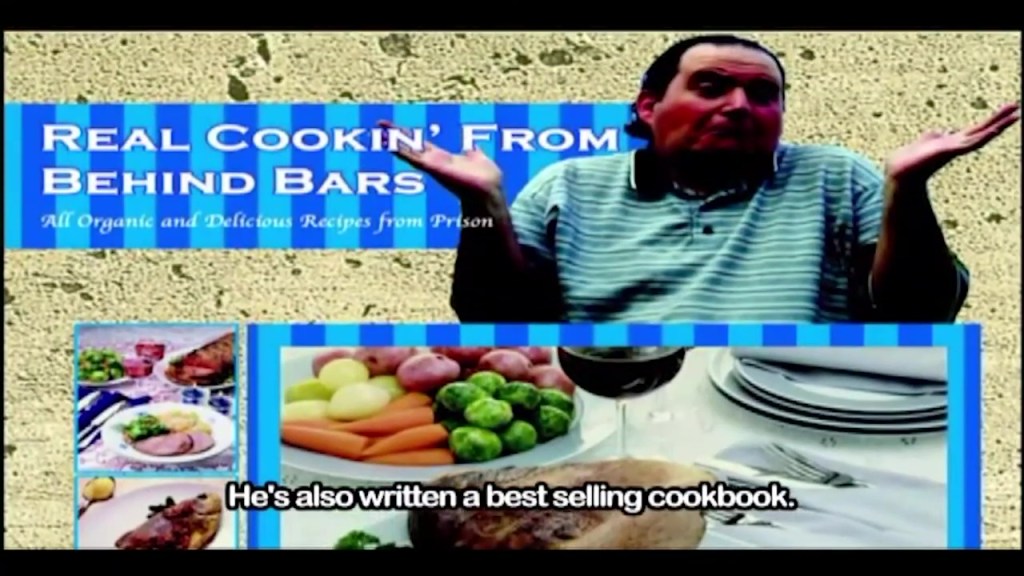
At the end, he is in jail, but he has published a cookbook. His cooking show has finally paid off.
This is a low-budget film, but is a lot better than might be expected. The creators were lucky enough to secure the services of Chris Bridges, the special effects artist whose credits include the Dawn of the Dead remake, Saw III & IV, 300 and Star Trek Discovery. Unless they actually killed and dismembered people, the result is spectacularly authentic. Anthony Alviano is brilliant in the role, which was written with him in mind.
The full movie (although slashed drastically from 81 minutes to 56 minutes) can, at the time of writing, be seen at https://youtube.com/watch?v=vnGXBRkxXuo.
Cannibal was the directorial debut of the German director Marian Dora in 2006, and is basically a re-enactment of the famous case of Armin Meiwes (pronounced like the Sinatra song “I did it my way”), the so-called ‘Rotenburg Cannibal’. Meiwes was a German computer technician who was into “vorarephilia” (sexual attraction to eating, or being eaten by, another). He advertised on the Internet for a man who was willing to be killed and eaten, and ended up doing both of those things to an engineer named Bernd JürgenBrandes whose greatest desire was to be eaten. Unlike most crime re-enactments, this one was easy to research, because Meiwes videotaped most of the killing, butchering and eating of Brandes. We’ve met Meiwes in a couple of earlier blogs: in Grimm Love an American researcher (Keri Russell) searches for the videotape and then freaks out when she gets hold of it. The documentary Copycat Killer covered the famous case with lots of dramatic music and comparisons to Hannibal Lecter, which was absurd. The Australian comedy Rake also did a great simplified version of it with the wonderful Hugo Weaving as both an economics professor and a cannibal (which is more terrifying?).
Marian Dora is a pseudonym used by a film-maker whose real name is shrouded in mystery. Probably for good reason – his first two releases were included in anthologies of short films named Blue Snuff 1 and Blue Snuff 2, the latter of which was withdrawn due to its extremely graphic content. He then went on to work with Ulli Lommel on a number of crime/slasher films.
This film was assigned to Dora by Lommel, but proved too rich for Lommel’s taste, and Dora ended up releasing it himself, direct to video. Really? Too rich for Ulli Lommel, whose grisly bio of Fritz Haarmann we reviewed earlier this year? Well, that’s promising. Lommel went on to make his own version of the Meiwes story, with the protagonist changed to female for some reason. This was also called Cannibal at first, then changed to Diary of a Cannibal, and has graced the “Bottom 100” lists of Yahoo and IMDB ever since. We… might get to it one day. Maybe.
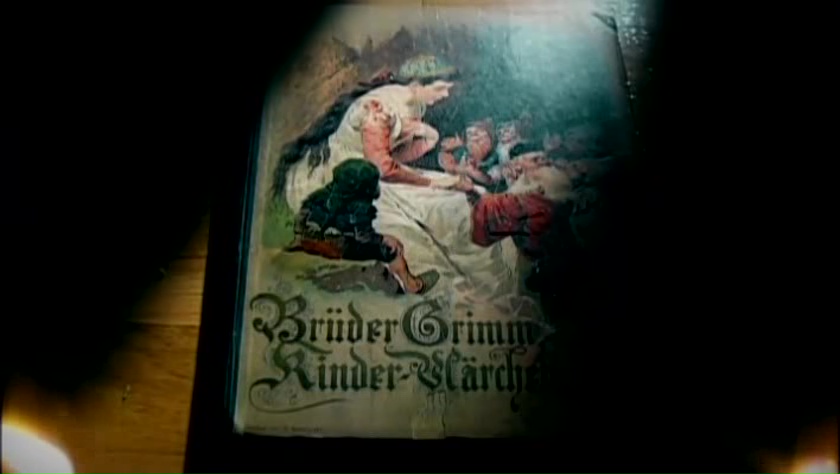
Meiwes and Brandes are not named in this film – the eater is just called “The Man” and the eaten “The Flesh”. There is very little dialogue, except for the Man’s mother reading him Hansel and Gretel at the beginning (when he was presumably called the Boy), presumably turning him into a cannibal (didn’t that happen to everyone who read the Brothers Grimm?)
We then Get To See A Selection Of The Man’s preferred reading matter: cannibal art by Hieronymus Bosch and Hans Staden, books on Jeffrey Dahmer, and some interesting texts on anatomy and butchering, which he will find handy later.
We see the Man having a series of meetings with a bunch of guys (and one woman) he has contacted on internet chats, all of whom turn out to be not that serious about going through with the whole, you know, kill me and eat me thing. The woman might have been ready, but he writes, “Women are too important for the survival of mankind.” Pretty much how the dairy and egg industries operate, when they sex the calves and chicks and immediately kill the males.
He even meets up with a couple of kids, not presumably through the web, but seems to prefer his meat aged and consensual.
The Man finally meets the Flesh, who introduces himself,
“I’m your flesh”
But then adds:
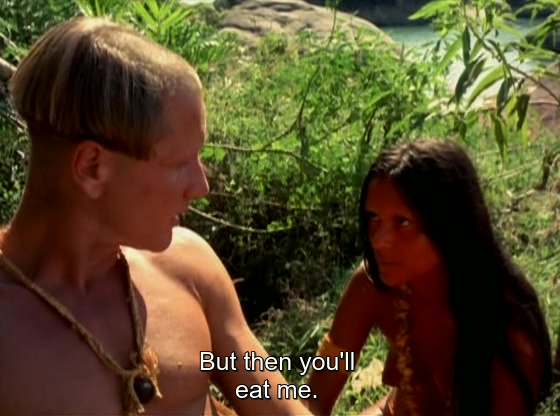
“I don’t want to suffer”
Yeah, no probs, mate; the Man stops on the way home from picking up the Flesh at the railway station to buy some schnapps and some cough medicine.
Then after a game of petanque and some sweaty sex, the Flesh won’t feel a thing. Hmmm.
“You’ll become a part of me”
Seems to me to be a bit of a misunderstanding of how the alimentary system works. However.
Once they enter the house, the movie becomes very dark. Literally – one of those movies where it’s hard to see what the hell is going on. They’re going to have sex, one of them is going to eat the other, but first, a nice cuppa tea.
There’s a lot of plinky-plonky music and sex scenes which drag on interminably, and end with the Flesh anally penetrating the Man. No one was expecting that. Isn’t cannibalism supposed to be about dominance? It’s an interesting conflict. They curl up on the floor together and, when they awake, the Flesh demands the Man bite off his penis. My thoughts immediately went to Monty Python (“ergh! With a gammy leg?”) at the thought of biting his penis after anal sex; but hey, call me old fashioned. Anyway, the Flesh is not called the Teeth or even Jaws, and can’t do more than draw blood, a kind of ineffective circumcision, and the Flesh growls:
“You are too weak!”
Freud would have had an orgasm of his own at this point – we have power, guilt and of course male fears which, he said, were based around the act of castration, usually due to the fear of the father’s anger at the boy’s Oedipal desires. But this man is too weak to eat him! Perhaps because he needs to eat. They need to merge before they can merge. It’s another challenge. But as Freud said, the cannibal “only devours people of whom he is fond”, which is why, according to Brigid Brophy, Christians eat God to affirm the love of the Father. The Man is seeking the transubstantiation of the Flesh.
So anyway, the Man does what any man does when his lover is disappointed – runs for the cough medicine; let’s knock him out! But then they both fall asleep, seeming to decide that this wasn’t such a hot idea. When they wake, it seems like it’s all over, but they are a stubborn pair – a splash of water on his face and the Flesh is ready and raring to get ate. This time they pick up prescription sleeping tablets at the pharmacy – Stilnox, very popular among Australian athletes apparently, and the Flesh washes it down with a bottle of brandy.
“Castrate me, then kill me. Do it now.”
The Man sets up the video (and this is all pretty much as it happened – Meiwes did videotape the whole procedure, which helped the police considerably during the court case). He puts on a record of church music, and fetches a knife. We get to see a lengthy scene of Bobbitting (hint – don’t try amateur anaesthesia at home: the cough medicine and booze don’t work very well).
He fries the severed cock up with some garlic (yep, all true to the actual case) but they find it tough and inedible. They spit it out (in the real case they fed it to Meiwes’ dog, but the sensible dogs of Germany refused to sign up for this movie).
Then the rest of the film is the killing of the Flesh and the preparation of his flesh. The Man puts the Flesh in the bathtub to bleed out, and reads a Jerry Cotton book while he waits. This is an outrageous fictionalisation – Meiwes in fact read a Star Trek novel. Ah well, poetic licence.
When the Flesh refuses to die by the time the Man finishes his book, the Man drags him out of the bath, vomiting, urinating and defecating, and lays him out in the Schlachthof he has set up, arms outstretched like the Broken Christ, then cuts his throat.
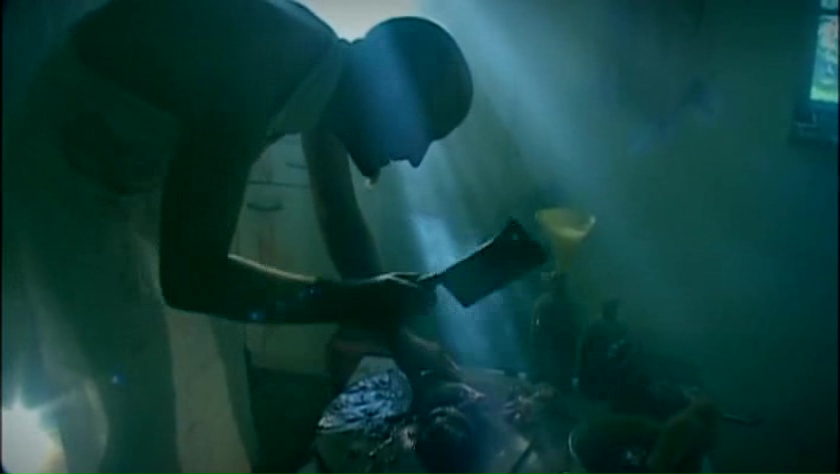
The final twenty minutes or so of this film (if anyone is still watching) is clinical – a masterclass in butchery. The Flesh is strung up by his feet and the Man disembowels him in great detail, vomiting as he does so. The Flesh, already dehumanised, is now deanimalised too; he is simply a carcass being prepared for the meat chiller.
I loved this review from Letterboxd which complains that the movie describes:
“how a cannibal prepares his food, everything is in detail and the scene came exactly when I was going to have my breakfast fuck me it’s like the movie knew when I’m going to eat my food, this has happened quite a few times with me now and its getting creepy 😂”
“One of the sickest and freakiest movies ever to come from a nation well-known for its freaky and sick movies (Germany)”
To me, the butchery was not the most abject part of the film; it was the sort of thing you might see in an instructional video for abattoir workers, except not with the usual species of victim. The defecation and vomiting were harder to take, but I guess that is subjective. All in all, most people will find something to disgust them in this film, and perhaps that was the point. It’s disgusting, but it’s not that different to what we get minimum-pay workers in slaughterhouses to do eight hours a day to some seventy billion animals every year. Unless the special effects budget was huge (not obvious from the rest of the film), a real animal was gutted and chopped up to make this film, which is actually the sickest part of it.
The butchery is shown in loving detail and for extended time. It lets us experience what it would be like to do that (I’m guessing most of us have not butchered an animal, human or otherwise). Being his first time, the Man keeps stopping to either snack on some flesh or to remorsefully throw up; pretty sure neither would be encouraged in the industrial meat corporation.
For a real slaughterhouse worker, wielding the cleaver would be sickening the first time, then boring for the hours thereafter. We see the Flesh reduced to just meat cuts. As King Lear said, when stripped of civilisation:
“unaccommodated man is no more but such a poor, bare, fork’d animal”
If you don’t want to watch the whole thing, there is an excellent and hilarious summary by Mike Bracken “The Horror Geek” which had me laughing out loud several times, despite the content.
At the end of the film, the Man has a nice Flesh dinner (the Flesh is present at the table, short of one body), then jerks off to his home movie, and next morning is all scrubbed up, in a nice suit, and trotting off to meet his potential next sacrifice. In fact, Meiwes was eventually caught because he advertised for another victim a few months later, when he started running out of Brandes. Meiwes is still in jail in Germany, and is now apparently a vegetarian.
As I said, we know very little about the director, except that Dora is not his real name, and that he is vegetarian and works as a physician. After watching this movie, you’ll understand why he wants to remain anonymous. Perhaps also why he’s a vegetarian.
Let’s get this out of the way – there is nudity. Lots of it and throughout the movie. Well, it’s set in pre-colonial Brazil, and the Indigenous peoples did not bother with a lot of clothes, so it’s historically accurate. To ensure authenticity, the actors and the crew were all naked, so that nudity would become natural. If that bothers you, please read the blog but skip the movie.
While it was refreshingly authentic, the nudity was also a problem. First, because the authenticity is somewhat diminished, as The New York Times critic pointed out, by the fact that the natives are “middle-class white Brazilians… stripped down and reddened up for the occasion”. Secondly, the film was refused entry to the Cannes Film Festival because of all the swinging dicks. In Brazil, the censors were eventually persuaded that the natives indeed did walk around naked, but remained vehemently opposed to the nude Frenchman, a telling comment on the racist distinction that the film was intending to expose.
So, the plot in a nutshell: the French and the Portuguese are fighting to control the rich lands of South America. Each has allied with local tribes who are at constant war with each other, often involving (so the European narrative goes) capturing and eating each other’s warriors. The Tupinambás are allied with the French, while the Tupiniquins are allied with the Portuguese. The Frenchman of the title escapes his own command, is captured by the Portuguese, and is then captured by the Tupinambás, who are allies of the French, but believe him to be Portuguese, so intend to eat him. Got all that? – there will be a test.
Tupi custom involved bringing the captive into the community, feeding and homing him, and even finding him a wife, then eventually killing him in a ceremony that will allow them to capture his essence, bravery, speed, and so on.
This wide-spread belief about the Tupi comes from a European who was captured but then escaped in 1554, came back to Europe and wrote a book. His name was Hans Staden, and he was actually a German who was trying to get to India. But since it was the French who were invading South America at the time, the director changed his nationality.
De Bry’s engravings of Tupi cannibalism were “eaten up” by the Europeans.
Tupi cannibalism has a whole literature explaining it or denying it – William Arens claimed the ‘evidence’ was mostly based on Staden’s account, which contained several contradictions, and had been continually retold as if it had happened to new re-tellers. Other anthropologists such as Rene Girard explained Tupi cannibalism as a seamless explanation for the way culture and religion have evolved. The universal violence of the human species is redirected toward the outsider, who is taken into the tribe, but remains foreign enough to be killed as a scapegoat, to release the social pressure that would lead to endless internal revenge feuds. For many, Jesus became the ultimate scapegoat under this theory, even to the extent of insisting that his followers eat and drink wine and bread transubstantiated into his “blood and body” in the Eucharist ritual.
For my flesh is meat indeed, and my blood is drink indeed.
John 6:55
The Brazilian anthropologist Eduardo Viveiros de Castro proposed a ‘post-structural anthropology’ in his book Cannibal Metaphysics. De Castro sought to ‘decolonise’ anthropology by challenging the increasingly familiar view that it was ‘exoticist and primitivist from birth’, denying that cannibalism even existed, and so transferred the conquered peoples from the cannibalistic villains of the West into mere fictions of colonialism. Arguing that the ‘Other’ is just like us is to deny any separate identity and to return the focus of anthropology to that which interests us: ourselves. Rather than deny the existence of cannibalism, which allows a reclassification of the Amerindian peoples as like the colonialists, de Castro examines the details of Tupinamba cannibalism, which was ‘a very elaborate system for the capture, execution, and ceremonial consumption of their enemies’. This alternative view of Amerindian culture rejects the automatic assumption of the repugnance of cannibalism, which serves to either confront it or deny its existence.
Well, that’s pretty much where this film planned to go. Pereira dos Santos challenges the Eurocentric perspective which insists on a superior civilisation overcoming a primitive one. It is true that Tupi civilisation was destroyed by the slavery, smallpox and slaughter of the Portuguese who, the film tells us at the end, also wiped out their allies the Tupiniquins. The Tupi peoples are now a remnant, confined to small areas and currently being decimated by COVID-19.
But the chief, in the killing ceremony which promises the Frenchman’s body parts to his relatives (his wife will get his neck), tells the story as a mirror image:
“I am here to kill you. Because your people have killed many of ours, and eaten them.”
So the film asks: who were/are the cannibals? It does not fully succeed in telling this story, because the audience gets involved with the Frenchman’s story, instead of his captors. Pereira dos Santos lamented that the public:
“…identified with the French, with the coloniser. All spectators lamented the death of the hero. They did not understand that the hero was the indigenous, not the white, so much were they influenced by the adventures of John Wayne.”
Nonetheless, the binary of the colonised and the powerless occupied victims is so deeply embedded in our cultural stories that it is refreshing to see this mirror image version, where the indigenous win the battle, if not the war.















 The Cannibal Guy