A 31-year-old man is in custody on suspicion of killing a man and eating parts of the victim’s face last weekend at East Charleston Boulevard and 3rd Street Las Vegas.
The Las Vegas Metropolitan Police Department released this report:
Police advised that the alleged perp, Colin Czech, had “biological matter in his hair, mouth, and on his clothing.” “Biological matter” is a euphemism for blood, flesh and other bodily substances.
Czech reportedly claimed the victim had attacked him. Police said the victim, identified as Kenneth Brown, was bleeding from head wounds and one of his eyes was missing. He was transported to the hospital, where a doctor pronounced him deceased.
During an interview, Czech allegedly said he was homeless and had been awake for several days because something was “possessing him.” Reports say Czech told detectives he “used his teeth to eat the victim’s eyeballs and ears.”
Police booked Czech into the Clark County Detention Center in absentia on a charge of open murder. Clark County District Attorney Steve Wolfson said it was one of the most unusual cases he has ever seen in more than 40 years as a defence attorney and prosecutor. He says the competency of the defendant will no doubt be addressed, adding “It is not uncommon for some of these cases to take years. Sometimes people never become competent.”
Czech was set to appear in court on Monday, April 29, but was hospitalised. In his eventual court appearance, he appeared dazed and uncomprehending.
Eating faces is not unknown in the annals of Cannibal Studies. In 2012, Rudy Eugene, “the Causeway Cannibal”, bit off the face off a homeless man in Miami, Florida before being shot to death by Miami police. In Wales in 2014, Matthew Williams lured a young woman back to his hotel room and began eating her face, apparently under the influence of amphetamines. Williams had been released from prison just two weeks before the killing and was described by police officers as “demonic”. Again in Florida in 2016, Austin Harrouff killed a couple he didn’t know and chewed off a victim’s face. He was found not guilty by reason of insanity.
Why all the faces? There is not much flesh on a face, yet it is considered a delicacy in some cultures. In the movie Eye without a Face, the protagonist watches on a hacked computer camera as a woman prepares a Persian dish called kale pache, literally “head and hooves”. It’s usually from a sheep, but whose head is it this time? Is she a cannibal serial killer? No spoilers here – you’ll have to watch it to find out.
Meanwhile, back in California, the man this blog reported on a few weeks back who found a human leg on the street in Bakersfield and started chewing on it has been sentenced to one year in jail in a Kern County courtroom. With good behaviour (and eating all his veggies?) he could be out in a lot less than that.
Under the dominant ideology of anthropocentrism or “speciesism”, buying the head or leg of a sheep for consumption is considered perfectly legal, if a bit quirky (or repulsive to some), yet eating a human face is headline material. But is there really that huge a difference between two species of mammals?
Has there ever been an era when people were more connected and yet more alone? A person I know (no names – you know who you are) subscribes to social media posts but never, ever posts or comments. The ultimate loner, though, is the geek sitting in a darkened room and relating to people on his screen, people who don’t even know he exists.
That is the plot of this quirky movie, which brings Hitchcock’s Rear Window into the twenty-first century. In that film, Jimmy Stewart played a photographer who is confined to his apartment in Manhattan with a broken leg. He watches his neighbours, without their knowledge, even giving them nick-names. A harmless hobby, until it isn’t – one of his neighbours seems to have murdered his wife.
In EYE WITHOUT A FACE, it’s not just a guy with binoculars and a zoom lens. That little hole on the top of your laptop screen? Yeah, it’s a webcam, and it comes on when you Zoom or Skype. What does it do the rest of the time?
Well, the nightmare scenario is that it can be hacked and used to see what is going on in your home, WITHOUT YOUR KNOWLEDGE. Is it true? I’m a blogger, not a hacker, so I can’t say for sure, but I know a couple of programmers who have band-aids over their laptop cameras. So there’s that. Also this article.
Anyway, for the sake of enjoying this movie, assume that it’s not only possible but common. You’re going to get the band-aids now? It’s OK – I’ll wait.
The protagonist (he’s no hero) is Henry (Dakota Shapiro – who, IMDB tells me, comes from Byron Bay!), a hacker, a stalker or perhaps more accurately a voyeur as he likes to watch. Henry wouldn’t have even noticed COVID lockdowns as he almost never leaves his home except to walk the dark, melancholy streets of LA, thinking about his angry, spiteful father, a man he sees in a devil mask.
Henry sees himself as the “guardian angel” of the women whose cameras he has hacked. And yes, not coincidentally, all those over whom he watches are good looking young women, and he chats with them. For the first few minutes of the film, it looks like a dialogue, a Zoom call in which he wishes them a polite good morning and comments on whatever they are doing, but we quickly realise that they don’t answer – they don’t know Henry is watching. They don’t even know he exists. They are so close, yet totally unattainable to a shy introvert like him.
Henry’s flatmate is, Eric (Luke Cook, another Aussie, who played Lucifer in Sabrina) and he is almost Henry’s opposite – more interested in putting his own selfies and vodcasts on the web than seeing what anyone else is up to. He meets women on line, but doesn’t remember their names after one-night stands. Henry reaches for his monitor to stroke their hair, Eric wants to seduce them.
Eric warns Henry that he is staring into the abyss, and if you do that too long, as Nietzsche said:
What does Eric, the struggling Australian actor in LA, mean by quoting Nietzsche? Well, he does do a lot of drugs, but there’s still a point to his warning. Nietzsche is perhaps best known for stating that
“God is dead… and we have killed him… Must we ourselves not become gods simply to appear worthy of it?”
Nietzsche was warning that a world without supernatural judgement could easily descend into nihilism, a feeling of alienation and hopelessness, an abyss that has no meaning or purpose. Darwin had disproved the superstitions about humans being somehow higher than animals, leaving us as just smart apes, and Nietzsche urged a further evolutionary leap: to become the Übermensch, the super-man who will rise above the mob. We need to become gods, or at least angels. Hannibal Lecter has a bit to say on the subject.
But Henry is no god, nor is he, as he thinks, a guardian angel. He stares into the abyss of the empty, depressing lives of the women who unknowingly show him their own forms of despair – one is a singer whose partner sees her purely as sexual relief, another sells tawdry on-line sexual fantasies, another seems to be killing people to make head-soup. He has the eye of a god, his computer and their webcam, but none of the powers. The abyss of their lives and deaths is what Eric is trying to warn him about. It’s a world of alienation and superficial relationships involving intimacy, often remotely, but without love. He laughs and cries at their antics and their awful boyfriends, as if he is watching a series of soap operas. Perhaps he is. The abyss is gazing into him, and seeing only death and darkness.
Eric is intrigued by Henry’s hack and wants to meet these women. Henry swears him to secrecy, so of course we know this is not going to end well.
One of the women Henry watches, Tessa (Ashley Elyse Rogers) does webcam porn – men pay her to fantasise oral sex – with a strawberry or a peach standing in for their cocks. Eric finds her on Instagram and brings her home to meet Henry, who freaks out.
Eric hasn’t mentioned the webcam; he’s told her that Henry is an Instagram follower. But later, Henry calls her on her paid sex-line, hoping just to chat, and this time she freaks out when she realises he knows where she lives. Hanging up the sex line, he watches her on her hacked webcam as, terrified, she loads a gun and puts it under her pillow.
Henry only leaves the house at night when he goes for his creepy walks, clad in hoodie and avoiding eye contact. But on his return that night, he catches Eric watching “his” women. Upset, he turns the screen to Laura (Vlada Verevko, who, fun fact, was in the movie Hacker). Laura seems to have a lot of different boyfriends – she gives them a drink and then takes them up to her room, but Henry never sees them coming down again. This night she puts what looks like a human heart in a bowl in her fridge, then he sees her dragging what looks like a body bag out of the apartment.
Next day, Laura is cooking dinner for friends – kale pache, literally “head and hooves”. It’s usually from a sheep, but whose head is it this time? Is Laura a cannibal serial killer?
The following morning, Henry and Eric watch her prepare a drink for a young man, and are convinced he is going to be drugged and become her next victim.
Henry texts 9-1-1 (apparently you can) and the cops bust in and find – ginseng. But now she knows she’s being watched and she puts tape over her webcam, but not before promising to find Henry and turn him into dog-food. The rest of the film is the chase, with a twist – you’re going to have to watch it to see the denouement.
What is this parable really about? Henry thinks he is a “guardian angel”, yet he does nothing to assist any of the women with their issues – abusive men, drink, failure or sex. He just watches. The theme here is theodicy – a term invented by Gottfried Leibniz in 1710 when attempting to explain why an all-powerful, loving god would allow evil and suffering. It’s one of the favourite questions of believers, particularly when something terrible happens to them. A common view, particularly in Christianity, is that humans are sinners and evil arises from our failure to repent. It points to a time when evil will be abolished by the coming (or second coming) of a messiah, who bears and cleans away our sins. Henry as Isaiah’s suffering servant?
A variant of this discourse says that God gave humans free will, and although he hates to see us suffer, he can only watch, because intervening would revoke that free will and leave us just puppets. This view sees God weeping in the death camps together with his people.
Then there is the devil, whom Henry identifies as his violent father who brought him up with threats and fists. Henry wishes he could save his “friends” from this avenging, fallen angel who seems to stalk them. Then as he watches, someone starts slitting the throats of the women he has been watching.
Henry think he is the silent, suffering, guardian angel. He sees the women invite toxic masculinity into their lives and begs them (from behind his screen where he can’t be heard) to cease their wicked ways, but he “grants” them free will and does not intervene. Plato said that evil exists because of human “intimate indolence” – we can’t be bothered to combat it. Henry doesn’t try to intervene.
Until he does. Once Laura, the eater of heads, knows he is watching, it’s time for the final judgement, the battle between good and evil.
Is Laura killing and eating people? Is Henry’s dad really dead and gone? Why does Henry keep lathering up and wielding his father’s razor, yet still has a week-old stubble in the next scene?
Don’t miss it. It’s one of those films where nothing much happens for most of it, yet I found it impossible to turn away. The direction, the photography, the acting and the music are superb. It’s not a gorefest, nor is there (much) cannibalism involved, but the unravelling of the story is fascinating, and the idea that we are being watched, by a god, a devil or a hacker, makes for a fascinating story that stays in the mind afterwards, raising all sorts of metaphysical issues, including: why is it OK to eat sheep, but not their heads and hooves? Why is it OK to eat sheep, but not humans? And who is watching and judging us, anyway?







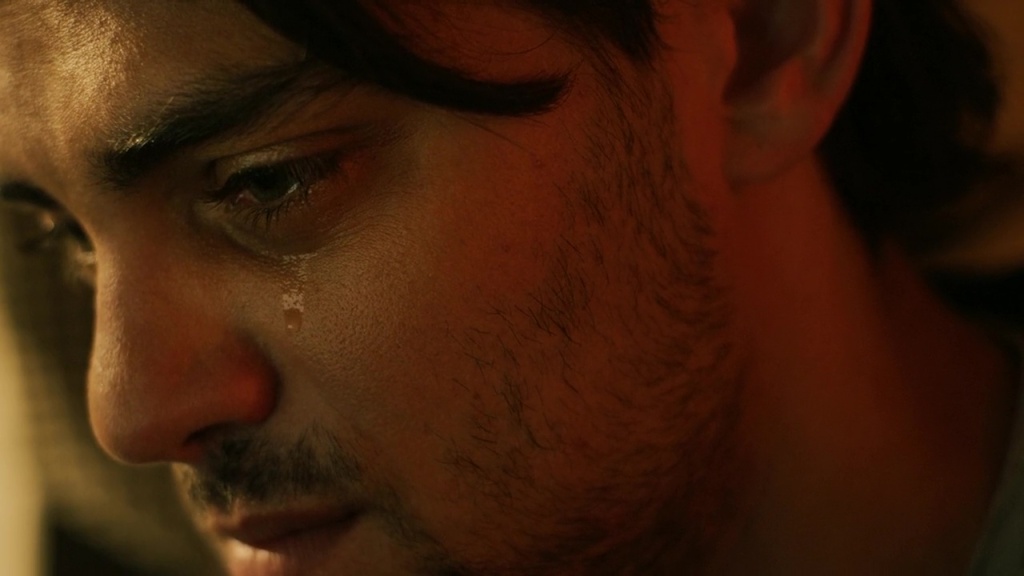


 The Cannibal Guy