
2025: The Year in Cannibalism

Then every thing includes itself in power,
Power into will, will into appetite;
And appetite, an universal wolf,
So doubly seconded with will and power,
Must make perforce an universal prey,
And last eat up himself.
    — Shakespeare – Troilus and Cressida Act 1, Scene 3

January

Violence in the Highlands of Papua New Guinea marred celebrations of the country’s 25th anniversary of independence. Armed men were shown in videos holding body parts and saying “this is our meat.” The story brought back memories of former US President Joe Biden claiming his uncle’s body was never found during the Second World War as he had been eaten in PNG, stating that “there were a lot of cannibals, for real, in that part of New Guinea”.

Sean ‘Diddy’ Combs, already in hot water for sex trafficking and racketeering charges, has been accused of cannibalism now. In the Peacock documentary Diddy: The Making of a Bad Boy – which covers the rise and dramatic fall of Combs, 55 – former Making the Band 2 contestant Sara Rivers revealed what she and others experienced when cameras weren’t rolling. When Diddy got angry, she says, he threatened her band member:

“You make me so mad I want to eat your flesh!”

In the North West Province of South Africa, one of a group of illegal miners (zama zamas, or “those who take a chance” inZulu) in the Stilfontein mine (which closed in 2013) has disclosed that he and his fellow miners turned to cannibalism when they ran out of food 2km (1.25 miles) underground. The police had cut off food supplies the previous August to ‘smoke out’ the illegal miners.

February

Two artists put on a show in Scotland where they made and cooked “black pudding” sausages from their own blood. Although they did not eat the sausages after this show due to legal considerations, they have done so in the past, although one of the artists has since become a vegetarian and has said he will not be eating them in the future.
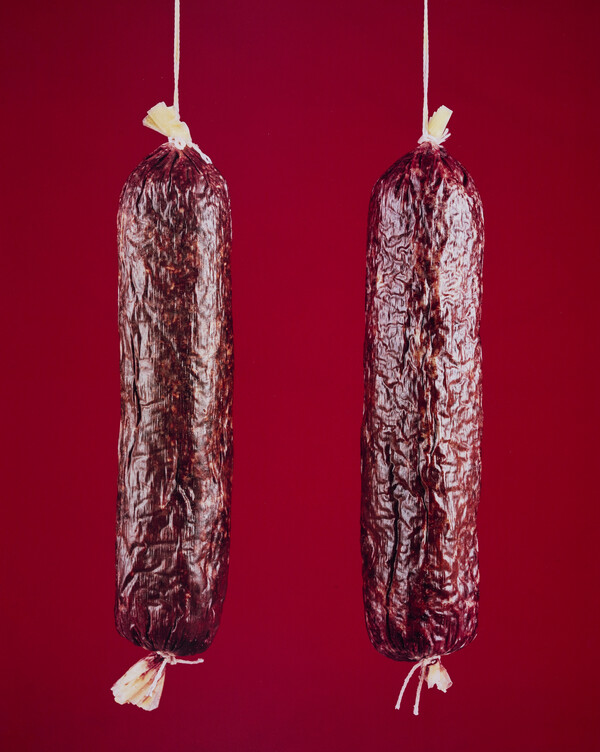
John Beagles and Graham Ramsay

Tyree Smith, the “Connecticut Cannibal”, was given conditional release by the Nutmeg State’s Psychiatric Security Review Board from the mental facility to which he was incarcerated. Smith was handed sixty years in 2013 for killing a homeless man and eating his brain and eyeball in a cemetery, washed down with sake. Doctors who have been treating Smith said he’s been fully rehabilitated, thanks to medications that quelled the voices in his head. Others, including the family of the man he killed and ate, are less optimistic about his future plans. Mr Gonzalez’s sister-in-law, Talitha Frazier, asked the review board “How do we know he’s not going to do this again?” Republican state Senator Paul Cicarella said “Murder and cannibalism and release in the same sentence … that’s a problem”.

What’s with all the eyeballs? A “preppy” Princeton grad was charged with murdering his brother at their luxury Princeton apartment, after which he ripped out the victim’s eyeball and ate it. He also reportedly set the family’s cat on fire. Even the Duke of Cornwall in King Lear would have blushed at that transgression.

March

A woman in Brazil barbecued and ate her victim’s heart and penis. Josefa Lima de Sousa, 65, left a blood-stained sign by the mutilated corpse with a message, using her street name, saying: “Gringa got rapist.” She told police the victim had been a child abuser.

A Texas embalmer with the wonderful name Amber Ludermilk was charged with the felony “abuse of a corpse” after cutting off the penis of a deceased sex offender and jamming it into his mouth. An arresting constable stated that “No matter what one thinks of his life, the law requires that he be treated with dignity in death.” In a world where thousands of humans die of starvation every day, and we casually torment, kill and then mutilate the corpses of billions of other animals every year for food, medical experiments, clothing or entertainment, are we expected to weep for this sex offender’s insentient corpse?

A South Carolina mental health facility was sued by family of a victim of murder and cannibalism. The lawsuit alleged that the killer, another inmate, had killed two men and eaten both the victims’ ears, as well as drinking their blood so he could “gain their power.”

In Rwanda, a minister said that persecution and cannibalism of Tutsi people are still “commonplace.” Readers may remember that just over thirty years ago, almost one million ethnic Tutsis in that country, some 75% of the Tutsi population, were slaughtered in the space of just 100 days. Although the word genocide has come to mean ‘anything done by someone you don’t like’, that one was a real genocide.

June

A young woman who calls herself pterodactylhunny disclosed on TikTok that her doctors had given her one her ribs which had been surgically removed. She took it home, boiled it to remove the meat, then ate the meat to see what it tasted like. Spoiler: the formaldehyde in which it had been soaked made it taste pretty bad. The cannibalism of eating her own flesh, however, she described as “cool” and “not that weird”. Viewers responses ranged from shocked to approving, pointing out that eating one’s own meat could be considered vegan, since the animal from which it came had given her consent.

July

16 men were arrested in the West Pokot region of Kenya after human remains were found including the bodies of several children. One boy was found in a maize field with his organs removed. Police say the suspects have confessed to killing and eating eight people.
Relatives of the victims of a mass-murderer in Idaho were outraged to find that he had taken a plea deal for the stabbing of four students in 2022, thus avoiding the death penalty. No indication of him eating his victims, but a forensic psychologist reported that he had become a strict vegan before that, because:

He was afraid that if he let himself go to taste meat once, he would become addicted to it—like he had become to heroin—and start killing and eating people.”

In Kenya, a man recently released from prison for killing his wife, murdered his second wife, cooked her flesh and fed it to his children. Irate members of the community lynched him and set him on fire. The incident elicited sharp debate among Kenyans over the old claims of cannibalism among members of the community. Samuel Bosire Angwenyi, the Secretary General of Abagusii Council of Elders, dismissed the claims saying it was a myth which some people blindly believed. “If there is a person who can eat a fellow human being, then that must be Satan.”

August

An Australian boxer whose nickname is “the Butcher” told fans he had “become a cannibal”. What he meant was that, as part of his training for a big fight, he had taken advantage of the birth of his child by eating his wife’s placenta, in tablet form, washing it down with a little breast milk. He said:

“I’ve technically become a cannibal. It’s actually like a superpower”

In Cuba, a man arrested for murder was found to have a jar filled with human fat, jars of fried meat, and a bag of ribs in his refrigerators. Cannibalism was suspected but never officially confirmed. Meanwhile, other residents of Santiago de Cuba, seeing an unusual level of police activity in September, fear that the case may be linked to the disappearance of other residents from the Abel Santamaría neighbourhood.

In Zimbabwe, a woman allegedly poisoned her four-year-old granddaughter, Tawanayasha Kadhene, before mutilating her body in Shurugwi on 26 August. Police said: “The suspect gave the victim a maheu drink laced with a maize pesticide pill. The child collapsed and died instantly. The suspect then cut flesh from the victim’s cheek, mixed it with herbs prescribed by a sangoma, cooked it and ate the mixture.” The ritual killing allegedly happened following the woman’s consultation of a traditional healer.

September

In an unusual case of auto-cannibalism, a patient at the University of California Los Angeles (UCLA) David Geffen School of Medicine received intravenous lorazepam to treat anxiety and claustrophobia in order to facilitate an MRI. He subsequently developed acute psychosis, performed self-inflicted digital enucleation of his left eye, and then ingested it. Lorazepam is a benzodiazepine that has been FDA-approved as a fast-acting anxiolytic and sedative. It is one of the most commonly used medications for these indications. The studies of the case claim that it is an “extremely rare paradoxical reactions to benzodiazepines.” Worth keeping an eye on though.

October

A thirteen-year-old boy in Egypt was arrested after reports he had murdered his classmate, sawed his body into pieces and ate them “out of curiosity”. He told the police that he that he found human flesh was “similar to breaded chicken”.

November

The strange case of Gabriela Rico Jiménez, a 21-year-old model from Mexico who disappeared in 2009 after raging against alleged cannibalistic captors while outside a fancy hotel in Monterrey Nuevo Leon, has been rediscovered by TikTok posters. Didn’t know this was happening until my blog on the story suddenly started to take wings recently.

@hfnkw1

She warned us… and then vanished. The Gabriela Rico Jimenez case gets DARK.#scary #scarystories #horrortok #fyp

♬ original sound – hfnkw1

In New Zealand, a mortuary technician lost his licence due to posting online talks ‘promoting cannibalism. He offered to obtain human tissue to interested readers, and added “When we have burn victims…. They smell so good sometimes”. The man also engaged in online conversations about rape and sexualising children, his own alleged drug use and ways of making explosives.

December

We closed the year with allegations from the Ukrainian government that Russian troops trying to occupy Zaporizhzhia in eastern Ukraine have run out of food and are killing and eating each other. The Ukrainian spy service GUR reported that:

“Due to a lack of food, the occupiers are sharpening their knives and preparing to eat their younger comrades”

Intercepted radio messages apparently include soldiers saying “We’ll eat each other, it’s all fucked up here. We’re already looking for someone younger” and “I’ve sharpened my knives. I don’t give a shit who I have to cut up. I just want to eat. Fuck everyone else”.

Around this time last year, this blog reported on several convicted Russian murderers who had admitted to cannibalism but been offered pardons if they agreed to serve in the Russian forces in Ukraine for six months. Later reports have noted that the pardons and repatriations may not ever have happened.

Back in Russia, “Perm cannibal” Mikhail Malyshev died at the age of 65 in a clinic, while waiting for a doctor. Malyshev was arrested in 2000 for two proven murders, although a polygraph test claims that he was involved in at least eight: he killed, dismembered and partially ate a man and a woman. Malyshev reportedly used the soft tissue to fry cutlets and threw away the rest. He often made kebabs out of stray dogs. He was sentenced to 25 years and served his sentence in the Perm region, undergoing mandatory psychiatric treatment. He was released from prison in October 2022. Some reports stated that after his release from prison, Malyshev had found work at a shelter for homeless animals. That part may be the most disturbing aspect of the 2025 story!

New cannibalism movies

A veritable swathe of new releases this year, showing again that cannibalism is the flavour of the month (sorry about the pun) or the year, or indeed the whole damn century:

Know Me: A True-Life DramaStory of the “Causeway Cannibal” and media response
DevourAll female metal band called “The Virginia Bitches” come across a town full of cannibals
Human Hibachi 3: The Last SupperCult of devout followers eat human sacrifices in a “last supper”
Cannibal ComedianCannibal takes a stab at stand-up
Cannibal MukbangShe makes vodcasts of voracious eating – mixed with cannibalism of bad men
DeliciousYoung working people work for, then eat, the rich
The WagerTrue story of a mutiny in the British Royal Navy in 1741 and the events that followed for those who survived
Red Night at Skye’sZombie meth cannibals led by a mad scientist
40 AcresDescendants of African American farmers fight roving cannibal gangs
Forgive Us AllNZ film – survivors flee through cannibal infested forest
River of BloodFour kayakers take wrong river into jungle of a cannibal tribe
No Tears in HellMother and son kill and eat poor people – based on Alexander Spesivtsev
Lone SamuraiSamurai battles cannibal tribe on island
StephenSerial killer’s victims are eaten by mysterious person
The BoatyardAtrociously acted ripoff of Hills Have Eyes
The Priest-Thanksgiving MassacreDepraved priest from earliest European settlement comes back to life to kill and eat people
The Weed EatersNZ film – new strain of marijuana turns users into cannibals
Quarantine CannibalWorking man fired from job cannot control cannibalism urges in quarantine

What a year. Can’t wait to see what 2026 is going to bring!

Was Joe right? Cannibalism in PNG?

You may remember people heaping scorn on US President Joe Biden back in April 2024 for claiming that his Uncle Ambrose was eaten by cannibals in PNG (Papua New Guinea) during the Second World War.

“He got shot down in New Guinea, and they never found the body because there used to be — there were a lot of cannibals, for real, in that part of New Guinea.”

This anecdote aroused plenty of outrage from PNG politicians who proclaimed that there was never, not much, or hardly any cannibalism in the good old days.

But now the story has once again raised its well-chewed head. 2025 is the 50th anniversary of independence for PNG, a year which was expected to be a celebration. Instead, the news is full of stories about nine people being killed in shootouts in Enga Province over that New Year period, as violence escalates in the highlands, a region that was hit by a catastrophic landslide last May.

That news was overshadowed by a video that soon went viral of armed gang members holding mutilated body parts in Central Province, 60 miles (100 km) from the capital.

Voices in the Tok Pisin language on the video said they planned to eat the victim, with one man making licking motions as they displayed a severed foot, saying,

“this is our meat, we will cook it and eat it”

There was an immediate furore over the claims of cannibalism. Police said the deceased was killed in a dispute in the remote Goilala mountains in the province, but there are conflicting accounts of when the video was made. 

Prime Minister James Marape called for calm, and stated,

“Such acts of inhumanity are intolerable and represent a significant challenge to our shared humanity”

Marape had objected to Biden’s claims about cannibalism during the war, saying that PNG did not deserve to be labelled as a nation of cannibals.

Community leader Matilda Koma from Auga Dilava added,

“We do not eat people. Goilala people are not cannibals”

Fane’s Catholic priest Francis Pirit said that the video of the killing and youths pretending to eat human remains was a show of bravado, boasting because they had won a battle.

“There are no cannibals in the Goilala area. I sleep, eat and live amongst them. They do not eat human beings”

Despite the boast by the men, there is no footage of flesh being eaten in the gruesome video.

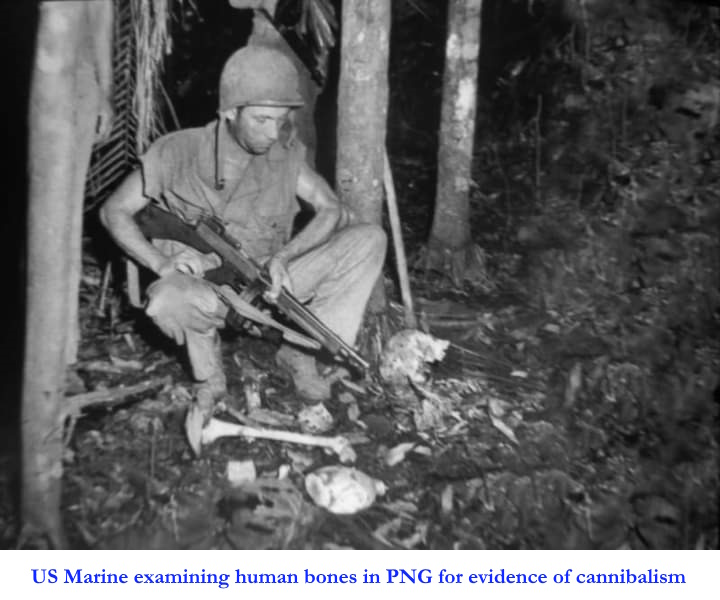
Cannibalism in PNG was largely a ritual practice by a small number of tribes and largely ceased by the 1960s after being banned by the colonial power, Australia. The suspicion that colonised peoples are inevitably cannibals has never completely disappeared; when the Australian soldiers of the 7th Division AIF began to find mutilated and cannibalised bodies in New Guinea in late 1942, they were not sure whether to blame the Japanese or local tribesmen. After a lengthy commission of enquiry, the Australian government in 1945 finally added cannibalism to the War Crimes Act 1945, the only nation to do so.

As recently as 2012, 29 members of a “cannibal cult” were arrested in Madang province on PNG’s northeast coast. Forensic reports and statements made by the accused led police to believe parts of the victims had been eaten.

One of the more persuasive substantiations of PNG cannibalism was Kuru, a rare, incurable neurodegenerative prion disorder that was found in the Fore people of Papua New Guinea in the middle of the last century. Kuru is a form of transmissible spongiform encephalopathy, related to the “mad cow” disease that cured people from eating beef for many years, and appears to have been spread by funerary cannibalism. It is often touted as a reason not to be a cannibal, appearing unexpectedly in films like Jim Mickle’s We Are What We Are and many films about wendigos.

So, cannibalism remains a sensitive topic in PNG. President of the PNG Law Society Hubert Namani sparked outrage when his comments condemning the “barbaric killing, mutilation and cannibalism” over the festive season were reported by the Post Courier newspaper.

Meanwhile, Goilala’s local member of parliament, Casmiro Aio, pointed out this week that there had been no regular police presence in his electorate for 10 years.

The questions remain – did any of the dead people get eaten? And more interestingly, why would that be so much more appalling than the fact that nine people were killed?

BIDEN AND THE CANNIBALS: the case of Uncle Ambrose

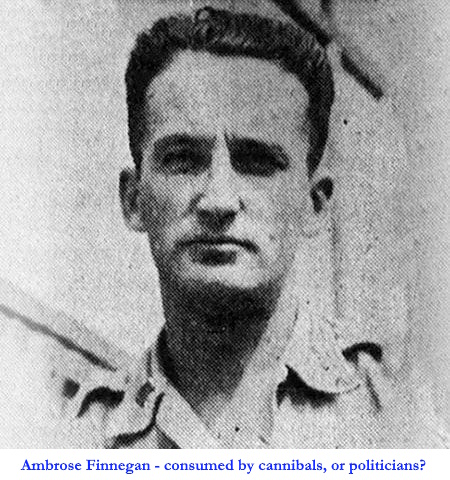
Raising eyebrows is a national sport of the USA during election years, and both Trump and Biden, the contenders, have done their share of the heavy lifting. But Biden really hit his eyebrow-raising stride this week (on April 18 2024) with claims that his uncle, second lieutenant Ambrose Finnegan (known in the family as Bosie), was shot down in the Pacific in 1944, and may have ended up on the dinner menu of Papua New Guineans.

Visiting a missing-in-action war memorial in Scranton, Pennsylvania, Biden put his hand on the engraved name of Ambrose Finnegan, whose plane went down but whose body was never recovered. Biden said,

“He got shot down in New Guinea, and they never found the body because there used to be — there were a lot of cannibals, for real, in that part of New Guinea.”

The Defence Department POW/MIA Accounting Agency saw the case differently:

“For unknown reasons, this plane was forced to ditch in the ocean off the north coast of New Guinea. Both engines failed at low altitude, and the aircraft’s nose hit the water hard. Three men failed to emerge from the sinking wreck and were lost in the crash. One crew member survived and was rescued by a passing barge. An aerial search the next day found no trace of the missing aircraft or the lost crew members.”

Biden’s cannibalism story, told twice during his visit to Pennsylvania, was clearly intended as a gesture of respect for those who died in the war, and a dig at Trump. White House Press Secretary Karine Jean-Pierre stated that Biden’s story presented a contrast with Donald Trump, who reportedly described Americans who died in war as “losers” and “suckers” after refusing to attend the American cemetery in rainy Paris in 2018. Trump also mocked George H.W. Bush who was shot down in 1944 and John McCain who was captured and tortured in Vietnam, claiming real heroes did not get shot down or captured. Trump denies it all, but the Paris story was later confirmed by John Kelly, his longest-serving White House chief of staff.

However, like a lot of off-the-cuff comments, this one may have backfired for Joe Biden. Cannibalism is a convenient excuse for vilifying others, but vilifying Pacific Islanders does not help make any points against Donald Trump, and instead proved a distraction.

Certainly, cannibalism has been reported in Papua New Guinea (PNG), the Pacific nation that occupies the eastern half of the island of New Guinea, off the northern coast of Australia, but not always by the locals. At least 100 cases have been documented in which Japanese soldiers killed and ate the flesh of Allied troops, Asian labourers and indigenous people in Papua New Guinea during WWII. Researcher Toshiyuki Tanaka, an associate professor of political science at the University of Melbourne, reports,

“These documents clearly show that this cannibalism was done by a whole group of Japanese soldiers, and in some cases they were not even starving.”

Cannibalism can be an affirmation of victory, a way of humiliating an enemy beyond death. Historian Gerald Linderman reports that Japanese soldiers would disembowel captured Americans and leave the bodies “with their severed genitals stuffed in their mouths,” not only symbolically gagging the mouth of the victim but declaring him both sterile (castrated) and edible in one metaphorical gesture of contempt. George H.W. Bush, later to be President of the US, was shot down during bombing raids on Chichijima, a tiny island 700 miles (1,100 km) south of Tokyo, in September 1944. Eight of the airmen with him were captured, tortured and executed, and Japanese officers then ate parts of the bodies of four of the men. Bush was the only one to evade capture.

While the Japanese army may have practised cannibalism in PNG for political and psychological ends, those (relatively rare) tribes of local peoples who did so almost certainly were motivated by ritual, reverential reasons. The memory of ancestors is maintained in some cultures by ceremonially eating their flesh. Some tribes have even cashed in on the cannibal mystique, ushering awestruck tourists around monuments to their supposed recent cannibal past.

Local commentators have not been amused by Biden’s colonialist characterisation of their citizens as primitive savages who routinely eat outsiders, a trope that has proved useful throughout the history of imperial conquest as a pretext for invasion, enslavement and extermination. Michael Kabuni, a lecturer in political science at the University of Papua New Guinea, said that the comments were unsubstantiated and poorly judged, particularly when the US has been seeking to strengthen its ties with the country, and counter Chinese influence in the Pacific region.

“The Melanesian group of people, who Papua New Guinea is part of, are a very proud people. And they would find this kind of categorisation very offensive. Not because someone says ‘oh there used to be cannibalism in PNG’ – yes, we know that, that’s a fact. But taking it out of context, and implying that your [uncle] jumps out of the plane and somehow we think it’s a good meal is unacceptable. There was context. They wouldn’t just eat any white men that fell from the sky.”

Biden is right to say that there were some cannibal tribes in PNG last century, but wrong to universalise it as something routine and simply gustatory. His anecdote may have been inspired by the infamous tale of Michael Rockefeller, the 23-year-old Harvard graduate and son of New York governor Nelson Rockefeller, who vanished in western New Guinea in 1961 while on a trip to collect wooden carvings of the Asmat people for a museum. His boat capsized on the way, and he was reported to have swum towards the shore. His disappearance captivated the world’s media, and later led a researcher to claim in a book that Rockefeller made it to shore and was eaten during a ritual by the Asmat. It became fashionable to set cannibal movies in the jungles of PNG, even if they were not actually filmed there.

There is one more aspect of the history of PNG cannibalism that adds insult to injury. One of the most commonly cited examples of modern cannibalism, often used as a reason to avoid the practice, references kuru, the fatal, neurodegenerative disease discovered in PNG and caused by “misfolding and aggregation of a host-encoded cellular prion protein” and purportedly transmitted by cannibalism. Transmissible spongiform encephalopathies became best known during the outbreak of “mad cow disease” caused by human-imposed bovine cannibalism, in which cows were fed bone meal from other cows. It occurs also in sheep as “scrapie” and in humans as Creutzfeldt–Jakob disease, one form of which, kuru, literally the “trembling” disease, peaked among the Fore people of the Eastern Highlands of Papua New Guinea in the late 1950s. It became famous, not least for showing that cannibalism is not something lost in the mists of history – it even won a mention on The Love Boat! The disease mainly affected women and children, who were allegedly the main consumers of brain tissue during funerary rites. Instances of the disease fell off sharply when cannibalism was prohibited by Western administrators, which led to the hypothesis that kuru was a result of the ingestion of human brains and central nervous systems.

But even if cannibalism and kuru are directly related, it seems a stretch to make this a primary reason for avoiding cannibalism. Mad cow disease was far more widespread than kuru, and yet did not significantly affect the sales of bovine flesh in the long term. Nor, as far as I am aware, have any cannibals reported a preference for central nervous system tissue. Nor would they be likely to catch it from white men that fell from the sky.

MOUNTAIN OF THE CANNIBAL GOD (Sergio Martino, 1978)

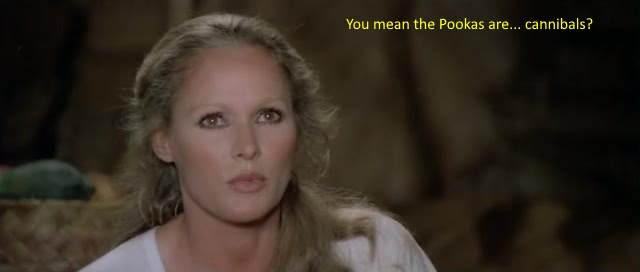
“Why is everyone so scared of the Pooka?”
“In their language, Rara Me means mountain of the cannibal god

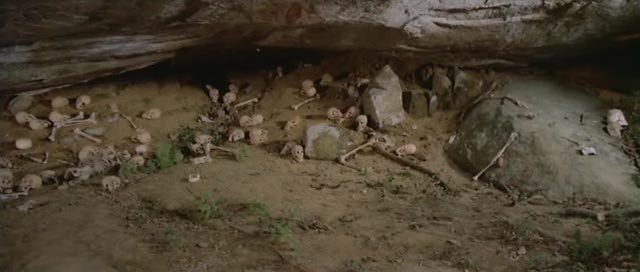
Well that explains it then. Why Susan (Ursula Andress, who was the first “Bond Girl” in Dr No), is tied up in the jungle naked, being smeared with cream by some local girls. Why her husband’s skeleton is being worshipped as a god because his Geiger counter is still ticking within his bones. Why Professor Foster (Stacy Keach) is admitting to having been a cannibal (spoiler: he didn’t like the taste much).

Hey, that pretty much sums up the whole movie. The film starts with stock footage of animals, intended to persuade us we are in the jungles of PNG, but they seem to be chosen at random. The grey-headed flying fox, for example, is native to Australia. Close, but no points.

Like all the Italian horror movies of the seventies, this one has the obligatory scene of real animals being cut up and eaten, some of them while still alive. It was intended to add “realism” to what were pretty dumb plots, but just managed to put a lot of people off watching the films. There is an inordinately long scene of a python eating a monkey alive, and then humans eating a lizard, which Foster tells us is “part of their religion”. Just like eating meat is part of the religion called ‘Humanism’. I guess these scenes also try to teach us that the law of the jungle applies just as much to humans as to other animals. Or else it teaches us to appreciate the fast-forward button.

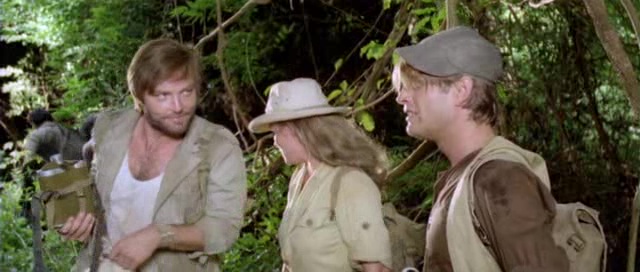
Manolo (Claudio Cassinelli), a wandering adventurer, joins the merry band and tells them:

“Animals only follow their instincts. That of all living beings – killing and eating. Man too has the same instincts. To satisfy them, he uses more subtle means. Lying, trickery.”

He also tells them he doesn’t kill animals, which would probably make living in the jungle difficult (not many vegan restaurants), but they all seem to enjoy coconuts, so who knows?

The first half of the film is about a motley bunch of white people heading for Papua New Guinea (it was actually filmed in Sri Lanka) on a Pakistani plane, to explore a heavily wooded island inhabited by cannibals called the Pookas, and the various reasons they are there (uranium, that sort of thing, yawn).

The title card explains that “life has remained at its primordial level” – meaning the rest of us have advanced? Just turn on the news channel any time to fact-check that.

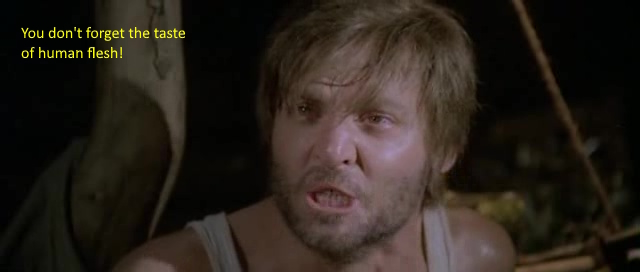
Cannibalism doesn’t get a look in until after the first half, when Foster admits to having lived with the Pooka tribe, where he had to eat human flesh. It haunts him still, and he wants to exterminate them. Sure, eating dead humans is horrifying, but killing live ones is fine.

Thirty minutes before the end, they finally agree that the Pooka exist, when they stumble into their pantry.

They are soon captured and the Chief checks them out for meat quality, but then he remembers that he has a photo of her with her husband who, I may have already mentioned, is being worshipped due to his clicking Geiger counter, a proof of his immortality, despite being a rotting corpse.

So now Susan is the new god, and gets dolled up for the occasion, while her brother, luckily dead, is disembowelled for the coronation feast.

Susan gets to eat some of her brother, while the girls who so enjoyed smearing her with whipped cream lie around pleasuring themselves, and the guys engage in bestiality with a totally uninterested pig. This is getting sillier and sillier.

One of the men, perhaps tiring of being ignored by the pig, tries some hanky-panky with the new goddess, and is pulled off and given a rather extreme form of circumcision. Following which, the tribesmen all start eating snakes, for no apparent reason, but with considerable gusto. The film by now is longing to reach some conclusion, so Manolo has a snack with his new friends (seems to be Kentucky Fried Lizard).

Susan is invited to chop up the rapist, but chooses to stick the knife in the Chief instead, and there is now so much meat to go around that everyone goes for a post-prandial nap. Except for Manolo, who watches a bird fight a snake (Pooka version of Netflix perhaps). Finally bored silly, Manolo and Susan fight their way out, kill a lot of cannibals on their way, and escape on a floating log into a river that we have been shown is full of crocodiles. Yes, it’s a happy ending. Maybe more so for the crocs.

Mountain of the Cannibal God is the translation of the Italian title (La montagna del dio cannibale). The movie was released in the US as Slave of the Cannibal God in 1979 and the UK as Prisoner of the Cannibal God, but not until 2001 due to its “graphic violence”. Can’t see the problem myself, but maybe I have watched too many cannibal movies.

The review from Allmovie said:

“a graphic and unpleasant film, with all the noxious trademarks intact: gratuitous violence, real-life atrocities committed against live animals, and an uncomfortably imperialist attitude towards underprivileged peoples.”

I found it a bit dull, with long scenes of exposition and lingering images of the cast struggling through the jungle or over waterfalls. I guess they had to pad it out somehow, considering all the action takes place in the last ten minutes.

The complete movie, at the time of writing, was available on YouTube.

200 And don’t miss “The Horror Geek” Mike Bracken’s hilarious review at Sick Flicks: