Immigrants and cannibals: TWO HEADS CREEK (Jesse O’Brien, 2019)

The thread that runs through cannibalism texts, from Homer’s Cyclops to Harris’ Hannibal Lecter, is the social outsider. It is a theme that never seems to age, since humans love to form cliques, united by an irrational hatred of those who don’t belong, even if it’s just because they dress differently or support a different sporting team. The most obvious example at the moment, and for most of modern history, is the immigrant.

Norman is played by Jordan Waller who also wrote the script – you may have seen him appear in the TV series Victoria. He runs his mother’s Polish butcher shop in Slough (it’s a real place, although there is definitely a pun in there). It’s post-Brexit Britain, and the locals scream abuse and paint his windows with dog-shit.

vlcsnap-00005.jpg

He’s English, but his shop sells Polish meats, so he is the hated outsider. His twin sister Anna (Kathryn Wilder) is the assertive one, and is totally uninterested in his butcher shop.

vlcsnap-00014

When they discover at their mother’s funeral (held in the butcher shop) that they were adopted, they find a postcard from their mother, postmarked from a small Australian town: Two Heads Creek. Not sure if this is international invective, but in Australia, “two-heads” is pretty much a synonym for “inbred”, and is used to denigrate rural people. The outsider does not need to come from outside – just a different region will do.

vlcsnap-00008.jpg

Norman is named after his mothers’ favourite singer, the Australian pop star Normie Rowe, who was enormously popular in the sixties, until the government decided to conscript him to the war in Vietnam as a publicity stunt. Normie’s oeuvre is featured heavily in the soundtrack. Nevertheless, the twins know nothing of Australia as they sell the butcher shop and head “Down Under” to seek their birth mother, except for clichéd English convict stereotypes, so when the customs agent asks if he has a criminal record, Norman answers “is that a prerequisite?” They travel ten hours to the outback town with a group of Asian immigrants, on a bus driven by an Indigenous man, Apari (Gregory J. Fryer) who is treated like dirt by their guide.

This is a blog about movies involving cannibalism, so it’s probably not a big spoiler to mention why the immigrants are being sent to Two Heads Creek.

pic-00009pic-00010

Australian governments of both parties have a long-standing practice of locking up refugees in offshore detention and leaving them there to rot or go mad. So far, they have not considered cannibalism as a solution, so we have to hope they don’t see this movie.

There are lots of explicit cannibalism scenes, as well as some cute intertextual references, e.g.

pic-00011.jpg

19vlcsnap-00019.jpg

The movie is far from subtle in its treatment of jingoism, racism, sexism and various other discriminatory practices popular in Australia and elsewhere.

pic-00032

But an important thing to realise about cannibalism is that it is an ultimate equaliser – although only certain groups may be chosen as victims, once skinned and cooked, we are all the same. Our differences are, literally, skin deep.

pic-00015pic-00016pic-00019

The scenes of cannibalism are accompanied by another soundtrack, this one the Aussie group Skyhooks, with their big hit “Horror Movie” which, in the song, turned out to be about watching the evening news, and so is just as relevant now as ever. Perhaps more so.

pic-00024.jpg

They do get to meet (and almost eat) their mother, yes, she is named Mary (the wonderful Kerry Armstrong from Lantana, Seachange and so much more), who perplexes them by describing their father as “a good man”.

pic-00042

The final act is a climax of gore, wildly over the top and full of people being stabbed in the crotch, presumably for the 14-year-old-boy market. The main antagonist, Apple (Helen Dallimore) gets shot with an arrow and goes into the giant meat-mincer with her middle finger the final part to be ground up, while screaming the theme of the movie:

pic-00054pic-00056

The best line of the film is from their mother, who is hit in the neck by a lethal boomerang studded with nails, but dismisses it as “only a flesh wound”

pic-00068.jpg

Apari, a descendant of the original inhabitants of the land, is left to clean up the blood and corpses that litter the town. With some justification, as he watches the Australians and the English hobble off, he says:

pic-00058

This well-crafted film is only the second feature from Australian director Jesse O’Brien. He said of the setting, the mining town of Cracow in the Banana Shire, 500km northwest of Brisbane, that

“I think that myth of the outback being ‘a scary place’, which isn’t always true, does fit rural Queensland really well.”

pic-00044.jpg

The cast is great and the film is fresh, funny and still manages to ask some interesting questions about differences and about appetites. It has a 90% fresh rating on Rotten Tomatoes. Film Threat described it as:

“A deliciously deranged horror-comedy, overflowing with blood and wit.”

The movie is available on Amazon Prime.
 

“All I want is to eat that arm and become like you”, DISTRICT 9 (Neill Blomkamp, 2009)

Back in 2009, fifteen years after the end of apartheid, South Africa seemed to be the obvious place to make movies that offered clear metaphors about racism and xenophobia. Today, they’d probably be filmed in Minneapolis, but nonetheless, after more than ten years, this movie works just as well, perhaps even better in this time, when people have to fight for their lives against both racism and an invasive disease.

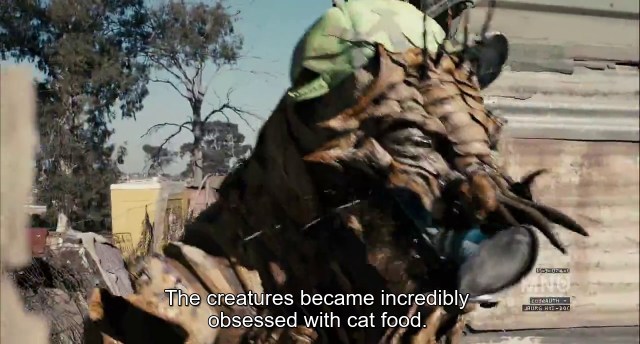
DISTRICT 9 is directed by Neill Blomkamp and produced by Peter Jackson (yes, that Peter Jackson), and set in Johannesburg, South Africa. It is presented as “found footage” – fictional news stories, CCTV and interviews. District 9 is an internment camp for aliens – not from across the border or across the ocean, but across the universe. A giant UFO hovers above the city showing no signs of life, and when the authorities cut their way inside they find it is full of diseased and starving aliens, who look, as Roger Ebert said, like two metre tall lobsters. They are brought to land and housed in a secure area – District 9 – where they recover, and cause havoc with their love of wrecking stuff and eating lots of cat food.

pic-00006

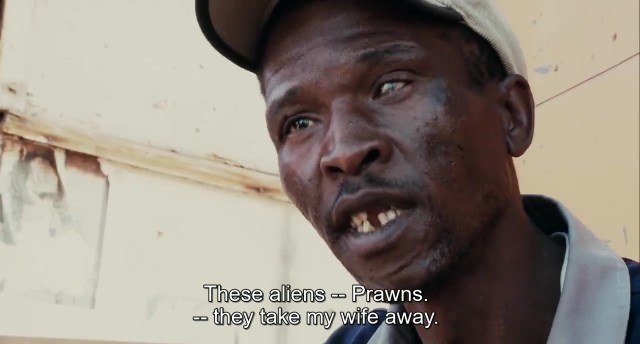
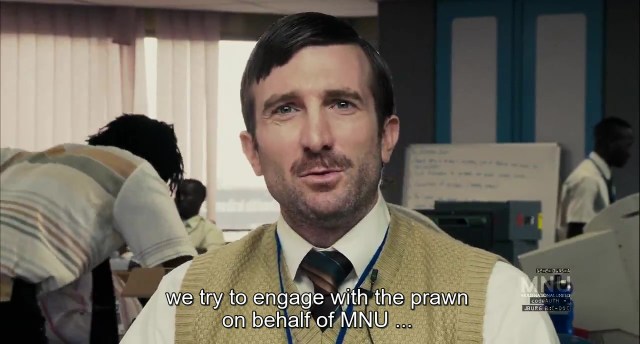
Yes, it’s not without humour. There are “interviews” with people of different races, all saying that these aliens – now known universally as “prawns” – should be sent home or else taken out of the city, away from human contact. Resettlement camp, detention centre, ghetto – those who are different can be separated with just some pernicious circumlocution.

vlcsnap-00012

vlcsnap-00017

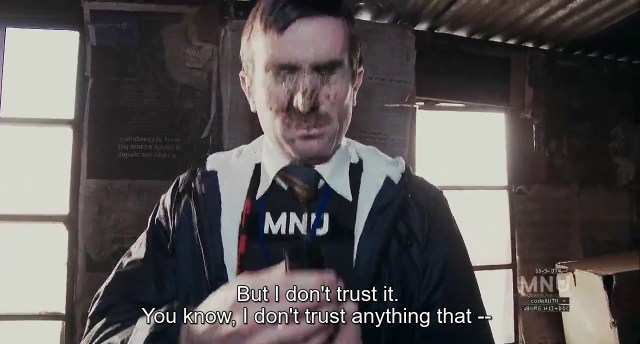
The movie follows Wikus van de Merwe (Sharlto Copley), a naïve and nerdy mid-level executive in a huge multi-national corporation called MNU (it stands for Multi National United), which supplies mercenaries for just such situations.

vlcsnap-00001

Wikus heads off with his army and a clipboard, believing that he is going to knock on doors and ask the “prawns” to agree to be moved to a new camp, whereas of course the whole process is aimed at intimidation and terrorising of the populace.

vlcsnap-00028

Searching one building, he finds a tube of alien fuel, which they have been synthesising for twenty years, planning an escape. He opens it, and it sprays all over him.

pic-00017

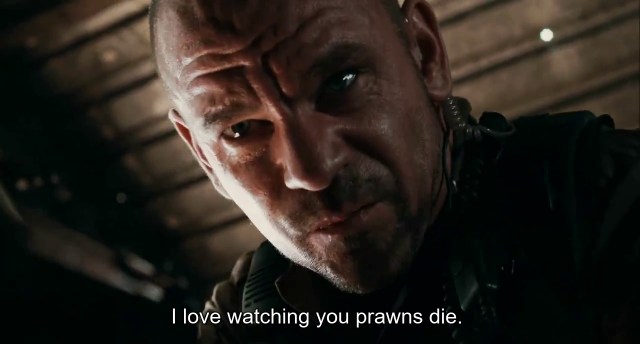
Soon, he starts metamorphosing into a “prawn” – his hand turns into an alien claw, and his teeth and nails start to fall out. This is obviously a big problem – actually two. First, his company, MNU, wants to cut him up and study his organs, desperate to learn how to transmute others, because the aliens have immensely powerful weapons that will only operate in the hands of someone with alien DNA. He escapes back to District 9, pursued by the sadistic head of the corporation’s private army, who personifies white supremacist violence.

pic-00035

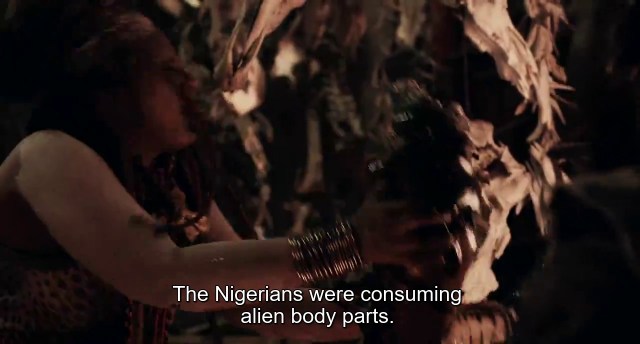
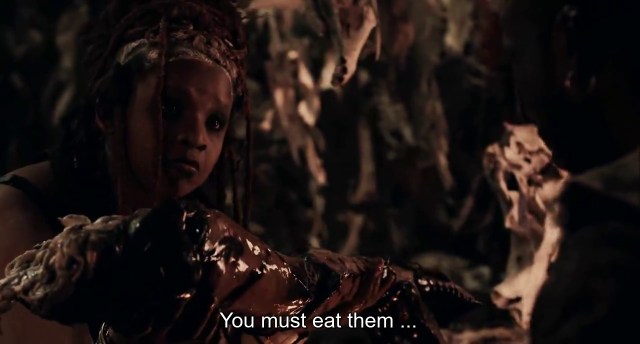
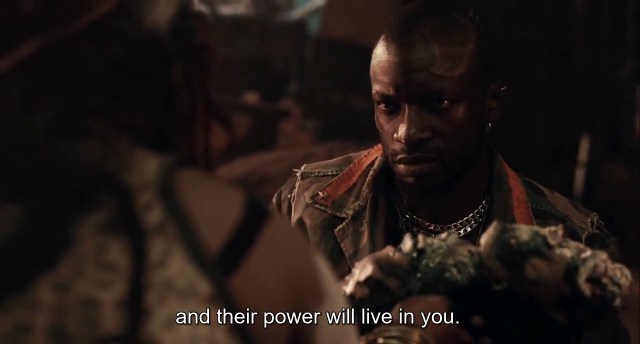
Back in District 9, Wikus is captured by a Nigerian criminal gang, who make their fortune from the aliens, selling them cat food, and offering interspecies prostitution (delicately presented). The Nigerians’ leader, whose name is taken from that of a former President of Nigeria, also wants to control those weapons, and believes eating Wikus’ arm will make him part alien as well. Why not just eat a prawn? Oh, they’ve tried that.

pic-00040

The trope of cannibals taking on the strengths of those they eat has been around pretty much forever. It is used to explain both mortuary cannibalism, where the strength of the ancestors is passed to the descendants through their flesh, and also aggressive cannibalism where the legs of the fastest enemy, or the testicles – you get the idea. It revolves around the idea that “you are what you eat”, but if you believe that, well, what does that say about the trolls who love to write “But BACON!” on vegan social media sites?

The film was shot around Johannesburg, and the squalid hovels shown were in an area of Soweto that was being demolished and the people relocated. The story is based on the true case of District Six in Capetown, where 60,000 inhabitants were forcibly removed during the 1970s by the apartheid regime. But finding a parallel story of forced removals of oppressed populations would not be difficult in most of the world’s nations. A reviewer wrote in an article entitled “District 9 reveals human inhumanity”:

“Substitute “black,” “Asian,” “Mexican,” “illegal,” “Jew,” or any number of different labels for the word “prawn” in this film and you will hear the hidden truth behind the dialogue, echoing what we historically as a species are all too capable of doing.”

Several different facets of cannibalism are presented in District 9. The Nigerians eat “prawns” – is that cannibalism, or if not, what about their plan to eat Wikus as he transforms into a prawn? The big corporation is only interested in the billions of dollars that will come from working out how to operate the alien weapons, and are ready and willing to sacrifice Wikus and use his body parts in pursuit of this goal. The aliens are tall and powerful (pulling people limb from limb in a few scenes) and look a bit reminiscent of the creatures from the Alien movie franchise, even though they don’t eat each other or the humans; but  they are keen on meat from other species like pigs and goats and whoever ends up in the slurry called cat food.

pic-00019pic-00022pic-00023

The formal definition of cannibalism tries to restrict the definition to humans eating humans, but it is always leaking out the sides. What we see in this film is the way that anyone can be abused, objectified and even eaten if they can be reclassified as inhuman or subhuman. Wikus starts the story happy to burn down shacks full of alien eggs, enjoying the sound of the eggs bursting, which sounds like popcorn. Captured by the corporation and made to operate alien weapons, he is happy to destroy pigs but begs not to be made to shoot the aliens. Later, turning into a “prawn”, he is more than happy to use the alien weapons to blow apart various soldiers of his former employer, to protect the prawns. The irony of this film is that Wikus, who is a fully carnophallogocentric human in the terms used by Derrida (“adult white male, European, carnivorous and capable of sacrifice”), only finds his humanity when he begins morphing into something else and becomes one of the outsiders he previously disdained.

It’s well worth seeing – if you don’t dig the message, then there’s plenty of action scenes, car chases and explosions. Some unintended explosions after the movie, too, when the Nigerian Information Minister asked cinemas to ban the film because it depicted Nigerians as criminals and cannibals. Not the first time white people have applied those epithets against Africans, and the film also scored a mention in Salon’s list of “white saviour” movies, since Wikus is white, and desperate to remain so. But the Malawian actor, Eugene Khumbanyiwa, who played the gang leader, said that the Nigerians in the cast weren’t bothered: “It’s a story, you know. It’s not like Nigerians do eat aliens. Aliens don’t even exist in the first place.” Sensible, but not a great look for a film that is slamming racist stereotypes through the metaphor of speciesism.

pic-00001

The direction is adroit and the story buzzes along with never a dull moment. The acting is first rate, even the guys in the alien suits become sympathetic characters, and the special effects are first rate. The film has a 90% “fresh” rating on Rotten Tomatoes. It’s available on Netflix.