

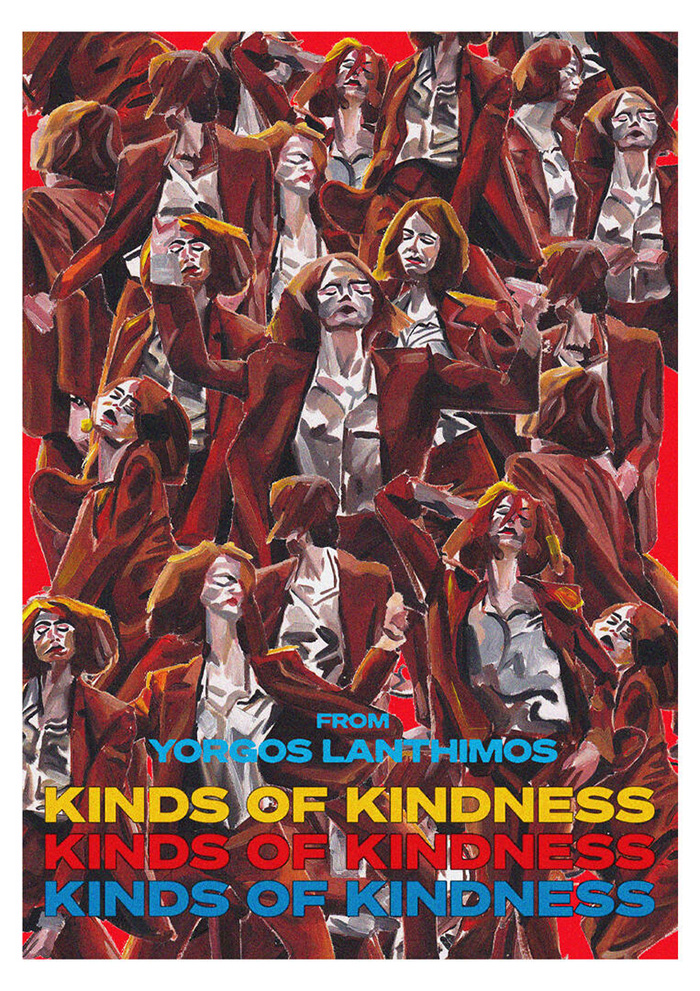
Kinds of Kindness is a black comedy drama, presented as a “triptych fable” – three separate stories which are nevertheless connected. The director, Yorgos Lanthimos, has made many celebrated films, including The Lobster, The Killing of a Sacred Deer and most recently Bugonia. He has won a BAFTA and been nominated for five Academy Awards. Kinds of Kindness has his regular extraordinary cast, including Emma Stone, Jesse Plemons, Willem Dafoe and Margaret Qualley.
When directors use ensemble casts, it usually means they use the same actors in a series of unrelated films, but this one is really three films in which the same actors play different roles. The one of interest to us is the middle section, “R.M.F. is flying”, which employs the theme of this blog, cannibalism. But the whole film is a entertaining (if somewhat lengthy), and there is a relationship between the three parts that makes an interesting, if somewhat disorienting and bewildering, whole. Life imitates art, in that the director and Stone have recently been involved in signing uninformed statements about international politics, an area in which they clearly are sadly ignorant. Imagined kindness becomes abusive behaviour, the theme of the film.
Spoiler alert – if you haven’t seen the movie, and plan to do so, maybe do that first.
The first part of the trilogy explores abusive relationships, particularly in the workplace, as Robert (Jesse Plemons) lets his boss Raymond (Willem Dafoe) control every aspect of his life. Raymond is loving and generous (a kind of kindness), but only as long as Robert obeys every order Raymond gives him, including his daily food regime, his sexual activities, and the order to kill a person known only as R.M.F. Kindness is presented as a toxic attachment.

The second story, R.M.F. is Flying, follows a police officer named Daniel, (Plemons), whose wife Liz (Emma Stone) has disappeared at sea while on a biology research expedition. Despite all predictions, she is found and flown back home by R.M.F., but Daniel believes she is an imposter – her shoes don’t fit, she does not remember his favourite song, and she suddenly loves chocolate which she previously could not stand, telling of a dream where dogs were the master species and fed their pet humans on chocolate.

Flashbacks reveal how she survived – by cannibalising the other members of the team.

At one point, the distraught cop Daniel shoots a suspect in the hand, and starts licking up the blood from the wound, just as a dog might do. Like the dogs in her dream, Daniel becomes Liz’s pack leader and she accepts his humiliation and cruelty like a “beta dog” would. Demanding she prove her love, Daniel asks her to cook him one of her fingers or thumb, and we see her cut it off and fry it.
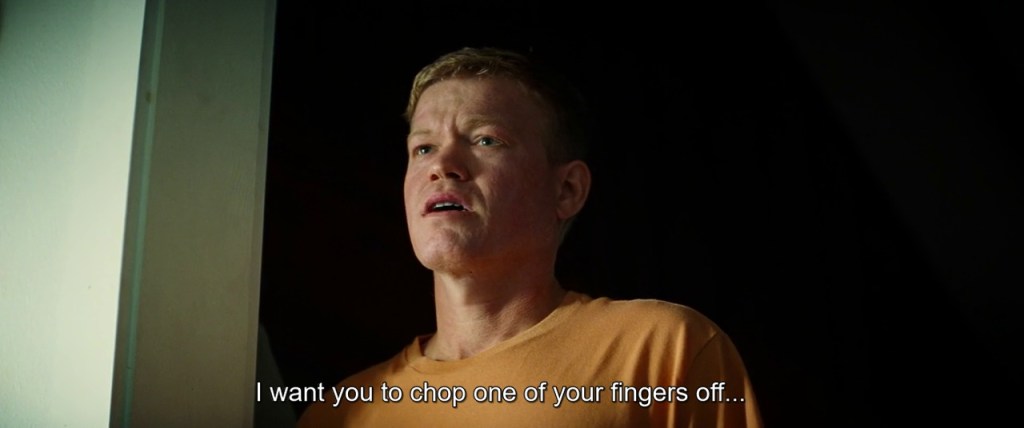

When she reveals she is pregnant, he beats her until she loses the baby.
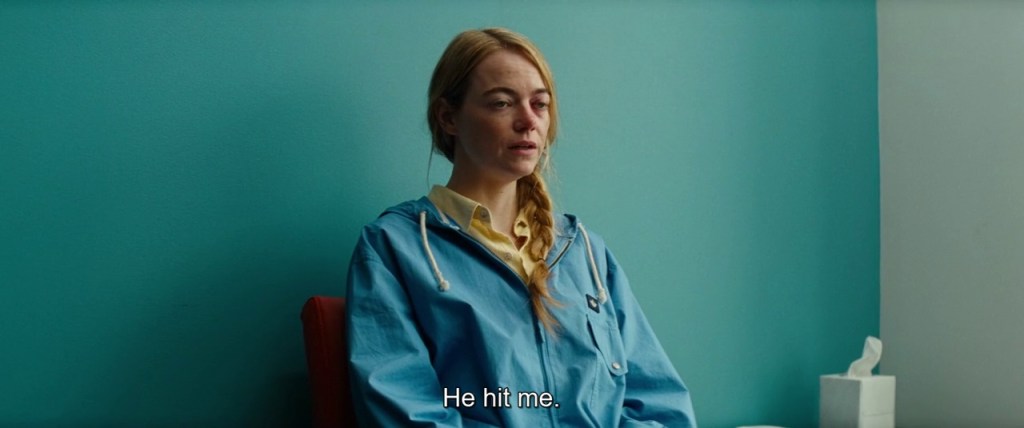
Finally, he says he is still hungry, famished, and says he wants her liver. She removes it with a kitchen knife, dying in the process, and we see the ‘real’ Liz appear at the door, to be greeted lovingly by Daniel.

The closing credits show dogs driving a car, a dead human lying by the roadside like roadkill. This story exposes kindness as vulnerability in intimate relationships. Daniel is determined that Liz be exactly as he wants her and rejects all her overtures of love, eventually leading to her death and rebirth as his ideal wife.

The final story examines a sex cult led by Omi (Dafoe) and Aka (Hong Chau) where followers are purified by drinking water cleansed by the tears of the leaders, and can thereafter only have sex with Omi and Aka. Emily (Stone) and Andrew (Plemons) are paired and sent out to find a messiah – a woman who can revive the dead. Emily, like many converts to cults, has left her family behind, although she sneaks into her old house sometimes to sit on her little girl’s bed. Eventually she goes to visit her family, but the daughter is asleep and her ex-husband drugs and rapes her, meaning that she is now, to the cult, ‘contaminated’, and so ejected from the compound. She perseveres and eventually finds the messiah, a veterinarian named Ruth (Margaret Qualley) who heals a stray dog whose paw Emily has cruelly cut. Liz drugs Ruth and takes her to the morgue, where Ruth brings back R.M.F. from the dead. Triumphant, Emily drives the still dazed Ruth to cult headquarters after doing a victory dance that appears in the trailer at the top of this blog. As the credits roll, though, her reckless driving ends up with her driving her Dodge Charger into a wall, killing Ruth. Abusive kindness again, this time as spiritual devotion turned toward thralldom and abuse.
In all three stories, the characters seek fulfilment and, yes, kindness, going to excessive lengths to achieve it – Daniel kills a man to win his boss’ love, Liz cuts out her own liver to feed her husband and placate his repulsion, and Emily kidnaps her purported messiah to win back the love of her cult leader.
The film is an absurdist romp, reflecting the incongruity of human relationships and social behaviour. In each part, someone is being exploited and abused, a form of consumption, but the middle story makes cannibalism, inherent in all abuse, graphically apparent. There are many variations of cannibalism; Liz indulges in starvation cannibalism to survive as she waits to be rescued, Daniel becomes psychotic and licks blood from a wounded civilian, Daniel indulges in revenge cannibalism, ultimately killing Liz.

When he is convinced the woman that was rescued is not really Liz, he becomes contemptuous, and from that point, her death and consumption are inevitable. She has been, in his eyes, dehumanised, objectified like the animals sent to their deaths by the billions every year for human consumption. They are “de-animalised” – their flesh turned into commodities, made to look as little as possible as the living, feeling animals from which it came. For humans to be cannibalised, they must first be animalised, then de-animalised.

Thus, Daniel licks the wound of the man he shot like a dog might treat a wound; thus, Liz’s dream in which the dogs are in charge and feed the humans, not exactly what they want, but chocolate, of which there is plenty, probably because dogs cannot eat it (it’s toxic for them).

In relationships built on distrust and rage, we are animalised, and animals like dogs become the paradigm of civilisation. The humans are just wearing people masks.

 The Cannibal Guy