“Drowning in a river of blood”, SON (Ivan Kavanagh, 2021)

Children as cannibals seems to be the fashion, with fans of Timothée Chalamet waiting impatiently for the new cannibal romance movie Bones and All due towards the end of 2022 (maybe). Chalamet teams up with Taylor Russell, who plays a girl that has been a cannibal since she grew her first teeth. Yeah, I read the book, but no spoilers here. A couple of weeks ago, we looked at the movie It’s Alive, which featured a man- (and woman-) eating newborn baby. Combine that hungry little fella with the cannibal kids in The Girl With All the Gifts and some baffled doctors in Rosemary’s Baby or The Exorcist or The Omen and we get this little boy named David (Luke David Blumm from The Sinner), who is a sweet little boy, except that he kills and eats people.

His mother, Laura (Andi Matichak from Halloween) kicks off the movie as she escapes from a religious cult, hugely pregnant, and gives birth in her car as a King Lear level storm rages outside. Yes, there be some devil work afoot – those demons love a young virgin. Or is she escaping extreme sexual abuse? Or is she chronically delusional?

Eight years later, Laura and David are a happy, well-adjusted family of two, until one night she goes into David’s room and there are a whole bunch of people standing around his bed, which she is not happy about – has the cult come back for David? He seems OK, though, with the normal hopes and dreams of an eight-year-old boy.

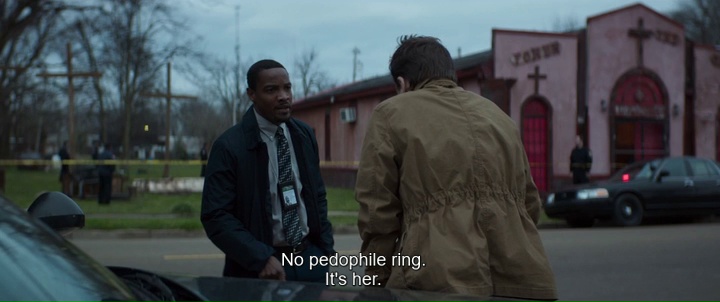
The cops think she’s crazy, except for Paul (Emile Hirsch from Into The Wild) who seems to have no police work to do other than sympathise with Laura. David starts having seizures, skin irruptions and internal bleeding, which the doctors are baffled by, as they normally are in this genre. Some of them seem to be in cahoots with the cult members who want not Laura, but David. The cult’s slogan is “HE IS COMING”. It turns up, written in blood, all over the place.

There is only one thing that makes David feel better – a nice dose of human body parts. Not a cure exactly, but it seems to clear up the crusty sores and vomiting of blood very nicely. Laura escapes the hospital with David when she figures the doctors are all involved in the cult, and flees to the home of her friend Susan. She leaves David with Susan while she gets a few essentials from home, but when she comes back, David is feeling much better, and Susan much worse. Yes, some fresh human flesh is a great aid to healing, apparently.

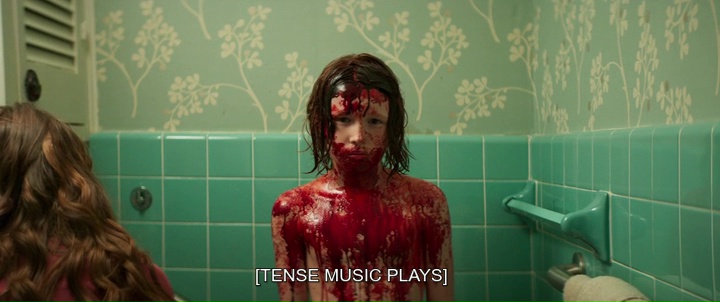
And so it goes. Laura washes David down in the shower and subsequently listens to his entreaties (“It hurts, mom!”) and his threats (“Get me some fuckin’ food, you bitch!”).

But eventually, she does what any good mother would do when faced with a hungry child – she finds him some food. But not just, you know, anyone; like Hannibal who prefers to eat rude people, or Sheila from Santa Clarita Diet who wants to eat “someone bad, who deserves it… the prototype would be a young, single Hitler”, Laura sees a very nasty pimp beating up one of his girls, and decides to invite him around for dinner.

Of course, one of the worst parts of being a parent is cleaning up after dinner.

So it’s a cannibal mystery. Laura is really named Anna and, according to the newspapers of the time, she was repeatedly raped by her father and a whole lot of men to whom he sold her from the age of ten. A paedophile cult!

If you can’t accuse someone of being a cannibal, call them a paedophile. But her childhood friend, who admittedly is now a hopeless junkie, tells her that in reality her father didn’t touch her; she was sacred.

The cult would torture and kill animals in her bedroom then force her to chant a spell to summon a demon named Palystes (fun fact, that is not the name of a demon but of a spider) who would rape her and, yep, get her with child. Rosemary’s Baby and The Omen for a new century, a new, improved version, now with cannibalism. Her shrink (retired) tells the police, who are interested in talking to her about the hollowed out friend Susan, that she is psychotic and imagined the whole cult thing. The cops, even Paul who’s really into her, decide she is having a psychotic episode and is the one killing and dismembering people.
Well, it’s a new movie and you might want to catch it, so no spoilers (although so many reviewers say the ending is obvious). The directing by Irish filmmaker Ivan Kavanagh is sure footed, the Irish certainly know their way around devils and the children of supernatural beings. The actors are great, particularly Andi Matichak as Laura and Luke David Blumm as the junior cannibal, the plot rolls along well and if the continuity is a bit jumpy, well, that’s part of the psychotic story arc. For those who like that sort of thing, there is a LOT of gore, and having a cute little boy doing the killing and eating is a nice touch. Although why no one believes a little boy could be a cannibal killer baffles me. I was a little boy once, and I wouldn’t put anything past the kids I knew.
Son scored a respectable 76% “fresh” on Rotten Tomatoes, with the Los Angeles Times calling it “an amped-up version of everyday parental paranoia” and the San Jose Mercury News saying “it’s engrossing and well-made, but you’ll need a strong stomach to get through it”.

Son asks some interesting questions about trauma, believing victims but also questioning false memories, fear of the past and vengeance. It also reminded me of people who are shocked at cannibalism movies, but even more shocked at vegans who, they complain, are neglecting their children by not feeding them meat. David has no such problems in this movie. As Hannibal would say, “nothing here is vegetarian”.

Harvesting hitchhikers: UNDER THE SKIN (Book: Michel Faber, 2000) (Film: Jonathan Glazer, 2013)

“We’re all the same under the skin.”

The philosopher Thomas Nagel claimed that we are unable to understand the point of view of another being, giving as examples the difficulty imagining what it’s like for a human to imagine being a bat, or for a blind person to imagine being sighted. J.M. Coetzee in the guise of his character Elizabeth Costello thought differently – it’s about being, seeking, feeling, and of course eating. We all do those sort of things. We can sympathise, no matter how alien that other may be.

The movie and the book of Under the Skin feature a ‘real’ alien – a being from another planet, disguised as a human woman, here to harvest human flesh for food. They both ask – what’s it like to be an alien? In the book, the aliens are quadrupeds, looking something between a horse and a sheep apparently, except for the protagonist, Isserley, who has been surgically mutilated to make her look like a ‘human’ of earth. I say ‘human’ in inverted commas because her people, like many clans interviewed in the reports of anthropologists, believe that they are the humans, and so everyone else must be aliens or subhumans. To Isserley’s people, the denizens of Earth are “vodsels” (Dutch for “food” – the author Michel Faber is originally Dutch) – dumb animals that can be captured, castrated, fattened up and then slaughtered for meat, which is exported back to the home planet.

Isserley is a hunter. Her weapon in the book is a small car which has anaesthetic needles in the passenger seat. In the movie, it’s her appearance – she looks like (because she is played by) Scarlett Johansson (identified in the credits as “The Female”).

Men get in her car and eagerly accept the offer to come home with her, but at home, they disappear into a pool of black ectoplasm.

She stalks her prey, driving around the roads of Scotland and picking up hitchhikers, asking them questions to draw out whether they will be missed and, if they are loners, losers, tranquilising them with a drug called icpathua and taking them back to be processed. The film took an audacious decision to use real men, not actors (most of them), many of whom were offered a lift by Johansson, and recorded by secret cameras in her van. They don’t recognise Johansson as a movie star, just as their unwitting “characters” don’t recognise her as an alien hunter. In the book, Isserley is not portrayed as any kind of Scarlett Johansson, but does have huge breasts, the prototype for the surgery being based on some questionable magazines sent back to the home planet by the advance crew.

The story in both media is not just about being alien (which she is in several ways: as a woman, as an alien, and as a hunter) but about how difficult it can be to sympathise with the other, the stranger, the prey, and how dangerous it can be when one finally does so. In the book, Isserley is purely interested in whether they will be missed, and is unconcerned about what is done to them, which is described in graphic detail: they are shaved, castrated, tongues removed and fattened up. In the film, she will go to any lengths to capture her prey, at one point dragging away a man who had tried to save a drowning couple, leaving their baby crying on the beach.

But what happens when the hunter starts to identify or at least sympathise with the prey? Isserley is made to think through the implications when she needs to convince the aristocratic scion of the ruling family of her planet that the vodsels are just dumb animals, and their feeble attempts to beg for mercy by scratching in the sand of their cages are just gibberish (he is unaware they can speak, as their tongues have been cut out). He is a believer in animal rights, and frees some of the captives, whom Isserley then has to hunt once again, this time with a shotgun. Isserley never really challenges the morality of hunting, mutilating, fattening and slaughtering the stupid vodsels (us) although she is horrified at the suggestion of eating sheep, serene animals who look like the children of her species, unlike the “brutish cunning of the vodsels”. Her morality, like so much of ours, is based on similarity. Her challenge comes when she picks up a man who (we know, although she doesn’t) is a serial killer, sedates him, then realises she has left his dog to starve in his van. She heads back to where she picked him up, frees the dog, and decides to quit, try to make a life as an Earthling, even though she cannot even eat our food.

The Female of the film has a different challenge. She picks up a man with severe facial deformity, who admits that not only will no one miss him, but that there has never been anyone who might have.

She takes him back to the black pond, but rescues him at the last moment, and then flees. Then she ceases to be the hunter, and becomes the hunted. Both the film and the book have a vicious rape scene when the prey, the desperate from among men she collects, turn on her.

The story may be interpreted according to many discourses of our times. It can be interpreted as the struggle of immigrants against the racism and resentment of those whose territory they enter. It is more widely interpreted as a feminist narrative, in which the standard horror trope of the sexually active female being stalked by the monster is turned on its head – the males walking alone at night are the prey, the woman is the molester and murderer. It is also a comment on economic class distinctions: the men she picks up are the strays, the unemployed who are exiled, isolated and vulnerable. She is culling those whom society has expelled, like a lion preying on the old and weak of a herd of antelopes. They are the aliens from this planet. 

The book in particular is a metaphoric condemnation of modern factory farming. The vodsels (that’s you and I) are considered “vegetables on legs”.

“The thing about vodsels was, people who knew nothing whatsoever about them were apt to misunderstand them terribly.  There was always the tendency to anthropomorphise. A vodsel might do something which resembled a human action; it might make a sound analogous with human distress, or make a gesture analogous with human supplication, and that made the ignorant observer jump to conclusions. In the end, though, vodsels couldn’t do any of the things that really defined a human being. They couldn’t siuwil, they couldn’t mesnishtil, they had no concept of slan.”

Aren’t these the same arguments thrown at vegans on social media every day? “Humans” are intellectually superior, and therefore the only ones worthy of moral consideration. And to these aliens, we are not the humans. Isserley and her crew are the embodiment of John Harris’ famous quote (usually misattributed to George Bernard Shaw):

Suppose that tomorrow a group of beings from another planet were to land on Earth, beings who considered themselves as superior to you as you feel yourself to be to other animals. Would they have the right to treat you as you treat the animals you breed, keep and kill for food?

The film is less distinct in its message. Glazer said in an interview that he wanted

“to make a film representing, as purely as possible, an alien view of our world.”

How do we step into another’s consciousness, be it a man or woman or bat, be it a predator or prey? How is it to be an outsider, an alien, a stranger in a strange land? It is difficult to comprehend, and yet sometimes it is easy, because we have all felt like aliens at one time or another. Think of your first day at a new school.

The brilliance of this story is that we see humanity (us, that is) through the eyes of an alien. In the book it’s Isserley’s thoughts and feelings about the vodsels, Earthlings, to whom she feels both contempt and grudging admiration. In the film, it’s images – the dark streets of Glasgow, the crowds jostling and threatening, the shopping mall that suddenly seems like an alien landscape.

In other words, we get to feel how it is to be an alien, proving the truth of Coetzee’s Elizabeth Costello when she says: “there are no bounds to the sympathetic imagination”. But this insight is not accessed through rational contemplation, which tells us we can do whatever we want if we have the power and the will, but rather from the heart, “the seat of a faculty, sympathy, that allows us to share at times the being of another.” We sympathise with this alien, as she begins to sympathise with us.

Matt Zoller Seitz, the critic from RogerEbert.com, interprets the story’s message as saying:

“Here is an experience that’s nothing like yours, and here are some images and sounds and situations that capture the essence of what the experience felt like; watch the movie for a couple of hours, and when it’s over, go home and think about what you saw and what it did to you.”

The film earned a very respectable 84% on Rotten Tomatoes, The Guardian called it a masterpiece, but it was a box office flop. Let’s hope it, and the book, continue to ascend into the realms of cult texts. They are both highly recommended for your consideration.