All-consuming teenage desire: “DER FAN” (Eckhart Schmidt, 1982)

Simone (a bravura performance by 17-year-old Désirée Nosbusch) is a teenage fan obsessed with a pop singer known only as “R.” That obsession takes over her life – she drops out of school, waits outside the post office for a week for a reply to her letter, which will never come because his fan mail goes straight to the tip.  She climbs to the top of the church steeple in her town of Ulm (it’s actually the tallest steeple in the world) and thinks about jumping off, splattering herself all over the town square, but with a letter to R in her pocket, so he will hear of her at last.

Nosbusch as Simone offers a fascinating glimpse of the modern cannibal – she looks and acts normal (for an angst-ridden teen) but underneath are irresistible currents of passion and voracious appetite for her idol. She attacks the postal worker who disappoints her by not having a letter for her, she attacks her father for turning off the TV show on which R is performing. The walls of her room are covered in pictures of R. The film shows parallel imagery to her obsessive love; images of Nazi salutes – the same obsessive love that led Germany and the world into catastrophe a few decades previously.

The word “fan” comes from “fanatic”. The fanatic believes he or she has found the answer, the one who knows us, cares for us. She feels that R, who has never heard of her, knows her inside out. And she will know him, inside out.
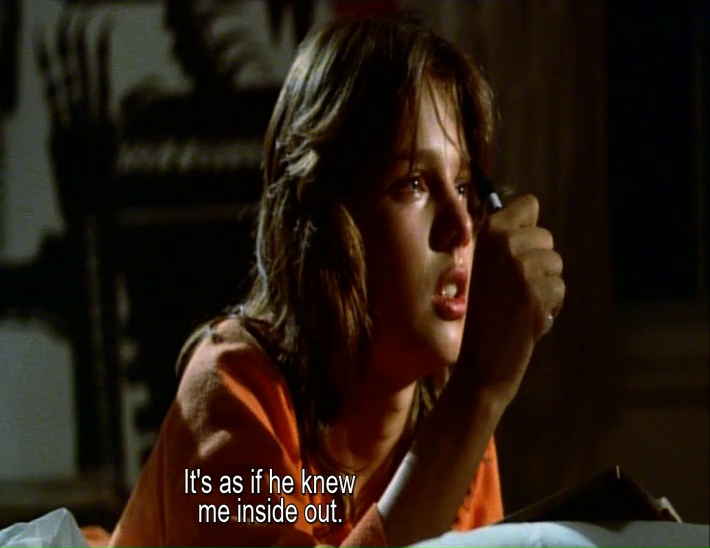
She drops out of school and hitchhikes to Munich, where R’s shows are recorded, being accosted on her way by a range of toxic men, but of course the worst of them is the one she is so desperate to meet. She sleeps in unlocked cars while she waits outside the studio, so frantic that, when she finally meets him, she faints.

R seems concerned and kind, invites her to his show, where he appears as a mannequin surrounded by store mannequins – a bald wig symbolically obscuring the divide between human and inhuman, life and death.

He takes Simone back to the apartment of a friend who has gone to the US for a year, where she finally achieves the intimacy she has craved. Nobody knows they are there, so anything can (and does) happen.

But R is a superstar – he is not interested in the meeting of the souls that she imagines will happen, and afterwards tells her he has to go back to his work, tries to fob her off with vague promises of future meetings. He tells her to leave the keys on her way out.

Simone wants to own him and his love, but he just wanted her young body. As he leaves, she picks up a figurine of the goddess Diana, the Huntress, and she then hunts him, killing him with a blow to the head.

Once he is dead, he is hers at last, to do with as she wishes. The imagery switches to that of a Christ, broken and crucified, and she cradles him in her lap like an erotic Pietà.

She sees a freezer, and she sees an electric knife.

R’s blood is, as the Bible says, his life, and she laps it up from the floor and from her knife.

When R is neatly packed in the freezer, Simone faints, but next day we see pots boiling on the stove, his foot being basted with his juices.

She eats him over a few weeks, then grinds his bones to dust and takes the dust back to the TV studio; pouring it out at the place she met him.
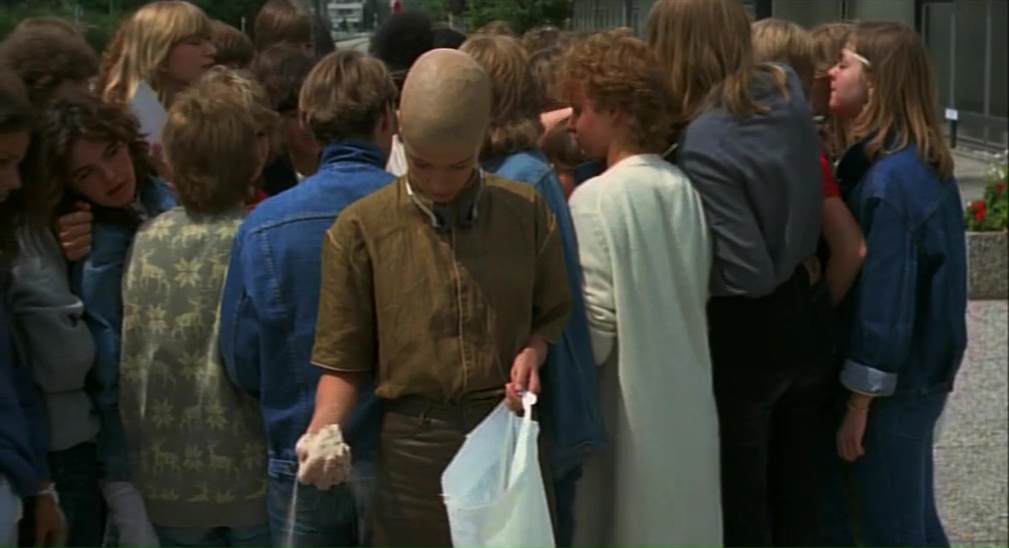
Her revenge involves ceremonial murder and cannibalism, to ensure he will always stay with her, and inside her. Leaving for home, her head shaved so she looks like one of the mannequins from his performance, she promises her parents to return to school.

She sits with them and watches the news – R’s disappearance weeks ago remains a mystery. But she knows where he is.

“I missed my period. I’m four weeks late. I will bring you into the world. We will be happy. I know you love me. And me too: I love you.”

He is inside her, and so is his seed. Like Christian mythology, R will be reborn, but this time totally dependent on her, loving only her.

 The film did not garner a lot of interest or decent reviews, but has picked up a bit of a cult following in the years since. It is an excellent study of the monstrous-feminine, a figure often found in cannibal narratives, particularly around revenge and love. Mariana Enriquez’s recent collection of stories called The Dangers of Smoking in Bed has a similar story called “Meat”, in which two similarly obsessed fans dig up a dead pop idol and eat his rotting corpse. Well worth a read if, perhaps, not during mealtime.

Fuelled by a minimalist synth soundtrack from Rheingold and stunning photography, Der Fan is an engrossing and fascinating study of love, not in its sentimental, romantic form, but as possession, greed, rage and cannibalism. Much of lovemaking is expressed orally, through kissing, fellatio, cunnilingus, and licking or sucking and sometimes chewing of various body parts. Simone has taken this to its logical extreme. R is inside her, and so is an embryonic version of him, which she promises to love as she had hoped to love its father. It’s resurrection through transubstantiation.

Indiana court upholds life sentence for man convicted of murder and cannibalism

On May 17, 2023, The Indiana Supreme Court in Indianapolis upheld the life sentence without parole for a 41-year-old Indiana man convicted of killing his ex-girlfriend and dismembering her body before partially eating several of her internal organs.

Joseph Oberhansley was convicted in September 2020 of murder and burglary in the slaying of 46-year-old Tammy Jo Blanton in Jeffersonville in September 2014. Clark Circuit Judge Vicki Carmichael sentenced Oberhansley to life in prison without parole, based on the jury’s recommendation.

Oberhansley’s legal team filed a brief for an appeal in June 2022. It is available at this link. His attorney, Victoria Casanova, argued before the court in April 2023 that her client’s mental health was not taken into consideration and that the jury did not return a proper verdict form in weighing aggravating and mitigating circumstances.

The opinion, written by Justice Christopher Goff, said the jury made “the necessary weighing determination.” Three other justices concurred and Justice Geoffrey Slaughter agreed in part.

The body of Blanton, 46, was found at her home the morning of Sept. 11, 2014, badly mutilated with more than 25 sharp force injuries and multiple blunt force injuries.

Jeffersonville Police reported that at approximately 9:30 a.m. on the morning of Sept. 11, 2014, officers responded to a call requesting a welfare check at Blanton’s home. Several hours earlier, Blanton had called 911 because an angry Oberhansley was upset about the end of their relationship—refusing to leave her home until ordered by several police officers.

Upon arriving at Blanton’s home, officers knocked on the door and Oberhansley answered. A detective on the scene noticed a cut on Oberhansley’s hand and searched him, finding in his pocket a brass knuckle and a knife that appeared to have hair and blood on it.

Investigators obtained a warrant for the home and inside the bathroom found a “big bloody mound of something in the bathtub.” It was Blanton’s body. She had been stabbed 25 times in the head, neck, and chest.

The body had also been extensively mutilated. The front portion of her skull, a portion of her brain, lung, and most of her heart had been removed. Further investigation revealed that parts of her organs were found on a dinner plate next to a frying pan, bloody knives, and a pair of tongs that had blood on them.

During a subsequent interview with police, Oberhansley “revealed to the detectives that he ate Tammy’s brain” and that he also “tried to pull the ‘third eye’ out with tongs,” police wrote. He also admitted to eating the organs that he removed from Blanton. Oberhansley was originally charged with murder, abuse of a corpse (because cannibalism is not a crime in 49 US states) and breaking and entering.

Oberhansley testified that two men had been at the victim’s home when he arrived around 4 a.m. that morning and said they were responsible for Blanton’s death. He said the men had knocked him out and that he awoke when police arrived.

Clark County Prosecutor Jeremy Mull told jurors Wednesday during opening statements in Oberhansley’s murder trial:

“Joseph Oberhansley butchered Tammy Blanton like you wouldn’t kill a livestock animal. But this lady died with dignity.”

Mull said Blanton locked herself in a bathroom before Oberhansley kicked a door down and attacked her — just one week after holding her captive and raping her. Oberhansley told police during a videotaped interview that Blanton “really wasn’t all that scared, surprisingly,” as if she knew she was about to die, Mull recalled. “In her last moments, she wasn’t going to give him the pleasure of seeing her scared,” the prosecutor said.

 A psychologist testified at trial that Oberhansley was “the most severely mentally ill person whose case she had reviewed,” Oberhansley’s defence attorney Cara Schaefer Wieneke wrote:

“It would be easy to look at the horrors visited upon Tammy and conclude they were simply the actions of a monster. But doing so would be reductive, and this Court’s 7(B) review must look deeper. This Court must consider his actions in the context of his profound mental illness.
There is also no question that Oberhansley was suffering from a severe mental illness when he committed this crime. What there is a question about, however, is whether Tammy would be alive today if Oberhansley were not so severely mentally ill. There are reasons to believe that she would. Because of that, Oberhansley asks this Court to find his sentence of life without parole is inappropriate.”

Oberhansley’s mental state was a recurring complication in the court process, in which he was found at different times competent and incompetent. For example, in 2017, his defence wrote that their client believed they were working for the devil, according to The Courier-Journal.

The case was originally declared a mistrial after witness testimony put forth information about Oberhansley’s past that parties had stipulated would not be introduced during the proceedings. For example, it was not specified in court that the defendant had spent a 12-year stint in a Utah prison for manslaughter because—while he was jealous and high on meth—he shot and killed his girlfriend Sabrina Elder, and shot his own mother (who later forgave him).

Oberhansley’s sister had grabbed his and Elder’s infant son. He shot at them, but missed. Then Oberhansley shot himself in the head. He survived, but a psychiatrist wrote he’d given himself a “partial lobotomy.” He pleaded guilty to a manslaughter charge, down from murder. His family was reluctant to take the stand, prosecutors said.

In his first trial over Blanton’s death, Oberhansley’s defence asserted that their client’s mental state was a major factor. Lawyer Bart Betteau cited horrifying details of the murder, saying that jurors would hear that Oberhansley believed Blanton was going to kill him and that she could hear his thoughts.

“Think about the process and say to yourself, is this someone who’s thinking right? His thought was that someone was after him.”

Oberhansley’s attorneys couldn’t mount an insanity defence, however. They lost their ability to do so in return for the state declining to seek the death penalty. The attorneys’ previous attempt to lodge an insanity defence was thwarted when Oberhansley filed a motion to withdraw it. He denied living with a mental illness.

Oberhansley is incarcerated at the New Castle Psychiatric Unit of the Indiana Department of Correction.

The most interesting part of this extended legal battle (nine years) from the point of view of Cannibal Studies is the statement from the prosecutor about the victim being “butchered… like you wouldn’t kill a livestock animal.” Philosophers struggle with the inconsistency of our social customs – we cherish dogs and cats, protect whales, but accept the butchery in mind-boggling numbers of cattle, sheep, pigs, chickens, and others. We know about the horrendous suffering in the slaughterhouse, but close our minds to it. We know that on top of its appalling cruelty, the meat industry is one of the largest sources of greenhouse emissions as well as a cause of several severe human health problems such as hypertension and colon cancer. Yet the meat industry remains exempt from much of the environmental and health debate that surrounds other issues. Stanley Cavell states that becoming part of a social contract requires becoming “conspirators”, agreeing implicitly what will be acceptable, disregarding its ethical conundrums. Such “perpetual failure of justice invites the threat of madness”.

Cannibals are routinely described as insane, as if their capricious psychotic episodes fully explain both their choices and the appalled revulsion of the rest of society. Oberhansley’s appeal described him as “detached from reality”. But the persistent portrayal of cannibalism as unthinkable and cannibals as insane relates to their refusal of the fissure between reality and the language able to describe it. The cannibal personifies ruthless attempts to satisfy voracious human appetites, while realising the animality of fellow humans; he puts the unthinkable into reality through the flesh and blood of his victim. His madness arises in the gap between the carefully expurgated language of the social contract and the reality of the world as a giant slaughterhouse.