
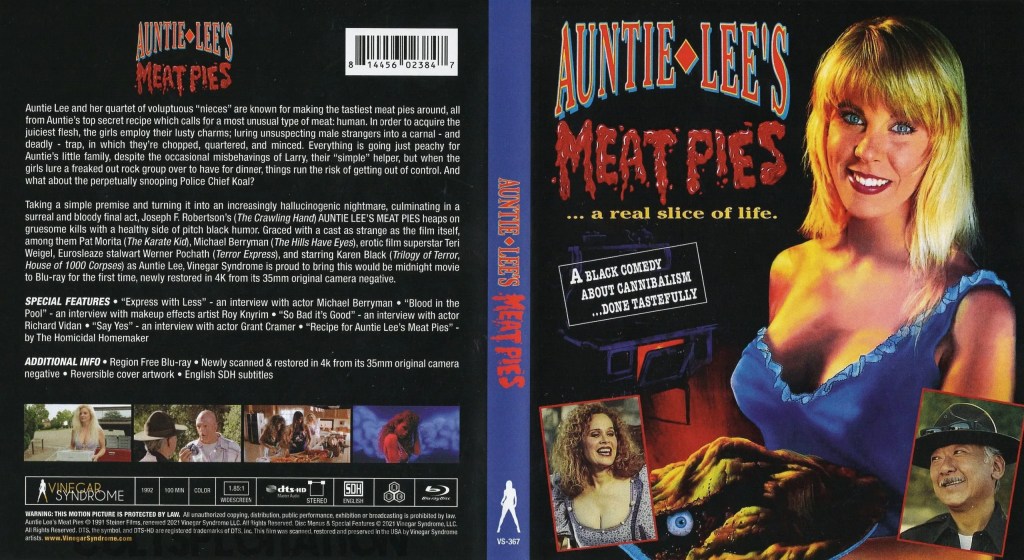
This is described on the cover of the Bluray disc as:
“A black comedy about cannibalism… done tastefully”

The particular genre of this little known 1992 film is “innocent cannibalism” – humans slaughtered and made into meat dishes for sale to unwitting customers; those customers thereby becoming the cannibals. It’s eternally fascinating, because everyone at one time has pulled something a bit lumpy or fibrous from their pie, hot dog or burger and wondered what (or who) that came from.
The plot is simple, even simplistic. Auntie Lee (the wonderful Karen Black) is a Satan-worshipper who sends her nubile nieces out to lure men back to the house/bakery (often by shooting out their tyres and then offering them a lift) where they are slaughtered in various grisly ways and then chopped up and made into pies, which are irresistibly delicious and widely sought after in the nearby restaurants.

This trope started with Sweeney Todd, the “Demon Barber of Fleet Street”, a crucial figure to modern cannibalism. There are those who argue that Sweeney really existed and was hanged outside Tyburn Prison in London in 1802. At any rate, his story was popularised in the 1846 “penny dreadful” A String of Pearls: a Romance (Prest, 2010) and remains enduringly popular. Sweeney in his early nineteenth century incarnation insouciantly slaughters his clients, dropping them through a trap-door and supplying their corpses to his partner, Mrs Lovett, to use in her popular meat pies, unwittingly setting a precedent for the industrial slaughter facilities that would proliferate in following years. The first movie version was a silent film in 1928, in which the whole narrative turned out to be a nightmare. A 1936 version showed Sweeney as a true hedonist, a man who just enjoyed killing and robbing his customers. Several remakes have happened since, most recently a musical by Tim Burton. A Danish adaptation called The Green Butchers with Mads Mikkelsen, who later played Hannibal in the eponymous television series, depicted unsuccessful butchers suddenly becoming wildly popular when they start serving human flesh. The 2021 French film Barbaque [Some Like it Rare] depicts French butchers hunting vegans whose flesh, unpolluted by animal products, turns out to be hugely popular with their customers.
Most recently, the Sweeney story has been reborn as a fictional “true-crime” podcast becoming a Broadway play, which in turn becomes a television series: the wonderful Horror of Dolores Roach, which I finished reviewing last week. Like Dolores Roach, Auntie Lee reverses the usual order of carnivorous virility—instead of the psychopathic male murderer (there is one, but he is dispatched quickly after raping one of the women), the killing is done by young, nubile women who lure men into traps which are increasingly intricate and gory. This is the monstrous-feminine – the male fear of what may happen when lust overcomes caution and the female reverses the birthing role and instead reabsorbs her victim.

The female killers are Playboy models, and were clearly chosen for talents other than their acting. However, other main characters are really good—Karen Black who has appeared in several horror B-movies is Auntie Lee, sending the girls out to bring home “the makings”, Pat Morita (Happy Days, Karate Kid) as the witless sheriff, and the inimitable Michael Berryman (One Flew Over the Cuckoo’s Nest (1975), The Hills Have Eyes), whose hypohidrotic ectodermal dysplasia gave him such an unusual appearance that he made a career from portraying everything from idiots to monsters.

Except for the wooden acting by the “nieces”, this is a well-acted, light-hearted if gory comedy, and many of the images are very striking.

At the end, after every man who enters the house is dead and being cooked, Auntie Lee and the nieces speculate about moving out of the town to New York City, where “we’ll never run out of beef”. In popular parlance, the brawny male is often called “beefsteak”, while sex is offered as a transaction, becoming almost indistinguishable from any other form of commodity, including feeding. As Coral says to the man she is leading to his death (using one of the most popular double entendres in Cannibal Studies):
“I can’t wait to have you inside me”
Such is the nature of modern capitalist cannibalism – the human is just another species, a resource like any other, potentially exploitable, vulnerable, even edible. Auntie Lee won’t cook Mormons or Californians, but New Yorkers are fair game, just as some people won’t eat pigs or dogs but will eat sheep or chickens. As Isaac Bashevis Singer said:
“As long as human beings will go on shedding the blood of animals, there will never be any peace.”
At the time of writing, the full movie is available on YouTube.
 The Cannibal Guy
Pingback: Meat is meat: THE MAD BUTCHER (Guido Zurli,1971) – The Cannibal Guy