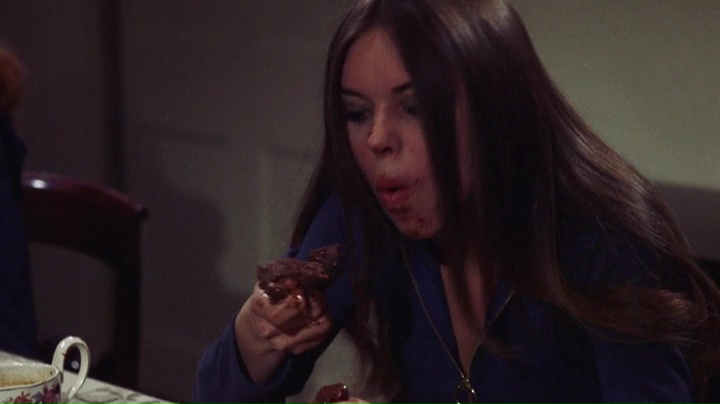
“What do you collect?” THE MAN WHO COLLECTED FOOD (Matthew Roth, 2010)

Written, directed and produced by Matthew Roth, The Man who Collected Food (also released as Cannibal Collector) is a parable of modern consumerist society.

Miguel (Mike N. Kelly) is the unexceptional, almost unnoticeable man next door (like most modern cannibals), who is quietly (or sometimes noisily) proud of his collection. What he collects is food, and he hoards it in cupboards and on display shelving. Like any serious collector (think of Barbie collections or comic books), it is definitely not for consumption.

He carefully stores his purchases in their original packaging, knowing that they would be ruined as collector’s items if he were to open them or, heaven forbid, eat them! Like any obsession, collecting takes over his life.

To survive without spoiling his collection, he eats people. He won’t open any of his food packets, but has a cold-room full of abducted humans, collected according to ethnicity, some already cooked, others tied and gagged and awaiting prep, which involves unfastening them and then chasing and killing them with various fun toys like mediaeval maces.

“Mother always told me to never play with my food. But I don’t think she know how much fun it really is.”

It’s just his quirk, and his neighbours are presented as even crazier than him. There’s the deer hunters, identical father and son in matching lumberjack plaid, and then there’s Kelvin, who runs around with a shotgun shooting at aliens (and who is covered in what he claims are bits of their green brains).

Kelvin sums up the film’s theme:

“I believe that there’s something a little strange in all of us. Whether we’d like to admit it or not, there’s just that one thing we don’t want anyone else to know about.”

Miguel attends a group therapy meeting for people with traumas and more common addictions like sex and cigarettes. He tells the group he collects food, which doesn’t seem that big a deal, until he adds,

“In order to keep my collection in mint condition, I have to resort to cannibalism.”

He tells them he can’t eat “animals” because they are food, and so belong in his collection. The facilitator asks him how that is logical, in that people are also food, at least to cannibals, but he points out that people are not food to other people.

“They don’t package or can people, if they had people-sized packages, then you’d have a better argument.”

She might have had better luck pointing out that people are animals too. Instead, she announces that they are all going to go to his home to open all his packets as therapy, and that makes him really mad. The middle of the film is a long, slow-motion sequence of him killing all the people in the group, and then the cleaner who finds the bodies.

His secret is discovered by the deer hunters who decide to hunt him, until he kills and eats them, then hears a phone message about a friend who keeps escaping death in various accidents and is called “the luckiest man in the world”.

Taking the essentialist argument seriously, Miguel decides that eating such a man might allow him to incorporate that luck, and finally find what he has been searching for: “that package of Ranch Wall Rice with Chicken and Vegetables”. Eating the “luckiest man in the world” will, he hopes, make him lucky.

Taking obsession to its logical conclusion, The Man Who Collected Food is a black comedy (or red comedy given the amounts of gore) with a serious message; a critique of modern consumerism.

“It’s all because I’m different. Sometimes I just wish I could collect comics or coins or anything – it has to be food, food, food!”

Our appetites are incited by marketing and advertising, while at the same time we are told that the Earth is being destroyed by our voracious cravings. We are insatiable, and yet we are ashamed of that. As Dylan said,

“If my thought-dreams could be seen, they’d probably put my head in a guillotine,
but it’s all right Ma, it’s life and life only!”

The script is somewhat feeble and the acting varies between wooden and histrionic. The film earned a respectable 71% “fresh” on Rotten Tomatoes, even though there are no reviews listed. But nonetheless, it’s entertaining and funny, the theme music by Daniel Alcheh is terrific, and the gore hounds will appreciate the amount of carnage. And it actually has a lot to say about obsession, greed, consumerist voracity, and the illogical cultural binaries of edibility and abhorrence. Worth a look, if you can find it.

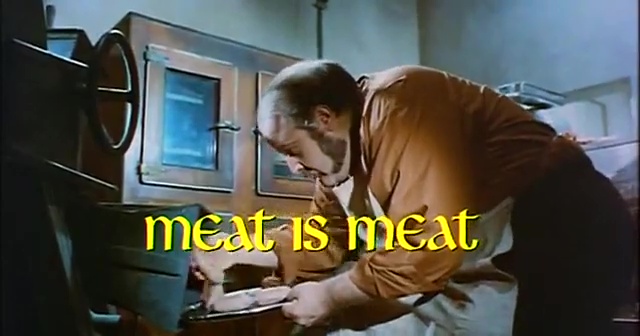
Meat is meat: THE MAD BUTCHER (Guido Zurli,1971)

Some months ago, I reviewed a film called Auntie Lee’s Meat Pies, in which I asked readers “What’s in your pie?” This film, The Mad Butcher (Lo strangolatore di Vienna), asks a far more profound question: “What’s in your sausage?” In each case, a better pronoun might have been “who”.

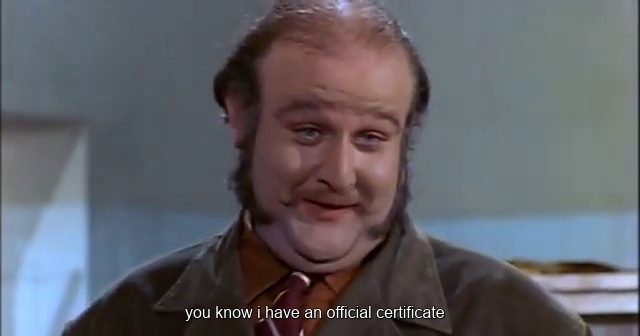
Guido Zurli was an Italian director but this film was made in English, set in Vienna and starred the wonderful, larger-than-life Hollywood actor Victor Buono, who plays the “Mad Butcher” of the title. In the USA, it was released as Meat is Meat, a better title IMHO – describing cannibals as “mad” is such a lazy approach, an intellectual shrug of avoidance. And to the butcher of this film, meat really is… just meat.

Otto (Buono) is dedicated to his calling – cutting up and selling animal flesh, and to him, the women he kills and minces are just that – meat. Otto has anger issues, which caused him to be confined to an asylum for three years, after slapping a customer with a piece of liver. But now he is being released, with an official certificate allowing him to say, “I’m not crazy now.”

His wife, who had had him committed (to save him going to jail, she claims) wants him to come home with her, worried about what the neighbours will say, but he wants to move into his butcher store where, he tells anyone who will listen, he is “the best butcher in Vienna”.

While throwing from his window the rubbish left by his wife’s brother who was running the store in his absence, Otto sees a neighbour as she showers, in silhouette. She looks, well, edible to him.

His wife catches him staring at the neighbour and, during the resulting row, he strangles her. At first horrified, he realises that there is only one way to get rid of the evidence. After that, he has to dispose of a sex worker brought home by the brother-in-law, and then the brother-in-law, who he has spent much of the film calling a “pig”. Well, he is a very popular butcher, the best in Vienna, and after all, as he opines, “I need this meat.”

But then, when he manages to abduct the neighbour (she of the long showers with the lights on and the blinds open), he has to deal with the American protagonist – a journalist who inexplicably is allowed to hang out with the police and investigate their cases. Otto rips off her clothes (there’s a lot of that sort of thing) and promises her

“I’m not just the best BUTCHER in Vienna!”

As the logline says, in one of those double-entendres that haunt cannibal movies, “His sausage was a cut above the others!

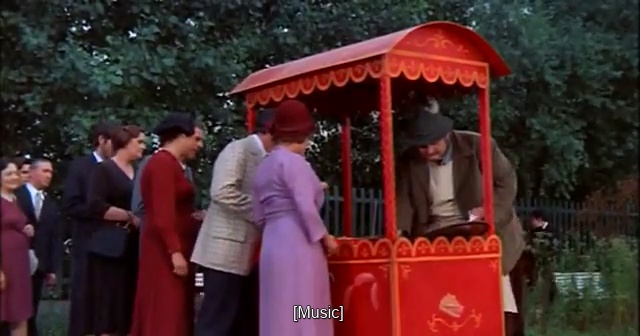
This is more black comedy than traditional horror – Otto relishes turning his customers into innocent cannibals. They, in turn, rave about his sausages, lining up to buy them from his push-cart in the park.

When his activities are disclosed, the police chief, who has been happily eating other animals all movie, is suddenly smitten by a serious bout of nausea.

“Those sausages that I ate! They were made of human flesh!”

The innocent cannibal theme has been popular since Sweeney Todd, who first appeared on film in 1928. Forty years earlier, Jack the Ripper had terrified the citizens of the heaving metropolis of London, brimming with workers drawn to the dark Satanic mills, driven into town by the centralisation of agriculture and the promise of gainful employment. Social cohesion seemed to be failing (isn’t it always?) and the cannibal was the figure who best represented the city as voracious beast. Henry James described London as “an ogress who devours human flesh to keep herself alive to do her tremendous work”. The “savage” of foreign climes who had so thrillingly filled the imaginative accounts of the colonial explorers had come home personfied as their own city, and the unknown faces dwelling within it were chief suspects. This was reflected in H.G. Wells’ first novel, The Time Machine, in which the proletariat, thousands of years in the future, have evolved into a highly technological cannibalistic tribe who feed off the soft, effete gentle people who are all that remain of the bourgeoisie.

Sweeney Todd took this to a new level, showing that even a “gentleman”, an apparently respectable member of society, could kill people. But Sweeney is never shown eating anyone; it is his customers, or the customers of his girlfriend who owns a pie-shop, who enjoy (immensely) the flesh of his victims. This could be done for revenge, as in the later, Tim Burton version of Sweeney, or for profit, particularly in times of shortage, such as Ulli Lomel’s Tenderness of Wolves concerning the German serial killer and cannibal Fritz Haarmann, who supplied meat of many species, particularly human, to his unwitting and grateful neighbours.

The outer limits of the world were still full of cannibalistic savages, but now they were in the same country – Texas Chain Saw Massacre featured a bunch of rednecks who captured tourists and fed them to other tourists (as well as catering to the extended family of course). But we were more worried about the cannibal in our midst, driven by the spectre of Ed Gein, an unassuming if eccentric man who dug up graves and used the bodies for ornaments, graduating into killing people and possibly feeding their flesh to neighbours as venison, an accurate term for animals hunted down for food and fun. A later version was Farmer Vincent in Motel Hell who collected tourists to serve in his motel, quoting his motto “meat’s meat and a man’s gotta eat!). Another slightly less light-hearted group of entrepreneurial cannibals like Vincent were the merry animal liberationists who farmed, milked, slaughtered and sold the flesh of those observed eating animals (to others who pay to eat animals) in The Farm.

Other films from all around the world feature butchers profitably selling human flesh for human consumption: The Butchers, Ebola Syndrome (from Hong Kong), Delicatessen from France, The Green Butchers from Denmark, and Barbaque (Some Like it Rare), also from France. In most of these films, the flesh of humans is found to be irresistibly delicious, until its provenance is discovered (although in Barbaque, only flesh from vegans has that special something). This is also the theme of Sweeney Todd even in the latest personification, The Horror of Delores Roach, in which New Yorkers line up around the block to buy the most delicious empanadas, unaware they are made of the chef’s landlord. Hitchcock had explored the same territory in 1959 with his episode called Specialty of the House, in which members of an exclusive men’s club crave the specialty “lamb Armistran”, which turns out to be the flesh of patrons who had enquired too deeply into the methods of the chef. Just so in this film, The Mad Butcher, which was the subject of this blog before I embarked on one of my legendary tangents.

Hannibal Lecter, untypically, did not eat humans because they were irresistibly delicious, but because they were another species of edible mammals, inferior to Hannibal the Übermensch and those few he considered his equals, no more or less acceptable morally and gustatorily than any other meat animal. Hannibal found amusement watching his guests enjoy his cooking, not because of the type of the meat, but because of his gastronomical skills. Hannibal’s meals were just as delicious whether filled with human, cow, pig, sheep, or anyone else. It’s the preparation, what Claude Lévi-Strauss called “the cultural transformation of the raw”. Hannibal refined the rude into delicious concoctions. Otto feels the same way about refining annoying people through the artistry of his butchery.

“Let me explain. Animals tear meat. Butchers carve.”

Rotten Tomatoes gives this film a solid 42%, based on the wordless review of one critic. I think as cannibal films go it would be forgettable, except for the amazing performance of the great Victor Buono, who turns it into a melodrama, or even a pantomime. It is, whatever its critical failings, very watchable and a lot of fun, and for those who are interested in such things, there is no gore but lots of meat, and lots of dresses being ripped from female bodies. To the protagonist, Otto, sex is one more appetite, like hunger, easily satisfied by violence, and not to be denied by the stultifying conventions of society.

If you speak Italian, the full movie can, at the time of writing, be seen at: https://ok.ru/video/1511628212842

Ladies that lunch: CANNIBAL GIRLS (Ivan Reitman, 1973)

Mention cannibalism in conversation (sorry, yes, I often do), and you will usually (in my experience) be met with either humour or revulsion and very often both at once. Ivan Reitman has wrestled with that paradox in this early movie – he went on to direct Meatballs, Stripes, Ghostbusters I and II, Twins, Kindergarten Cop, Dave and Junior. Great comedy classics, but none of them involved cannibalism, unfortunately.

This Canadian film employs the classic horror trope of the young couple lost or having car problems or, in this case, both at once. The couple are Clifford and Gloria, played with gusto by the very young and almost unrecognisable Eugene Levy (American Pie, Schitt’s Creek, most Christopher Guest movies) and Andrea Martin (My Big Fat Greek Wedding).

There’s the creepy gas station person, the corrupt cop, and a particularly unctuous reverend. When shown in the cinemas, there was apparently a bell that rang immediately preceding the gore to warn the squeamish to close their eyes. This was omitted in the version I watched, and with good reason – if you don’t know what to expect when a guy starts pulling on his clothes and a woman reaches for a sharp implement, then you are probably watching the wrong channel.

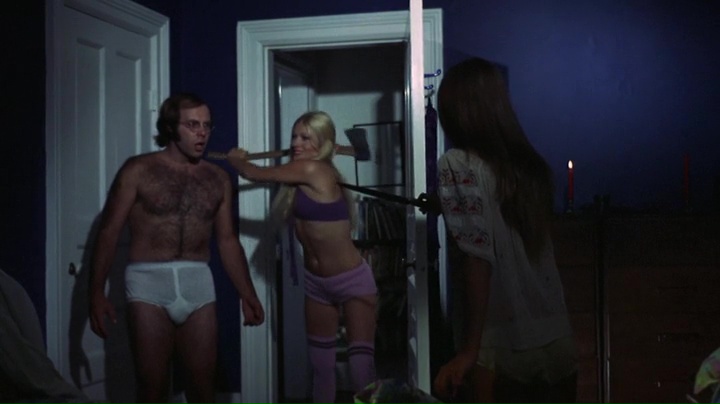
Then there’s the hotel of horrors, where the motel proprietor tells them the “legend of the three beautiful girls”, who lure men to their farmhouse, take them to bed, and then kill and eat them.

“Food can be a marvellous appetiser” one of them tells her chosen victim. The girls have a ritual – a dab of blood between the breasts and the incantation:

“Within me and without me, I honour this blood, which gives me life.”

There’s the wink to the audience as the butcher holds up a piece of meat and tells a customer: “Mrs Wilson, if it was any fresher, it would get up and tell you itself”.

And then, there are the cannibal girls of the title. Turns out they are, I dunno, maybe succubi? Anyway, they eat human flesh, drink blood, and live forever. And, we are told, they never get sick. They feed the reverend, who seems to be in charge of all this hocus pocus, on their blood, as they chant:

“We shall drink the blood of life, of life eternal, and we shall live forever.”

The problem here is that the film is trying to be a horror story and a comedy at the same time, and does OK at both, but brilliantly at neither. It was made on a low budget, not uncommon in cannibal movies, but, to make a long story short, the less the money, the greater the tendency to make a short story long. It drags a bit, and although there’s lots of blood and meat, there’s not much terror or humour.

But it does get to the point of cannibal stories – humans are edible, under the skin we are just another large mammal, and probably taste, as several cannibals report, somewhere between veal and pork. The movie reminds us of that sad truth with subtle hints like cows grazing beside the road, and a meat truck carrying some sort of mammal flesh to the local butcher.

Hard to build a whole horror show on that, so of course there has to be a supernatural element, based on traditional beliefs about capturing the strength, wisdom, skill or even soul of the one being eaten. You can trace this belief, or hope, in contested stories of cannibalism, such as the Fore tribe of PNG who ate their ancestors and acquired not strength or skill but a nasty shaking disease called Kuru. A popular version is the myth of the Wendigo, a spirit that inhabits humans and gives them an insatiable desire for human flesh, which makes them immortal and invulnerable – a topic covered rather nicely in the movie Ravenous.

These cannibal girls are not Wendigos – they are not particularly strong, just well armed, and are under the thrall of the reverend, who lives off their life forces and can hypnotise anyone with just a glance. Maybe he is some sort of evil spirit.

But real life cannibals do not gain strength from their meals, and they do not live forever. Jeffrey Dahmer hoped only to keep his boyfriends with him as zombie sex slaves, and eventually was beaten to death in prison. Ottis Toole died of cirrhosis of the liver, also in prison. In the final analysis, what cannibals eat is just meat, it has no magical powers, and usually results in legal trouble rather than invulnerability.

But it’s an entertaining enough movie, and after all the movies we have reviewed, it is a refreshing change to see some women tucking in to a bit of man-flesh.

That’s a carrot she’s peeling. Behave yourselves.