Texas embalmer cut off dead sex offender’s penis and stuffed it in his mouth

The ultimate story of our sins coming back to bite us?

Amber Paige Laudermilk, a 34-year-old licensed embalmer from Texas, has been accused of castrating the corpse of a sex offender.

Laudermilk is behind bars at the Harris County Jail after turning herself in on Tuesday. She’s been charged with Abuse of a Corpse – a felony – and remains in jail on a $5,000 bond.

According to a press release from Harris County Constable Alan Rosen, Laudermilk worked for Memorial Mortuary & Crematory and is accused of, in January 2025, “mutilating the body of a dead sex offender.”

The 58-year-old registered sex offender, Charles Roy Rodriguez, had received 10 years of Deferred Adjudication after being charged with Sexual Assault in 2001. Rodriguez died from natural causes in January.

Laudermilk’s alleged action, according to charging documents, was brought to the attention of the funeral director by two employees who said they witnessed the crime. One witness said they saw her stab Rodriguez’s body twice in the groin with a scalpel, before cutting off his penis, after learning Rodriguez was a sex offender.

She then “stuffed it in his mouth,” and allegedly told a trainee in the cremation room, who saw it happen, that they “didn’t see anything.” The witness reported that Laudermilk’s demeanour was threatening. When other employees went to see the body, Laudermilk allegedly covered his groin area with a sheet and said he had “a lot going on with him.”

Precinct One Constable Alan Rosen said in a statement:

“This case is about two troubled people: the victim who was a registered sex offender and the defendant, who is accused of viciously attacking his dead body. No matter what one thinks of his life, the law requires that he be treated with dignity in death.”

Laudermilk’s license was suspended by the Texas Funeral Service Commission, and the Memorial Mortuary & Crematory confirmed that Laudermilk is no longer employed by them.

In their statement, they said:

“We are deeply troubled and saddened by the unlawful and horrifying actions of this individual ex-employee. Our thoughts are with the family and loved ones of the deceased.”

Now, why is this story on a cannibalism blog, I hear you ask? Well, cannibalism is not just about swallowing another person’s flesh or organs. It is also an act of dominance, and often revenge or intimidation. Gerald Linderman in his book on Americans at war in WW2 writes that the Japanese would disembowel captured Americans and leave the bodies “with their severed genitals stuffed in their mouths.” Tim Blackmore, in his book detailing modern military technology and its dehumanising effects, comments,

“Where there was a tongue, now there is a useless penis, a double castration and silencing. Putting flesh in the mouth also suggests that the enemy can be eaten. Cannibalism makes the soldier strong at the attacker’s expense.”

So this was, in a way, the embalmer expressing her opinion, her freedom of speech, using a scalpel instead of a keyboard (which would have been protected by her First Amendment rights I guess). Plenty of written opinions deny the dignity or humanity of the person being described. Does a dead sex offender deserve “dignity in death”, even though he may have had little or none in life?

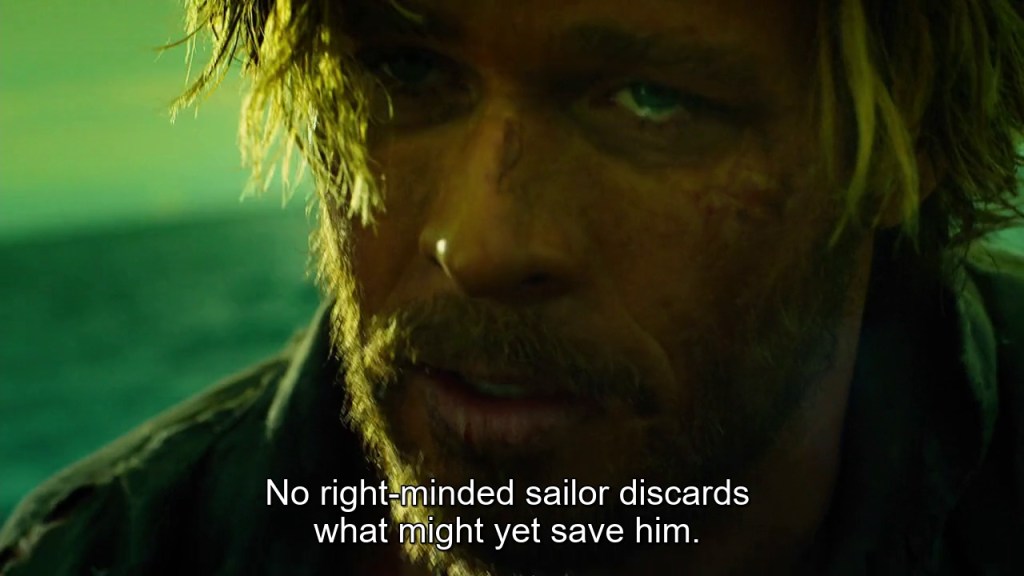
The fact is that the dead human is just meat. Starving survivors of catastrophes, ship wrecks or plane crashes quickly realise this and soon eat the dead and sometimes even the living – think the Donner Party. Remember the words of a famished Chris Hemsworth saying to his dying crewmen “No right minded sailor discards what might yet save him.” Or the debate in the crashed plane as a group of young men slowly starve to death surrounded by snap-frozen corpses:

“if the soul leaves the body when we die, then the body is just a carcass… What’s there in the snow is just meat, Antonio. Food.”

There are thousands of people dying of starvation every day around the globe, and what dignity do we offer them, even in their last moments of life? As for dignifying the dead, we casually torment, kill and then mutilate the corpses of billions of other animals every year for our food, our medical experiments, our clothing or our entertainment. Yet we are expected to weep for this sex offender’s insentient corpse?
Whales and cannibals: IN THE HEART OF THE SEA (Ron Howard, 2015)

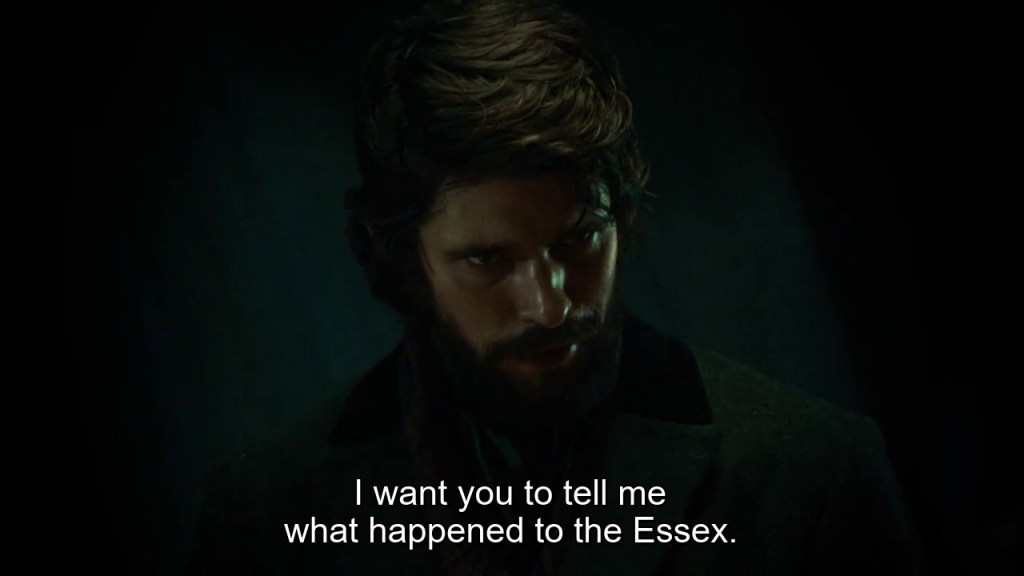
Herman Melville’s Moby Dick, the original ‘Great American Novel’, was based on the story of the Essex, a whaling ship that was destroyed by a bull sperm whale in 1820. The story of the wreck, and particularly the subsequent cannibalism that some of the survivors employed to survive, has largely faded from public knowledge (Moby Dick finished with the whale sinking the ship), but in the nineteenth century, every American child would have learnt about it at school, and this film starts with a young Melville (Ben Wishaw, who played a very different role in Perfume) seeking out the last survivor some decades later, hoping to get the full story to use in his novel.

This film is based on a meticulously researched 2000 book of the same name on the Essex disaster by Nathaniel Philbrick, which won him the National Book Award for Nonfiction in that year. Whaling was no more controversial in the early nineteenth century than crude oil in the early twentieth – it was used to power the factories and light up the cities of the world, and was worth a fortune. As the fleets decimated the whales near shore, the boats had to head further into, well, the heart of the sea, to find their victims. Whaling was, and remains, an incredibly brutal business, with small boats harpooning the giant mammals then drawing near and stabbing them to death. A successful kill was signalled by a plume of blood spurting out of the whale’s blowhole.

Whaling was a class-based system, with the captains drawn from the powerful old families in Nantucket, the tiny American island that was the centre of the industry. The main protagonist of the film is Owen Chase (Chris Hemsworth – the mighty Thor) as the first mate, who was refused the captaincy because he is socially inferior, an “off-islander”.

His best friend is the second mate Matthew Joy (Cillian Murphy from 28 Days Later). The Captain, George Pollard (Benjamin Walker from Abraham Lincoln: Vampire Hunter) is ineffectual but is from one of the original Nantucket families, and so has been promoted over Chase. In fact, the ships were run on strict class and race lines: the African-Americans and off-islanders lived in the Foc’s’le or front of the ship, where the food was inferior, and did the dirty work. The Nantucketers lived aft, and were fed and treated better. They were, in general, the ones that survived sinkings. Six African-Americans made it into the whaling boats – none survived. True Nantucketers were also mostly devout Quakers, pacifists who, however, saw no problem in killing magnificent whales and “raising bloody havoc at sea” as Philbrick put it. Class conflict is the basis of the story for the first half, before the angry whale comes along.

The story of the Essex is told to Melville by a decrepit old drunk who is the last remaining survivor, Thomas Nickerson (Brendan Gleeson, who was also in 28 Days Later). Nickerson had been a cabin boy (played by Tom Holland – Spiderman) when the boat sank. Nickerson did write an account of the events, but it was not discovered until 1980, so Melville did not in fact use his words. Chase’s brief account would have been the one known to Melville, who embroidered the conflict, as authors do, to make the whale white and almost supernatural, and avoided the controversy, not mentioning the cannibalism that resulted from the wrecking of the boat.

This does shed some light on the different reception of cannibalism over time. When the Essex set sail, cannibalism at sea after shipwrecks was not uncommon, and was generally considered embarrassing but necessary. The Monty Python team did a skit based on a version of this incident.

In the Heart of the Sea suggests a conspiracy by the whaling company to ignore the cannibalism as the presence at sea of a giant, angry whale would discourage further exploration, but Chase and Pollard refuse to cooperate. By Melville’s time, cannibalism was too graphic for his potential audience (he wanted to sell books after all). In our time, the great white whale is still of interest, in that he represents nature fighting back against human rapaciousness, but the real point of this film is now the cannibalism. Would anyone go to see a movie about a shipwreck if Thor didn’t eat anyone?

Or even if he did. The film’s tagline was “Based on the incredible true story that inspired Moby-Dick”, which did not inspire enough people to see it – it grossed $93 million, which sounds great until you see that it’s budget was $100 million. It scored a paltry 42% on Rotten Tomatoes, with the Seattle Times critic summarising it as:

“Thor and Spider-Man fight a whale.”

Despite some critics seeing the movie as over-long and dull, the scenes at sea are full of action (if not exactly Pirates of the Caribbean) and very well done, and the special effects are spectacular, especially the whales and the sails, and the whales demolishing the sails (you can guess which side I was on).

But as Philbrick wrote in his book,

The Essex disaster is not a tale of adventure. It is a tragedy that happens to be one of the greatest true stories ever told. (p.236)

The halfway point of a movie is usually the turning point in some form, and it certainly is here – in the middle of the film, in the middle of the Pacific, they finally find an abundance of whales, including the great white whale that they were warned about on a stop in Ecuador. He charges the ship, staves in the side, the whale oil they had collected goes up in flames, and they have to abandon ship and fit as much food as they can (which isn’t much) into their little whaling boats.

The rest of the movie is all about how some (a few) of them survived the long voyage of 4,500 nautical miles back to South America. They reach a small but uninhabitable island, and the white whale makes them welcome by tipping over their boats as they head for the beach. Chase and the Captain abandon their class struggle to engage in dialogue about anthropocentric carnivorous virility instead.

Pollard answers with presupposed anthropocentric arrogance.

“We are supreme creatures, made in God’s own likeness. Earthly kings, whose business it is to circumnavigate the planet bestowed to us…”

The island cannot sustain them – they find the skeletons of a previous party that took shelter there, so repair the boats and head off again for another agonising trip across the endless ocean. After 48 days stranded, with almost no food or water, one of the sailors on Chase’s boat dies. The others prepare to toss him overboard, but Chase stops them. It’s all handled quite delicately, but it’s definitely become a cannibal movie.

“We prepared the body. We removed the organs. Separated his limbs from his body and cut all the flesh from the bones.”

In the other boat, no one dies so conveniently, so they draw straws for a victim. The captain gets the short straw, but his cousin cannot shoot him and shoots himself instead, keeping the catering in the family.

The whale comes back, but he and Chase exchange a look, and Chase cannot bring himself to kill the magnificent bull.

After ninety days at sea, the survivors reached South America. According to the book, a boat that drew up alongside saw two men sucking the marrow from the bones of the dead, refusing to give them up. Unlike some survivor cannibal stories such as Alive, where the actors looked pretty much the same weight at the end of the ordeal, Hemsworth reported that the cast were put on a strict ration of 500–600 calories a day, and he lost 40 pounds (18kg), giving him a reasonable idea of what the sailors had gone through.

What the film doesn’t mention is that the survivors could have had a much easier time of it if they had headed not for South America but west toward the Marquesas Islands, only 1,200 miles away. They chose not to do so, because of earlier reports that the natives were, yep, cannibals. One mariner, Georg von Langsdorff, had written in 1804 that the natives so loved human flesh that “those who have once eaten it can with difficulty abstain from it.” Of course, it was all nonsense.

Instead, they headed east, and ended up eating each other.