More words have been written about The Odyssey than most movies, because it has the attraction of being both a grandiose blockbuster told with the complexity and brilliance that is the signature of Christopher Nolan (Dark Knight trilogy, Oppenheimer, and many more), as well as a reinterpretation of one of the most important classics of Western civilisation. Most critics seem to love it, some hate it, and others nitpick over issues like the use of modern slang and obscenities, while ignoring the fact that the characters are speaking modern English instead of ancient Greek. Or the fact that the Wooden Horse was not mentioned in Homer’s telling of the Trojan war (The Iliad) and mentioned only briefly in The Odyssey; most of the detail came from Vergil’s The Aeneid, which was written some 700 years after Homer.
Luckily, writing a blog on cannibalism means never having to worry about stuff like that – all that matters is who gets eaten, by whom, and what it means, which is pretty subjective (like everything else in literature). Mythology is full of cannibals, and the Greeks had more than their fair share, for example the revenge cannibalism of Thyestes unknowingly eating the flesh of his sons served to him by his brother Atreus. Cannibalism is an unmatched method of revenge because not only is the victim killed, but is then reborn as excrement, the ultimate degradation. Shakespeare used revenge cannibalism with gusto in his play Titus Andronicus.
In the case of The Odyssey, there are two narratives of cannibalism, only one of which Nolan bothers to show us.
Odysseus, the King of Ithica, is trying to get home from the destruction of the great city of Troy, an orgy of destruction, rape and slaughter that has left him racked with guilt. Not so easy in a sailboat travelling through largely uncharted seas. He and his army land on an island populated by the cyclopes, literally “round eyes”, shepherd giants with one large eye in the middle of their foreheads. The cave the Greeks blunder into seeking provisions is the home of the cyclops Polyphemus, who is a son of the sea god Poseidon and Thoösa, the sea nymph daughter of the primordial sea god Phorcys, neither of whom are gods you want to upset if you’re trying to sail home without a good GPS. Polyphemus likes the Greeks a lot; he eats them with gusto, as Homer puts it:
He dashed their heads against the floor as though they had been puppies. Their brains ran out on the ground and soaked the earth. Limb by limb he tore them to pieces to make his meal, which he devoured like a mountain lion, never pausing till entrails and flesh, marrow and bones, were all consumed.
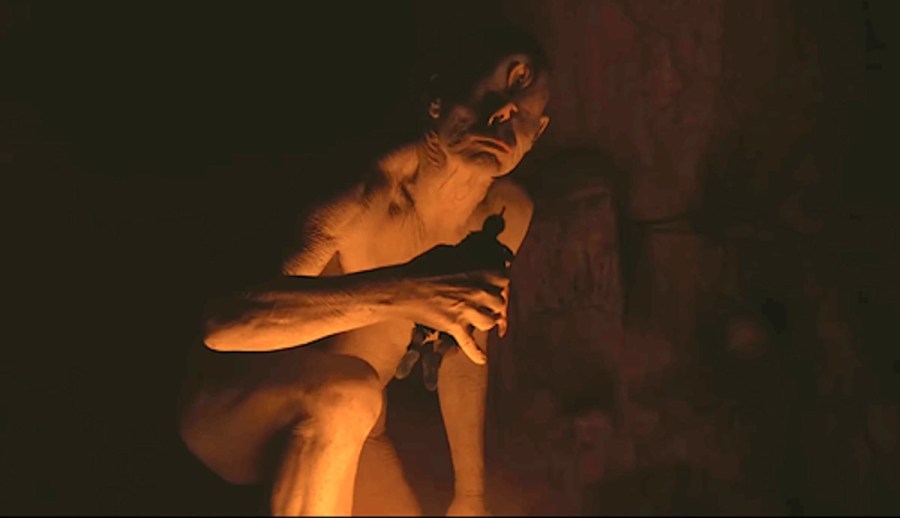
Nolan, who seems to avoid computer graphics, used a 60-foot animatronic puppet, forced-perspective framing, and full-body performance capture to show Polyphemus and, IMHO, it’s one of the highlights of the film. Odysseus and his men blind the cyclops (which admittedly is half as hard as blinding a giant with two eyes) and the distraught Polyphemus, after hurling rocks at the departing boats, prays to his father Poseidon to avenge him, meaning that this voyage is going to be much more difficult and take a lot longer than even the three-hour film makes it seem.
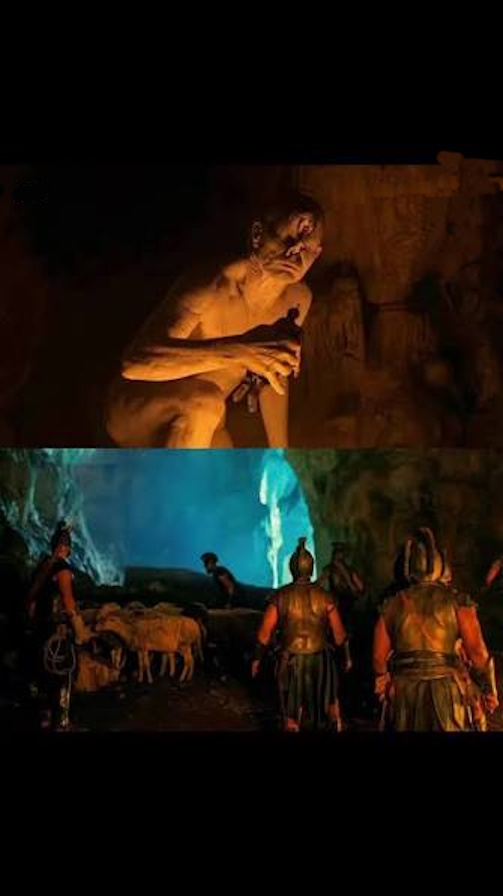
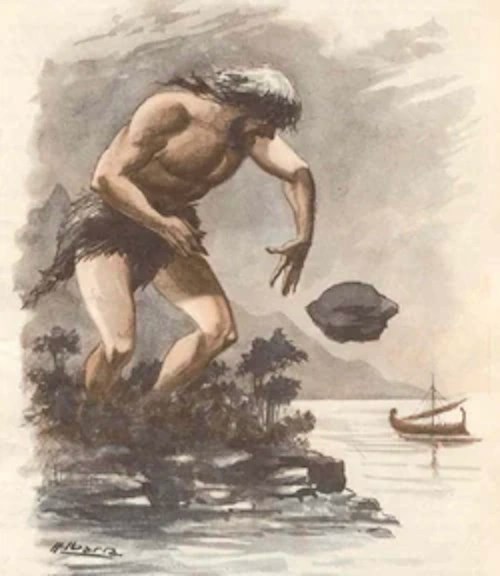
The Greeks land on another island; this time inhabited not by solitary sheepherders like Polyphemus but a race of giants called the Laestrygonians, who are not nearly so pleased to see them. In Homer’s original version, Odysseus sends three scouts, one of whom is rapidly digested before the giants head to the hills where they keep a handy supply of boulders, which they hurl down until they have destroyed all the Greek ships except that of Odysseus, proceeding to spear the Greek soldiers like fish before having a beach barbecue.
In the film, the Laestrygonians are presented as giants (but not as big as Polyphemus apparently) and mysteriously clad in mediaeval armour. Alas, Nolan does not show us the fate of the slaughtered Greeks, but those of us who read Homer or glance at the internet know that they are certainly on the menu.
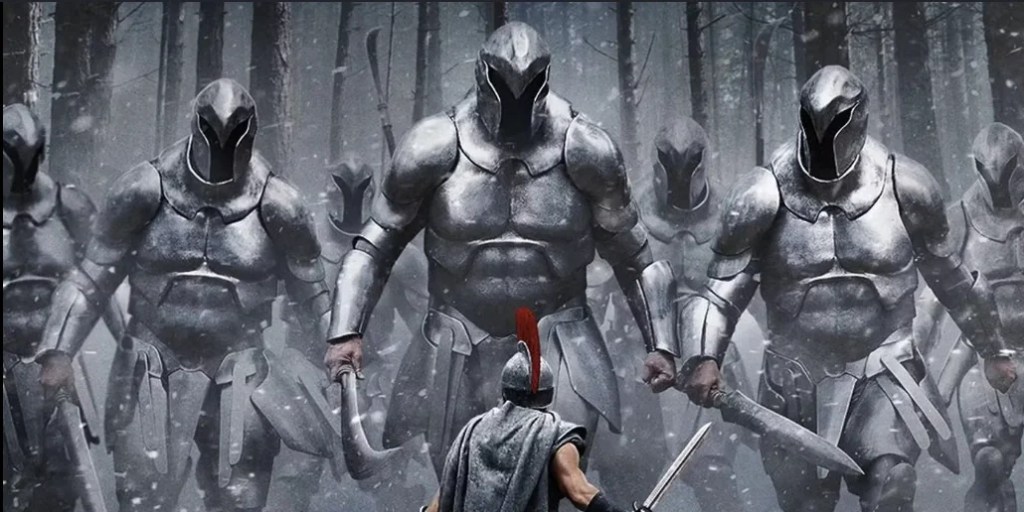
Various other sea monsters eat crew members as the voyage continues interminably, but we’ll concentrate on the incidents above, as the cannibals depicted are at least humanoid, if somewhat larger than life. What the cyclopes and Laestrygonians have in common is their size. Very few depictions of cannibals show small, meek perps, although in reality many cannibals have been quite diminutive, making up in ruthlessness for their meagre size. Think of Ottis Toole or Issei Sagawa. It is perhaps difficult to persuade people to be scared of pint-sized villains, especially in the relatively short time allowed a movie, so monsters are almost always large and intimidating. One of the main precepts of Greek civilisation, as we are told several times in the film, is hospitality to the stranger (xenia or Zeus’s Law), and both Polyphemus and the shiny knights are entirely lacking in that virtue. I guess the men and boys who sought comfort in the home of Jeffrey Dahmer might agree that lack of hospitality seems basic to cannibalism.
The differences between Homer’s cannibals are more interesting though. The cyclopes are isolated outsiders, pastoralists who herd sheep and eat them (and any people that wander by), and do not seem to engage in poetry or philosophy or young boys the way the ancient Greeks did, and therefore, from the point of view of the Greeks, they are uncivilised. In fact, it is debateable whether the cyclops is technically a cannibal (defined as a human who eats other humans), as he appeared to be some other species (a giant with a single eye), but he speaks good Greek (at least in Homer’s version) and so at very least seems to possess what Aristotle called the “rational principle”, as well as a powerful appreciation of carnivorous virility – domination through consumption. Like most cannibals, they are depicted as outsiders who threaten the assumed boundaries of social and symbolic orders. The classical “anthropophagus” (the word “cannibal” had to wait for the Spanish to adapt it from the Antilles in the sixteenth century) was, like Polyphemus, a hybrid human/animal monster—a warning against the dangers of straying from the sovereign and the church. The cyclops has one eye because he has no perspective – social, cultural or ethical.
The Laestrygonians, on the other hand, are a highly organised community, able to buckle on their armour at a moment’s notice (unless perhaps they sit around in it, waiting for scrumptious strangers to appear). In their anonymity and well-drilled efficiency, they are the picture of totalitarian society – identical, disciplined, totally intolerant of outsiders (except for dinner). They appear to be a fascist league, armed and violent.
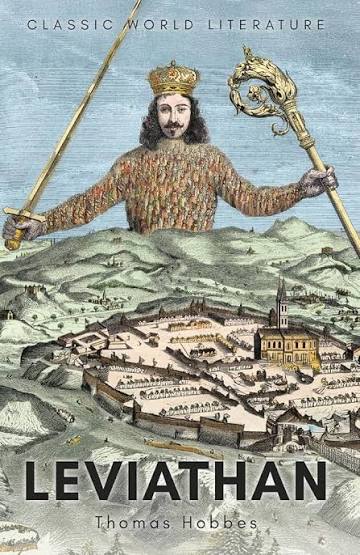
Thomas Hobbes in his famous work Leviathan warned against rejection of the social order. Without civilisation and a strong central authority, a sovereign, we would live in what he called a “state of nature”, which he described as a “war of all against all”. The human response is to declare war on nature and try to dominate it, overcoming our biological weakness and vulnerability by banding together like Laestrygonians. As Odysseus warns the freeloading suitors in his house, foretelling their sudden change of fortune and mortal existence,
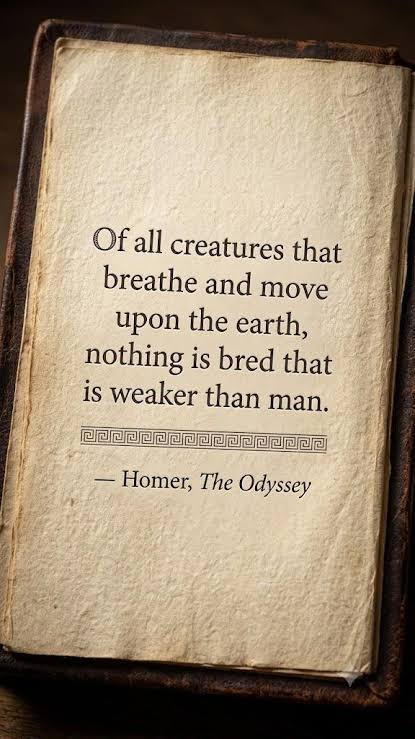
In Hobbes’ state of nature, there would be no culture, no industry, no buildings, no science, no arts, and:
“which is worst of all, continual fear, and danger of violent death; and the life of man, solitary, poor, nasty, brutish, and short.”
This is an accurate portrait of the cyclops, lonely, violent and brutish, in his cave reeking of death. But the Laestrygonians go to the opposite extreme, where there is no room for difference or dissent. They, like us trying to control the environment, use technology and strategic cooperation to enforce their wills. They do not ask who the Greeks are, what they need, or whether they come as a threat – they slaughter them and eat them just for the crime of being on their land, the way the Nazis killed Jews and Roma for daring to exist. The absolute sovereignty of Hobbes’ Leviathan may be no more civilised than that of the ant colony that attacks any prey within its reach. Their cannibalism is simply the resolution of difference.
Cannibal stories from Homer onward reveal as much about the victims as the perpetrators. They demonstrate that we are all flesh, at our most physical and animalistic at the time of death and consumption, be that consumption by worms, cyclopes, Laestrygonians or the seemingly innocuous cannibal next door. We can be slaughtered like puppies, consumed as if by a lion, and our integrity and transcendence is contradicted by being split and ruptured—our brains gush, our entrails, flesh and bones and marrow are revealed as common comestibles. Like all animals, we eat and try to avoid being eaten. But unlike nature, which as Tennyson said is “red in tooth and claw”, we can elect to make ethical choices.