Screams, smashed skulls, flying flesh were not what villagers of an Uttar Pradesh village expected on a quiet Monday morning when a 30-year-old labourer brutally murdered his wife and mother on the rooftop of his house and then chewed flesh from their smashed skulls as his neighbours watched.
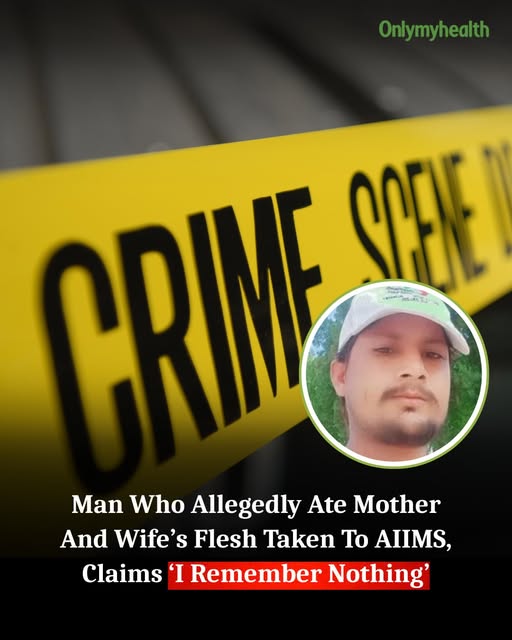
A 30-year-old man was arrested on 12 January 2026 in Kushinagar’s Parsa village for the double murder of his mother and wife. The suspect, who has been identified as Sikandar Gupta, had returned to the village about a month previously after working as a labourer in Mumbai. According to police reports, the victims were identified as his wife, Priyanka (28), and his mother, Runa Devi (60). Gupta initially attacked the victims with wooden sticks, and then with cement bricks, causing fatal head injuries to them.
Local residents rushed to the scene as the screams of the women echoed through the neighbourhood. Witnesses reported seeing Gupta mutilate the bodies and consume portions of the remains. When the crowd attempted to stop him, Gupta began throwing pieces of debris and human flesh at them, which caused widespread panic until the Ahirauli police arrived to detain him.
Kushinagar Superintendent of Police, Keshav Mishra, said that,
“a case of double murder was registered, and police are also examining the accused’s mental condition as part of the investigation.”
Neighbours informed police that Gupta had a history of substance abuse involving alcohol and cannabis and was known for frequent domestic disputes. The accused remains in custody pending a formal psychiatric evaluation to determine if he is fit to stand trial or if the murders were the result of a total psychological collapse.
Gupta has been admitted to the Psychiatry Department at AIIMS (All India Institutes of Medical Sciences) under police custody. According to reports, Gupta is speaking incoherently, at times claiming he was drunk during the incident and at other times saying he does not remember anything at all. Doctors have sedated him due to aggressive behaviour and are closely monitoring his condition.
Experts suggest the violence points to deep-seated psychological issues. Dr. PK Khattri, a senior clinical psychologist in Lucknow, said that Gupta’s agitated and non-communicative behaviour “points toward a severe psychotic break” that led to cannibalism.
As Dr Watson used to say, “No shit, Sherlock!”
Ashok Srivastava, an independent criminologist and an associate of the National Forensic Sciences University (NFSU), said that such extreme acts often stem from a
“desire for total domination”
He added that this type of behaviour represents an “ultimate expression of control, often triggered by internal frustrations or extreme psychopathology.”
Which could be said of human societies generally. From bullying in school to sexual abuse to war atrocities to the commercially pressured obsession with eating the flesh of other animals, appetites are driven by this “desire for total domination”, of territory, of food, and of the bodies of others. Anthropocentrism, sometimes called speciesism, is maintained by the practice of killing other animals in ever increasing numbers, to prove our superiority and deny our own animality and mortality. The French philosopher Jacques Derrida called that “carnivorous virility”, the sacrificial slaughter and consumption of “inferior” animals by the rational, patriarchal civilised meat-eater.
What happens when the lust to dominate or kill outruns the limits of anthropocentrism and is instead turned back on fellow humans? The biological fact is that humans are animals, and animals are made of meat. When a society reaches a point where the old ethical agreements are disintegrating, it can either forge new ones or dissolve into chaos, war and, yes, cannibalism. The psychopath, such as the one in this case who allegedly started his brutal rampage with domestic violence before turning to murder and flesh eating, seems to understand this better than most ‘sane’ people.
First things first, and this is a first – the first time THECANNIBALGUY.COM has reviewed a Welsh film. They are not as rare as we imagine (particularly in Wales) but the fortunate coincidence of Welsh language and cannibalism has not raised its head before. Luckily, this one makes up for lost time – Dread Central called it
“a delightful, sumptuous dish from start to finish”
And that is exactly what we are served – a fancy dinner party in which the hired help, Cadi (Annes Elwy) has a lot more to offer than just laying the table and preparing the feast. The feast is to be held in the Welsh mountain home of a rich family who clearly owe their fortune to outrages against the environment. They have invited a sleazy businessman, Euros (Rhodri Meilir), who has been drilling for oil on their land.
The film opens with the contrast of the green fields (and how green is Wales!) being penetrated, raped, by a giant exploration-drilling rig. A man standing next to the machine is then seen staggering through the fields, only to collapse with blood streaming from his ears.
This is a cannibalism blog, and the cannibalism takes place near the end of the film, so I apologise for spoilers. The Feast is on Hulu or available for purchase or rent on the usual platforms, so if you’re going to watch it, and don’t like spoilers, go and watch it then come back (please) for my analysis. Then again, the Director recommends watching it several times, saying you’ll get more out of it each time. So it is not really a mystery, more a mood piece, and knowing what is going to happen may actually enhance the enjoyment of the story.
Cadi as a hired kitchen hand is the epitome of the saying “you can’t get good help anymore” taking ages to actually do any work, and getting it all wrong – she knows nothing of human etiquette. Turns out she is a nature goddess, disturbed by the drilling, taking the body of a woman who has just drowned, and she knows the humans in that house are up to no good. She is badly frightened by the sound of the father, the local (and clearly corrupt) politician, shooting rabbits. Her hands excrete mud, and she stains the pure white tablecloth she has just laid out; messy nature is invading the stark and sterile human house. When he brings the rabbits for her to skin, she flees into the fields, where one of the sons tells her that’s why his father likes to come back to Wales from Parliamentary duties in London.
The MP’s wife Glenda (Nia Roberts) takes over the skinning of the rabbits, much to Cadi’s disgust. Nature, as Tennyson told us, is red in tooth and claw, and rabbits routinely come to a sticky end by way of fox or disease or trap. But Cadi, who it seems is not too worried by bloodshed when it comes to humans, is horrified not at the slaughter and plunder, but at the use of technology to do it – guns, oil rigs. Nothing natural enters this human world, because civilisation, in its modern technological form of patriarchal capitalism, is built on the rejection of animality and domination of nature.
The man most guilty is Euros (Rhodri Meilir), an oil driller who is hoping to use the dinner party to persuade the family’s neighbours to allow drilling on their land. Euros arrives in his fancy car and admonishes Cadi for slacking off, whereupon he drops (perhaps with her magical intervention) a bottle of expensive wine. Told to clean it up, Cadi tastes the wine on the driveway and then inserts a piece of the broken bottle in her vagina, with no sign of any discomfort. This acts as a vagina dentata; she subsequently uses it to kill one of the sons by offering him sex.
He’s the one who had left medical school to prepare for a triathlon, part of his training involving eating nothing but raw meat. And he’s not the weirdest person there. Nor is his the most gruesome death.
Some people don’t like subtitles, but generally hearing the words in another language adds a dimension, a music or poetry, and this film would not have been as powerful in English, even though the patriarch is an MP who spends most of his time in London. As the Director put it,
“Our culture’s incredibly rich in terms of myths and legends.”
The film adapts various Welsh folk legends. One is the story of Blodeuwedd, who was made of flowers by two magicians in order to help their protégé, Lleu Llaw Gyffes, who’d been cursed by his mother never to take a human wife. Jones explained:
“This wizard harnessed the forces of nature and put her in a body of flesh and blood. But, of course, Blodeuwedd was very frustrated by that, and therefore decided to get her revenge. The character of Blodeuwedd is very definitely in the DNA of Cadi.”
The drilling site is called “The Rise”, a burial site that is considered sacred, although modern, rationalist people like Glenda scoff at this, claiming it was just a way to frighten children away from the fields. But Cadi is the goddess who was resting in The Rise, and they have disturbed her. She is out for revenge.
Freud wrote about the “death drive” which propels all life in the direction of death, a return to its original organic form. In The Future of an Illusion, he described how humans connect this death drive to nature, which is interpreted as the enemy of civilisation. Humanity therefore fights an unremitting war with nature, seen as the cause of the excruciating “riddle of death”, a war in which we may win every battle but, as mortals, we must lose the war.
“Human beings are so radically estranged from themselves and from nature that they know only how to use and harm each other.”
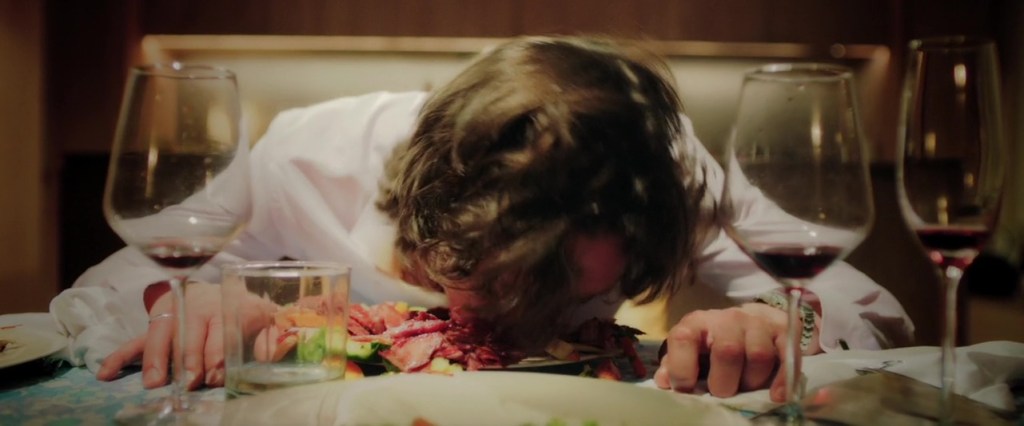
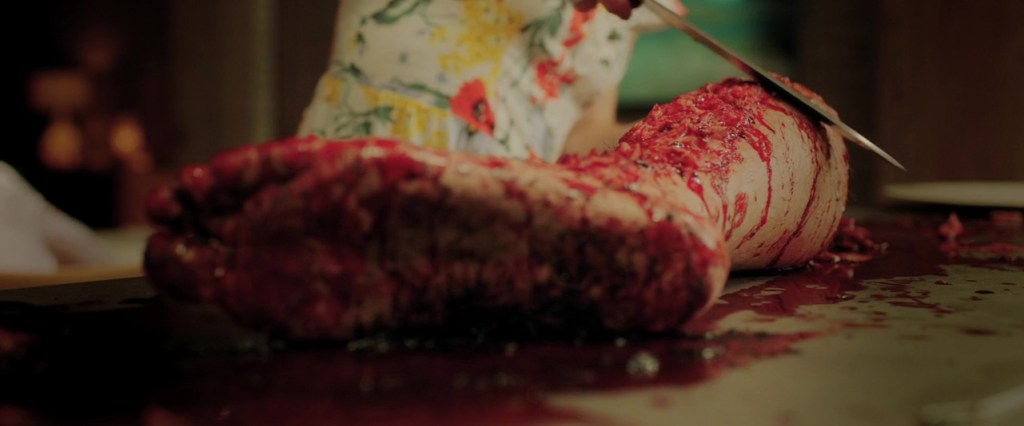
Humans invented the “seven deadly sins” to judge themselves and others. So now Cadi, or the goddess who controls her body, judges and executes judgement on the family according to their sins. The father represents greed (taking bribes even though he is already rich), the mother exhibits envy, trying to bully her friend, who is content being a simple farmer, into giving in to the oil company’s plans, and the sons exhibit wrath and lust (one is a drug addict who is furious with his family for confining him in the country, and the other has been fired from the hospital for raping sedated patients). Then there is Eunos, the skinny man who offers the perfect image of gluttony; the corrupt capitalist is voraciously eating everything left on their plates, his face plunged into the food, not bothering with cutlery. The mother, in a trance, butchers her son’s body and puts slices of his leg in front of the insatiable Eunos, who gobbles them down. This is the “feast” of the title, and it’s the last supper for that family.
Eunos falls into food catalepsy, and when he awakes, Glenda has a shotgun pointed into his mouth, and asks him the question that sums up the film, our society, Western civilisation and the era that has come to be called the Anthropocene.
“After you’ve taken everything, what will be left?”
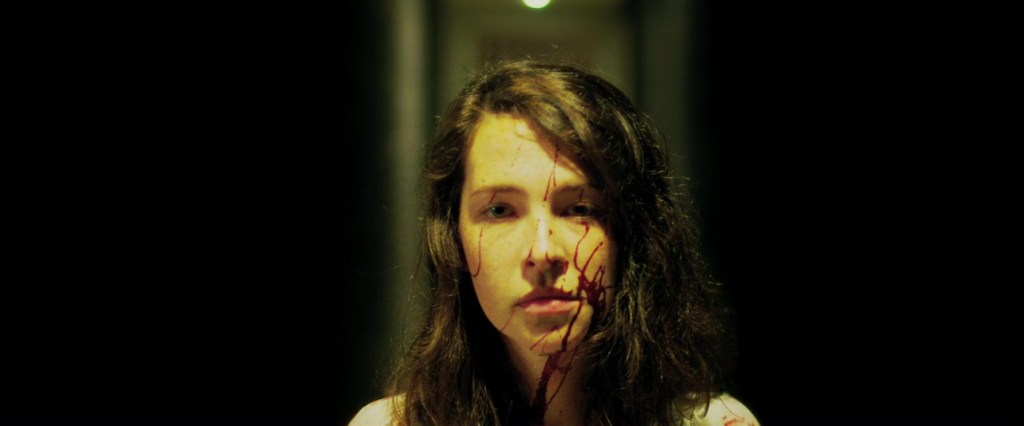
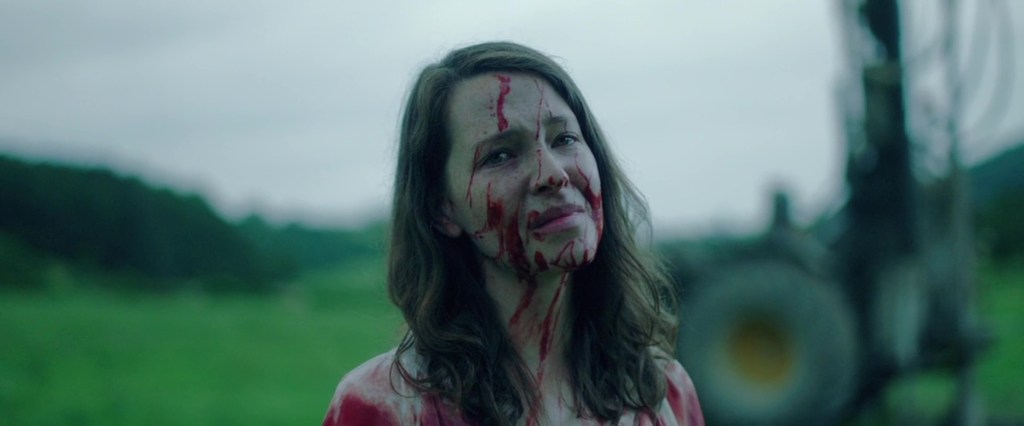
The final scene of the film is a tour de force by Annes Elwy, no longer Cadi but now the goddess, covered in blood, at first smiling at her triumph, but then sinking into grief at the prospect that the war will continue until either humanity or nature (including us) is destroyed utterly.
Like Helen Mirren in The Cook, The Thief, His Wife and Her Lover, she is looking directly at us, the viewers, accusing us of complicity, both in the war and the cannibal feast.
The film scored a very respectable 82% on Rotten Tomatoes, meaning that four times more critics liked it than didn’t. Those who didn’t carped about it being slow in the first half, a criticism that is often levelled at movies sold as horror but offering more intelligent themes than just slasher gore. The acting is superb, the photography is stunning, particularly of the natural environment and the contrast with the stark family home, and the soundtrack is never less than interesting, and often (especially the Welsh songs) quite enchanting. Well worth seeing, and perhaps, as the Director suggests, more than once.







 The Cannibal Guy