California Cannibalism: man arrested after reportedly eating a severed human leg

A man was arrested on Friday March 22 in Kern County (north of Los Angeles in the San Joaquin Valley) and charged with the “removal of human remains from other than a cemetary” (sic) according to the Sheriff’s office.

Construction workers in Wasco reported seeing the man near the Amtrak station.

“I’m not sure from where, but he walked this way and he was waving a person’s leg. And he started chewing on it over there, he was biting it and he was hitting it against the wall and everything.”

It seems a pedestrian (unidentified so far, some reports say male, others female) was killed by a train on Friday morning near 7th and G streets in Wasco. According to eyewitnesses, a man was subsequently seen eating a human leg that had been torn off in the accident.

The video shows the man in a red hoodie and black pants bending over something. He turns around and laughs at the person taking the video and then walks away. Shortly afterwards, the video shows the police responding and the man waving the leg at the officers.

A voice can be heard on the video saying, “He’s eating that shit!” in English and then in Spanish. Most of the news reports edit out the parts where it looks like he might be eating the leg.

Other news footage from KERO-TV showed what appeared to be bloodstains on the sidewalk at the scene of the incident. Some reports say he was charged with mutilating the body, supporting claims that he had consumed some of the limb.

The sheriff’s office later confirmed that they had arrested the man and identified him as 27-year-old Resendo Tellez. He was charged with six offences including possession of controlled substance paraphernalia.

Social media commentary varied from reflecting on drugs, homelessness and poverty to accusations of demonic possession and culture war accusations against California liberals allowing a “breakdown of societal norms”. One headline stated, “Cannibals Are Alive and Well in Newsom’s California.”

News footage of the story often contains warnings of “distressing material” and in most cases blur the leg when showing the video. Is there something weird about all this shock and horror?

If the same person had not been hit by a train, it would have been perfectly normal to show that person’s leg in a program on, say, beach holidays. On a porn site, the leg would have been the least of what we might have seen. Yet once detached from the torso, a human limb becomes so abject it must be blurred, and even then, warnings issued. The reason seems to be that we are terrified to admit our animality. We can go to a supermarket and push a trolley around containing the leg of a cow or a lamb, with the overt understanding that we will be eating it later, just as Tellez allegedly did with what he identified as a piece of meat lying on the ground. Yet because it is a human body part, it becomes obscene, repulsive, horrifying, because it reminds us that we, too, are mortal, edible animals, made of meat.

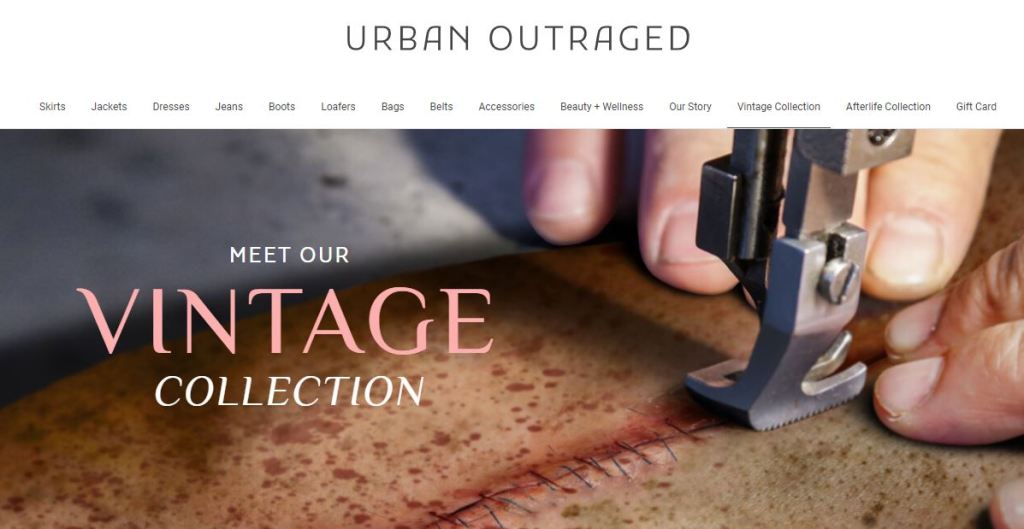
Skin in the Game: PETA’s URBAN OUTRAGED campaign, 2021

https://www.urbanoutraged.com/

This website purports to sell leather goods: shoes, belts, coats, etc., all made from human body parts. And like many websites in this competitive time, they offer free shipping!

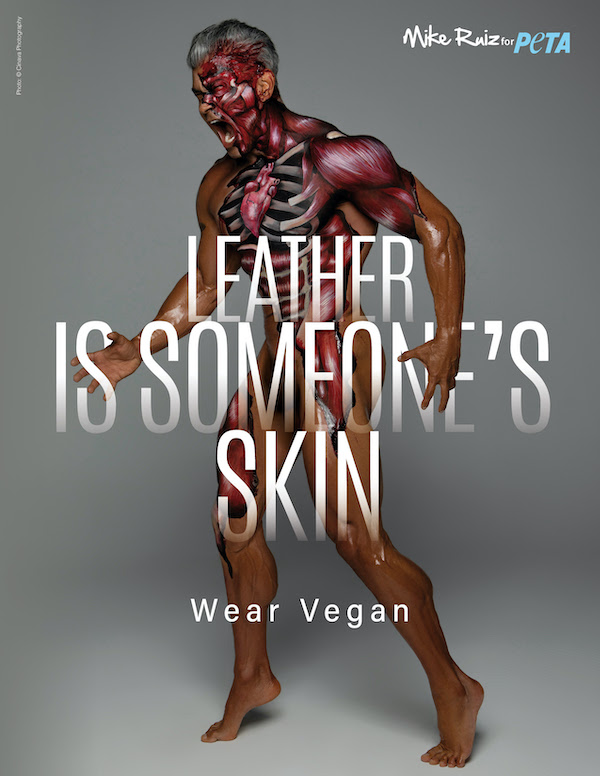
The campaign is from PETA (People for the Ethical Treatment of Animals) and started back in June with a poster from celebrity photographer Mike Ruiz, who has photographed Kim Kardashian, Ricky Martin, Katy Perry, and Paris Hilton, as well as being a judge at America’s Next Top Model and RuPaul’s Drag Race.

PETA’s press release stated that leather production isn’t just cruel, but also contributes to the climate crisis, releasing hazardous chemicals. The World Bank has also cited cattle ranching as one of the largest drivers of deforestation in the Brazilian Amazon. Farming, transporting and killing animals for meat and leather is responsible for a very large proportion of global greenhouse emissions.

Here’s the poster near Penn Station in New York.

On the Urban Outraged website, the items for “sale” reveal human faces, human teeth, and oozing blood. Each item is named after an individual who was “killed” for it and is “reviewed” by customers. (“I’m not really a boot person, but I’m glad Meg was, because these are the best boots I’ve ever worn.”). Users can even send a fake “gift card” to their friends’ emails using the form on the last page.

After the initial page, the website gets deadly serious and asks:

Why is it OK to raise sheep just to shear off their wool?
Why is it OK to kill a cow for leather?
Why aren’t you horrified by what’s already in your closet?

“While Urban Outfitters, Anthropologie, and Free People (all owned by Urban Outfitters, Inc.) don’t actually kidnap, abuse, or kill humans or other animals for their products, they do sell skin and other animal-derived materials from farms and suppliers that exploit and kill animals.
Every year, billions of animals suffer and die for wool, cashmere, leather, down, mohair, silk, and alpaca fleece production. Sheep are often beaten, stomped on, and kicked in the wool industry. Goats exploited for cashmere scream out in pain and terror as workers tear out their hair with sharp metal combs. Later, their throats are slit in slaughterhouses and they’re left to die in agony. And cows are routinely beaten and electroshocked for leather at some of the largest suppliers

Many cannibal films featured in thecannibalguy depict not just the consumption of human flesh but the use of other body parts, particularly skin. Think of Leatherface in The Texas Chainsaw Massacre, wearing a mask made of human skin. Or Jame Gumb, “Buffalo Bill” from The Silence of the Lambs, making a woman suit because he is frustrated at being diagnosed as not a true transsexual. Both characters, as well as Norman Bates from Psycho, were based on the real-life “Butcher of Plainfield” Ed Gein, who did kill a couple of women but mostly sourced his body parts from gravesites, and produced a bewildering array of  chairs, waste-baskets, bedposts, bowls, corsets, masks, belts and lampshades from human skin and bones.

The use of human skin, including for binding books, is known as anthropodermic bibliopegy. Human skin used as a medium goes back into prehistory, and was reportedly popular among the Assyrians, who would flay their prisoners alive and display their hides. Perhaps the best known modern examples were the lampshades of Nazi concentration camp guards, but it was also not uncommon among slave owners, who felt that, since they owned the slave, they could use his or her body as they wished.

People have expressed shock and outrage at PETA’s new website, but that really was the point. Such atrocities against humans were carried out by people who saw nothing particularly wrong with what they were doing. The workers who skin cows and sheep, minks, snakes and crocodiles, dogs and cats and so many other animals are just, they say, doing their job. But that acceptance of appalling suffering for the sake of meat or clothing brings us closer to the possibility of adding one more species to the list of edible, flayable animals.