Hobbit cannibals: THE CANNIBAL IN THE JUNGLE (Simon George, 2015)

As a general rule, I am not a big fan of “mockumentaries” – if you’re making stuff up, then why not just describe it as fiction? And if you are a channel like Animal Planet which makes factual documentaries about (real) fauna and flora for its seventy million viewers, it seems at least deceptive if not actively fraudulent to start showing made up stuff as if it is a “documentary”. This is not the first time they’ve done it; they had previously tried to make us believe they had found evidence of dragons and mermaids. So an untrue ‘true-crime’ documentary about a fake cannibal locked up for supposed cannibalism which was actually carried out by an extinct species of hobbits seemed pretty tame to the Ethics Department of Animal Planet I guess.

I should concede that some of the classics of cannibal texts are mockumentaries or “found footage” inventions. Many of the Italian ‘cannibal boom” films attempted to appear as factual records, particularly the classic Cannibal Holocaust, for which the director, Ruggero Deodata, secreted away the actors to make it appear they had been killed, then had to produce them in court to avoid facing  homicide charges. More recently, District Nine, Ghoul and Long Pigs have all made somewhat desultory attempts to persuade us that we were watching the actual killing and eating of humans by humans.

In this week’s offering, The Cannibal in The Jungle, the director Simon George presents a feature-length ‘true-crime’ special about an American scientist accused of murdering and consuming the remains of his fellow explorers while on an expedition in 1970s Indonesia. The murder/cannibalism case is told through interviews with an Australian anthropologist Richard Hoernboeck (played by Scottish actor Jim Sturgeon with a broad Australian accent), who says he found evidence of a tribe of very small hominids which he calls hobbits, and subsequently chose to investigate the murder/cannibalism case, 25 years after it happened. He tells us that in 1977, an American ornithologist was convicted of killing and cannibalising two colleagues in the jungles of Indonesia while on a quest to study eagles, as well as hoping to find a supposedly extinct owl. Instead, Dr Timothy Darrow, branded ‘The American Cannibal’ by the press during his trial for murder and cannibalism, claimed in his (unsuccessful) defence that they had been attacked by a lost species of early humans. These hobbits, he said, were responsible for the murder and consumption of his friends. Nobody believed him. Cannibalism is easier to believe than hobbits.

In fact, the remains of a species matching Darrow’s description were found in those jungles of Indonesia in 2003 by an anthropologist from Wollongong University, although his name was Mike Morwood (a hobbit name if ever I heard one). In what is now regarded as one of the most important anthropological finds ever, a team of scientists discovered the bones of an entirely new species of human, one that stood only 43 inches or 110cm tall. Homo floresiensis (popularly called Flores Man or more popularly Hobbits) lived on the island for perhaps over a million years before going extinct. Some recent research suggests that a tribe of the hominins known as Homo erectus became isolated on this remote Indonesian island, perhaps a million years ago, and evolved a dramatically smaller body size.

But did they really go extinct? An indigenous tribe on the Indonesian island of Flores, where the remains of the ‘hobbits’ were discovered, have their own accounts of little wild men that climb trees and walk on two legs. They also describe them as cannibals. And according to their legends, they may never have died out at all. This story claims to follow Hoernboeck’s expedition into the jungle of Flores, Indonesia, seeking to discover if hobbits still exist, whether Timothy Darrow’s ill-fated expedition really encountered the supposedly extinct creatures, and if the ‘American Cannibal’ was therefore innocent of the crimes for which he was convicted more than three decades previously.

The local people of the island, the Lio, claim that the hobbits were around until very recently, and may still be hiding out in the forest. In the fake doco, they are shown suggesting that they would kidnap and eat children, although being a different species to Homo sapiens, I suppose this would not technically be cannibalism.
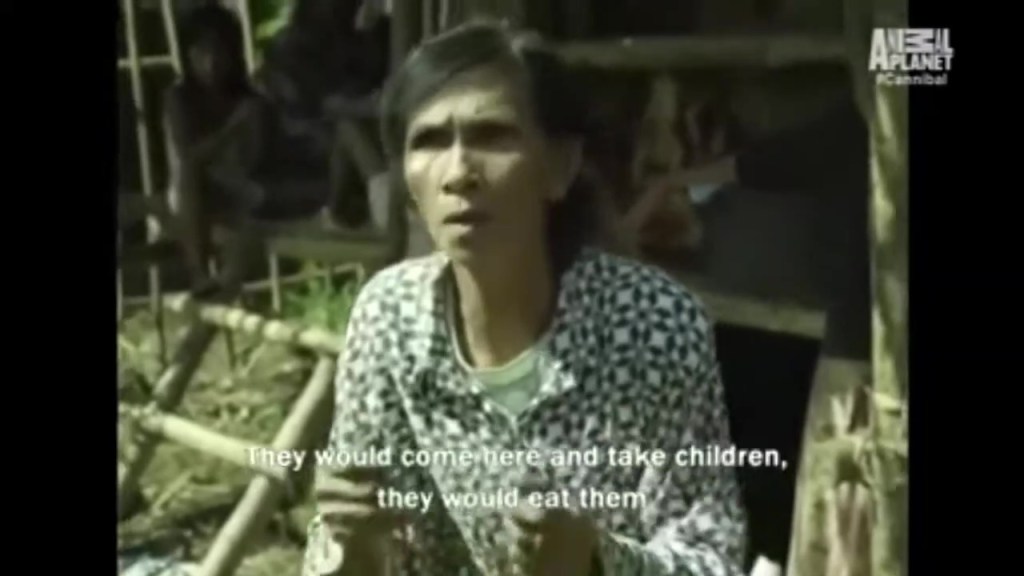
The program is ingeniously done. Hoernboeck, the modern-day anthropologist, shows purportedly real video of his interviews with the imprisoned Darrow (played by Richard Brake, who was in Game of Thrones and Hannibal Rising, so there’s a giveaway for the alert horror fan), and his expedition to trace the journey on which Darrow supposedly found the hobbits. Interspersed with this, we are shown what we are told is a reenactment of the original expedition by Darrow and his friends/victims. The implication is that we can believe the rest is real, because they told us what was staged. We move to the present to see the anthropologist tracking down Darrow’s tape recorder which contains the taped call of the hobbits, then eventually the actual film taken by Darrow that proved his innocence but, alas, not until after he died in the brutal Kerobokan prison.
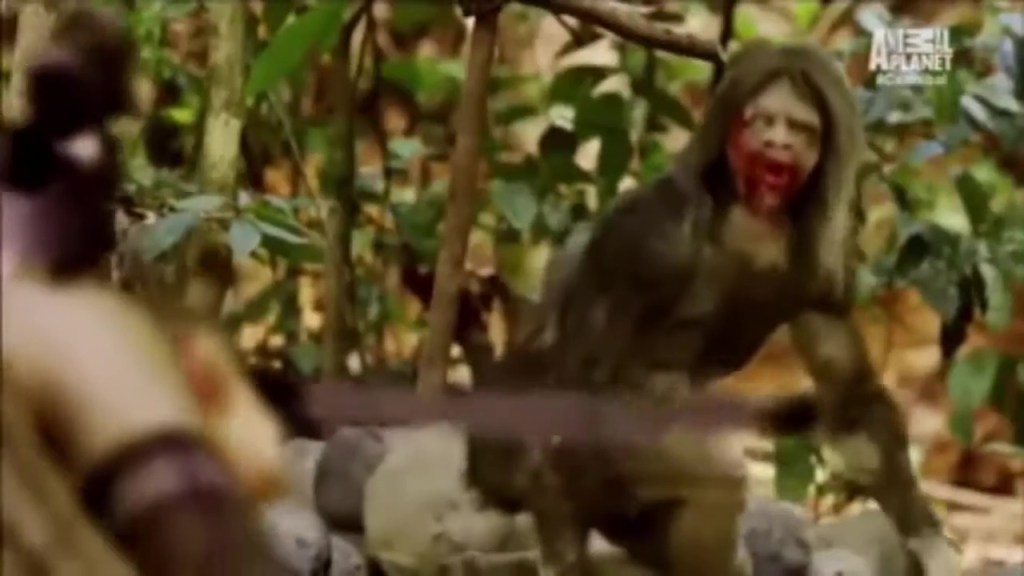
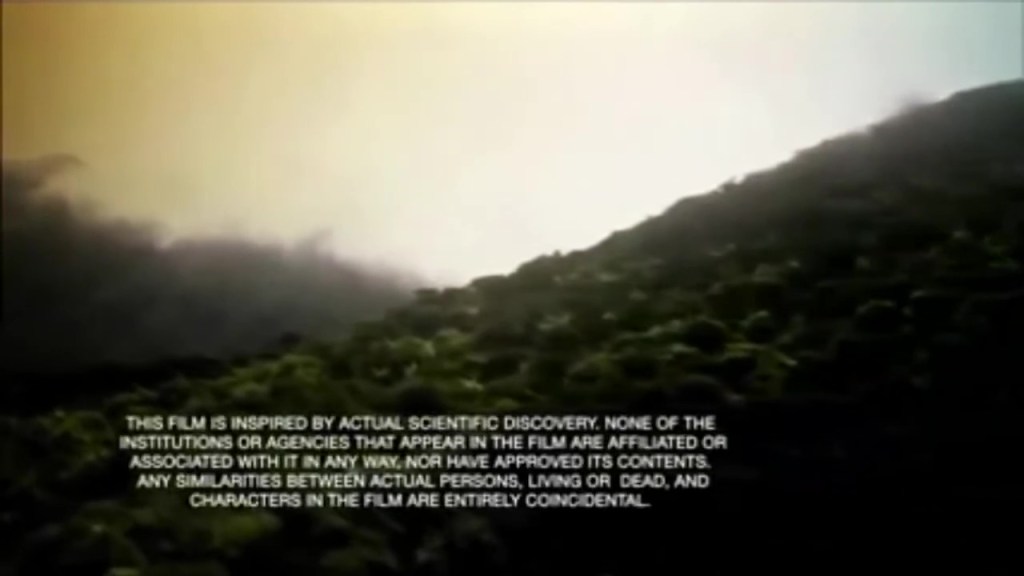
With a modicum of willing suspension of disbelief, it’s actually pretty convincing, and quite sad, unless we keep reminding ourselves that the whole thing is a fake. Those who watched it when it first came out, unless they recognised the Night King or the war criminal who ate Hannibal’s sister, did not discover that it was all fictional until the very end, when there is a (very) short statement. Most viewers probably wouldn’t even have noticed it.
What I found interesting is the depiction of the totally credible outrage of the Indonesian authorities, furious that an American would eat the Indonesian guide. Yet when the Flores locals are shown talking about the hobbits capturing and eating their children, there is inaction. Nature is red in tooth and claw! Animals eat each other, and eat people if they can, so if some unidentified ape ate your child, well, that’s unfortunate. But anthropocentric ideology denies our animality, so for a human to eat a human still manages to shock. The false binary of human/animal has led science to tie knots in the language, with some calling the hobbits “ape-men” and one learned anthropologist, Gregory Forth, calling his book about them Between Ape and Human. Like this documentary, the idea of a lacuna between apes and humans is fictional. We are a species of great ape, and our DNA is 98.8% identical to chimps.

Dr. Darrow’s supposed cannibalism was more horrific than nature’s mundane bloodbaths, not because he was genetically similar to the victim, but because he was a post-doctoral scientist, a ‘civilised’ man. If either party to slaughter, the one wielding or the one enduring the blade, can be defined as ‘animal’, all bets are off. The cannibals we consider in this blog are simply better than most people at dehumanising, objectifying the other.

The full movie is available, at the time of writing, at Daily Motion.

Cannibalism in the Ukraine: GHOUL (Petr Jákl, 2015)

Ghoul is a “found footage” movie, a postmodern affectation that pretends it is a documentary that has been ‘found’ after some gruesome disaster. The genre was popularised (although not originated) by the Blair Witch Project in 1999 which, like Ghoul, had young film-makers heading off to investigate the paranormal, and wishing they hadn’t. One of its most famous antecedents was Cannibal Holocaust in 1980, which was purportedly a documentary about missing documentary makers, and was (purportedly) believable enough to lead to a court case in which the actors had to be produced to prove they had not in fact been killed in some sort of snuff movie. This was of course great publicity for the film, as was the fact that it had been banned in several jurisdictions. The very first film in the genre was probably Punishment Park in 1971, in which anti-Vietnam War demonstrators are supposedly dropped in the desert and hunted by Nixon’s cops.

The main point of interest in this film (the found footage itself being unoriginal and totally preposterous) is the fact that it is set in The Ukraine which, at the time of writing, is again suffering from decisions taken in Moscow. The “Holodomor” (literally “murder by starvation”) was an event that took place in the Ukraine in 1932-3, during which the population was deliberately decimated by the collectivisation of the farms and seizure of food stores. As starvation set in, corpses began to disappear, and the government response was simply to put up signs saying, “Eating dead children is barbarism”. Timothy Snyder’s Bloodlands, the history of Nazi and Soviet mass murders between the wars, examines the incidents of cannibalism in the Ukraine and Poland, and concludes “With starvation will come cannibalism”. When there is no bread or other meat, human flesh becomes the currency. Snyder describes several reports, including an orphanage in Kharkiv where the older children began eating the youngest, who himself joined in, “tearing strips from himself and eating them, he ate as much as he could.”

Pretty difficult to invent a story worse than such a reality. So to add some spice, we have in Ghoul an amateur film crew from America who are fascinated by cannibalism (as, apparently, are very many people: this blog is currently receiving over 10,000 views per month – THANK YOU for reading!) They are researching evidence of cannibalism during the Holodomor, as part of a planned television series on cannibals of the twentieth century. They are conducting interviews in Kyiv of elderly survivors of that time, but they are also hoping to interview a man named Boris who was arrested rather more recently for eating a colleague, confessed to the crime under hypnosis, but then was released, as the body was never found. He said that he was made to do it. By whom, they wonder.

The crew are taken to a local psychic/witch, who tells them that paranormal entities were behind that murder. The crew dismisses this as superstition, getting drunk and getting her to perform a séance involving a pentagram, in which they mockingly summon the ghost of Andrei Chikatilo, a notorious serial killer and cannibal who killed and partially consumed dozens of women and children in the late 1970s and 1980s.

The next morning is full of strange and uncanny events, but the crew are unable to leave for help. The Ukrainian psychic tries but fails to evict Chikatilo’s presence, with no luck: he’s back now, and killing again. The idea is that Chikatilo forced Boris, their reluctant interviewee, to kill and eat his victim. He possesses (as in takes over the body of) a cat, then Boris, who proceeds to chase the young filmmakers, screaming, through various dark, gothic passages.

WTF? (Or що за біса as they say in The Ukraine). The film’s poster (below) says “INSPIRED BY TRUE EVENTS”. But where is the connection between Stalin’s attempted genocide in the 1930s and the ghost of a cannibal who had been active in Russia in the 1970s and 80s and was executed by a bullet behind his ear in 1994? Well, turns out Chikatilo had a brother that disappeared during the famine, and his ever-loving mummy told him the brother had been kidnapped and eaten. This may have just been to make him behave better (spoiler: didn’t work very well). So anyway, he decided to become a cannibal, specialising in small children. A real piece of work, and not one you’d want to reawaken from the dead.

I find hand-held filming annoying even in the hands of an expert, and this lot are supposed to be a bit sloppy, so the picture is jumping all over the place, to the point of seasickness. Reminds me of my dad’s Super-8 home movies (although he didn’t have a cannibal ghost to film, just bored kids). If you are patient enough to put up with the soundtrack (annoying bangs meant to scare you) and the shaky camera, the concept of a massacre being presented through the dispassionate eye of a video camera is interesting, in that it could be interpreted as the way the universe indifferently watches the suffering of its animals as they eat each other or, more immediately, the way the world watches as Russia tries to cannibalise Ukraine.

But besides the irritating camera work and the noisy things that go bump in the night, the plot is absurd – you have a historical tragedy, an imaginary murderer and the supposed ghost of a real murderer, who is somehow able to take over cats, people (including during sex) and of course kill people. The whole thing is frankly a bit of a yawn. It somehow managed to get to 22% on Rotten Tomatoes, with the LA Times critic summing it up well:

“Ghoul” can’t decide whether it should be about cannibals, serial killers, ghosts or demons. The found footage trivializes rather than reflects the horrific events that serve as the film’s basis.

According to IMDB, Ghoul was the highest grossing horror in Czech history. It also won the Vicious Cat Award at the Grossmann film and wine festival. Not sure if that will impress you or not.

The full movie was available on YouTube last time I checked, but all the dialog is in Czech and Ukrainian. Even if you speak both fluently, I wouldn’t bother.

Cannibal – the game (Deodato 2020)

You may remember the seminal cannibalism movie Cannibal Holocaust which I reviewed last year:

“I wonder who the real cannibals are” CANNIBAL HOLOCAUST (Deodato, 1980)

Well, yes, now there is going to be a game based on it, written by the Director, Ruggero Deodato. Set in Borneo, the Cannibal video game will allow players to take on the role of a variety of different characters. We don’t know who those characters will be yet, but more information will follow.

Based on the artwork, it seems as though Cannibal will attempt to replicate the found footage style of the movie, which is something that’s been done in games like Outlast and Resident Evil 7. With one of the innovators of the found footage genre at the helm, though, it will be interesting to see if Cannibal will be able to take this style of horror game to the next level.

Cannibal will launch in November for iOS, Android, PC, PS4, Switch, and Xbox One.