Peter Kürten: THE VAMPIRE OF DÜSSELDORF (Robert Hossein, 1965)

Peter Kürten was a German serial killer, often called “The Vampire of Düsseldorf” and the “Düsseldorf Monster”. Described as “the king of sexual perverts”, Kürten was beheaded in July 1931 at the age of 48.

He perpetrated at least nine murders and a number of sexual assaults between February and November 1929 in the city of Düsseldorf. Previous to this, Kürten had accrued a long criminal record for offences including arson and attempted murder. He also confessed to the 1913 murder of a ten-year-old girl in Mülheim am Rhein and the attempted murder of a 17-year-old girl in Düsseldorf.

Kürten was called the “Vampire of Düsseldorf” because he occasionally drank the blood of his victims. He was also known for decapitating swans in the Düsseldorf Hofgarten to drink their blood.

This week’s movie, The Vampire of Düsseldorf or, in French, Le Vampire de Düsseldorf, was a joint production between Spain, France and Italy, filmed in 1964. Fritz Lang’s 1931 film M – Eine Stadt Sucht Einen Mörder was loosely based on Kürten (who had been beheaded the year the film was made), but also on the other German serial killers of the time: Haarmann, Großmann, and Denke. Fritz Haarmann had killed at least 24 boys and young men between 1918 and 1924, often by biting their throats, and then allegedly eating or selling the meat from their corpses as pork or horse-meat. Carl Großmann was arrested in 1921, suspected of up to 100 murders of women and girls, whose flesh he was supposedly selling on the black market and from a hot-dog stand in Berlin during the Great War. Karl Denke killed and sold the flesh of dozens of homeless vagrants and travellers from 1903-1924. So Peter Kürten was far from unique in famine-stricken Germany between the wars.

The Director of this film, Robert Hossein, cast himself in the title role of this and several of his films, which is not that unusual among auteur filmmakers. He didn’t look much like Peter Kürten, who was a remarkably nondescript individual (as are so many modern, domestic cannibals), but that’s not the problem. The film twists the story but ends up turning it into a fairly pedestrian slasher rather than the psychological profile of a cannibal serial killer, which it could have been. It also sanitises the story, ignoring the many murdered children and in fact the whole aspect of cannibalism by clinical vampirism (his consumption of blood).

Kürten started his killing well before anyone had heard of Hitler, and even before the First World War, which led to the economic crises that presaged fascism. But by 1929, when most of Kürten’s murders took place, the darkened streets of German cities were full of violence: fascists battling communists, unemployed workers demanding bread and work, and killers like Kürten taking advantage of the chaos.

It is not therefore totally unfair for the film to present Kürten as the embodiment of the sickness that led to the growth of totalitarianism. We see several faces of Europe between the wars – Kürten helping an old neighbour with her groceries, the crowded music halls so popular in Weimar Germany, and the killer, still dressed as respectable citizen, stalking the streets. Kürten, had he survived a bit longer, might have made a very powerful Nazi, with his penchants for smart clothes and extreme violence.

The plot is much simplified. Kürten kills young women and writes letters to the police boasting of his exploits (much as Jack the Ripper did around forty years before him).

He falls in love with a nightclub singer, Anna, who mocks him, sparking his misogynistic rage. He meets two young girls from the countryside who should know better than to open their doors to strangers.

Anna eventually becomes his lover, but then she finds the latest letter he is writing to the police.

Anna must die, much to Kürten’s regret, and his rage is expressed in arson attacks on the nightclub.

The real Kürten was of course a serial killer whose toll was far higher, and whose preferred victims were often very young girls. He was also an arsonist, and he achieved orgasm both through the act of killing and the burning of the body or buildings. Murderpedia has a full account of his acts if you want to read further. It’s pretty gruesome.

Little attempt is made in the film to portray the real Kürten, and even less to explain why he was the way he was. But the film was made in 1965 when sensitivities were somewhat more pronounced than now, particularly in Germany which had only shed the Nazis twenty years earlier. But it’s a masterfully made film, and the music by Hossein’s father, André, is particularly affecting. Worth seeing, if you can lay your hands on it.

As he was led to the guillotine, Kürten asked the prison psychiatrist,

“Tell me, after my head has been chopped off will I still be able to hear; at least for a moment, the sound of my own blood gushing from the stump of my neck? …That would be the pleasure to end all pleasures.”

After he was beheaded, Kürten’s head was preserved and his brain removed for examination, to see if there were any anatomical anomalies (there weren’t). The mummified and bisected head can still be viewed, if you feel so inclined, in the “Odditorium” of Ripley’s Believe It or Not! At 115 Broadway, Wisconsin Dells.

CANNIBALISM NEWS January 2022 – German killer who had ‘cannibalism fantasies’ jailed for life

‘Cannibal teacher’ hid his victim’s penis to avoid being outed

A man dubbed by the press a ‘cannibal teacher’ has been convicted of murder and sentenced to life in prison. The judge said the murder was carried out as part of his “cannibalism fantasies”. The 42-year-old, identified only as Stefan R, was also convicted of disturbing the peace of the dead, after a trial that opened in August 2021 and concluded this week.

German prosecutors described evidence of cannibalism in the killing of 44-year-old high-voltage technician, Stefan Trogisch, on 6 September 2020.

Stefan R. allegedly ate parts of his lover after sex, and subsequently concealed somehow the victim’s penis, so he wouldn’t be “outed” as gay. German police arrested the 41-year-old maths and chemistry teacher in November 2020 on suspicion of “sado-cannibalism for sexual gratification” after they found human bones stripped completely of flesh in a Berlin suburb. Under German law, the man’s surname cannot be revealed, yet there are pictures of him everywhere, so I’m guessing this is not a serious privacy issue.

A Berlin prosecutor’s office spokesperson said

“The suspect had an interest in cannibalism. He searched online for the topic.”

Well, hello! So do I, and maybe you, dear reader. I also look up COVID and cricket, but that doesn’t mean I caught one or played the other. Maybe he was writing a PhD thesis?

No one knows whether the victim, the other Stefan, had an interest in cannibalism, but we know that the two men were communicating on a gay dating website called Planet Romeo, according to a report in Der Spiegel. Stefan R. called himself “Spieltrieb1976” (roughly translated as “instinct to play”) and Stefan T. (now deceased) was “Dosenöffner79” (tin opener). Stefan R. also used the handle “Masterbutcher79” which prosecutors claimed was a reference to Armin Meiwes, who was dubbed the “Master Butcher of Rotenberg.”

The bones of Trogisch were found a couple of months after the murder, and showed signs of bite marks, although having been out in a field for a couple of months, it’s hard to say what species of animal had been biting them. A police officer told the newspaper Bild:

“Based on the bones found, which were completely stripped of flesh, and further evidence, we strongly suspect that Stefan T was the victim of a cannibal.”

Sniffer dogs led police to the apartment of the suspect, where they discovered knives, a medical bone saw, and a large freezer. Investigators also discovered 25kg of sodium hydroxide, a reagent that can be used to dissolve bodily tissue. It can also be used to make soap, which the accused claimed he bought it for. Traces of blood were discovered in the hallway of the suspect’s flat. The defendant had previously erected a sex swing in the living room and had a sign on the window ledge that read: “Instructions for emasculating and slaughtering a person.” He reportedly searched terms associated with cannibalism on the dark web such as “long pig” and “fatten and slaughter people” before Trogisch arrived at his residence. According to German newspaper Bild, he had also previously searched whether or not a person could survive after having their penis cut off.

Stefan R. told the court that Trogisch had died in his sleep on the sofa after a (presumably vigorous) sexual tryst. He claimed that Trogisch had consumed a cocktail of drugs and alcohol, and that he tried to revive him, but did not call emergency services “because it would have come out that I am homosexual”, according to Bild.

He said he decided to dispose of the body, and opted to separate Trogisch’s genitals “since my DNA could still have possibly been present due to the oral sex I performed”. But hours after the death, he logged back into the human slaughter forum where he proudly told a man from the city of Bremen: “I have it [the penis] now!”

In the sensitive style that we have come to expect from British news media, The Sun wrote

“the victim’s manhood has not yet been found.”

Judge Schertz said that, in 30 years as a judge, “nothing like this has come across my desk before”. He added that the defendant’s version of events was “unbelievable from start to finish”, noting the “very careful separation of testicles and penis” as evidence of a cannibalistic ritual.

The trial began in August 8 2021 and heard an autopsy report which revealed that the cause of death was a fatal loss of blood from the pelvic area due to a severed artery. This would seem to indicate that Trogisch bled to death after his penis was chopped off. The autopsy also ruled out the defendant’s claim that the victim was affected by alcohol or drugs, causing his death.

It’s a sensitive subject in Germany, where cannibalism was not uncommon between the world wars and was made into the subject of Fritz Lang’s masterpiece – “M – EINE STADT SUCHT EINEN MÖRDER” one of my favourite cannibalism movies. More recently, Armin Meiwes in 2001 met Bernd Jürgen Brandes on a site called Cannibal Café, and after a romantic interlude, agreed to Brandes’ request to kill him and eat him. The first act of the killing (all captured on video) was Meiwes cutting off Brandes’ penis, which he then cooked and the two men attempted to eat, very unsuccessfully. Meiwes subsequently killed Brandes and ate an estimated 45-65 pounds of flesh (20-30kg) from him.  Meiwes is still in jail, and Brandes is still in Meiwes (well, only in spirit, unless he has a very slow digestive tract). Unlike Brandes, there is no evidence that Trogisch had “consented” to his killing.

Then in 2013, Detlev Guenzel, a German police forensic specialist (you couldn’t make this stuff up), chopped up a man he met on a cannibalism fetish website and buried the pieces in the garden, taking a picture of himself standing next to a skeleton and holding an axe, wearing nothing but socks and sandals. There is little evidence to show that Guenzel ate any of the victim, although the victim’s penis and one testicle were not found in the flowerbed where the other pieces of the puzzle were unearthed.

There is probably another thesis to be written on the proportion of cannibalism reports that involve queer sexuality. Meiwes, of course, and Jeffrey Dahmer, who collected young men and killed them to keep them close. The film The Silence of the Lambs was heavily criticised when it was released for showing the serial killer Jame Gumb (“Buffalo Bill”) as a transsexual, although the plot was all about how he wasn’t authentically trans, and was killing women because he was rejected for gender reassignment surgery, and so was making himself a woman suit out of the skin of his victims. The film’s cannibal, Hannibal Lecter, was not gay in that series of films and books (he fancied the hell out of Clarice Starling), although Krendler, the nasty dude from the Justice Department in the book Hannibal, said he “figured he [Hannibal] was a homosexual” because, you know, he had good taste in food and wine and music – “artsy-fartsy stuff”. Krendler’s brain is later eaten by Hannibal and Clarice, so we have no reason to take him too seriously. But there was certainly plenty of homoerotic interaction in the twenty-first century reboot of Hannibal on TV, particularly when Hannibal is holding Will tenderly while cutting him up.

Is this tendency to depict cannibals as queer a reflection on the traumas experienced by gay youths and where they may lead behaviourally, or simply a noxious reaction against the lifting of restrictions on gay couples? Someone will write a paper on that one day. They probably already have.

The other issue raised by this case if of course the persistent theme (Meiwes and Guenzel again) of the chopping off and consumption of the male penis. Stefan R. discussed on one forum whether it was possible to survive a genital amputation – saying that some people desired it in order to feel like women, or else take masochistic pleasure in it. Prosecutors argued that Stefan R. had cut off the victim’s genitals with the intention of eating them, and the judge agreed, but it could not be established whether he had carried out that plan.

Freud had a lot to say about this! When little boys discover that their mothers or sisters have no penis, they assume the women were castrated, and as a result fear their own castration by their father (whom they suspect of the act). This is supposed to be the basis of the repression that eats away at the male mind and drives us to our various deviant behaviours.

Subsequent psychological studies as well as feminist analyses have demolished much of Freud’s speculative theories, but there is one thing we still don’t know – where is Stefan Trogisch’s penis?

The presiding judge, Matthias Schertz, told Stefan R. “What you did was inhuman”. But another German, Friedrich Nietzsche, might have called it “Human, all too human”.

“Egoism is not evil, for the idea of one’s “neighbour” (the word has a Christian origin and does not reflect the truth) is very weak in us; and we feel toward him almost as free and irresponsible as toward plants and stones. That the other suffers must be learned; and it can never be learned completely.”

The Vampire of Hanover: THE TENDERNESS OF WOLVES (Ulli Lomel, 1973)

The Tenderness of Wolves (Die Zärtlichkeit der Wölfe) is about the German serial killer and cannibal Fritz Haarmann. It’s not a documentary though, it’s an artistic interpretation of the story, and it’s a classic of the cannibal genre.

Fritz Haarmann, a.k.a. “the Butcher of Hanover” or “the Vampire of Hanover”, was a German serial killer who sexually assaulted, murdered and mutilated at least 24 boys and young men between 1918 and 1924 in Hanover, Germany. His case was the partial inspiration for Fritz Lang’s film M, the antagonist of which was a composite of Haarmann and at least three other interwar cannibals.

The most recent film to be directly based upon Haarmann’s murder spree, Der Totmacher (The Deathmaker), was released in 1995 and focused on the written records of the psychiatric examinations of Haarmann.

The real Fritz Haarmann

Haarmann was a petty thief, conman, and homosexual (which was against the law at that time) and served several prison sentences. Germany was in dire social and financial distress after the war, and crime was rampant. The police knew of Haarmann’s minor criminalities, but preferred to use him as an informant, and even tolerated him patrolling the railway stations demanding to see travellers’ documents and making arrests.

The film transfers the action to the late 1940s after the second world war; it was too expensive to recreate the streets of 1924, although the final scene reveals that Haarmann was executed in 1925. But the story is timeless, so the time shift is incongruous, but not disturbing.

Everything else about the film is disturbing though. The streets of Germany were full of homeless youths, and Haarmann would offer them shelter, take them home, feed them and make love to them, and then bite through their adam’s apples to kill them. He called this his “love bite”. He was never actually charged with cannibalism (it was not a criminal offence, and still isn’t in most jurisdictions) but he actively traded in black-market ground meat, and neighbours reported seeing him carrying large amounts out of his apartment, although he was never seen to bring in any carcasses.

The film makes it clear that the meat he supplies his delighted neighbours is human. The “innocent” cannibals around the table accept Haarmann’s story that the meat comes from a butcher named Karl, are pleased to be able to get meat, and do not ask questions.

Tenderness of the Wolves was produced by Rainer Werner Fassbinder, the prolific if short-lived German film maker. Fassbinder also appears in a minor role as Haarmann’s criminal accomplice, Hugo Wittkowski.

The director, Ulli Lommel – later responsible for the infamous video nasty The Boogeyman – was a regular actor in Fassbinder films, but this was only his second directorial effort and shows an exquisite artistry.

Kurt Raab wrote the screenplay as well as delivering an astonishing performance as Haarmann. At once vulnerable and yet able to play the tough cop, Raab’s Haarmann is drawn from Peter Lorre’s performance in M but also F.W. Murnau’s 1922 Expressionist vampire classic Nosferatu. The symbolism of the monstrous killer is clear at the beginning as we watch Haarmann’s shadow moving over the street, just as we saw, in the earlier movie, the nosferatu climbing the stairs.

But is he the vampire Nosferatu or the snivelling child molester from M?

Well, both, and that gives him a complexity that makes the film so fascinating. Haarmann is not the only criminal in the story – he is just worst among equals. Everyone is grifting and looking for an edge. The homeless kids are looking for food and shelter and affection, and Haarmann is only too willing to give them all that, but there is a price – their lives and their flesh. He is looking for love too, but from all the wrong people, in particular his tempestuous relationship with Hans Grans, who sees him purely as a meal ticket.

Roger Ebert summed up the film:

“the movie has a haunting banality. It’s about insignificant creeps, and it invests them with a depressing universality.”

Haarmann in this film is both tender and wolf, and in that he encapsulates Hannah Arendt’s summation of Adolf Eichmann in her study of his war crimes trial. Eichmann was a leading figure in the Holocaust, the destruction of European Jewry during the second world war. Arendt found that, while it would have been comforting to find that Eichmann was a monster, in fact he was “terribly and terrifyingly normal”. Eichmann maintained that he was just following orders, doing his job, and Arendt called this “the banality of evil”.

Just so, Haarmann would have argued that he was just doing his job, doing what he needed to do to survive a broken society, make a little money and feed his appetite for food, for sex and for flesh. And for love, the one thing he never achieved.

At the end, Haarmann is led off to the police car, his neighbours and followers who ate his meat gladly watching on. His last words are:

“Take my little life. I am not afraid of death through the axe or the hangman. It is my salvation. I am happy to give my death and my blood for atonement into God’s arms and justice. It could have been thirty, but also forty – I don’t know. There are victims that you don’t know about. But they are not the ones you’re thinking of. They were the most beautiful ones I had.”

The full movie is currently available on YouTube.

Fritz Lang’s Cannibalism Masterpiece – “M – EINE STADT SUCHT EINEN MÖRDER”, (1931)

Fritz Lang considered this film to be his magnum opus. It regularly appears on lists of the best movies ever made, it was voted the best German film of all time by the Association of German Cinémathèques, and it is one of the few movies with 100% on the website Rotten Tomatoes. It set the standard by which police procedurals and serial killer stories would be judged for the next century. But is it a cannibal movie?

01.png

The story starts with a group of small children standing in a circle, and a little girl, Elsie, is choosing who is eliminated from the game, using a song:

“Soon will come the man in black for you…”

03.png

04.png

Ja, it’s a cannibal film. We don’t see anyone get eaten, but that is not unusual, particularly in the older films from the cannibal genre.

Elsie is heading home after school, bouncing her ball, past a poster seeking information about the murderer of eight children.

06.png

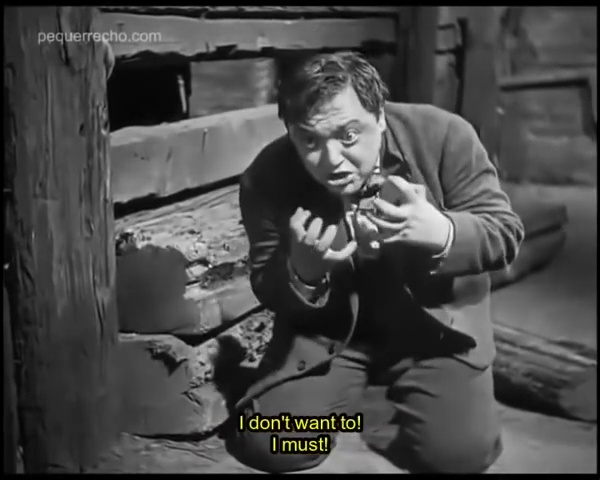
A nice man, Hans Beckert (Peter Lorre in his first major film role), compliments her colourful ball and offers to buy her a balloon. He is whistling Grieg’s “In the Hall of the Mountain King”. The music is best known for its use in Ibsen’s Peer Gynt, which is not actually a cannibal story, but does involve a lot of stuff about trolls eating people.

Soon we see the ball rolling away, the balloon floating off, briefly caught on telegraph wires.

09.png

Like most modern cannibals since Jack The Ripper, the killer is indistinguishable from the rest of the public – just a normal guy (well, as normal as Peter Lorre could ever be).

13.png

The panic over the ninth murder makes everyone a suspect, particularly after Beckert writes to the papers, boasting that he’ll keep on killing.

11.png

12.png

vlcsnap-2020-04-26-22h18m29s472.png

The police raid the criminal underground every night, which is terrible for business.

14.png

16.png

The bar owner complains to the police that even the hardest working prostitute…

“hides a mother inside… I know many hard crooks whose eyes mist up looking at the little children playing.”

19.png

And so it goes. The coppers can’t catch him, so the underworld decides they will catch him, just so they can get back to business as usual.

vlcsnap-00007.jpg

The police have their own theories of why they cannot catch him:

“He’s not a real crook! Maybe he’s somebody who shows the harmless look of a good citizen who wouldn’t kill a fly.”

vlcsnap-00009.jpg

“If it wasn’t for this… apparent innocence of murderers, it would be unthinkable that a man like Grossmann* or Haarmann* could live for years next door to their neighbours, without raising any kind of suspicion”.

The police follow leads from the asylums; the crooks have other methods. Of course, everyone is a suspect, except – the beggars. The heads of the underworld offer them a reward to watch all the children of the city. Meanwhile, Beckert is watching little girls in shop window reflections.

vlcsnap-00022.jpg

The “M” of the title is chalked onto his coat by one of the beggars, as he is taking away his next child.

vlcsnap-00036.jpg

No more spoilers. Let us just say that the climax is a trial, in which Lang asks some hard questions about whether we are responsible for our actions, even when we cannot control our own minds.

vlcsnap-00044.jpg

vlcsnap-00063.jpg

vlcsnap-00110.jpg

The moral of the story is presented by Elsie’s mother, sitting outside the court, who says:

“This will not bring our children back to life. People should take better care of their children!”

Indeed.

No mention is made of the precise fate of the victims in the movie – Lang leaves that up to our imagination, and some knowledge of German serial killers of that time. They disappeared without trace for some days and…

21.jpg

*   Some critics and reviewers claim that M was based on serial killer Peter Kürten—the Vampire of Düsseldorf—whose murdered at least ten people including several children in the 1920s and achieving sexual climaxes from the killings, and from drinking the blood of some of the victims. He was also keen on writing to newspapers, as is depicted in the film. Kürten was beheaded in 1931 for his crimes, so would have been very much in the news at the time of the film’s creation.

Fritz Lang, however, in an interview in 1963 with film historian Gero Gandert, denied that M was based solely on Kürten

“At the time I decided to use the subject matter of M, there were many serial killers terrorizing Germany—Haarmann, Grossmann, Kürten, Denke”

The first two are actually mentioned in the film. Fritz Haarmann, known as the “Butcher of Hanover”, killed at least 24 boys and young men between 1918 and 1924, often by biting their throats, and then allegedly eating or selling the meat from their corpses as pork or horse-meat. Carl Großmann was arrested in 1921, a suspect in up to 100 murders of women and girls, whose flesh he was suspected of selling on the black market and from a hot-dog stand in Berlin during the Great War. Karl Denke killed and sold the flesh of dozens of homeless vagrants and travellers from 1903-1924.

The fact that Lang quoted those four serial killers as his models indicate that he certainly had cannibalism in mind when creating the role presented by Peter Lorre – the serial killer who cannot control his urges.

vlcsnap-00098.jpg

M is highly recommended as a classic, not just of the cannibal genre, but of cinematic art.

The full movie is currently available (and with excellent quality) on Youtube: