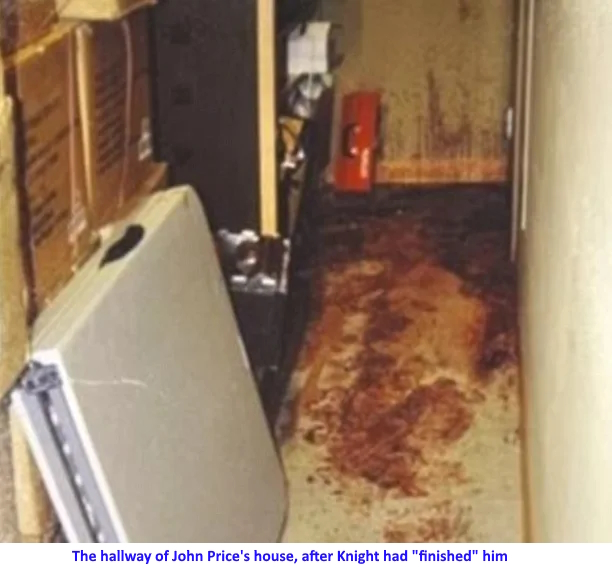
In the year 2000, 44-year-old slaughterhouse worker Katherine Knight had a night of passion with her partner, John Price, then stabbed him 37 times, professionally skinned him, hung his hide on a meat hook over the lounge room door, decapitated him, butchered his corpse and cooked parts of him. She served up his meat with baked potato, carrot, pumpkin, beetroot, zucchini, cabbage, squash and gravy in neat settings at the dinner table, putting beside each plate place-names for Price’s children. Another meal was tossed into the backyard; it appears she intended to eat it but couldn’t do so. The police arrived before Price’s children so, as far as we know, none of him was consumed (by humans anyway).
Knight pleaded guilty to murder and the judge ordered that her papers be marked “never to be released.” An appeal was quickly denied, and she is still serving her life sentence at Silverwater Women’s Correctional Centre in Sydney.
Shoreline Entertainment planned to make a film of the incident based on Peter Lalor’s book Blood Stain, but so far it has not surfaced.
It appears that Knight was NOT a cannibal, despite one of the favourite media labels about her being “Kathy the Cannibal”. Other reports called her “The Woman Hannibal Lecter”, a comparison that makes no sense at all, since Hannibal did not use 37 strokes to kill people, definitely did eat parts of them, and did not (as Knight did) take a cocktail of sleeping tablets afterwards while lying in bed with the mutilated corpse.
Darren O’Sullivan, whose documentary is linked at the top of this blog, commented,
“this is possibly the most horrific thing I have ever discovered”.
Although the series is called “Real Twisted Tales”, I suspect O’Sullivan must have led a sheltered life. Knight was a slaughterhouse worker, recognised for her skills in knife work. She grew up in the NSW town of Aberdeen, where everyone in her family and most of the town were employed in the abattoir. Her job, from a young age, was to kill and cut up animals. She did to John Price what she was trained to do to other animals – slaughter them, cut them up, cook them. She did try to feed bits to his children, which is what farmers did in the UK (feeding cattle bone-meal to cattle), an act of cannibalism which led to Mad Cow Disease. But there is little evidence that she herself ate any of him.
The documentary above states that Katherine Knight is “one of the most evil people in the world”, because she was found sane enough to stand trial. But really, what she did was what she was paid to do every day, just to a different species than those who usually suffered and died under her hand.
Superstitious anthropocentric beliefs put humans on a tier somewhere between angels and animals, but really we are a species of Great Ape, closely related to the chimpanzee. Rationally speaking, there really is only a thin red line between killing and eating any species of animal.
As a general rule, I am not a big fan of “mockumentaries” – if you’re making stuff up, then why not just describe it as fiction? And if you are a channel like Animal Planet which makes factual documentaries about (real) fauna and flora for its seventy million viewers, it seems at least deceptive if not actively fraudulent to start showing made up stuff as if it is a “documentary”. This is not the first time they’ve done it; they had previously tried to make us believe they had found evidence of dragons and mermaids. So an untrue ‘true-crime’ documentary about a fake cannibal locked up for supposed cannibalism which was actually carried out by an extinct species of hobbits seemed pretty tame to the Ethics Department of Animal Planet I guess.
I should concede that some of the classics of cannibal texts are mockumentaries or “found footage” inventions. Many of the Italian ‘cannibal boom” films attempted to appear as factual records, particularly the classic Cannibal Holocaust, for which the director, Ruggero Deodata, secreted away the actors to make it appear they had been killed, then had to produce them in court to avoid facing homicide charges. More recently, District Nine, Ghoul and Long Pigs have all made somewhat desultory attempts to persuade us that we were watching the actual killing and eating of humans by humans.
In this week’s offering, The Cannibal in The Jungle, the director Simon George presents a feature-length ‘true-crime’ special about an American scientist accused of murdering and consuming the remains of his fellow explorers while on an expedition in 1970s Indonesia. The murder/cannibalism case is told through interviews with an Australian anthropologist Richard Hoernboeck (played by Scottish actor Jim Sturgeon with a broad Australian accent), who says he found evidence of a tribe of very small hominids which he calls hobbits, and subsequently chose to investigate the murder/cannibalism case, 25 years after it happened. He tells us that in 1977, an American ornithologist was convicted of killing and cannibalising two colleagues in the jungles of Indonesia while on a quest to study eagles, as well as hoping to find a supposedly extinct owl. Instead, Dr Timothy Darrow, branded ‘The American Cannibal’ by the press during his trial for murder and cannibalism, claimed in his (unsuccessful) defence that they had been attacked by a lost species of early humans. These hobbits, he said, were responsible for the murder and consumption of his friends. Nobody believed him. Cannibalism is easier to believe than hobbits.
In fact, the remains of a species matching Darrow’s description were found in those jungles of Indonesia in 2003 by an anthropologist from Wollongong University, although his name was Mike Morwood (a hobbit name if ever I heard one). In what is now regarded as one of the most important anthropological finds ever, a team of scientists discovered the bones of an entirely new species of human, one that stood only 43 inches or 110cm tall. Homo floresiensis (popularly called Flores Man or more popularly Hobbits) lived on the island for perhaps over a million years before going extinct. Some recent research suggests that a tribe of the hominins known as Homo erectus became isolated on this remote Indonesian island, perhaps a million years ago, and evolved a dramatically smaller body size.
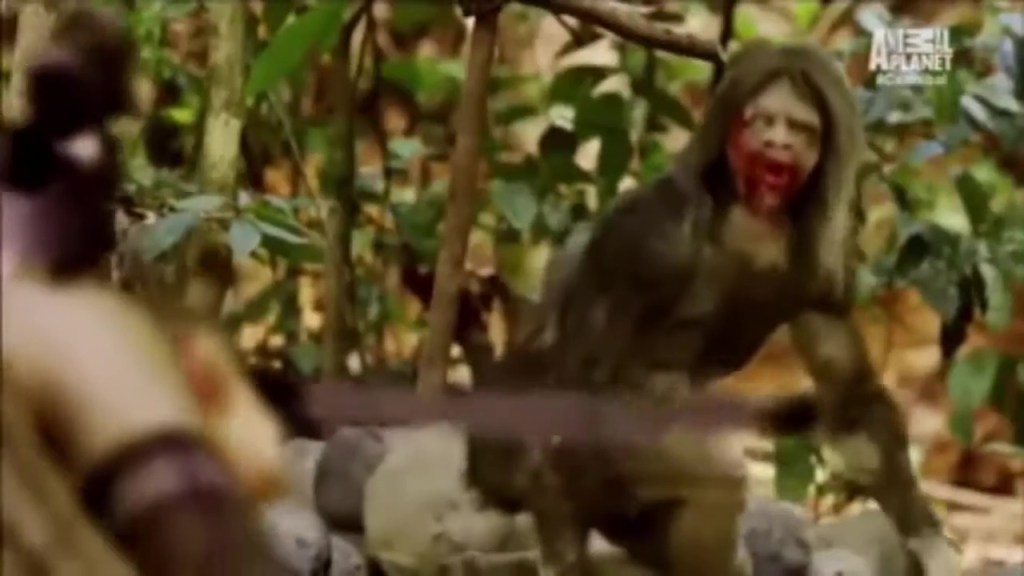
But did they really go extinct? An indigenous tribe on the Indonesian island of Flores, where the remains of the ‘hobbits’ were discovered, have their own accounts of little wild men that climb trees and walk on two legs. They also describe them as cannibals. And according to their legends, they may never have died out at all. This story claims to follow Hoernboeck’s expedition into the jungle of Flores, Indonesia, seeking to discover if hobbits still exist, whether Timothy Darrow’s ill-fated expedition really encountered the supposedly extinct creatures, and if the ‘American Cannibal’ was therefore innocent of the crimes for which he was convicted more than three decades previously.
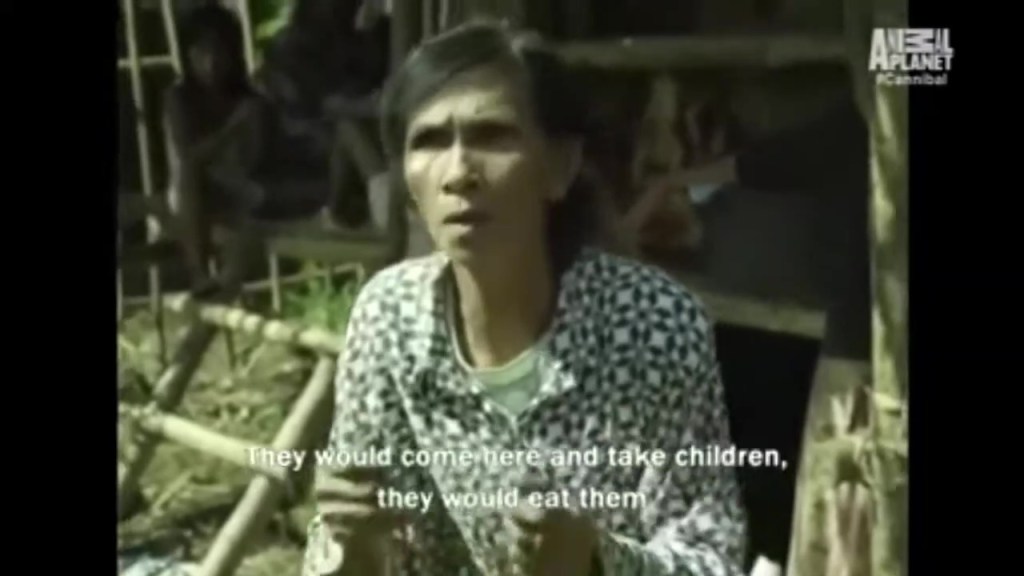
The local people of the island, the Lio, claim that the hobbits were around until very recently, and may still be hiding out in the forest. In the fake doco, they are shown suggesting that they would kidnap and eat children, although being a different species to Homo sapiens, I suppose this would not technically be cannibalism.
The program is ingeniously done. Hoernboeck, the modern-day anthropologist, shows purportedly real video of his interviews with the imprisoned Darrow (played by Richard Brake, who was in Game of Thrones and Hannibal Rising, so there’s a giveaway for the alert horror fan), and his expedition to trace the journey on which Darrow supposedly found the hobbits. Interspersed with this, we are shown what we are told is a reenactment of the original expedition by Darrow and his friends/victims. The implication is that we can believe the rest is real, because they told us what was staged. We move to the present to see the anthropologist tracking down Darrow’s tape recorder which contains the taped call of the hobbits, then eventually the actual film taken by Darrow that proved his innocence but, alas, not until after he died in the brutal Kerobokan prison.
With a modicum of willing suspension of disbelief, it’s actually pretty convincing, and quite sad, unless we keep reminding ourselves that the whole thing is a fake. Those who watched it when it first came out, unless they recognised the Night King or the war criminal who ate Hannibal’s sister, did not discover that it was all fictional until the very end, when there is a (very) short statement. Most viewers probably wouldn’t even have noticed it.
What I found interesting is the depiction of the totally credible outrage of the Indonesian authorities, furious that an American would eat the Indonesian guide. Yet when the Flores locals are shown talking about the hobbits capturing and eating their children, there is inaction. Nature is red in tooth and claw! Animals eat each other, and eat people if they can, so if some unidentified ape ate your child, well, that’s unfortunate. But anthropocentric ideology denies our animality, so for a human to eat a human still manages to shock. The false binary of human/animal has led science to tie knots in the language, with some calling the hobbits “ape-men” and one learned anthropologist, Gregory Forth, calling his book about them Between Ape and Human. Like this documentary, the idea of a lacuna between apes and humans is fictional. We are a species of great ape, and our DNA is 98.8% identical to chimps.
Dr. Darrow’s supposed cannibalism was more horrific than nature’s mundane bloodbaths, not because he was genetically similar to the victim, but because he was a post-doctoral scientist, a ‘civilised’ man. If either party to slaughter, the one wielding or the one enduring the blade, can be defined as ‘animal’, all bets are off. The cannibals we consider in this blog are simply better than most people at dehumanising, objectifying the other.
The full movie is available, at the time of writing, at Daily Motion.
In the year 2000, 44-year-old slaughterhouse worker Katherine Knight had a night of passion with her partner, John Price, then stabbed him 37 times, professionally skinned him, hung his hide on a meat hook over the lounge room door, decapitated him, butchered his corpse and cooked parts of him. She served up his meat with baked potato, carrot, pumpkin, beetroot, zucchini, cabbage, squash and gravy in neat settings at the dinner table, putting beside each plate place-names for Price’s children. Another meal was tossed into the backyard; it appears she intended to eat it but couldn’t do so. The police arrived before Price’s children so, as far as we know, none of him was consumed (by humans anyway).
Knight pleaded guilty to murder and the judge ordered that her papers be marked “never to be released.” An appeal was quickly denied, and she is still serving her life sentence at Silverwater Women’s Correctional Centre in Sydney.
Shoreline Entertainment planned to make a film of the incident based on Peter Lalor’s book Blood Stain, but so far it has not surfaced.
It appears that Knight was NOT a cannibal, despite one of the favourite media labels about her being “Kathy the Cannibal”. Other reports called her “The Woman Hannibal Lecter”, a comparison that makes no sense at all, since Hannibal did not use 37 strokes to kill people, definitely did eat parts of them, and did not (as Knight did) take a cocktail of sleeping tablets afterwards while lying in bed with the mutilated corpse.
Darren O’Sullivan, whose documentary is linked at the top of this blog, commented,
“this is possibly the most horrific thing I have ever discovered”.
Although the series is called “Real Twisted Tales”, I suspect O’Sullivan must have led a sheltered life. Knight was a slaughterhouse worker, recognised for her skills in knife work. She grew up in the NSW town of Aberdeen, where everyone in her family and most of the town were employed in the abattoir. Her job, from a young age, was to kill and cut up animals. She did to John Price what she was trained to do to other animals – slaughter them, cut them up, cook them. She did try to feed bits to his children, which is what farmers did in the UK (feeding cattle bone-meal to cattle), an act of cannibalism which led to Mad Cow Disease. But there is little evidence that she herself ate any of him.
The documentary above states that Katherine Knight is “one of the most evil people in the world”, because she was found sane enough to stand trial. But really, what she did was what she was paid to do every day, just to a different species than those who usually suffered and died under her hand.
Superstitious anthropocentric beliefs put humans on a tier somewhere between angels and animals, but really we are a species of Great Ape, closely related to the chimpanzee. Rationally speaking, there really is only a thin red line between killing and eating any species of animal.
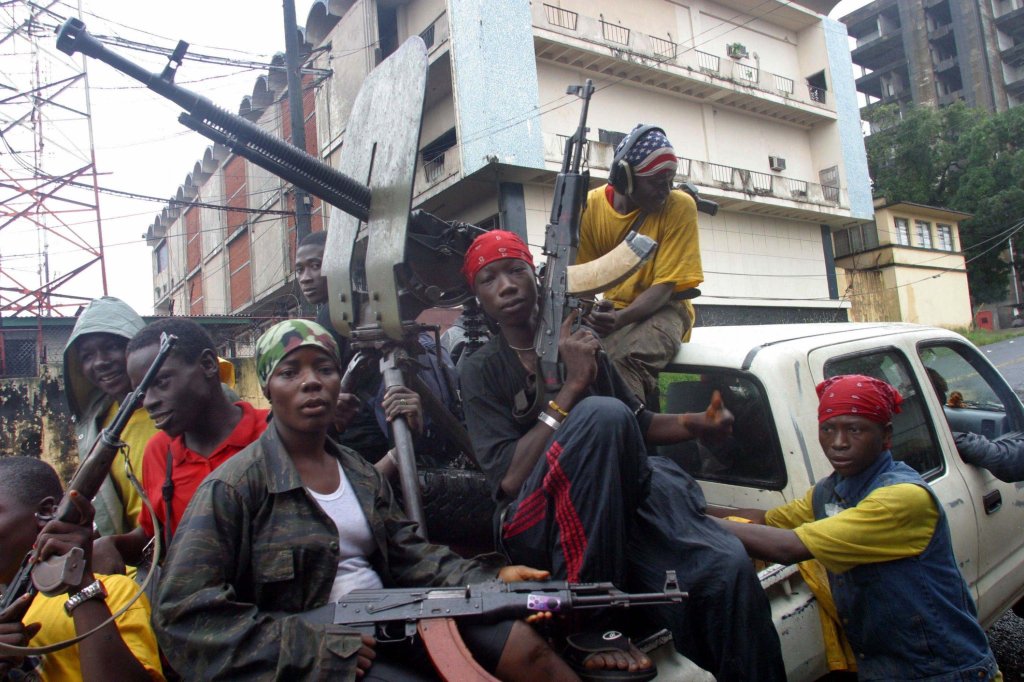
On Friday, 18 June 2021, a Swiss court sentenced 46-year-old Alieu Kosiah, a West African rebel leader, to 20 years in prison for rape, murder and cannibalism, committed during Liberia’s civil war. The case before a three-judge panel at the federal criminal court in Bellinzona was Switzerland’s first war crimes trial held in a civilian court.
Kosiah, AKA “bluff boy”, was a commander in the rebel faction United Liberation Movement of Liberiafor Democracy (ULIMO) that fought former President Charles Taylor’s army in the 1990s. He faced 25 charges, including one in which he was accused of eating slices of a school-teacher’s heart. He was found guilty of all but four of the charges. The court listed the charges as
“recruitment and use of a child soldier, forced transportation, looting, cruel treatment of civilians, attempted murder, murder (directly or by order), desecration of a corpse and rape.”
Criminal complaints were filed by Liberian victims, represented by civil rights group Civitas Maxima. The indictment says Kosiah killed or participated in the killing of 18 civilians, forced a displaced woman to be his “wife”, raping her repeatedly, and recruited a 12-year-old boy as his personal bodyguard. In one incident described in the indictment, Kosiah joined fighters in eating slices of a dead man’s heart off a metal plate. Acts of cannibalism were not uncommon in the conflict.
Child soldiers with ULIMO
Kosiah was arrested in 2014 under a Swiss law that allows prosecution for serious crimes committed anywhere, under the principle of universal jurisdiction. He had denied all the charges and told the court he was a minor when first recruited into the conflict.
Dubbed “the Monster” by survivors of the war, Kosiah is infamously remembered for the Black Monday attack on June 28, 1993 when rebels rounded up and massacred villagers in Foya, Lofa County.
Other Liberian war criminals
Liberia has ignored pressure to prosecute crimes from its continuous wars between 1989-2003, in which about 250,000 people died and thousands of child soldiers were conscripted and taught to kill and commit atrocities. Charles Taylor is himself currently serving a 50-year prison sentence for aiding and abetting rebels who committed atrocities in neighbouring Sierra Leone, but not for his actions in Liberia. His son, Chuckie, was sentenced for torture in Liberia by a U.S. court in 2009.
Ex-warlord Mohammed “Jungle Jabbah” Jabateh has been jailed for 30 years in the US for lying about his past as a leader of a force that carried out multiple murders and acts of cannibalism.
In July 2018, France detained naturalised Dutch citizen Kunti K, a suspected former militant ULIMO commander and placed him under formal investigation for crimes against humanity including torture and cannibalism. Another Liberian commander, Gibril Massaquoi, known as “Angel Gabriel” is on trial in Finland accused of eating his victims, burning kids alive and raping women. A verdict is expected around September this year.
Gibril Massaquoi
An ULIMO commander named Joshua Milton Blahyi known as “General Butt Naked” gave evidence to Liberia’s Truth and Reconciliation Commission in 2008:
“Any time we captured a town, I had to make a human sacrifice. They bring to me a living child that I slaughter and take the heart off to eat it… A lady offered me her child for my sacrifice. After cutting up the child I divided the heart among my boys and myself. The blood of the child was still on my hand when Jesus appeared to me and asked me to stop being a slave.”
Blahyi’s crimes included child sacrifice, cannibalism, the exploitation of child soldiers and trading blood diamonds for guns and cocaine, which he provided to boy soldiers as young as nine. He was never charged, and is now an evangelical pastor. He published an autobiography about his conversion.
General Butt Naked and Edna Fernandes
The cannibal as animal
One observation.
During his trial, Alieu Kosiah broke down and shouted:
“I’ve been locked up for six years, I have emotions, I’m not an animal.”
Well actually, he is an animal. We all are: humans are a species of Great Ape, as are our closest relatives the chimpanzees, who also wage war and indulge in occasional cannibalism. The point here, though, is that Kosiah saw himself stereotyped as a black man, an African, in a court full of white Europeans passing judgement on him. To the European, only a century or so ago, all Africans were considered savages and cannibals, little more than beasts, a libel which is hard to expunge, and a demonisation that was just as useful to European imperialist expansion as the use of gunboats. As recently as 1959, New York Times reporter Homer Bigart (an almost perfect name) wrote to his foreign news editor about his contempt for the new class of African leaders such as Kwame Nkrumah,
“I vastly prefer the primitive bush people. After all, cannibalism may be the logical antidote to this population explosion everyone talks about.”
The savagery and cannibalism of the multitudes of wars that have swept Africa in the last decades have led to appalling atrocities. But let us not forget the role of the colonialist rulers who divided the continent up, regardless of the local tribal areas, and sucked the riches out of the land, leaving the newly independent countries destitute and riven with implacable hatreds.
As Malcolm X wrote in 1965 about the colonisers of Africa:
They projected Africa always in a negative light: jungles, savages, cannibals, nothing civilized.
The legacy of this demonisation (see Milton Allimadi’s new book “Manufacturing Hate: How Africa Was Demonized in Western Media.”) is seen in the support given to psychopathic dictators who seize control for their own enrichment, but also for that of their overseas sponsors.
Milton Allimadi
Is it so surprising that this mythology of the ‘savage’ cannibal should be internalised and acted out in the heat of the internecine wars of our time?








 The Cannibal Guy