Convict Cannibals: FOR THE TERM OF HIS NATURAL LIFE (Norman Dawn, 1927)

For the Term of His Natural Life is a 1927 Australian film directed, produced and co-written by Norman Dawn. It is based on the 1874 novel by Marcus Clarke, and was the most expensive Australian silent film ever made. It remains one of the most famous Australian films of the silent era. John Laws, in the trailer above, calls it “the grandest of them all, the climax of Australia’s silent cinema.” Amazingly, it was the third attempt to film the story, starting in 1908 with the film version of a stage play of the book,  and then in 1911 another filmed stage adaptation, The Life of Rufus Dawes.

It’s the story of a gentleman (in the traditional sense of that obsolete term) who is wrongly convicted and transported to Australia for “the term of his natural life.” This was a fairly common trope in Victorian novels (no one wanted to read about real criminals), and was recreated by Tim Burton when he made Sweeney Todd into a returned convict in his version of the Demon Barber of Fleet Street. As a convict, he changes his name to Rufus Dawes, and the rest of the story tells of the brutality of life as a convict at Macquarie Harbour in Tasmania and his eventual escape to claim his innocence. And, in the American version of the film, a happy ending (the book and the British version saw the hero and his true love come to a watery end).

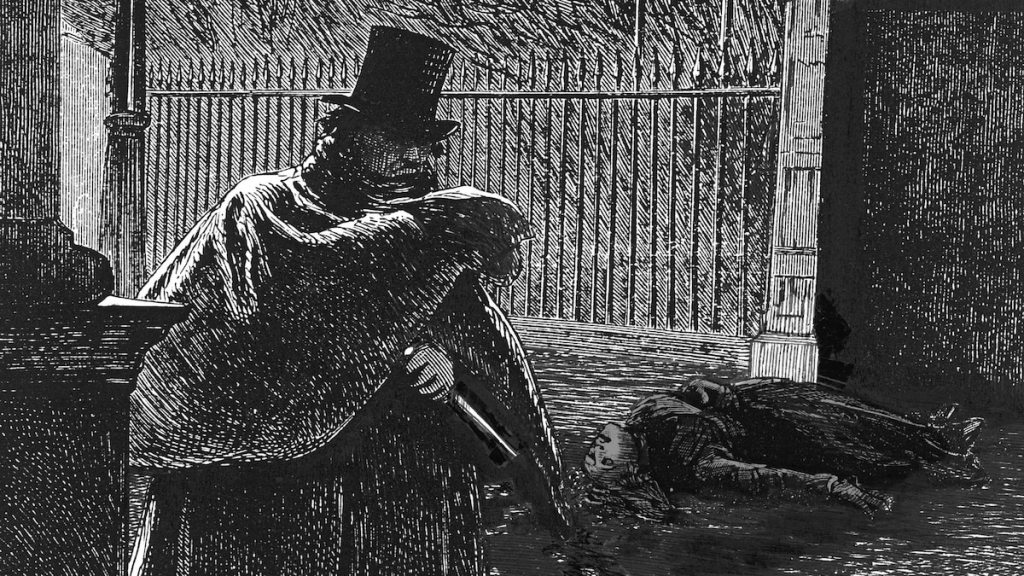
The bit that interests devotees of Cannibal Studies in this story is the escape of a group of men led by a particularly evil-looking convict named Matt Gabbett (played by Arthur McLaglen in the 1927 film).

Being a silent movie, even the narrator gets an intertitle card:

After nine days with no food, Gabbett points out that there are only two choices— starvation, or eating one of the followers, who has fortuitously become lame. We see him taking an axe to a fellow escapee, while the others cringe, as we suppose semi-civilised folk would.

Gabbett tells them:

The cannibalism subplot was one of the most controversial aspects of the film. Gabbett is based on the true story of Alexander Pearce, who escaped from Macquarie Harbour in 1822 with seven other prisoners. Once recaptured, Pearce confessed that he had eaten his companions, but the magistrate in Hobart refused to believe him. A year later, Pearce escaped again and this time he was recaptured with the flesh of another man still in his pockets. He was taken to Hobart and hanged.

The story languished somewhat until revived in a six hour mini-series in 1983. In 2008-09, a number of Australian films were made that referenced Pearce – The Last Confession of Alexander Pearce (2008), directed by Michael James Rowland; Dying Breed (2008 – about his supposed offspring who are still eating people in the 21st century), directed by Jody Dwyer; and Van Dieman’s Land (2009), directed by Jonathan auf der Heide, which cut the crap and concentrated on the cannibalism story. We’ll get to revue this one, dear reader, one of these days.

The controversy over Norman Dawn’s 1927 version was driven partly by Tasmanian sensitivities about the unwholesome revelation of the island’s history. Marcus Clarke’s book was one thing; a big international motion picture, intended for a mass audience overseas, was quite another. Certainly, the film does sensationalise the cannibalism, shifting the focus away from the book’s message, which was to advocate prison reform. Prisoners like Gabbett (played by the brother of well-known British actor Victor McLaglen) seemed more likely to offer justification of capital punishment.

Australia is sorely lacking in cannibal stories, so even though Alexander Pearce was Irish (as were a large percentage of convicts), we claim him as our own. He did, after all, eat people and get hanged here, and if he hadn’t, no one would even remember he ever existed.

The film is currently available on YouTube.
MIRACLE MEAT (yes, it’s baby cannibalism)

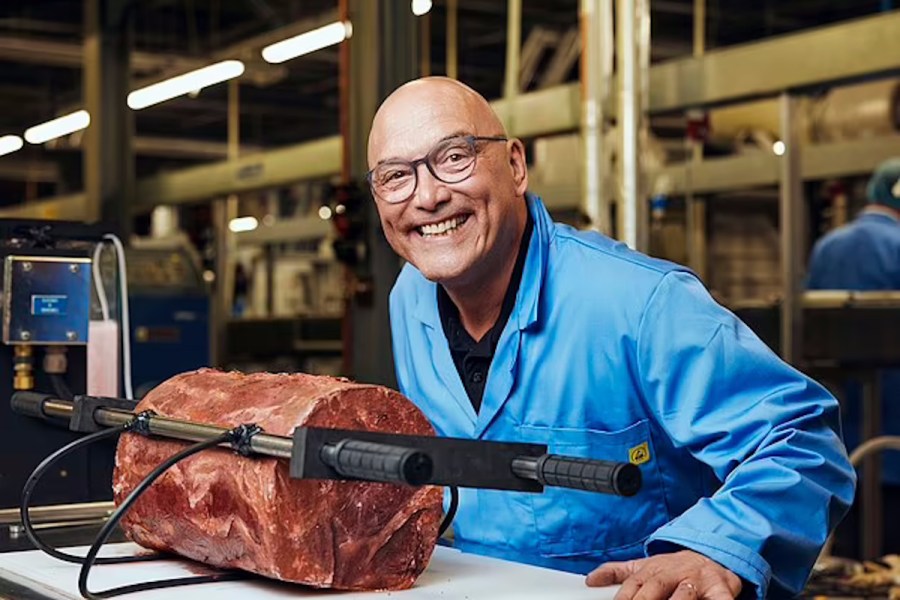
Gregg Wallace is arousing the fury of the Internet for hosting a show in which human meat is grown for human consumption. Yes, engineered cannibalism.

If you haven’t heard of Gregg Wallace (I plead guilty), he is a host of the UK version of MasterChef, a reality show where people have to cook flesh in a way that – I don’t really know, I don’t watch it.

This show is called The British Miracle Meat, and is quite obviously a satirical documentary, set in a factory which purportedly manufactures ‘engineered human meat’.

Following its debut, 408 people complained to the broadcasting regulator. The majority of complainants objected to the theme being the consumption of human meat. Which is, IMHO, pretty rich coming from people who tuned in to a show about meat.

It seems to have been inspired by a work written in 1729 by Jonathan Swift (the author of Gulliver’s Travels), which was called:

A Modest Proposal For preventing the Children of Poor People From being a Burthen to Their Parents or Country, and For making them Beneficial to the Publick

Swift suggested that the Irish could be relieved of their destitute states by selling their children to the Landlords who “have already devoured most of the parents”:

A young healthy Child, well nursed, is at a Year old, a most delicious, nourishing, and wholesome Food; whether Stewed, Roasted, Baked or Boiled; and I make no doubt, that it will equally serve in a Fricasie, or Ragout

Since the British Empire was sucking the Irish populace dry and leaving them to starve, why not eat them as well? Satire has remained a popular form of political action ever since, and is used extensively, particularly in American politics (watch any late-night show).

Wallace is shown visiting a heavily guarded processing plant in Lincolnshire, which houses a production line and clinical facilities. He is told that, for the last eight months, they have been producing meat made from human cells. Line manager Mick Ross explains that it is a relatively new process. “Under EU law we couldn’t possibly operate machines like this.”

We see little shavings of flesh hanging in a nutrient-rich vat and quickly developing into huge slabs of meat. Wallace interviews ‘donors’ who sell their flesh to fictional firm ‘Good Harvest’ as a solution for cash-strapped families. One 67-year-old retired receptionist said she had agreed to have flesh taken from her buttock and thigh in order to fund two weeks’ energy bills. The flesh is then shown growing in labs into larger slabs of meat – which can be used to make steaks, burgers and sausages.

These can yield up to one hundred steaks, which— according to taste tests carried out with men and women in the street by co-presenter Michelle Ackerley—are remarkably fine substitutes for beef, and at a fraction of the price. Is this the answer to the cost of living crisis?

“Why human meat, why not animal meat?” asks Wallace, and Ross explains that we know more about humans, we have centuries of medical and scientific knowledge, so can more easily manipulate it.

Good Harvest’s chief executive revealed the firm’s premium range comes from the flesh of children aged six and below – with a promotional video which billed the womb as ‘nature’s oven’. Well, we already know from watching Snowpiercer that babies taste best. And Gregg – let’s try to remember that humans ARE animals, yes?

But apparently many of the British viewing public did not get Gregg Wallace’s joke. The show gave no warning ahead or during the broadcast to indicate that it was fictional. That was supposed to be, in British parlance, bleedin’ obvious. Interviewed after the show aired, Wallace said:

It’s satire – so I suppose that was the point. Everybody was an actor. I was acting. None of it was real… While it was a complete fantasy, we wanted to raise important questions about the nation’s relationship with food and what those struggling with the cost of living are being asked to do in order to stay afloat.

A Channel 4 spokesman said:

This “mockumentary” is a witty yet thought-provoking commentary on the extreme measures many people are being forced to take to stay afloat in our society during the cost-of-living crisis. Channel 4 has a long and rich history of satire and has often used humour as an accessible way to highlight society’s most important issues.

The problem was, it was not clear what the point was. Lab meat can be grown from any animal cell. Find a readable chain of DNA and it may be possible to try whale, dodo or dinosaur flesh. Of course, the easiest cells to source are human ones – we routinely hand them to pathologists and crime scene investigators. When clean meat becomes commercially viable, there is no reason (other than administrative) to assume we could not grow human steaks, livers or sweetbreads. The eating of lab-grown flesh from celebrities is the starting point of the film Antiviral. Eating human meat grown in a lab would technically be cannibalism, but it would not, as with traditional cannibalism, involve cruelty, murder or despoiling of corpses.

The show concentrates on the cost of living crisis, and clearly cheaper food prices would help. Would people sell their own flesh, and would other people eat steaks grown from it? A better point might have been to point out that humans currently breed and slaughter some eighty billion (that’s 80,000,000,000) land animals every year to eat their flesh, not counting sea animals, whose numbers can only be estimated but might be about three trillion. Although most people prefer not to see the appalling conditions of the factory farms or the brutal deaths in the abattoirs, they tune in by the millions to watch cooking shows like MasterChef which treat the consumption of this flesh as unremarkable, and often the butt of crude humour.

So why not add one more animal to the conveyor belt?

As Herbert M. Shelton said in his book Superior Nutrition:

The cannibal goes out and hunts, pursues and kills another man and proceeds to cook and eat him precisely as he would any other game. There is not a single argument nor a single fact that can be offered in favor of flesh eating that cannot be offered with equal strength, in favor of cannibalism.

I wonder if Jonathan Swift would have recognised the plagiarism of his book? His brand of satire is usually called “Menippean” and is characterised by attacking mental attitudes and beliefs.

The joke is not that Wallace pretended to visit a factory that pretended to pay willing donors for flesh. The real belly laugh is that over 400 people complained about that, while probably tucking in to the corpse of an animal who really did not want to die.

“It’s primitive as can be”: GILLIGAN’S ISLAND (1964-67)

A tweet making waves the other day from film director James Gunn reminded me of the many hours I wasted spent as a child watching the seemingly endless travails of the seven castaways on the TV series Gilligan’s Island. Being shipwrecked on a desert island with Mary Ann and Ginger did not seem such an ordeal to my pubescent mind, except every now and the group would be threatened by the arrival of – yep – CANNIBALS!

English professor Priscilla Walton observes that her first encounter with cannibals was also on her television, watching the enormously popular show. The series ran from 1964-67 over some 98 episodes plus occasional reunion movies.

Gilligan’s Island (GI) was a clever reboot of the first English language novel, Daniel Defoe’s Robinson Crusoe (even mentioning that story in the closing song).

“No phone, no lights, no motor car, not a single luxury. Like Robinson Crusoe, they’re primitive as can be.”

Unlike Defoe’s story, Gilligan (Bob Denver) was not a lone survivor of a shipwreck but the hapless “first mate” on a little cruise boat, The Minnow. Gilligan, his skipper (Alan Hale) and five tourists left a tropical port for a three-hour tour, and instead were marooned on an uncharted island, apparently interminably. Various commentators with too much time on their hands have suggested that the seven castaways represent the seven deadly sins (e.g. Ginger was lust and Mary Ann envy). I’m not going near that one, fascinating as it is, because this is a cannibal blog after all. And cannibalism is neither illegal, nor one of the seven deadly sins. It just misses out on all the gongs.

Robinson Crusoe worried ceaselessly about his lack of company, eventually adopting Friday, a local ‘savage’ whom he rescued from a tribe of cannibals. He also spent a lot of the book and some of the movies worried about what to eat, and nervous that Friday might eat him. Like those of us marooned on this planet rather than an island, major preoccupations are always fear and appetite. Appetite is all about food and sex. Fear is about being killed and perhaps eaten.

The obsessions of Gilligan and the other all-white islanders were the same. Of course, it was the sixties, so no sex could be shown except for the movie star, Ginger (Tina Louise) who used her flirty charms to inflame and coax the men into various (non-sexual) activities. But – what did the castaways eat? Well, it was an island, so presumably the would eat sea animals, as well as various plants (including some that grew from a box of radioactive seeds in one episode). There seemed to be a lot of coconut pies.

Then of course, like Crusoe, there were the natives who, like most depictions of indigenous peoples until fairly recently, were assumed to be primitive savages and so, ipso facto, cannibals. No evidence was presented, and no one was ever eaten. From the earliest days of the movie, and well before, indigenous peoples who were being dispossessed by European explorers were declared cannibals, with no evidence needed other than their lack of “civilisation.” Think of movies like Cannibal Holocaust and the various Italian movies of that period, or old classics like Windbag the Sailor, Be My King, or the early racist cartoons like Jungle Jitters.

Sheer Eurocentric racism of course, as I suppose was the choice of the Irish name “Gilligan” for the show’s clown, a boy/man who is usually responsible for thwarting their rescue through his clueless blunderings. The “natives” were invariably people of colour wearing grass skirts with bone piercings in ears, noses, etc and horns on their heads. This probably is the image that springs to mind even now when a cannibal scholar mentions cannibalism in polite company – primitive savages who threaten our safety and bodies if we fall into their clutches. Of course, as Walton points out, the island was the traditional home of the “natives” – it was Gilligan and the castaways who were the intruders, introducing baffling technology and probably a few new pandemics to the locals. There’s a comprehensive study of GI Natives on a Gilligan fandom page. Yes Virginia, there is a GI fandom site.

But the cannibal has moved on. From the outsider who was only sighted by explorers or conquistadors, the cannibal has firmly come home and, since the time of Jack the Ripper who boasted of eating the kidney of one of his victims, the vast majority of reports of cannibalism involve people in urban cities and communities eating their neighbours. Generally, they are dismissed as psychotic personalities who know not what they do. That discourse has become ever less convincing, with cannibals like Fritz Haarmann or Armin Meiwes or even Jeffrey Dahmer all seeming to know exactly what they were doing. The ultimate example of the civilised, enlightened, urbane cannibal is of course Hannibal Lecter, who simply sees eating inferior or rude humans as no worse than eating pigs or fish. Unlike the other examples, Hannibal is fictional, but perfectly represents the cultural trend toward the modern, domestic cannibal.

So, who would the cannibals have been in a re-booted Gilligan’s Island? There are clues. While the men seem largely asexual (Gilligan and the Skipper could perhaps be considered bunk-mates, while the Professor is married to science and Thurston Howell III to Lovey and therefore to asexual domesticity), the women are given standard feminine stereotypes of the virgin (Mary Ann), the whore (Ginger) and the symbolic mother (Lovey). Barbara Creed‘s “The Monstrous-Feminine” emphasises the importance of gender in the construction of female monsters, and so it is not totally surprising that when people turn their fantasies beyond the wholesome storyline of the series, it is the gentle, subservient Mary Ann (Dawn Wells) who becomes the knife-wielding cannibal.

The 2002 comic strip Cool Jerk (above) depicted Mary Ann, or maybe a look-alike, as a cannibal named Mary Annibal. The Silence of the Lambs had swept the Oscars in 1992, and the sequel, Hannibal, had come out in a blaze of publicity in 2001.

Cannibalism on a desert island (or in an inaccessible place like the Andes) is a long tradition, and a rich source of humour. Above is the cover of the Horror Society’s Summer 2015 issue. Can you spot the Cannibal Holocaust reference?

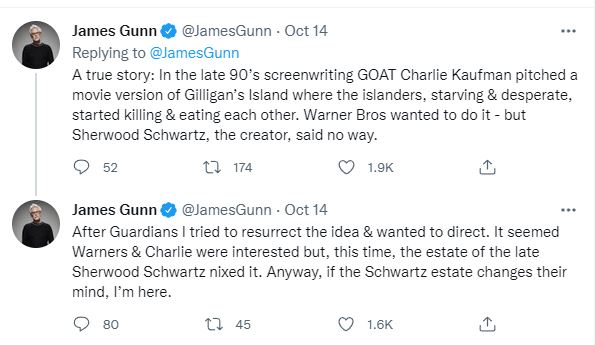
More recently, James Gunn, the director of Guardians of the Galaxy, Suicide Squad and many others (and a known provocateur with a wicked sense of humour) suggested that he and Charlie Kaufman had wanted to restart “Gilligan Kimishima” as a cannibal movie. He tweeted an image of his entry in a Twitter trend that asked people to “pitch a movie with two pictures, no captions.” He juxtaposed the GI tribe with Theodor de Bry’s 16th century engravings of the Tupinambá in Brazil, a series of engravings he based on the sensational accounts of Hans Staden and Jean de Léry, both of whom gave graphic descriptions of cannibalism (hey, it sells books).

Gunn went on to explain that this was a true story. He and Charlie Kaufman had pitched a movie version of Gilligan’s Island to Warner Bros. in which the starving castaways would kill and eat each other. Unfortunately, the creator of GI, Sherwood Schwartz (and later his estate) refused to let it go ahead.

Such a shame. Of course, most of the original GI actors are now dead (Dawn Wells sadly died from COVID-19 just before New Year), but with modern artificial intelligence and deepfake technology, who says we couldn’t have a cannibal feast on an avatar Gilligan’s Island? It would at least be white meat.