Issei Sagawa: “This Is A Manga Written By A Cannibalistic Murderer”

 “I just open the page, and the first thing I see is – a half-eaten head.”

If you’re not familiar with the term, “anime” is animation, which can be hand drawn or computer generated. It usually refers to Japanese creations, but in Japan it can apply to any animated work. Usually, anime is used to refer to TV shows or movies, while “manga” usually means graphic novels (comics). There is children’s anime and a whole range of adult material, which regularly wanders into the world of sex and violence.

The manga reviewed in this short YouTube clip (above) embraces both sex and violence, as well as combining those in the form of necrophilia and cannibalism, and does so in graphic detail. It is the autobiographical record of Issei Sagawa, a Japanese man who murdered and cannibalised a young Dutch student named Renée Hartevelt, whom he had befriended at the Sorbonne in Paris in 1981. Sagawa never served time for the act.

Sagawa’s story has been told in many formats, including several documentaries, including The Cannibal Who Walked Free in 2007 and CANIBA in 2017.

Sagawa died in 2022, but he left behind a record of his activities in the form of manga, a comic book, although it was far from comical. In fact, this review on YouTube is on the site “Anime Dork”, described as “a team of passionate anime otakus” (obsessive fans), formed in August 2022, whose reviews are usually fairly light-hearted and humorous.

Not this one. The reviewer, Sydney Poniewaz, who writes under the name sydsnap, is an actress and YouTube star (pushing toward a million subscribers, so very successful), and a True Crime aficionado, particularly fascinated by the often very weird crimes committed in Japan, where she sometimes resides. But she is clearly horrified by the content of the booklet she is holding which, she tells us, is drawn by “an awful human being”, and extracts of which she eventually begins showing us.

She gives a brief synopsis of the case, such as:

“He began to sexually assault her corpse, and then partake in cannibalisation of her body.”

In the manga, she tells us,

“He talked about everything he did to her body: every scent he smelled, every texture he felt, every disgusting brief or prolonged thought throughout any sort of disgusting act he did, which – he does a lot!”

She seems most shocked by the fact that he escaped justice and led the rest of his life a free man, making films including porn, writing books, and even doing restaurant reviews.

“I’m trying to show one image where he’s not being disgusting, but honestly, he always is… he’s talking about how good it felt to murder her, how he wants to do it again.”

So, Sydney did not like the book, which she bought for (no doubt) a lot of money, and then she had to pay lots more to have the Japanese text translated, which she truly seems to regret.

“I do not recommend it. I really, really, really do not recommend it for the faint of heart. I am a pretty hard person to shake in terms of content, but this is probably the most disgusting thing I have ever read.”

There are a lot of comments on the YouTube site, mostly shocked and horrified, and a few are below. I particularly like the one that emphasises that these stories almost always focus on the killer, this one being told by him from his point of view, and rarely the victim. Renée Hartevelt, like Charlene Downes whom we discussed last week, deserves to be remembered for more than just being eaten by another member of her species.

There are more extracts of the manga, if you are interested, in the Caniba documentary, and I captured a few for my review of it. Or if you really want to get into the whole story (and I suppose some readers will), the manga itself is available on eBay, for a hefty price tag.

Why did he do it? The manga makes that pretty clear. He ate Renée for the same reason any of us eat anything – because he wanted to. The outrage that followed is based on the deeply held but mostly unexamined idea, largely based in religion, that humans are somehow separate and above other animals, kind of demi-gods. Issei Sagawa, obviously, did not believe that.

“You guys eat people!” Gannibal (Shinzô Katayama, 2023)

Gannibal is a new seven-episode television series set in present day, rural Japan. The show is based on a Manga series (comic or graphic novel) which appears to be available on-line.

In the first episode, we see a policeman raging outside a house, accusing the occupants of cannibalism. He soon comes to a sticky end.

Police officer Daigo Agawa becomes Chuzai (residential police officer) at the Kuge village, accompanied by his wife Yuki and daughter Mashiro, after the previous Chuzai mysteriously went missing (the same officer seen being killed in the opening). Daigo has caused some incident in his previous posting, which has led to his transfer to this remote and eerie (but very beautiful) village.

The daughter, Mashiro, seems to have no fear, but also refuses to speak, which Daigo believes is his fault. On his first day, Daigo is summoned by the Goto family, who seem to run the small forestry village, like a local crime family.

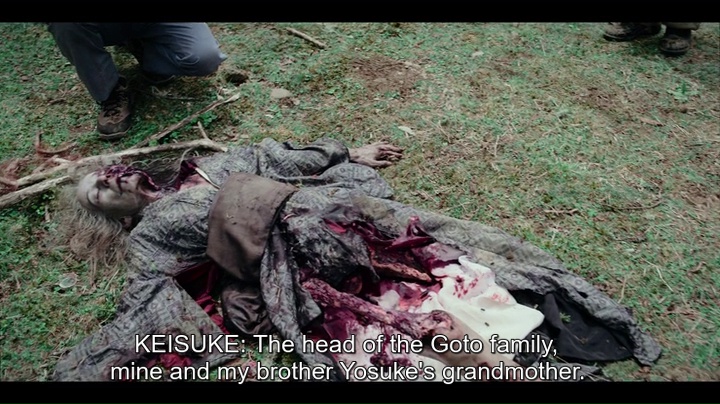
They have found the body of their grandmother, Gin Goto, the head of the family. They insist she was attacked by a bear, and pull out firearms when Daigo points out that the tooth marks on her arm are human.

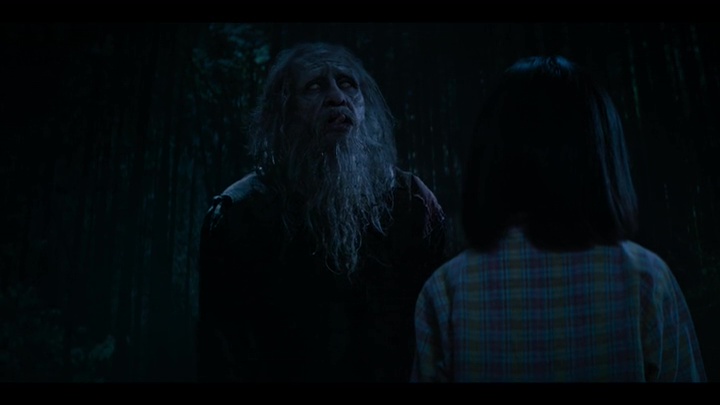
Meanwhile the little girl Mashiro wanders away from home, and meets up with a large blind guy who seems only able to snarl.

Showing no fear, she offers him a sugar candy, and in turn comes home with a human finger.

Problem: the finger is not from Gin Goto. Lots of people are, apparently, getting dismembered.

Daigo accompanies the Goto family on a hunt to find the bear that they claim ate Grandma, and is then attacked by a bear, who turns out to have granny’s specs in his stomach.

In a scene that could almost define carnivorous virility, the men gather around the bear and eat his flesh, a ritual that is supposed to keep Grandma within them.

This is what we call, in Cannibal Studies, “essentialism, the idea that the spirit or strength of a person lives on by eating them, even if only via the bear that ate her (even though that’s clearly not what happened).

In the following episodes, Daigo slowly unravels the truth about cannibalism in the village.

Gannibal is directed by Shinzô Katayama, the director of the horror-thriller Missing. Reviews have been glowing, stressing how ‘gross’ and unsettling the show is. One tweet said:

Except for the opening, which is over the top in Japanese anime style, the acting is great, the suspense interesting without jump scares, the music eerie, and the photography beautiful. If you like a good suspense show and don’t mind subtitles, this one is highly recommended.

Gannibal started streaming December 28 on Hulu. Also available on Disney+.

Issei Sagawa, in your face: CANIBA (2017)

In 1987, Japanese student Issei Sagawa murdered a young Dutch woman, Renée Hartevelt, a fellow student at the Paris Sorbonne, then mutilated, cannibalised, and performed necrophilia on her corpse over a period of two days.

Sagawa was declared insane in France and returned to Japan, where he could not be tried for murder as no evidence had been sent by the French. A free man, he became something of a celebrity, making torture porn movies, selling paintings (many of them nudes), writing books and manga showing his crime, and even becoming a food critic. The fascination so many people feel with the life and crimes of Issei Sagawa is shown by the number of documentaries made about him:

  • Cannibal Superstar (Viasat Explore, Sweden, 1986, 47 minutes)
  • Excuse Me for Living (Channel 4, UK, 1993, 60 minutes)
  • The Cannibal That Walked Free (Channel 5, UK, 2007, 46 minutes)
  • Interview with a Cannibal (Vice, US, 2011, 34 minutes)

And, most recently, this one: Canniba, made by two artists/anthropologists, Véréna Paravel and Lucien Castaing-Taylor from Harvard’s Sensory Ethnography Lab. Unlike the more standard documentaries which deal in psychoanalytic speculations and dramatic narration, this one is an extreme close-up of the cannibal himself, in his declining years. The only characters shown are Sagawa himself, his brother Jun and a young woman carer, who is inappropriately dressed in a maid’s uniform and happily tells him zombie stories as she prepares him for bed. Sagawa was hospitalized in 2013 from a cerebral infarction, which permanently damaged his nervous system, and due to this and severe diabetes is largely unresponsive through most of the filming, becoming animated only when discussing his murder of Renée. Jun sums his brother up:

“Cannibalism is really very much nourished by fetishistic desire. The desire to lick the lips of your lover, and things like that, are based on primal urges. Cannibalism is just an extension of that. Both extremes exist within him. Cannibalism is a totally different world for him.”
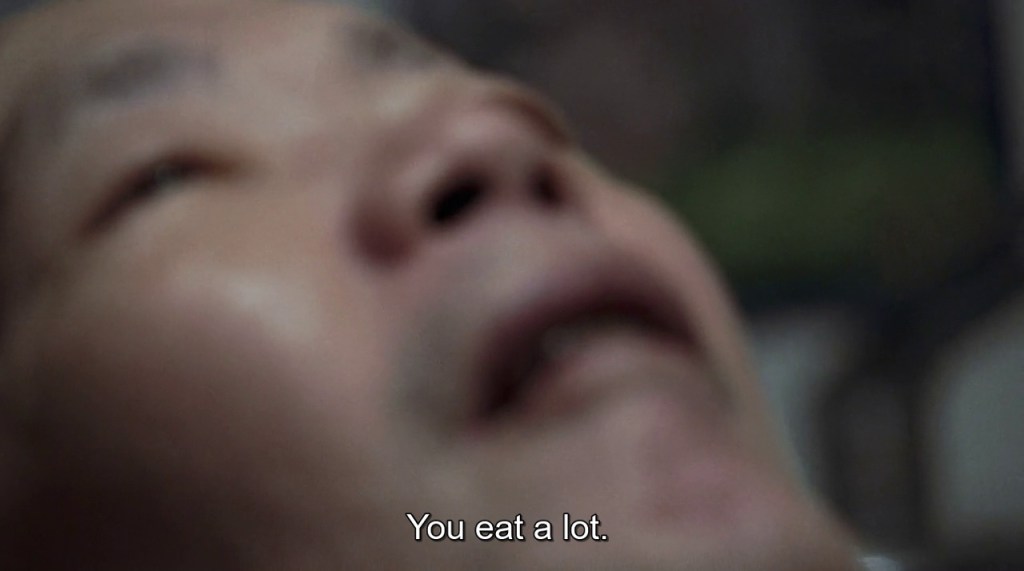
The film seems to ask us to consider our own fetishes (you don’t have any? That would make you unique) and asks whether we are repulsed by Sagawa’s acts, or by the abjection in ourselves which he forces us to confront.

The first thirty minutes are a gruelling close-up of the two men – Issei and Jun and their desultory interactions, with the camera so close you can see every pore, except when it (blessedly) goes out of focus. Issei is largely catatonic, staring sightlessly as we, in turn, stare in extreme close-up at his face, which looks almost like a death mask. The only signs of animation are when he is offered chocolate, of which he seems inordinately fond, perhaps as a substitute for the human flesh he so craved. Probably not great for his diabetes, but we’re not really hoping for a happy ending to this story.

Unable to see a future, Issei dwells on the past. He remembers his mother telling him in graphic detail about falling down some stairs in a department store and miscarrying.

From this glimpse of the behavioural background to his subsequent actions, we are suddenly catapulted to a clip of a much younger Issei in a porn film, biting a woman’s buttocks, as he did to the dead victim, then being urinated on and finally masturbated by her.

The horror of his ruined visage is contrasted to the prudish pixilation of the debauchery.

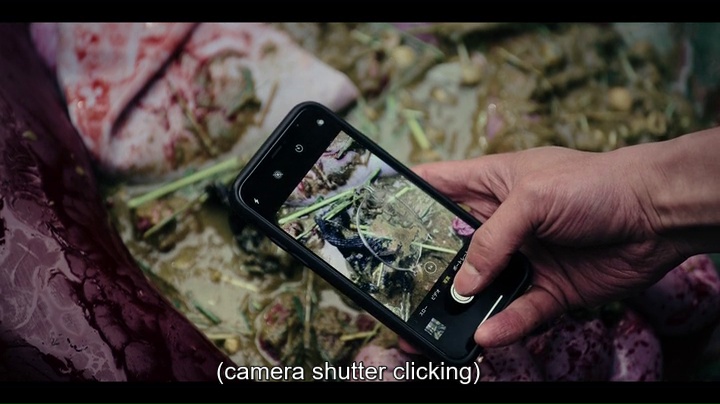
If we haven’t walked out by now, as many of the audience did at the early screenings in the Toronto and Venice film festivals, we are then treated to his commentary, now quite animated, on his manga – a comic-book format showing his murder, rape and cannibalisation of the young woman. His brother tut-tuts throughout, saying he doesn’t want to see such things, while Issei explains what he did, and what it meant to him.

“For a hideous person like me, she was out of reach.”

A bullet in the back of her neck was the only way he could think of to bring her into his reach.

“Finally the thing I was craving to eat was right in front of me! The stench doesn’t matter. I started with the richest part of her right buttock.”

The murder and cannibalism turned a shy, diminutive man-child into a fierce Samurai, in his own mind.

He describes the eating the flesh (the harvesting of which is shown in detail in the manga) as “an historical moment!” For that brief time, the woman was entirely his, and what Derrida called carnivorous virility gave him an absurd sense of masculine power as he “dominated” the woman’s corpse for his sexual and gastronomic pleasure.

There’s heaps more, but you’ll have to watch the film or get the manga – my blog has its limits.

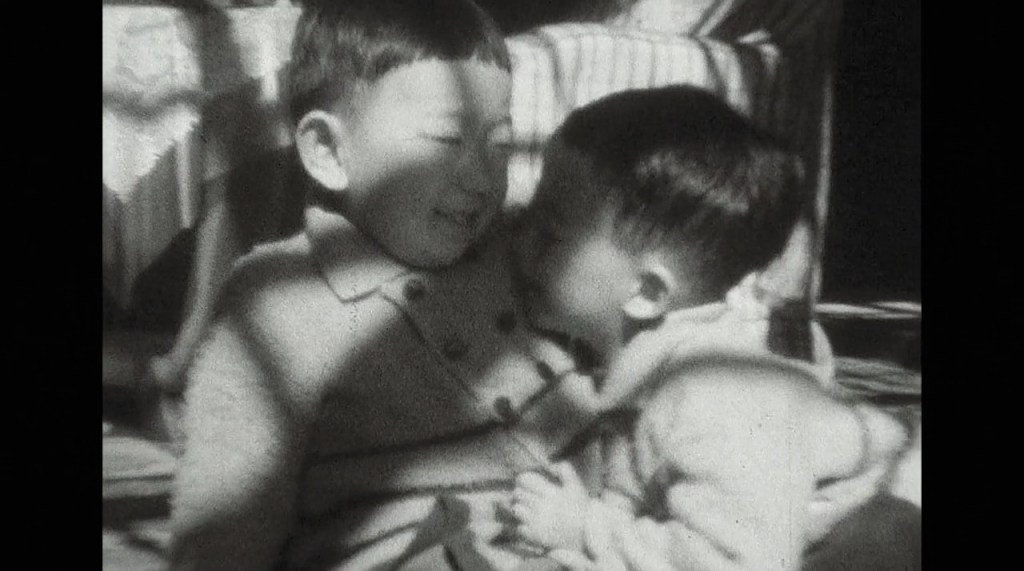
The film then disconcertingly lurches into home movies of the two men when they were cute little boys.

We are not given a commentary, but we know from other accounts that their uncle would dress up as a cannibal and capture them for his cooking pot. The psychoanalysts would eat that up, but we should consider that many of us are chased by various demented relatives in our childhood games without going on to become monsters in their likeness.

Issei’s brother Jun, now his carer, appears as the sane one in the family, but we are quickly disabused of that as we see his own self-abuse – he likes to wrap his arms in barbed wire, and cut his arms with knives. Everyone needs a hobby I guess. Issei is not impressed – compared to shooting a woman from behind and then having sex with the body and eating parts of it, a bit of cutting would seem fairly tame to him.

Finally we meet the carer, a young, attractive women dressed as a maid. This is actually Satomi Yôko, an actress playing a maid playing a carer, a further jolt to our fragile sense of reality. She giggles over Issei, telling him, as he stares into her breasts (a particular fetish of his):

She asks him if he wants to cosplay a zombie, and tells him a convoluted story about a zombie woman who eats the old man who keeps her in chains, a reversal of his history, and another fetish of Issei’s, who early in the film says “I want to be eaten by Renée.” She tells him:

“For the zombie to survive, I have to keep eating live humans… I’m alive, but I can’t be with normal humans.”

It’s a perfect summation for the fate of Issei Sagawa.

The only soundtrack is at the very end, The Stranglers’ 1981 song “La Folie” (“madness”) which concerned Sagawa’s crime.

It’s in French, but the partial translation is:

He was once a student
Who strongly wanted, like in literature,
His girlfriend, she was so sweet
That he could almost eat her
Rejecting all vices
Warding off all evils
Destroying all beauty

The film managed 53% fresh on Rotten Tomatoes, while the New York Times called the movie “an exercise in intellectualized scab-picking.” IndieWire summed up:

“Caniba” ranks among the most unpleasant movies ever made, but that doesn’t mean you shouldn’t see it.

There is another review of an earlier Sagawa documentary, The Cannibal That Walked Free on my blog. The film Caniba is available, if you are so inclined, from https://grasshopperfilm.com/film/caniba/