This film had a lot of publicity due to the cast – Armie Hammer (since mired in cannibalism scandals as detailed elsewhere) plays the Lone Ranger and, wait for it, Johnny Depp (mired in different scandals altogether) plays his Native American off-sider Tonto. Depp claims he has Native American ancestry, perhaps a great-grandmother, so I guess that’s fine. Helena Bonham-Carter is in there somewhere too, as a brothel madam with an ivory leg – she has certainly graced this blog before, and with Johnny Depp! The director, Gore Verbinski, directed The Ring and the first three Pirates of the Caribbean movies, at least one of which I recall walking out of, but so forgettable were they that I can’t remember which one.
Set in the Wild West in 1869, the Lone Ranger starts off as a lawyer named John Reid, coming to Texas as DA to impose law on a savage land, like Jimmy Stewart in High Noon. His “bible” (he tells the Presbyterians on the train) is John Locke’s Treatises, which insist that
“Whenever men unite into society, they must quit the laws of nature and assume the laws of men, so that society as a whole may prosper.”
Good luck with that.
Reid’s brother, a Texas Ranger, deputises him to help catch an escaped outlaw named Butch Cavendish (William Fichtner from Armageddon, Black Hawk Down and many more). All the deputies are killed by Butch’s gang, except the old drunk, who is working with the outlaws and leads them into an ambush. That could easily (and perhaps mercifully) have been the end of the movie, but Reid is awakened by a “Spirit Horse” and Tonto explains he cannot be killed in battle. He also tells Reid that Butch, the outlaw, is a Wendigo, a figure from Algonquin legend – the tribes from the north of America, and nothing to do with Comanche mythology, but hey, maybe Tonto read this blog.
A Wendigo eats people and gets bigger and stronger as a result, but also hungrier. According to Tonto, he can only be killed with a silver bullet (I think that’s actually vampires, kemosabe). Incidentally, Tonto in the original radio series was not a Comanche but from the Potawatomi nation (who might have referenced Wendigos), but let’s not bother too much with, you know, facts. After all, a spirit horse may have edited the script.
So Reid is still alive and puts on his mask (about an hour into the film), Butch captures his dead brother’s wife and child, a whole tribe of Comanches are massacred by the US Cavalry (that has a ring of truth to it at least), but why on earth is this nonsense being reviewed in a blog about cannibalism?
Well, Butch may or may not be a Wendigo, and may or may not require a silver bullet to kill him (he doesn’t), but he is a cannibal. He is pretty keen on eating people’s hearts, or eyes, or maybe his own foot, according to rumour.
The problem with the movie is that it really can’t decide if it’s a Western drama or a comedy. The bad guys are the essence of evil, but the good guys are clowns. Then in the middle they put a gratuitous massacre of Comanches which at least adds a touch of historical realism.
The special effects are pretty great, with people on horses chasing trains, jumping on trains from horses, jumping on horses from trains, and trains getting derailed and crashing spectacularly. The scenery is gorgeous (Monument Valley of course, even though the film is purportedly set in Texas).
But it flopped at the box office, grossing $260 million against the $650 million that it was estimated to need to break even. Rotten Tomatoes gives it a miserable 31% ‘rotten’ rating, with those 31% mainly loving it, and the rest totally trashing it. The New York Post called it a
“bloated, misshapen mess, a stillborn franchise loaded with metaphors for its feeble attempts to amuse, excite and entertain.”
Then again, the San Jose Mercury News was more forgiving, describing it as a “one hot mess”, but an entertaining one.
If you have two and a half hours to waste, I guess it will keep you amused or shocked or sickened or whatever you take from it. I reviewed it here because it has a bit of cannibalism (Butch eats the Lone Ranger’s brother’s heart) and because Tonto calls him a Wendigo. And there’s not much that’s better than a Wendigo movie.
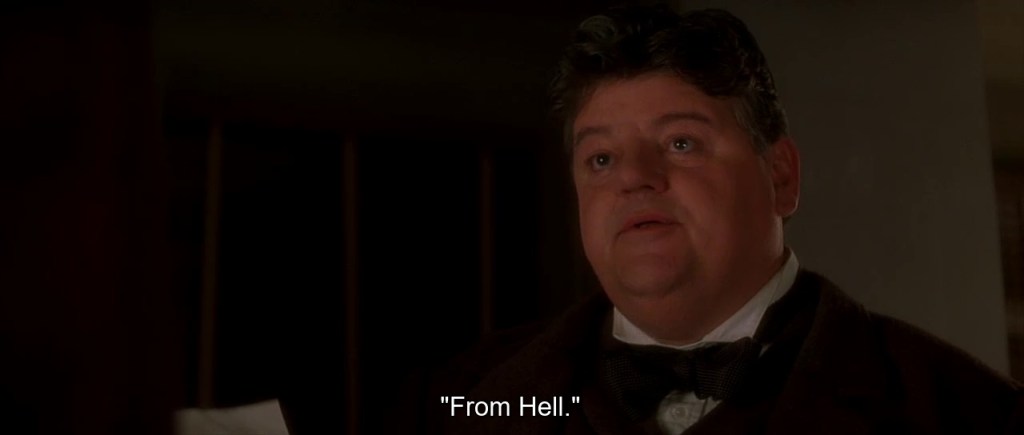
Even those who are not True Crime aficionados know of Jack the Ripper, a mysterious serial killer who slaughtered women in the Whitechapel district of London in 1888, took body parts for trophies, and on one occasion wrote to the authorities boasting of having eaten a victim’s kidney. Well, half a kidney – the other half was enclosed in the letter, and was positively identified as human tissue. The letter was entitled “FROM HELL”.
In my thesis, I date modern, domestic cannibalism from 1888, when Jack the Ripper murdered five or more women in the summer and autumn of that year.
The From Hell letter was sent to the Chairman of the Whitechapel Vigilance Committee in October with a box containing half a kidney. The letter stated that the writer had taken the kidney from a woman, and half of it was enclosed as proof. “tother piece I fried and ate it very nise” (sic).
This letter, and the half-kidney, are featured in this week’s movie.
A huge literature has developed on the history and likely identity of Jack, but none of it is conclusive; the crime writer Patricia Cornwell argued that the Ripper was the famous artist Walter Sickert. Others have written credible accounts of other suspects, including Prince Edward Albert Victor, second in line to the British throne. The enduring mythology of Jack the Ripper, though, depends on the fact that he remains unknown, a figure hidden by his presumed uniformity with those of his milieu. Jack was the domestic cannibal – murderous, voracious, and indistinguishable from any other citizen, just another face in the street, as demonstrated by the fact that he was never apprehended, or even conclusively identified.
Jack rapidly became an international phenomenon. A Chicago doctor wrote in the Medical Standard that,
… the Whitechapel murderer is a cannibal pure and simple. The Whitechapel murders are clearly the work of a lunatic of the so-called “sexual pervert” type, fortunately rare in Anglo-Saxon lands but not infrequently met with in Russia, Germany, Bohemia and France. In these lunatics there is a return to the animal passions of the lowest cannibalistic savage races. Cannibalism is shown in a thirst for blood, and these animal passions come to the surface when the checks imposed by centuries of civilization are removed either by disease or by the defects inherited from degenerate parents.
So critical to the creation of the domestic monster was The Ripper that almost a century and a half later, books and films are still investigating and theorising on his acts and identity.
Jack went “viral” long before the internet was around to invent the term. Jack conventions are held around the world offering attendees the opportunity to view and buy merch and listen to “experts” tell them who Jack (maybe) was. Many books have offered definitive proof of Jack’s secret identity, only to have other experts contradict them. One writer actually bought at auction a shawl belonging to one of the victims, Catherine Eddowes, and had it forensically examined, finding, through links to the DNA of descendants, that it contained her blood, and the semen of a long-suspected Polish immigrant named Aaron Kosminski. Seems conclusive, doesn’t it, but other Jack-fans were sceptical; DNA can be contaminated. Richard Cobb, who organizes Jack the Ripper conventions, told the Guardian that the shawl had been “openly handled by loads of people and been touched, breathed on, spat upon.”
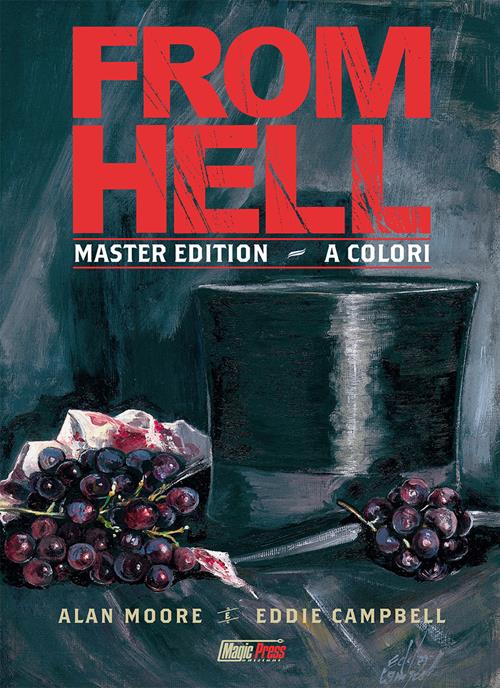
This film, From Hell, has a somewhat more circuitous lineage, being based on a graphic novel (formerly called comic book series) by Alan Moore and Eddie Campbell which was published from 1989-1998 and then collected into book form. That novel is based on a 1976 non-fiction book by Stephen Knight with the rather unfortunate title of Jack the Ripper: The Final Solution.Knight’s theory proposes a conspiracy by the Freemasons, in which high-ranking Freemason Sir William Gull, royal surgeon to Queen Victoria, is told to cover up the marriage of a shopgirl, Annie Crook to Prince Albert Victor, the heir to the throne, which had resulted in a baby who would be in line for the crown, particularly as the Prince was dying of syphilis. The murders themselves were not the crimes of passion common in impoverished London, particularly from the pimps that the women feared most, but involved the careful dissection of the bodies and removal of organs and often vulvas. The basis of many theories was that these were clearly the work of an educated man with medical or at least anatomical training.
“Martha Tabram was raped, tortured and killed. This is methodical. The butchery is irrational, yet meticulous and deliberate. Altogether a different breed of killer.”
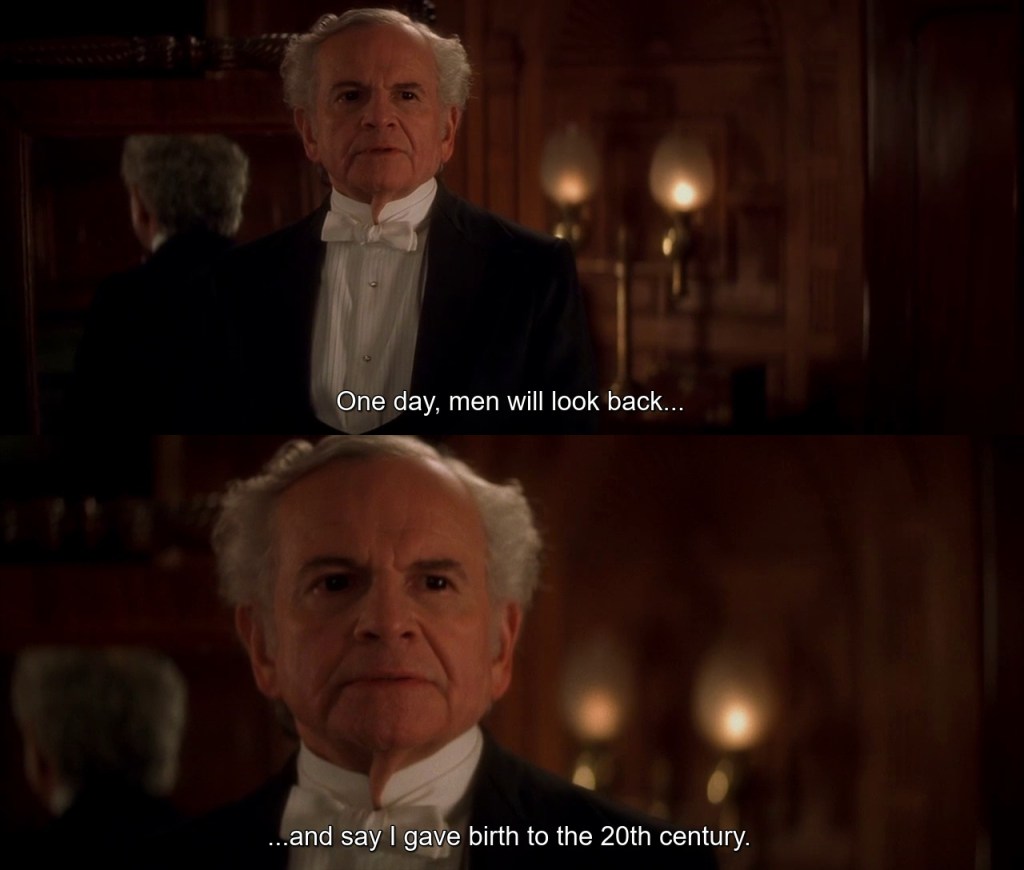
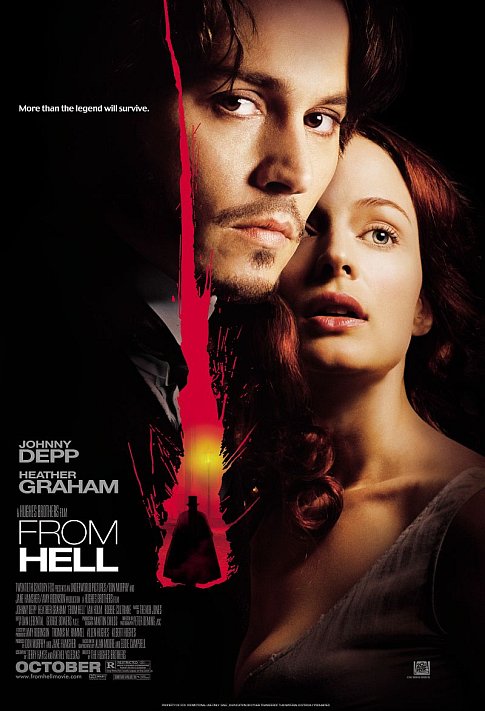
The film had mixed reviews, getting a 57% “fresh” rating on Rotten Tomatoes, but I found it an easy to watch, interesting tale told with some gusto, by a stellar cast: Sir William Gull, physician to His Maj and presumed serial killer, is played by the late lamented Ian Holm, who was playing a sweet, doddery, 111 year old Bilbo Baggins in The Lord of the Rings: The Fellowship of the Ring the same year he played Jack.
Johnny Depp plays Inspector Abberline, the cop searching for Jack, with his usual brooding sensual close-ups, while Heather Graham (Boogie Nights) is quite luminous as the sex worker Mary Kelly, who becomes his love interest as well as a target of Jack. Then there’s a delightful performance by Robbie Coltrane (Hagrid from the Harry Potter films) as Abberline’s sergeant, who quotes Shakespeare as he tries to revive Abberline from his opium den dreams, where he imbibes absinthe laced with laudanum and “sees” the murders as they happen.
Ian McNeice (Bert Large from Doc Martin) pops up as the coroner, and there are a host of other familiar faces. If you like a boisterous story and some great performances, you might enjoy this. But if you are serious Jack groupie, you will wince at the anachronism that puts the receipt of the kidney some time before the murder of Catherine Eddowes, from whom that kidney is likely to have been taken.
Like any fictional recreation of history, there is inevitably exaggeration and speculation. The film depicts an all-powerful Freemason movement infiltrating the police and medical establishment and threatening or killing anyone in their way. There is an evocative depiction of the life of late nineteenth century sex workers (called “whores” by the police, and often themselves, and “unfortunates” in official language). There is also some cursory mention of the classism and racism that English society exhibited in the age of Empire (and still does), seeking to blame the American natives in “Buffalo Bill’s Wild West Show” (perhaps a wink to the serial killer in The Silence of the Lambs?), foreigners, Orientals, Jews, Socialists – anyone other than the rich and powerful. Several scenes feature the hatred of Jews that saw the police and the populace open to antisemitic provocation when looking for a scapegoat. The chasm between the respectable killer and the honest but disreputable poor is made by means of an (otherwise gratuitous) appearance by the Elephant Man, Joseph Merrick who, like Jack, was a famous denizen of Whitechapel. He stands surrounded by respectable white men, wondering at his ugliness, but having no inkling of his humanity.
Foreigners, the disfigured, the “unfortunates” and Jews were outsiders in English society, and outsiders are denied the protection that other citizens expect, and so are easily accused, attacked, killed and sometimes even eaten. The “unfortunate” mother of the royal baby is kidnapped and given a frontal lobotomy, a new scientific technique which was instantly turned to the advantage of the elite.
In Victorian England, the poor were blamed for any and all of society’s ills, with the idea of suspecting a rich, educated man excluded from consideration. Of course, the Indigenous people in Queen Victoria’s empire were similarly objectified, enslaved or slaughtered, also using the benefits of modern technology such as the gunboat and machine-gun.
The movie opens with a quote, Jack, saying “One day men will look back and say I gave birth to the twentieth century.”
I can see no other reference to such a quote in any source other than this movie, but it has a certain ring to it, it makes sense of this modern drama between the rich, who only ever want more, and the poor, who scrabble just to stay alive. At a time when the environment has been appropriated and cannibalised by the ruling class, has Jack’s comment in 1888 proved prophetic?
Jack the Ripper was less “a return to the animal passions of the lowest cannibalistic savage races” and more a manifestation of the voracious appetite and greed of modern capitalist industrial society, where the value of everything, including the life of humans and other animals, is counted only in monetary terms, and the marginalised and objectified are cast out and consumed.






 The Cannibal Guy