

Seems to be the month for cannibal music videos. Last week we looked at the new song CANNIBAL by Marcus Mumford, directed by Steven Spielberg. A beautiful ballad about metaphoric cannibalism, the kind of cannibalism that relationships can turn into, particularly abusive ones. Mumford seems to be referring to child abuse, accusing his abuser of taking “the first slice of me and you ate it raw. Ripped it with your teeth and lips like a cannibal.”

This week’s video (the clip is at the top of this blog) is by the industrial/electronic music duo SKYND, who pioneered the true crime music genre, which presents stories based on murders and other crimes. They have previously written about the death of Elisa Lam whose body was found in a hotel cistern in LA, the manslaughter of Conrad Roy whose girlfriend sent text messages encouraging him to commit suicide, the mass suicide in Jonestown, the Columbine High School massacre, and killers such as Gary M. Heidnik and Katherine Knight.
Most of those songs weren’t about cannibals (Katherine Knight maybe, who killed and cooked her husband, although she didn’t eat him). But the song we are reviewing today retells poetically the story of one of the world’s most famous cannibals, Armin Meiwes, the German man who advertised for someone who wanted to be eaten, and then ate him.
The song starts with the repeated refrain
Let him be fat or lean, let him be fat or lean
Tomorrow I will kill him, tomorrow I will…
Let him be fat or lean, let him be fat or lean
Tomorrow I will cook him, tomorrow I will…
This is a reference to the fairy tale Hänsel und Gretel, recorded by the Brothers Grimm and published in 1812. You may remember this one giving you nightmares when you were very small – two children are abandoned in a forest by their penurious parents and, on the verge of starvation, come across a gingerbread house which they proceed to chew on, only to be captured by the owner, a witch, who wishes to enslave Gretel and eat Hansel, be he fat or lean. The story was reimagined a couple of years ago as the splendid movie Gretel and Hansel.

You may also remember (at least, Fannibals will) that Hannibal Lecter referred to this fairy-tale when he was serving up dinner to Abel Gideon; Gideon’s own leg, smoked in candy apples and thyme, glazed, and served on a sugar cane quill.

Armin Meiwes advertised in 2001 on a fetish website called The Cannibal Café for “a well-built 18 to 30-year-old to be slaughtered and then consumed”. The only reply that seemed sincere, indeed eager, was from a man named Jürgen Brandes, who was not really well-built or 18-30, but Meiwes was a tolerant sort of bloke, or perhaps desperate for his first human-meat meal, so they got together and, after getting to know each other (which included slicing off Brandes’ penis and cooking it), Meiwes left his friend to bleed out in the bath, and then proceeded to butcher his carcass and eat the meat, in a variety of cuts:

Cutlets
Ham
Goulash
Steaks
Knuckles
Bacon
Portion by portion
Cator, you’re a part of me now…
Forever

There is also a reference to Meiwes in the Hannibal episode “Digestivo”, when Mason Verger is planning on eating Hannibal and refers to Meiwes and Brandes eating the latter’s penis, even though it was radically overcooked.
If you want to know more about the case (for which Meiwes is still serving time), there are several excellent links on the Skynd case files website (these guys do their homework!).

Skynd said in an interview:
“When I investigated the case, I watched an interview with him. Meiwes didn’t seem like the typical beast you’d imagine when you think of a ‘cannibal.’ But then again, you might ask yourself, ‘What does a cannibal even look like?’ It’s a story that hasn’t left me for years and I feel like I have finally translated it into music.”
There are a lot of documentaries on this event, which mostly involve ominous music and hushed narratives and absurd comparisons to Hannibal Lecter. Also a movie in which their names were changed, and another one in which they weren’t given names at all.
Or you can just watch this video, which sums up the salient points rather succinctly.
Table set for tonight
Waited for this all my life
Candle lights shining bright
Pull the cork, pour the red wine
Long, big steak on my plate
Potatoes and sprouts on the side
I savor my first bite
Satisfied my appetite.

But before the killing and eating, which Meiwes had wanted to do for most of his life (and which Brandes seemed to want just as much), there was the question of what the “livestock” industry likes to call “humane slaughter”, one of the great oxymorons of the modern world. Brandes apparently wanted to be eaten alive, feel teeth tear into his flesh, but Meiwes was more considerate – pain may be a fun sexual fantasy, but it can really hurt. So they stopped on the way home (Brandes had only bought a one-way train ticket) and bought cough medicine (BREToN, which according to Google is Tulobuterol Hydrochloride and is for “asthma exacerbation”, although the website does rather hilariously say:
“Breton Syrup may also be used for purposes not listed here”
Two bottles of that, a fistful of sleeping tablets washed down with a bottle of schnapps, and Brandes was good to go. They collaboratively cut off his penis (again, it was supposed to be a tooth job, but it was too tough) and cooked it. It was inedible, and Meiwes threw it out (although an urban myth has developed that he fed it to a dog). Then Meiwes put Brandes in the bath to bleed to death and went off to read a Star Trek novel.
Pain killers, cough syrup
Sleeping pills, bottle of schnapps
Sink your teeth, chew it up
Take a knife, make a clean cut
Roast the flesh, medium heat
Add garlic, pepper and salt
Meat is too tough to eat
So I’ll feed it to the dog.Waiting for him to bleed out
Reading Star Trek for three hours
Finally kiss him once and kill him then slaughter him like a piece of…
Like a piece of livestock.

The clip ends with Father (the multi-instrumentalist other half of the duo) appearing as Meiwes, sitting down to have ‘an old friend for dinner’.
Of course, that is the point of this story. Farmers claim to love their animals and then send them off to a terrifying death, hung upside down with their throats cut. There is evidence that Meiwes probably witnessed the slaughter of pigs when he was a child, and found it arousing. In an interview, Meiwes said the butchering was simple:
“It was like cutting up a pig. Meat is meat.”
Meiwes was originally convicted of manslaughter, which caused an uproar in the media. His story was soon adapted in movies, and in the song “Mein Tell” by Rammstein, who then faced the threat of being sued by the cannibal for plagiarism!
Meiwes’ verdict was later amended to murder, a strange decision – can you murder someone who wants to die? His simple claim in his defence was that, unlike pigs, sheep, cows, chickens and other animals, here was a willing victim who consented to, indeed demanded, his own slaughter and consumption. Is it not clearly more ethical to eat an animal who wants to be eaten, whatever the species, than one who does not?


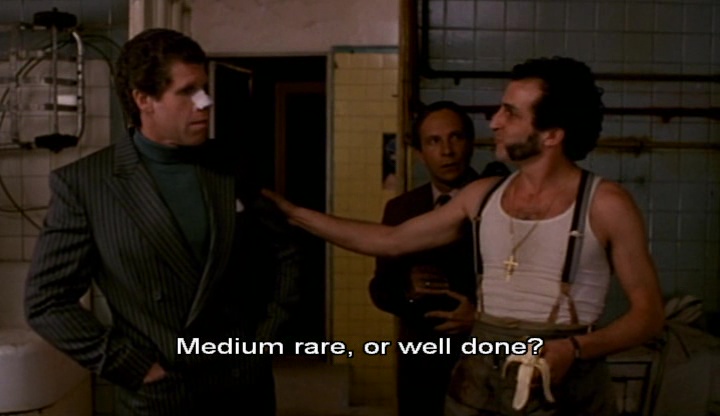







 The Cannibal Guy