

Some months ago, I reviewed a film called Auntie Lee’s Meat Pies, in which I asked readers “What’s in your pie?” This film, The Mad Butcher (Lo strangolatore di Vienna), asks a far more profound question: “What’s in your sausage?” In each case, a better pronoun might have been “who”.

Guido Zurli was an Italian director but this film was made in English, set in Vienna and starred the wonderful, larger-than-life Hollywood actor Victor Buono, who plays the “Mad Butcher” of the title. In the USA, it was released as Meat is Meat, a better title IMHO – describing cannibals as “mad” is such a lazy approach, an intellectual shrug of avoidance. And to the butcher of this film, meat really is… just meat.
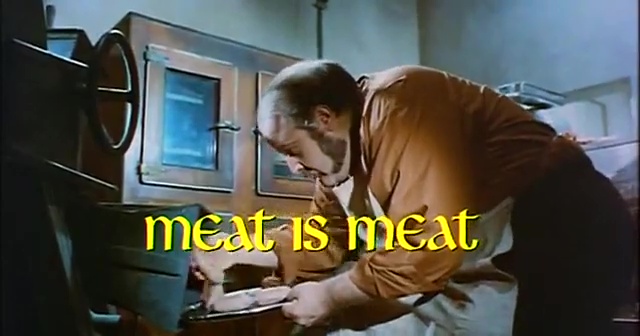
Otto (Buono) is dedicated to his calling – cutting up and selling animal flesh, and to him, the women he kills and minces are just that – meat. Otto has anger issues, which caused him to be confined to an asylum for three years, after slapping a customer with a piece of liver. But now he is being released, with an official certificate allowing him to say, “I’m not crazy now.”
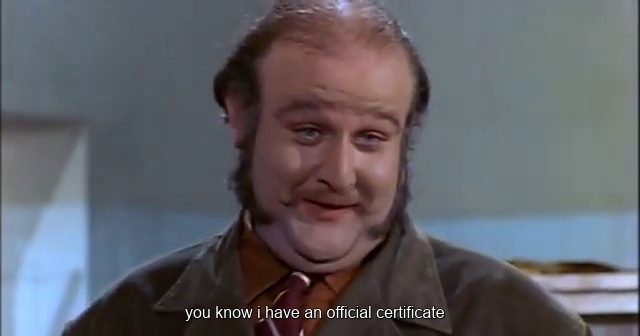
His wife, who had had him committed (to save him going to jail, she claims) wants him to come home with her, worried about what the neighbours will say, but he wants to move into his butcher store where, he tells anyone who will listen, he is “the best butcher in Vienna”.

While throwing from his window the rubbish left by his wife’s brother who was running the store in his absence, Otto sees a neighbour as she showers, in silhouette. She looks, well, edible to him.

His wife catches him staring at the neighbour and, during the resulting row, he strangles her. At first horrified, he realises that there is only one way to get rid of the evidence. After that, he has to dispose of a sex worker brought home by the brother-in-law, and then the brother-in-law, who he has spent much of the film calling a “pig”. Well, he is a very popular butcher, the best in Vienna, and after all, as he opines, “I need this meat.”

But then, when he manages to abduct the neighbour (she of the long showers with the lights on and the blinds open), he has to deal with the American protagonist – a journalist who inexplicably is allowed to hang out with the police and investigate their cases. Otto rips off her clothes (there’s a lot of that sort of thing) and promises her
“I’m not just the best BUTCHER in Vienna!”
As the logline says, in one of those double-entendres that haunt cannibal movies, “His sausage was a cut above the others!“
This is more black comedy than traditional horror – Otto relishes turning his customers into innocent cannibals. They, in turn, rave about his sausages, lining up to buy them from his push-cart in the park.
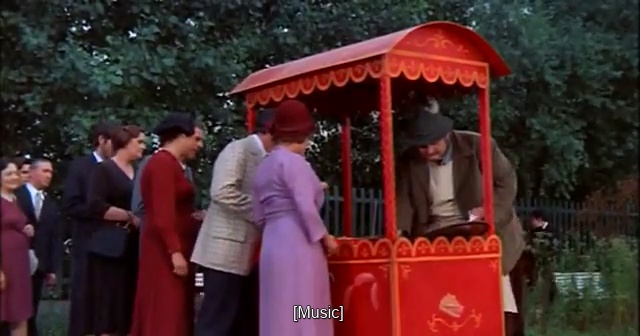
When his activities are disclosed, the police chief, who has been happily eating other animals all movie, is suddenly smitten by a serious bout of nausea.

“Those sausages that I ate! They were made of human flesh!”
The innocent cannibal theme has been popular since Sweeney Todd, who first appeared on film in 1928. Forty years earlier, Jack the Ripper had terrified the citizens of the heaving metropolis of London, brimming with workers drawn to the dark Satanic mills, driven into town by the centralisation of agriculture and the promise of gainful employment. Social cohesion seemed to be failing (isn’t it always?) and the cannibal was the figure who best represented the city as voracious beast. Henry James described London as “an ogress who devours human flesh to keep herself alive to do her tremendous work”. The “savage” of foreign climes who had so thrillingly filled the imaginative accounts of the colonial explorers had come home personfied as their own city, and the unknown faces dwelling within it were chief suspects. This was reflected in H.G. Wells’ first novel, The Time Machine, in which the proletariat, thousands of years in the future, have evolved into a highly technological cannibalistic tribe who feed off the soft, effete gentle people who are all that remain of the bourgeoisie.
Sweeney Todd took this to a new level, showing that even a “gentleman”, an apparently respectable member of society, could kill people. But Sweeney is never shown eating anyone; it is his customers, or the customers of his girlfriend who owns a pie-shop, who enjoy (immensely) the flesh of his victims. This could be done for revenge, as in the later, Tim Burton version of Sweeney, or for profit, particularly in times of shortage, such as Ulli Lomel’s Tenderness of Wolves concerning the German serial killer and cannibal Fritz Haarmann, who supplied meat of many species, particularly human, to his unwitting and grateful neighbours.
The outer limits of the world were still full of cannibalistic savages, but now they were in the same country – Texas Chain Saw Massacre featured a bunch of rednecks who captured tourists and fed them to other tourists (as well as catering to the extended family of course). But we were more worried about the cannibal in our midst, driven by the spectre of Ed Gein, an unassuming if eccentric man who dug up graves and used the bodies for ornaments, graduating into killing people and possibly feeding their flesh to neighbours as venison, an accurate term for animals hunted down for food and fun. A later version was Farmer Vincent in Motel Hell who collected tourists to serve in his motel, quoting his motto “meat’s meat and a man’s gotta eat!). Another slightly less light-hearted group of entrepreneurial cannibals like Vincent were the merry animal liberationists who farmed, milked, slaughtered and sold the flesh of those observed eating animals (to others who pay to eat animals) in The Farm.

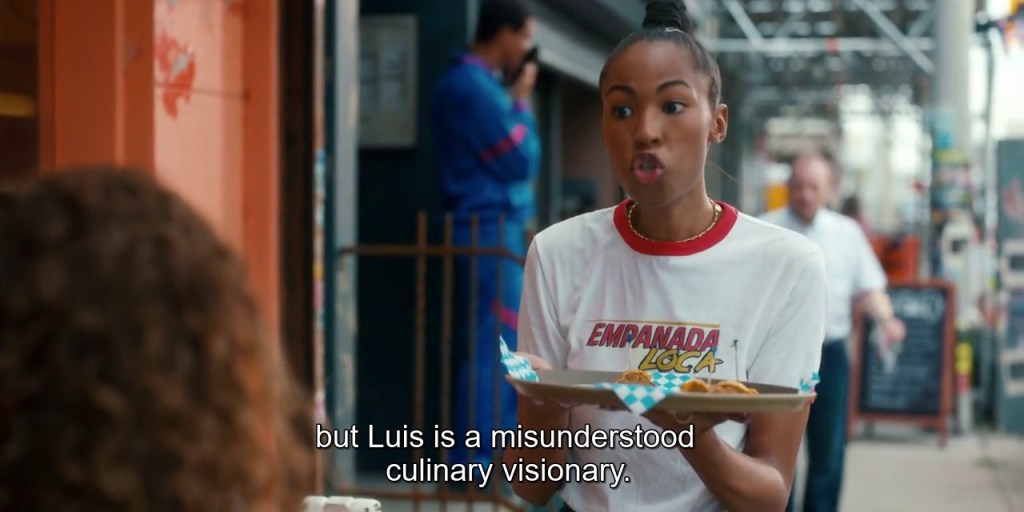
Other films from all around the world feature butchers profitably selling human flesh for human consumption: The Butchers, Ebola Syndrome (from Hong Kong), Delicatessen from France, The Green Butchers from Denmark, and Barbaque (Some Like it Rare), also from France. In most of these films, the flesh of humans is found to be irresistibly delicious, until its provenance is discovered (although in Barbaque, only flesh from vegans has that special something). This is also the theme of Sweeney Todd even in the latest personification, The Horror of Delores Roach, in which New Yorkers line up around the block to buy the most delicious empanadas, unaware they are made of the chef’s landlord. Hitchcock had explored the same territory in 1959 with his episode called Specialty of the House, in which members of an exclusive men’s club crave the specialty “lamb Armistran”, which turns out to be the flesh of patrons who had enquired too deeply into the methods of the chef. Just so in this film, The Mad Butcher, which was the subject of this blog before I embarked on one of my legendary tangents.

Hannibal Lecter, untypically, did not eat humans because they were irresistibly delicious, but because they were another species of edible mammals, inferior to Hannibal the Übermensch and those few he considered his equals, no more or less acceptable morally and gustatorily than any other meat animal. Hannibal found amusement watching his guests enjoy his cooking, not because of the type of the meat, but because of his gastronomical skills. Hannibal’s meals were just as delicious whether filled with human, cow, pig, sheep, or anyone else. It’s the preparation, what Claude Lévi-Strauss called “the cultural transformation of the raw”. Hannibal refined the rude into delicious concoctions. Otto feels the same way about refining annoying people through the artistry of his butchery.
“Let me explain. Animals tear meat. Butchers carve.”
Rotten Tomatoes gives this film a solid 42%, based on the wordless review of one critic. I think as cannibal films go it would be forgettable, except for the amazing performance of the great Victor Buono, who turns it into a melodrama, or even a pantomime. It is, whatever its critical failings, very watchable and a lot of fun, and for those who are interested in such things, there is no gore but lots of meat, and lots of dresses being ripped from female bodies. To the protagonist, Otto, sex is one more appetite, like hunger, easily satisfied by violence, and not to be denied by the stultifying conventions of society.
If you speak Italian, the full movie can, at the time of writing, be seen at: https://ok.ru/video/1511628212842









 The Cannibal Guy