“What do you collect?” THE MAN WHO COLLECTED FOOD (Matthew Roth, 2010)

Written, directed and produced by Matthew Roth, The Man who Collected Food (also released as Cannibal Collector) is a parable of modern consumerist society.

Miguel (Mike N. Kelly) is the unexceptional, almost unnoticeable man next door (like most modern cannibals), who is quietly (or sometimes noisily) proud of his collection. What he collects is food, and he hoards it in cupboards and on display shelving. Like any serious collector (think of Barbie collections or comic books), it is definitely not for consumption.

He carefully stores his purchases in their original packaging, knowing that they would be ruined as collector’s items if he were to open them or, heaven forbid, eat them! Like any obsession, collecting takes over his life.

To survive without spoiling his collection, he eats people. He won’t open any of his food packets, but has a cold-room full of abducted humans, collected according to ethnicity, some already cooked, others tied and gagged and awaiting prep, which involves unfastening them and then chasing and killing them with various fun toys like mediaeval maces.

“Mother always told me to never play with my food. But I don’t think she know how much fun it really is.”

It’s just his quirk, and his neighbours are presented as even crazier than him. There’s the deer hunters, identical father and son in matching lumberjack plaid, and then there’s Kelvin, who runs around with a shotgun shooting at aliens (and who is covered in what he claims are bits of their green brains).

Kelvin sums up the film’s theme:

“I believe that there’s something a little strange in all of us. Whether we’d like to admit it or not, there’s just that one thing we don’t want anyone else to know about.”

Miguel attends a group therapy meeting for people with traumas and more common addictions like sex and cigarettes. He tells the group he collects food, which doesn’t seem that big a deal, until he adds,

“In order to keep my collection in mint condition, I have to resort to cannibalism.”

He tells them he can’t eat “animals” because they are food, and so belong in his collection. The facilitator asks him how that is logical, in that people are also food, at least to cannibals, but he points out that people are not food to other people.

“They don’t package or can people, if they had people-sized packages, then you’d have a better argument.”

She might have had better luck pointing out that people are animals too. Instead, she announces that they are all going to go to his home to open all his packets as therapy, and that makes him really mad. The middle of the film is a long, slow-motion sequence of him killing all the people in the group, and then the cleaner who finds the bodies.

His secret is discovered by the deer hunters who decide to hunt him, until he kills and eats them, then hears a phone message about a friend who keeps escaping death in various accidents and is called “the luckiest man in the world”.

Taking the essentialist argument seriously, Miguel decides that eating such a man might allow him to incorporate that luck, and finally find what he has been searching for: “that package of Ranch Wall Rice with Chicken and Vegetables”. Eating the “luckiest man in the world” will, he hopes, make him lucky.

Taking obsession to its logical conclusion, The Man Who Collected Food is a black comedy (or red comedy given the amounts of gore) with a serious message; a critique of modern consumerism.

“It’s all because I’m different. Sometimes I just wish I could collect comics or coins or anything – it has to be food, food, food!”

Our appetites are incited by marketing and advertising, while at the same time we are told that the Earth is being destroyed by our voracious cravings. We are insatiable, and yet we are ashamed of that. As Dylan said,

“If my thought-dreams could be seen, they’d probably put my head in a guillotine,
but it’s all right Ma, it’s life and life only!”

The script is somewhat feeble and the acting varies between wooden and histrionic. The film earned a respectable 71% “fresh” on Rotten Tomatoes, even though there are no reviews listed. But nonetheless, it’s entertaining and funny, the theme music by Daniel Alcheh is terrific, and the gore hounds will appreciate the amount of carnage. And it actually has a lot to say about obsession, greed, consumerist voracity, and the illogical cultural binaries of edibility and abhorrence. Worth a look, if you can find it.

All-consuming teenage desire: “DER FAN” (Eckhart Schmidt, 1982)

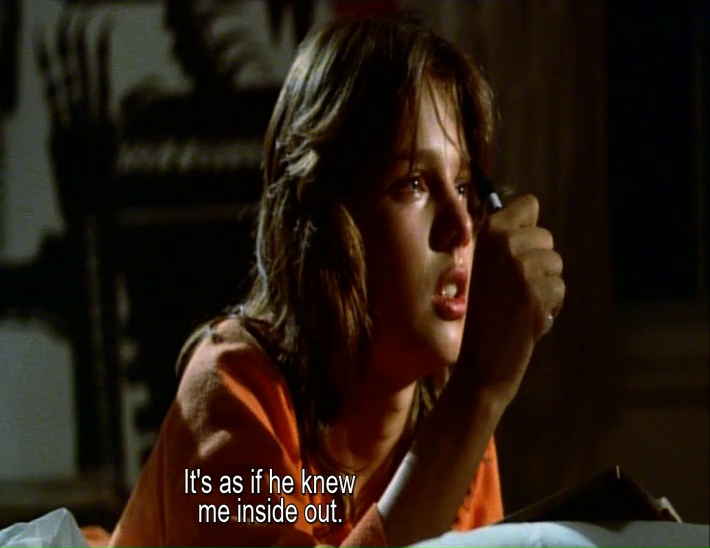
Simone (a bravura performance by 17-year-old Désirée Nosbusch) is a teenage fan obsessed with a pop singer known only as “R.” That obsession takes over her life – she drops out of school, waits outside the post office for a week for a reply to her letter, which will never come because his fan mail goes straight to the tip.  She climbs to the top of the church steeple in her town of Ulm (it’s actually the tallest steeple in the world) and thinks about jumping off, splattering herself all over the town square, but with a letter to R in her pocket, so he will hear of her at last.

Nosbusch as Simone offers a fascinating glimpse of the modern cannibal – she looks and acts normal (for an angst-ridden teen) but underneath are irresistible currents of passion and voracious appetite for her idol. She attacks the postal worker who disappoints her by not having a letter for her, she attacks her father for turning off the TV show on which R is performing. The walls of her room are covered in pictures of R. The film shows parallel imagery to her obsessive love; images of Nazi salutes – the same obsessive love that led Germany and the world into catastrophe a few decades previously.

The word “fan” comes from “fanatic”. The fanatic believes he or she has found the answer, the one who knows us, cares for us. She feels that R, who has never heard of her, knows her inside out. And she will know him, inside out.

She drops out of school and hitchhikes to Munich, where R’s shows are recorded, being accosted on her way by a range of toxic men, but of course the worst of them is the one she is so desperate to meet. She sleeps in unlocked cars while she waits outside the studio, so frantic that, when she finally meets him, she faints.

R seems concerned and kind, invites her to his show, where he appears as a mannequin surrounded by store mannequins – a bald wig symbolically obscuring the divide between human and inhuman, life and death.

He takes Simone back to the apartment of a friend who has gone to the US for a year, where she finally achieves the intimacy she has craved. Nobody knows they are there, so anything can (and does) happen.

But R is a superstar – he is not interested in the meeting of the souls that she imagines will happen, and afterwards tells her he has to go back to his work, tries to fob her off with vague promises of future meetings. He tells her to leave the keys on her way out.

Simone wants to own him and his love, but he just wanted her young body. As he leaves, she picks up a figurine of the goddess Diana, the Huntress, and she then hunts him, killing him with a blow to the head.

Once he is dead, he is hers at last, to do with as she wishes. The imagery switches to that of a Christ, broken and crucified, and she cradles him in her lap like an erotic Pietà.

She sees a freezer, and she sees an electric knife.

R’s blood is, as the Bible says, his life, and she laps it up from the floor and from her knife.

When R is neatly packed in the freezer, Simone faints, but next day we see pots boiling on the stove, his foot being basted with his juices.

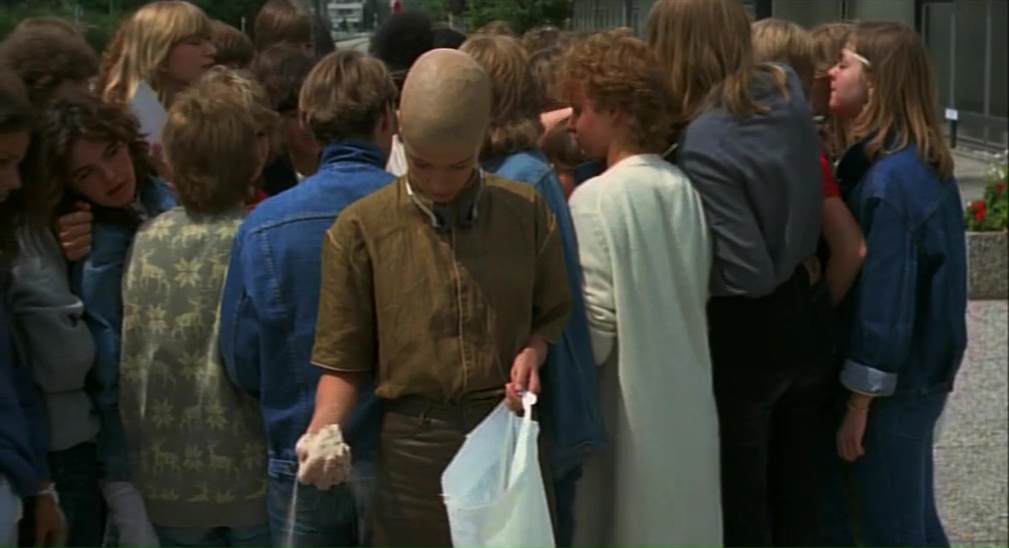
She eats him over a few weeks, then grinds his bones to dust and takes the dust back to the TV studio; pouring it out at the place she met him.

Her revenge involves ceremonial murder and cannibalism, to ensure he will always stay with her, and inside her. Leaving for home, her head shaved so she looks like one of the mannequins from his performance, she promises her parents to return to school.

She sits with them and watches the news – R’s disappearance weeks ago remains a mystery. But she knows where he is.

“I missed my period. I’m four weeks late. I will bring you into the world. We will be happy. I know you love me. And me too: I love you.”

He is inside her, and so is his seed. Like Christian mythology, R will be reborn, but this time totally dependent on her, loving only her.

 The film did not garner a lot of interest or decent reviews, but has picked up a bit of a cult following in the years since. It is an excellent study of the monstrous-feminine, a figure often found in cannibal narratives, particularly around revenge and love. Mariana Enriquez’s recent collection of stories called The Dangers of Smoking in Bed has a similar story called “Meat”, in which two similarly obsessed fans dig up a dead pop idol and eat his rotting corpse. Well worth a read if, perhaps, not during mealtime.

Fuelled by a minimalist synth soundtrack from Rheingold and stunning photography, Der Fan is an engrossing and fascinating study of love, not in its sentimental, romantic form, but as possession, greed, rage and cannibalism. Much of lovemaking is expressed orally, through kissing, fellatio, cunnilingus, and licking or sucking and sometimes chewing of various body parts. Simone has taken this to its logical extreme. R is inside her, and so is an embryonic version of him, which she promises to love as she had hoped to love its father. It’s resurrection through transubstantiation.

Scentless cannibalism: “PERFUME, The Story of a Murderer” (Tom Tykwer, 2006)

Making a movie of a hugely successful book is always fraught – if it is faithful to the book, it is criticised as too derivative and unoriginal, if it diverges, it is damned for breaking the spell by adding new and extraneous material.

The 2006 film of Perfume sticks pretty closely to Patrick Süskind’s novel of the same name, (originally written in German) which has sold over twenty million copies in 49 languages. There is also a German Netflix TV series of Perfume released in 2018. I haven’t checked that out yet, but it sounds very postmodern (the protagonists have read Süskind’s book!)

This 2006 film features a stellar cast, who do a pretty great job with it. Hard to go wrong with Dustin Hoffman and the sadly missed Alan Rickman, and you will also recognise Ben Wishaw as the main character, Jean-Baptiste Grenouille. It is directed by Tom Twyker, and who can forget his Run Lola Run? Since Grenouille doesn’t say much, we have a narrator, and who can fault the pipes of the late, great John Hurt – you may remember him giving birth through his chest in Alien.

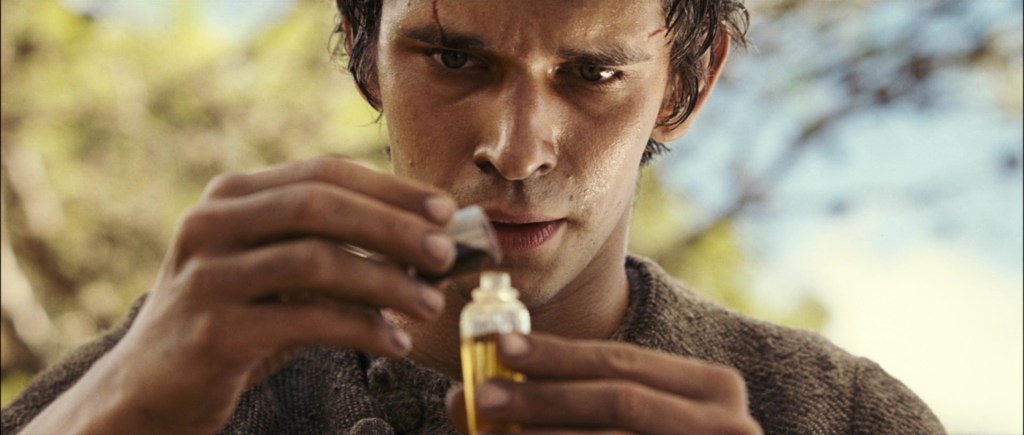
The lead character, Grenouille (Ben Wishaw), is a kind of supervillain, whose superpower is, wait for it, his nose. Grenouille is born in eighteenth century France in the worst circumstances – his mother drops him in the muck under her fish stall, assuming he will be stillborn like all her previous births. But he survives, and turns out to have the most sensitive nose ever – he can identify any smell, good or bad. He is raised in an orphanage and sold to a tanner, who eventually takes him to town, where he discovers the ‘scent of a woman’ (not to be confused with Al Pacino’s rather better behaved but still slightly creepy obsession). Young women are all too often the victims in modern movies, but usually they are desired for sex or (in cannibal movies) for nutrition. These young women just smell good. Grenouille is obsessed with capturing that scent, and thus their beauty.

One of the great teachers of Cannibal Studies is a certain Doctor Hannibal Lecter, seen sniffing Will Graham in the episode Coquilles. He taught us, among other things, that

“Taste and smell are the oldest senses, and closest to the centre of the mind. Parts that precede pity and morality.”

Well, a whole lot of cannibal movies concern the taste of humans (short summary: we taste somewhere between wild boar and veal). But smell, that primal sense that so many animals rely on, is usually neglected. Not so in this movie. If cannibalism is the consumption of another member of one’s own kind, then it can involve the devouring of any part, and that includes their odour.

Grenouille sniffs people, a bit like Hannibal, but with a different appetite. He terrifies a young woman by sniffing her, then unintentionally smothers her as he tries to silence her screams. He is horrified to find that her scent disappears as her body cools, and he becomes obsessed with the craving to recreate that smell. He decides that his life mission is to learn how to preserve scent,

He persuades a creator of perfumes, Baldini (Dustin Hoffman), to teach him the trade, in return for creating perfumes that make Baldini rich and famous.

But Grenouille cannot distil the essence of a person (or a cat in a particularly objectionable scene). For that, he needs to go to the perfume capital, Grasse, and learn their art of enfleurage. Baldini has told him that a great perfume has twelve different components, and a thirteenth scent that must be exquisite. On the way to Grasse he sees a young woman, Laura (Rachel Hurd-Wood) who he realises must become his thirteenth scent.

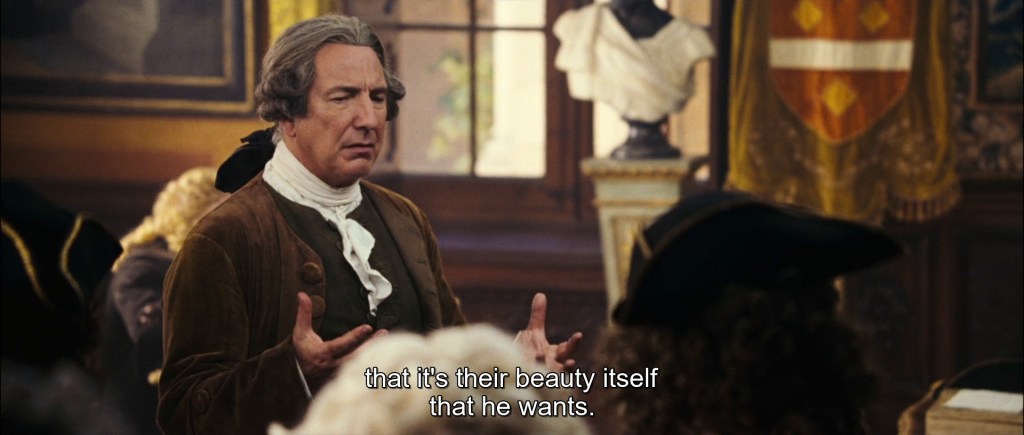
Her father Antoine (Alan Rickman) disagrees. He guesses the murderer’s motive.

Of course, killing the other twelve girls for the first twelve scents throws the town into panic, and in a startling recreation of 2020’s COVID-19 headlines, the town is closed down and the economy devastated as the murderer (he is variously described as a plague, a madman, an angel and a demon) is sought.

There’s a chase, Antoine leaves a false trail, but hey, you can’t hide from Supernose. He’s out to create Love Potion No. 9.

The film received mixed reviews (59%) on Rotten Tomatoes. The doyen of film critics, Roger Ebert, wrote

“This is a dark, dark, dark film, focused on an obsession so complete and lonely it shuts out all other human experience. You may not savor it, but you will not stop watching it, in horror and fascination.”

But his long-term co-host on Ebert & Roeper, Richard Roeper, said “Hated this movie. Hated it.

Look, I try to avoid spoilers, but I will mention that absorbing the scent of beautiful women is not the only kind of cannibalism in this movie. The ending has some of the more traditional kind but, to me, this would still have been a cannibal movie if he had only incorporated scents. Cannibalism is about voracious appetite, but not necessarily for food. We never see Grenouille eat or drink – scent seems to be all he needs, like the Astomi peoples who, according to Pliny, had no mouths and lived on odours. Furthermore, Grenouille has no scent of his own, this makes him an outsider, an alien, and explains why he seems invisible to others and can sneak past guard-dogs (who would understand, with Grenouille, the importance of smell). The modern cannibal, from Jack the Ripper to Jeffrey Dahmer, is typically invisible, unidentifiable, blending in with the crowd. Grenouille, though, is appalled to find that he has no identity to others in the only way that matters to him – through smell. He seeks to steal that identity from his victims, and incorporate the essence of their beauty into himself. The scent he creates is distilled beauty, with a menacing power – it can command love, leading to a mass orgy at what was supposed to be an execution.

Absence is one thing, surfeit another, but both can be lethal.

Incorporating the other, be it through eating, smelling, farming, enslaving or invading, is cannibalism.