“You draw the line there?”: DOLORES ROACH episodes 7 & 8

The climax. The denouement. The final two episodes of this quite brilliant podcast that became a Broadway show that became a television series about an untrue true crime, and includes podcasts and Broadway shows. If you need to catch up on the earlier episodes, I would suggest watching them, but if you can’t wait, here are my earlier blogs.

Episode 1

Episode 2 & 3

Episode 4

Episode 5

Episode 6

And here is the very brief synopsis.

  • In episode 1, Dolores has just been released from prison after 16 years – she took the fall for her boyfriend, who has since disappeared. She heads back to Washington Heights New York. but it’s all gentrified now, except for Empanada Loca, the shop of her old friend Luis, who offers her a room and sets her up as a masseuse, a skill she learnt in jail.
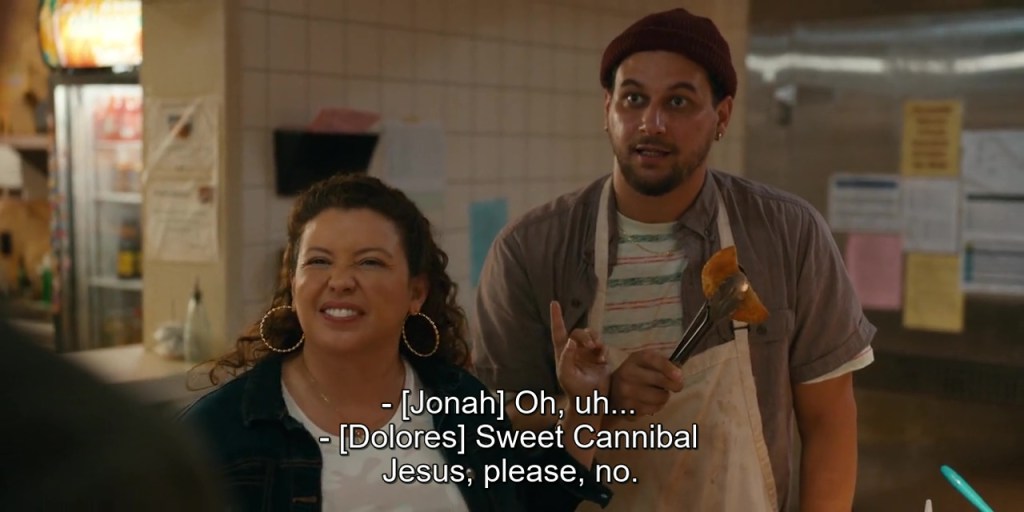
  • In episodes 2 and 3, Dolores kills the landlord who has been harassing Luis for his overdue rent, which he can’t afford because the neighbourhood is now fancy, and people don’t buy empanadas much. Luis creates a new empanada, MUY LOCO. It is hugely successful, because it contains, yep, human flesh, in this case, the landlord, Mr Pearlman, whose son, Jonah, appears in the shop at the end of episode 3, with two cops behind him.
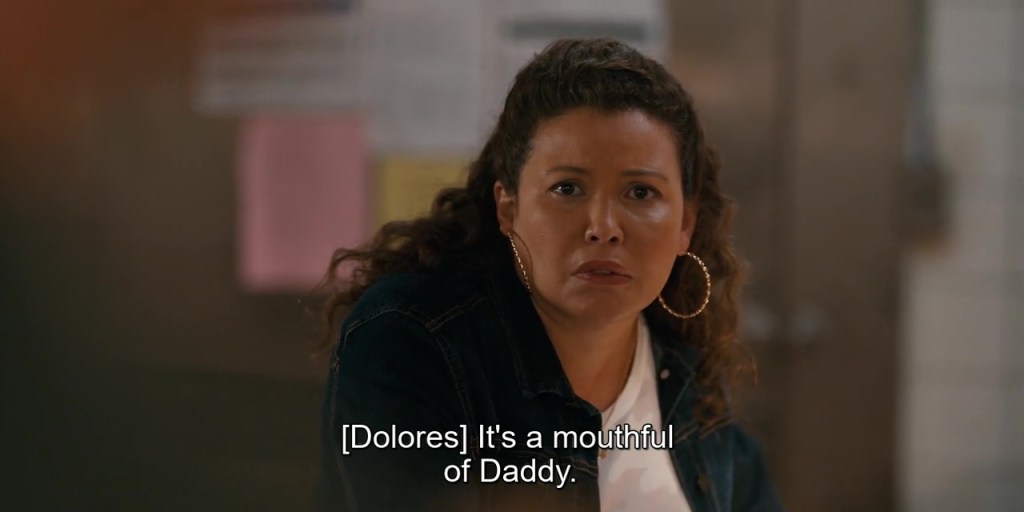
  • In episode 4, Dolores is shocked to find what Luis has done with the body of the landlord she murdered, and disgusted by the secret contents of the muy loco empanadas—Mr Pearlman. She is particularly horrified when Luis offers Jonah an empanada to try, a muy loco, which she knows is a “mouthful of daddy”. Meanwhile, the local drug dealer, Marcie, has pissed off Dolores, and now she is also in Luis’ fridge, and bits of her are now in the empanadas.
  • In episode 5, Dolores hires a private eye called Ruthie, played by Cyndi Lauper, to trace her ex, who cheated on her and let her take the fall in a drug bust. Ruthie’s motto (or perhaps mission statement) is I NEVER DON’T FIND THEM. But the last thing Dolores wants is for Ruthie to find Mr Pearlman.
  • In episode 6, we see cannibalism as a business. Luis has been clear-eyed about this all along – he gets rid of the annoying landlord, he thoroughly destroys the evidence (in customers’ stomachs) and he makes money from the meat, which is apparently delicious and hugely popular, while saving money by not buying the flesh of other animals from the food-services man, Jeremiah, the only sympathetic character in the story so far.

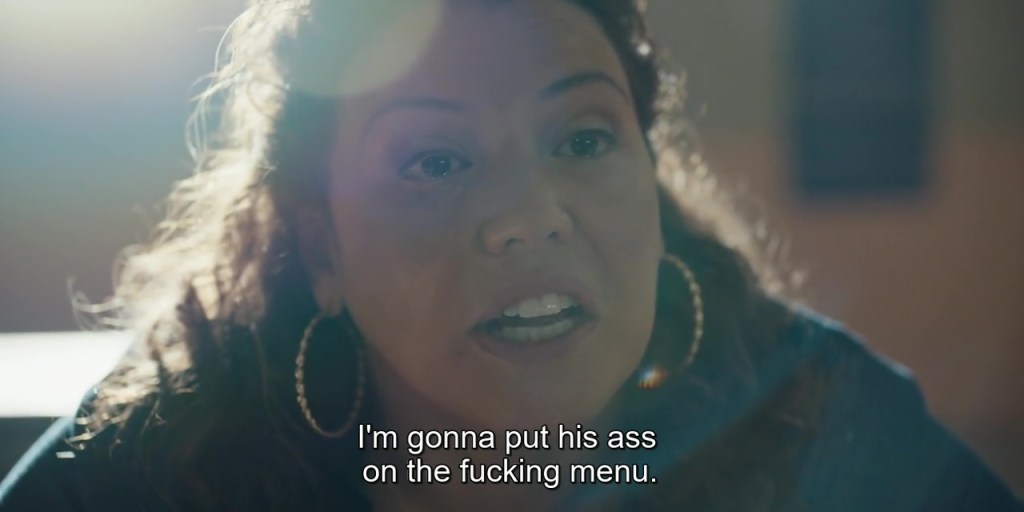
Not a lot of human flesh being eaten in these final two episodes, because everything is turning to shit, largely due to the impulsive plans of Luis, and the tendency of Dolores to snap the neck of anyone who annoys her. Police are looking for the drug dealer Dolores killed back in episode 4, and threatening to call in the DEA. Luis is still chopping up the bodies of Dolores’ victims to fill his empanadas, but he doesn’t want anyone to find the marijuana he is growing. THAT would be incriminating. Dolores points out that his fridge and apartment are full of chopped up bodies, and asks him the question that defines all ethical discussions.
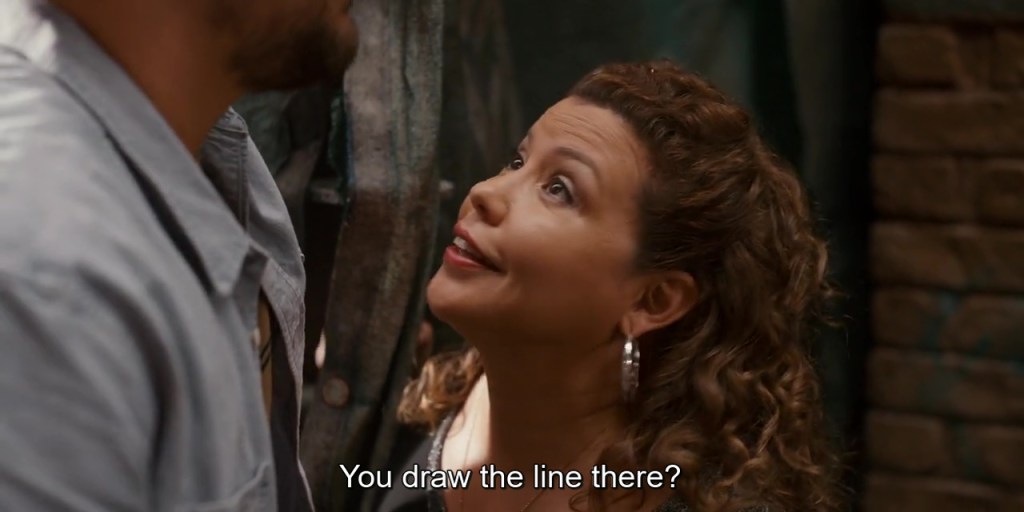
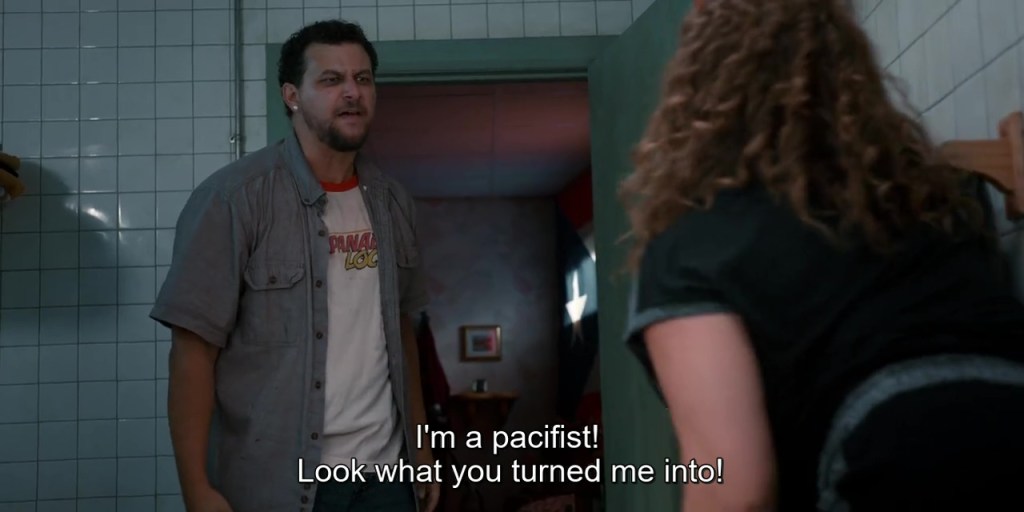
 She’s much more upset about the cannibalism than the increasing number of corpses she is leaving all over the shop. Odd that. Luis sees meat as his business, and Dolores’ steady body count as his (very reasonably priced) supplier. He’s not too fussed about all the killing, as long as he doesn’t have to do it – like customers in a butcher shop. When he finally kills a man, he is upset: “Look what you made me do!”
Luis cracks some of the best jokes in this show, in the middle of the street (much to Dolores’ fury) about the “fat fuck” she killed last episode, and how he is going to use the body fat in his pastry.

And some of the worst.
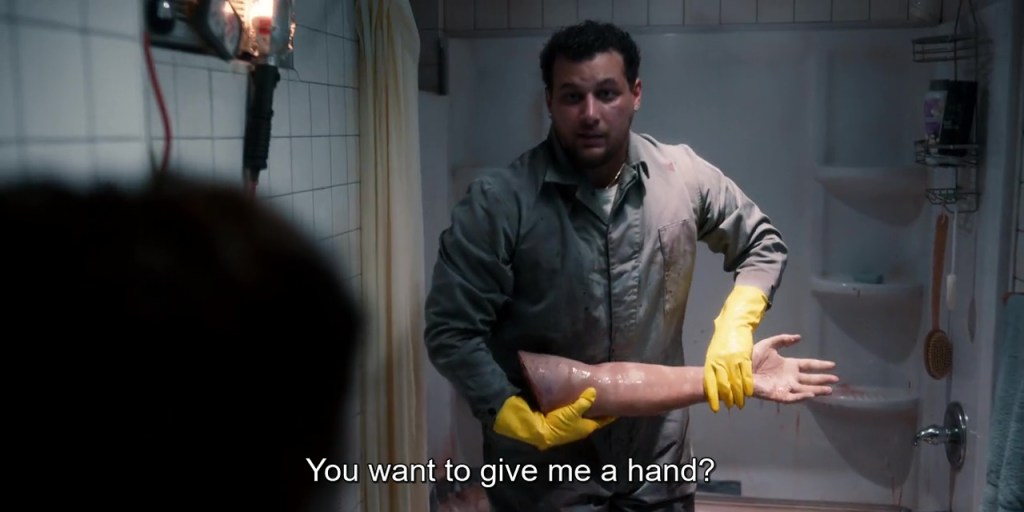
Lots of interesting Freudian things going on here – in earlier episodes, they discussed the difference between edible and Oedipal, and then there’s the whole thing with Luis only wanting to give Dolores cunnilingus, not penetrative sex, even though she has her period. She considers that eating her menstrual blood makes him a cannibal, even though he has been snacking on human empanadas all through the show, so it shouldn’t really be a surprise.

And his pet name is Mami. It’s apparently the Spanish equivalent of “baby” or “darling”, but is also used for, yep, mother. Freud said the two primary taboos are incest and cannibalism, and Luis definitely has an edible complex.

We find out why Luis doesn’t want sex – he fell in love with his father’s girlfriend when he was 12, had sex with her (so now we have another taboo covered) and then tried to castrate himself in punishment. He couldn’t cut through his penis (Meiwes and Brandes found it was much harder than you might think) and poured hot oil on the wound, leaving him horribly disfigured. Yes, Dr Freud, the threat of castration can be as big a motivation for mental illness as you thought.

Dolores just thinks she is a monster. But one of the fascinating things about cannibalism is that unlike other horror movie tropes, they are not supernatural or even particularly superhuman. And they really exist.

“I’m a monster. Worse, I’m real.”

Luis ends up “deep fried, like everybody else” in one of the most dramatic scenes, and Dolores escapes:

She goes looking for the showrunner of the play, a nice piece of postmodern complication as he clearly represents the creator of the show we are watching, Aaron Mark.

He is accused of humanising a serial killer, but hey, Dolores is very human, just like Macbeth and Oedipus and every tragic protagonist in literature. She’s not even a cannibal; in the whole eight episodes, we have not even seen her eat a human empanada! She’s just a misunderstood serial killer.

As she says, you have to draw a line somewhere.

She forces the showrunner to take her to a house where, he says, someone knows the whereabouts of the man who betrayed her and left her to rot in jail. When the door opens, she roars with laughter, and then pounces, but at whom? All we know is that, like Georgina in The Cook, The Thief, she is directing her invective at us, the audience! We may not know where her ex is living. But we do know that cannibalism starts at home.

“It’s a mouthful of daddy”: DELORES ROACH episode 4

This is such a great show. I was going to blog a couple of episodes at a time, but there is so much content in the short episodes that I had to do this one, the fourth, in splendid isolation. Also, I’m uploading it on father’s day (in Australia and probably some other places), and having a character eat some of his father just seems so pertinent!

If you haven’t read my blogs on the first episodes, you might want to do that first. In a nutshell, in episode 1, Delores has just been released from prison after 16 years. She heads back to Washington Heights NY but it’s all gentrified now, except for the Empanada Loca shop of her old friend Luis, who offers her a room and sets her up as a masseuse, a skill she learnt in jail.

In episodes 2 and 3, Delores kills the landlord who has been harassing Luis for his overdue rent, which he can’t afford because the neighbourhood is now fancy, and people don’t buy empanadas much. Luis creates a new empanada, MUY LOCO. It is hugely successful, like the chocolates in last week’s blog, because it contains, yep, human flesh, in this case, the landlord. Whose son, Jonah, appears in the shop at the end of episode 3, with two cops behind him.

All caught up, and now we’re at episode 4. It turns out Jonah does not know his dad is missing, and the cops are just waiting for their empanadas. But Delores does not want to go back to jail, having just got out after sixteen years, so you might think that finding Luis destroying (or actually cooking and selling) the evidence should be good news, but (call her old fashioned) she is horrified by the idea of cannibalism (although, funnily, not so much the murder she committed) and disgusted by the secret contents of the muy loco empanadas.

This dissonance between getting rid of the evidence of her rather serious crime and disgust at the fact that the evidence is being fed to an enthusiastic clientele is aggravated when Luis offers Jonah an empanada to try, a muy loco, reminding us of the lyrics of the old Stanley Holloway song about Sweeney Todd, on whom this story is based:

“For many a poor orphan lad
The first square meal he ever had
Was a hot meat pie made out of his dad
From Sweeney Todd the Barber”

Luis tells Jonah “the meat’s locally sourced” which is particularly true for him. Jonah loves the taste, asks if the meat is duck.

No, it’s no duck. We hear Delores’ thoughts:

Furious at Luis for feeding the landlord to his son, Delores takes the rest of the meat and sets fire to it, putting the muy loco off the menu. Luis is furious, and cannot see what the problem is, and then comes one of the great double entendres of the cannibal genre –

Luis barks at her:

“Hey, it’s edible! Like the Greek myth.”

Now we’re getting to the meat of the cannibalism debate!

Quick refresher: Oedipus was a mythological figure depicted in the play Oedipus Rex written by Sophocles some 2500 years ago. Oedipus became king of Thebes after unwittingly fulfilling a prophecy that he would kill his father, Laius (the previous king), and marry his mother, Jocasta (whom Oedipus took as his queen). It was more a case of mistaken identity and road rage than some deep psychosexual drive, but Sigmund Freud used it as the basis of what he called the Oedipus complex. This referred to a child’s sexual desire for the opposite-sex parent and hatred for the same-sex parent which, if not reconciled, leads to neurosis. Freud wrote that,

“It is the fate of all of us, perhaps, to direct our first sexual impulse towards our mother and our first hatred and our first murderous wish against our father. Our dreams convince us that this is so.”

Oedipus didn’t eat his father, but Freud believed that cannibalism is a foundation of the human unconscious. He asserted that cannibalism is one of the two original prohibitions of humankind, the other being incest. Freud’s conception was that the origin of human civilisation was an act of incestuous patricide and cannibalism by a group of pre-sapien savages, which became the origin of cooperative civilisation. In Totem and Taboo, he speculated that a prehuman group of brothers in a “primal horde” had come to resent their father’s monopolisation of the tribe’s females (common among primates) and conspired to kill the father and take their mothers and sisters for themselves. “Cannibal savages as they were, it goes without saying that they devoured their victim as well”. A later wave of remorse led these conspirators to create “out of their filial sense of guilt the two fundamental taboos of totemism”, the proscription of cannibalism and incest. This father/son guilt, he argued, corresponds with the Oedipus complex, which he called “the nuclear complex of the neuroses”.

So Jonah, like Oedipus has unwittingly eaten human flesh, the flesh of his father, not knowing what it was. If Luis had said it was duck, he would have believed him, and accepted that contentedly, because social conventions say we can eat ducks, but not dads. Yet the taste is so close that he couldn’t tell the difference. And since his dad was already dead, was this worse than deliberately killing a living, sentient duck?

Meanwhile, the local drug dealer, Marcie, accuses Delores of selling drugs and stealing her customers, because of the long queues of people waiting for muy loco empanadas. Delores tries to persuade her she is running a massage business and takes her downstairs for a massage, where Marcie starts to vandalise her room looking for drugs, and mocks her for protecting her old boyfriend, revealing that he cheated on her and eventually turned her in to the DEA to save his own hide. They fight, and Marcie becomes the new supply for the next batch of muy locos.

Delores is determined to find the cheating boyfriend. When she does, she promises,

“I did it… Meiwes!” CANNIBAL (Marian Dora, 2006)

Cannibal was the directorial debut of the German director Marian Dora in 2006, and is basically a re-enactment of the famous case of Armin Meiwes (pronounced like the Sinatra song “I did it my way”), the so-called ‘Rotenburg Cannibal’. Meiwes was a German computer technician who was into “vorarephilia” (sexual attraction to eating, or being eaten by, another). He advertised on the Internet for a man who was willing to be killed and eaten, and ended up doing both of those things to an engineer named Bernd Jürgen Brandes whose greatest desire was to be eaten. Unlike most crime re-enactments, this one was easy to research, because Meiwes videotaped most of the killing, butchering and eating of Brandes. We’ve met Meiwes in a couple of earlier blogs: in Grimm Love an American researcher (Keri Russell) searches for the videotape and then freaks out when she gets hold of it. The documentary Copycat Killer covered the famous case with lots of dramatic music and comparisons to Hannibal Lecter, which was absurd. The Australian comedy Rake also did a great simplified version of it with the wonderful Hugo Weaving as both an economics professor and a cannibal (which is more terrifying?).

Marian Dora is a pseudonym used by a film-maker whose real name is shrouded in mystery. Probably for good reason – his first two releases were included in anthologies of short films named Blue Snuff 1 and Blue Snuff 2, the latter of which was withdrawn due to its extremely graphic content. He then went on to work with Ulli Lommel on a number of crime/slasher films.

This film was assigned to Dora by Lommel, but proved too rich for Lommel’s taste, and Dora ended up releasing it himself, direct to video. Really? Too rich for Ulli Lommel, whose grisly bio of Fritz Haarmann we reviewed earlier this year? Well, that’s promising. Lommel went on to make his own version of the Meiwes story, with the protagonist changed to female for some reason. This was also called Cannibal at first, then changed to Diary of a Cannibal, and has graced the “Bottom 100” lists of Yahoo and IMDB ever since. We… might get to it one day. Maybe.

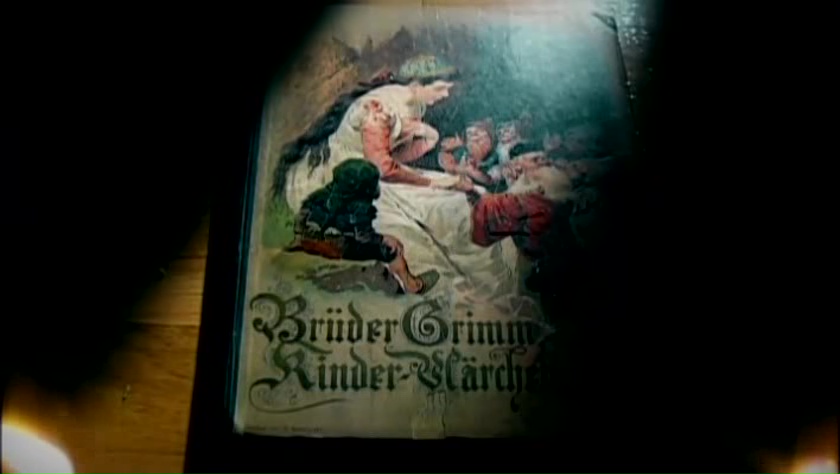
Meiwes and Brandes are not named in this film – the eater is just called “The Man” and the eaten “The Flesh”. There is very little dialogue, except for the Man’s mother reading him Hansel and Gretel at the beginning (when he was presumably called the Boy), presumably turning him into a cannibal (didn’t that happen to everyone who read the Brothers Grimm?)

We then Get To See A Selection Of The Man’s preferred reading matter: cannibal art by Hieronymus Bosch and Hans Staden, books on Jeffrey Dahmer, and some interesting texts on anatomy and butchering, which he will find handy later.

We see the Man having a series of meetings with a bunch of guys (and one woman) he has contacted on internet chats, all of whom turn out to be not that serious about going through with the whole, you know, kill me and eat me thing. The woman might have been ready, but he writes, “Women are too important for the survival of mankind.” Pretty much how the dairy and egg industries operate, when they sex the calves and chicks and immediately kill the males.

He even meets up with a couple of kids, not presumably through the web, but seems to prefer his meat aged and consensual.

The Man finally meets the Flesh, who introduces himself,

“I’m your flesh”

But then adds:

“I don’t want to suffer”

Yeah, no probs, mate; the Man stops on the way home from picking up the Flesh at the railway station to buy some schnapps and some cough medicine.

Then after a game of petanque and some sweaty sex, the Flesh won’t feel a thing. Hmmm.

“You’ll become a part of me”

Seems to me to be a bit of a misunderstanding of how the alimentary system works. However.

Once they enter the house, the movie becomes very dark. Literally – one of those movies where it’s hard to see what the hell is going on. They’re going to have sex, one of them is going to eat the other, but first, a nice cuppa tea.

There’s a lot of plinky-plonky music and sex scenes which drag on interminably, and end with the Flesh anally penetrating the Man. No one was expecting that. Isn’t cannibalism supposed to be about dominance? It’s an interesting conflict. They curl up on the floor together and, when they awake, the Flesh demands the Man bite off his penis. My thoughts immediately went to Monty Python (“ergh! With a gammy leg?”) at the thought of biting his penis after anal sex; but hey, call me old fashioned. Anyway, the Flesh is not called the Teeth or even Jaws, and can’t do more than draw blood, a kind of ineffective circumcision, and the Flesh growls:

“You are too weak!”

Freud would have had an orgasm of his own at this point – we have power, guilt and of course male fears which, he said, were based around the act of castration, usually due to the fear of the father’s anger at the boy’s Oedipal desires. But this man is too weak to eat him! Perhaps because he needs to eat. They need to merge before they can merge. It’s another challenge. But as Freud said, the cannibal “only devours people of whom he is fond”, which is why, according to Brigid Brophy, Christians eat God to affirm the love of the Father. The Man is seeking the transubstantiation of the Flesh.

So anyway, the Man does what any man does when his lover is disappointed – runs for the cough medicine; let’s knock him out! But then they both fall asleep, seeming to decide that this wasn’t such a hot idea. When they wake, it seems like it’s all over, but they are a stubborn pair – a splash of water on his face and the Flesh is ready and raring to get ate. This time they pick up prescription sleeping tablets at the pharmacy – Stilnox, very popular among Australian athletes apparently, and the Flesh washes it down with a bottle of brandy.

“Castrate me, then kill me. Do it now.”

The Man sets up the video (and this is all pretty much as it happened – Meiwes did videotape the whole procedure, which helped the police considerably during the court case). He puts on a record of church music, and fetches a knife. We get to see a lengthy scene of Bobbitting (hint – don’t try amateur anaesthesia at home: the cough medicine and booze don’t work very well).

He fries the severed cock up with some garlic (yep, all true to the actual case) but they find it tough and inedible. They spit it out (in the real case they fed it to Meiwes’ dog, but the sensible dogs of Germany refused to sign up for this movie).

Then the rest of the film is the killing of the Flesh and the preparation of his flesh. The Man puts the Flesh in the bathtub to bleed out, and reads a Jerry Cotton book while he waits. This is an outrageous fictionalisation – Meiwes in fact read a Star Trek novel. Ah well, poetic licence.

When the Flesh refuses to die by the time the Man finishes his book, the Man drags him out of the bath, vomiting, urinating and defecating, and lays him out in the Schlachthof he has set up, arms outstretched like the Broken Christ, then cuts his throat.

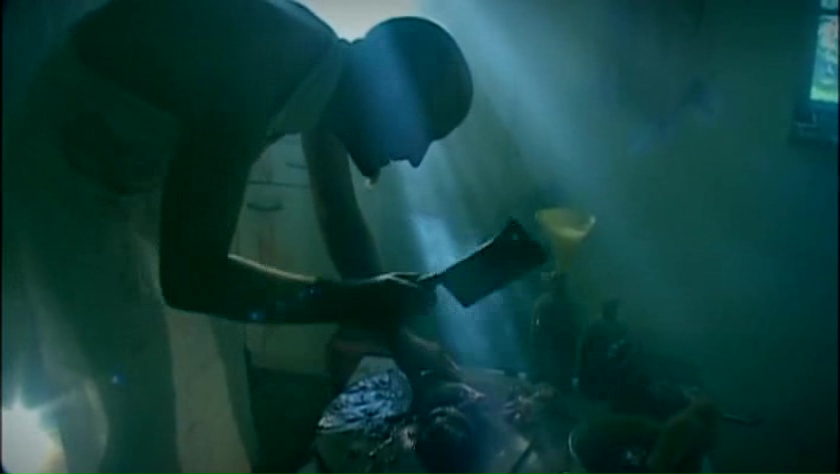
The final twenty minutes or so of this film (if anyone is still watching) is clinical – a masterclass in butchery. The Flesh is strung up by his feet and the Man disembowels him in great detail, vomiting as he does so. The Flesh, already dehumanised, is now deanimalised too; he is simply a carcass being prepared for the meat chiller.

I loved this review from Letterboxd which complains that the movie describes:

“how a cannibal prepares his food, everything is in detail and the scene came exactly when I was going to have my breakfast fuck me it’s like the movie knew when I’m going to eat my food, this has happened quite a few times with me now and its getting creepy 😂”

Scott Weinberg of DVD Talk wrote,

“One of the sickest and freakiest movies ever to come from a nation well-known for its freaky and sick movies (Germany)”

To me, the butchery was not the most abject part of the film; it was the sort of thing you might see in an instructional video for abattoir workers, except not with the usual species of victim. The defecation and vomiting were harder to take, but I guess that is subjective. All in all, most people will find something to disgust them in this film, and perhaps that was the point. It’s disgusting, but it’s not that different to what we get minimum-pay workers in slaughterhouses to do eight hours a day to some seventy billion animals every year. Unless the special effects budget was huge (not obvious from the rest of the film), a real animal was gutted and chopped up to make this film, which is actually the sickest part of it.

The butchery is shown in loving detail and for extended time. It lets us experience what it would be like to do that (I’m guessing most of us have not butchered an animal, human or otherwise). Being his first time, the Man keeps stopping to either snack on some flesh or to remorsefully throw up; pretty sure neither would be encouraged in the industrial meat corporation.

For a real slaughterhouse worker, wielding the cleaver would be sickening the first time, then boring for the hours thereafter. We see the Flesh reduced to just meat cuts. As King Lear said, when stripped of civilisation:

“unaccommodated man is no more but such a poor, bare, fork’d animal”

If you don’t want to watch the whole thing, there is an excellent and hilarious summary by Mike Bracken “The Horror Geek” which had me laughing out loud several times, despite the content.

At the end of the film, the Man has a nice Flesh dinner (the Flesh is present at the table, short of one body), then jerks off to his home movie, and next morning is all scrubbed up, in a nice suit, and trotting off to meet his potential next sacrifice. In fact, Meiwes was eventually caught because he advertised for another victim a few months later, when he started running out of Brandes. Meiwes is still in jail in Germany, and is now apparently a vegetarian.

As I said, we know very little about the director, except that Dora is not his real name, and that he is vegetarian and works as a physician. After watching this movie, you’ll understand why he wants to remain anonymous. Perhaps also why he’s a vegetarian.