Peter Jackson’s first feature film: BAD TASTE (1987)

Peter Jackson is a New Zealander, and the fourth-highest-grossing film director of all time, behind only Spielberg, Cameron and the Russo brothers. He is best known for The Lord of the Rings and The Hobbit trilogies, as well as movies like King Kong and the documentary The Beatles: Get Back.

But we all have to start somewhere, and Jackson’s first feature was Bad Taste, a splatter comedy which took years to make as it began life self-funded and only later received a grant from the NZ Film Commission. Many of Jackson’s friends acted and worked on it for no charge. Shooting was mostly done on weekends since Jackson was then working full-time for a newspaper in Wellington, the NZ capital. 

Bad Taste is about aliens who plan to capture humans for food. They take over a (fictional) NZ town called Kaihoro (which means something like “fast food” in Maori) and butcher all the residents.

“There’s no glowing fingers on these bastards. We’ve got a bunch of extra-terrestrial psychopaths on our hands.”

It turns out that they are not just hungry but entrepreneurs from the “Crumbs Crunchy Delights” company, and need to collect human flesh for the home planet market, and get it there before competing alien corporations.

“I am certain  that when the Homo sapiens taste takes the galaxy by storm, as it will, Crumbs Crunchy Delights will be back at the top”

They are disguised as humans until they drop the pretence and, luckily for us, they speak English to each other to reveal their plans. Their plans are foiled by a team of agents from the Astro Investigation and Defence Service (AIDS) entering the town to take down the invaders.

The action sequences are actually very well done, long before Jackson had access to special effects studios, with choreographed fight sequences and buckets of gore and brains and other body parts. Jackson took two roles, a nerdy scientist who is a member of the government agents, and a leader of the aliens, including a famous scene in which he fights himself on top of a cliff.

The film is most famous for its unapologetic gore, including half-eaten bodies, heads coming off, and brains leaking out of skulls. The brave Kiwis mow the aliens down in an interminable gun-fight, which culminates in Derek (Jackson) killing the alien leader, Lord Crumb, by jumping on him from the floor above while wielding a chainsaw, a favourite of cannibal films, cutting the alien’s body in half and disappearing inside the corpse. The film was banned in Queensland briefly, which did wonders for its publicity; the video release proudly proclaimed on the cover “Banned in Queensland”.

But is it cannibalism? It is after all a completely alien species from another world eating humans, or at least trying to. So not strictly cannibalism, but humans being eaten by aliens dressed as humans is a popular narrative in science fiction texts (see for example Under The Skin), and raises some interesting questions. Anthropocentric humanism maintains that we are somehow on a higher level than “animals”, even though we are animals, a species of Hominidae (Great Apes). Because of this ontological division, bolstered in past centuries by religious beliefs about humans being made in the image of the divine, we tend to judge other animals as possessions, inferior beings to whom we can do as we wish, so we kill them, skin them, shear them, eat them, experiment on them, race them, and so on. Not just other animals; the colonisers of Africa, South America and other parts of the world felt the same way about the indigenous peoples who lived in the areas they coveted, and so they were conquered, enslaved, converted or simply exterminated.

What if travellers from another planet, considering themselves far superior to us (not an entirely unreasonable proposition if they have conquered deep space travel), decide to colonise, exploit or even eat us? If we could take them to the Galactic High Court, the learned judges might rule that the aliens were simply doing to us what we do to billions of other earthlings each year. As John Harris wrote:

Suppose that tomorrow a group of beings from another planet were to land on Earth, beings who considered themselves as superior to you as you feel yourself to be to other animals. Would they have the right to treat you as you treat the animals you breed, keep and kill for food?

Bad Taste is well made, entertaining and, if you are not worried by lots of gore and brains, very watchable. It debuted at the Cannes Film Festival in May 1987, which is not bad for a first movie, a splatter comedy, made on a shoestring. It currently has 71% “fresh” rating on Rotten Tomatoes, which is far better than many far better financed films. A number of critics made great sport of the title, saying that “bad taste” described the film well, but that was deliberate, a clever combination that tells the audience that it is bad taste cinema (may leave a bad taste in your mouth) and that human meat tastes bad, which according to all the cannibals who have testified about it, is simply not true. We taste somewhere between veal and pork, and would certainly be very popular in galactic fast-food joints.

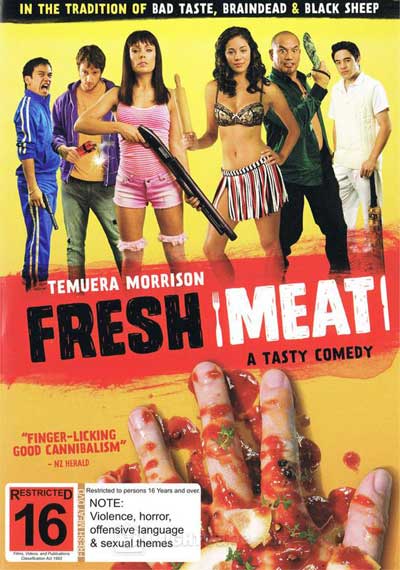
“We’re NOT Maori cannibals”, FRESH MEAT (Danny Mulheron, 2012)

New Zealand has produced some world class directors; think of Jane Campion, or Peter Jackson. Not a lot of cannibal movies unfortunately, considering the country’s reputation – Jackson’s first feature film Bad Taste had a lot of humans being eaten but, unfortunately for this blog, the eaters were space aliens, so not technically cannibals. Jackson’s Braindead was closer, involving zombies. Can you be a cannibal if you are undead? We’ll have to consider that question some time, perhaps when we run out of movies about living cannibals (probably about the time we get to net zero).

But Danny Mulheron gets right into freshly killed, cooked (and sometimes raw) human body parts in this film. Like Jackson’s Bad Taste, Fresh Meat was Mulheron’s first feature film, and it’s an impressive inception.

The plot involves a family of Maoris, recently converted cannibals, being taken hostage by some bumbling criminals. Rina (Hanna Tevita) is home from her lesbian explorations at “St Agnes Boarding School for Young Maori Ladies” when a bunch of criminals break in to her home to hide from the police, having killed some prison guards to free their boss from a prison van.

But that’s Rina’s second shock of the day; the first was finding her parents’ new eating regime in the fridge.

Turns out her Dad (Temuera Morrison from Once Were Warriors and The Mandalorian)  is reviving an “eighteenth century post-colonial religion” – he has found the prophecies of Solomon Smith and become a “Solomonite”; he now believes that eating people (“taking their life-force”) will cause the family to flourish.

Yes, among the satire on Maori and Pakeha cultures, there is the odd dig at Christian transubstantiation.

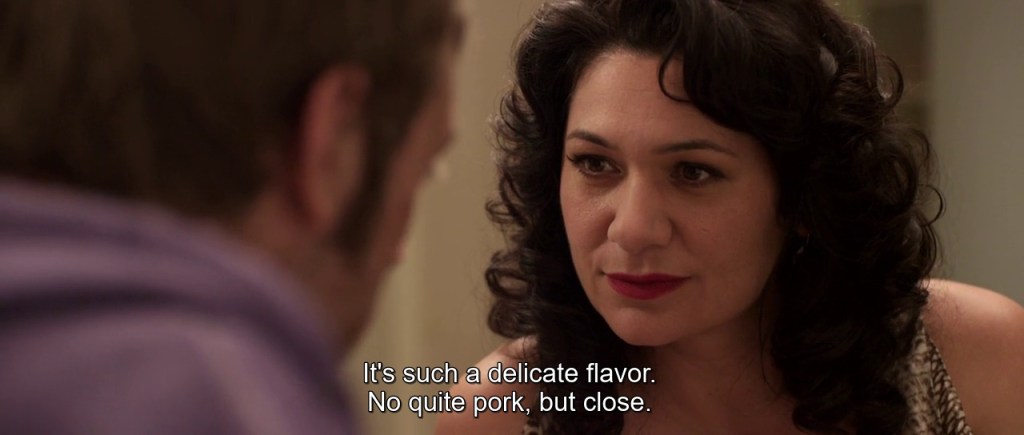
Mum (Nicola Kawana) produces hugely popular cooking shows and books, she’s a Maori Nigella, into marinades, and she describes the meat she uses:

Rina is shocked that her brother (Kahn West) would agree to eat human flesh, until he tells her about the pork and rosemary pies that her family sent to her at school. It wasn’t a choice.

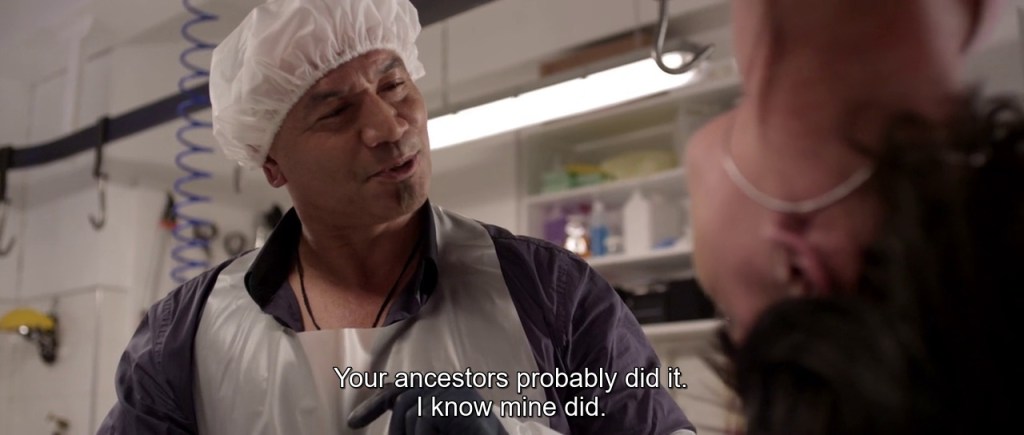
The subsequent bloody altercation with the criminals is set to fill the larder nicely. Dad tells the last living criminal, Gigi (Kate Elliott), who is hanging upside down ready for slaughter, that

“ritualistic cannibalism dates back to 1000BC to the Hun phase in Germany. The Bible itself refers to the siege of Samaria in which two women made a pact to eat their children. The Aztecs, the French, the Brits… Your ancestors probably did it. I know mine did.”

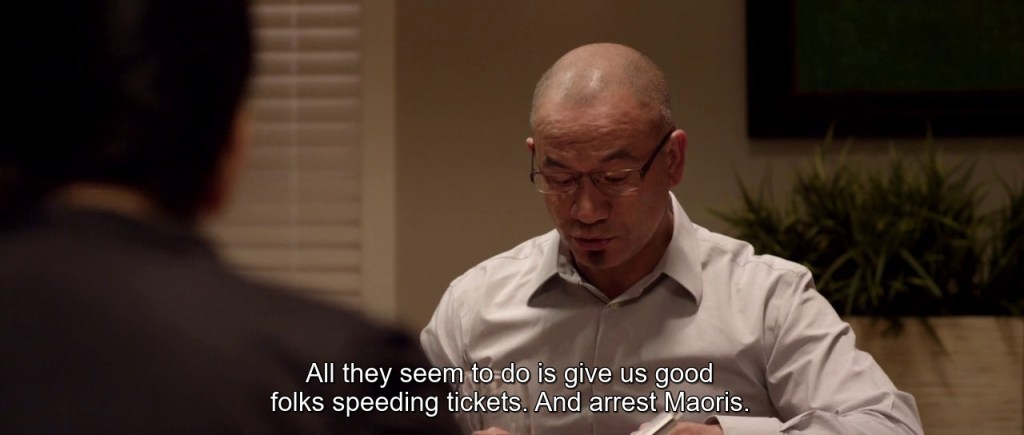
There is lots of Maori humour, and not all relating to cannibalism. Dad is an Associate Professor at the University, and blames white racism for his failure to be given tenure as full professor. When the cops knock at the door, he complains

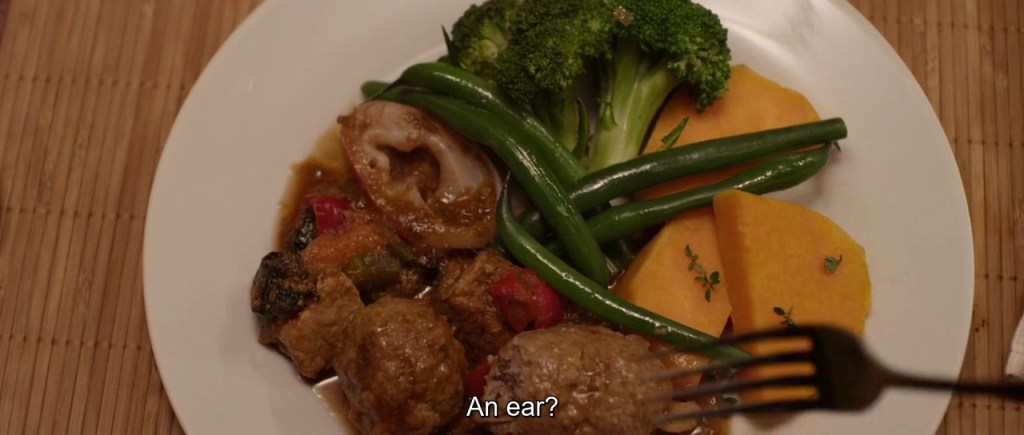
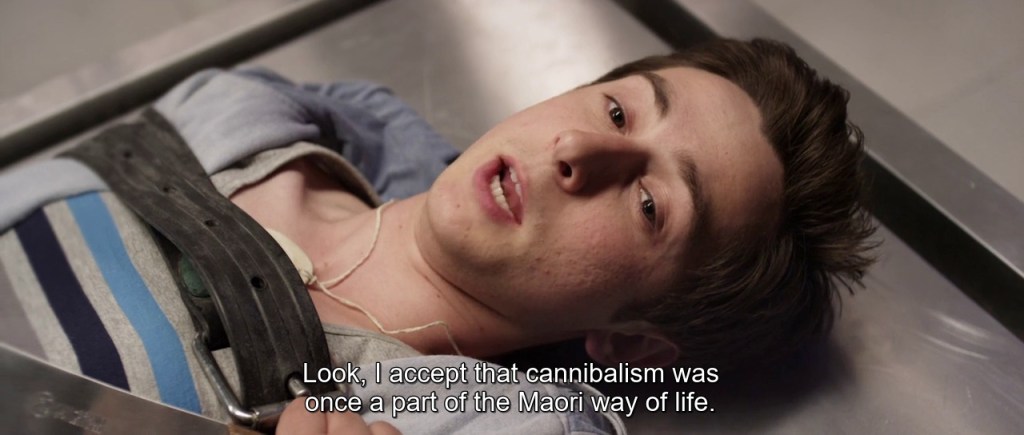
Rina’s neighbour is a white boy who is in love with her. When he appears and is invited in (“we’ll have him for dinner” says Dad – yes, Hannibal lives), he points out that he is a vegetarian, but politely eats what turns out to be a human testicle, only getting suspicious when he spots something else on his plate.

Even when they have him tied up in the basement ready for slaughter, he politely tells them

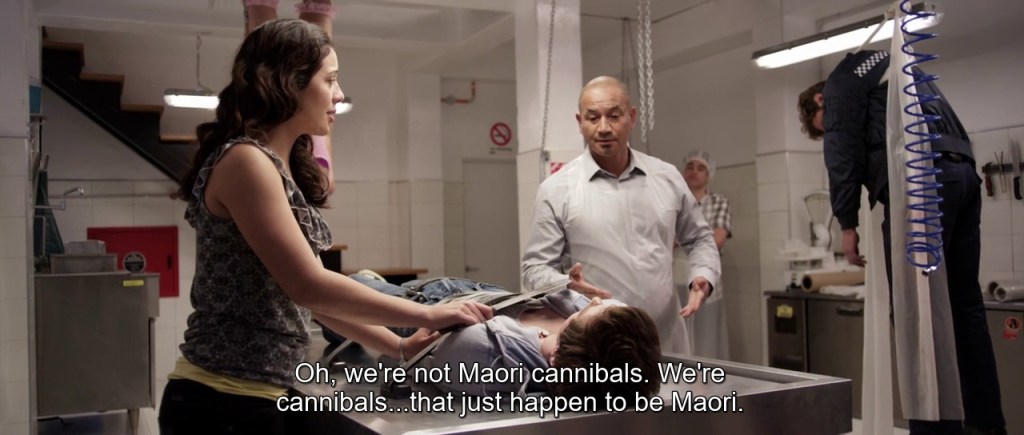
Dad replies with the best line of the movie:

“Oh, we’re not Maori cannibals. We’re cannibals… that just happen to be Maori.”

But Dad has his own agenda: to become immortal:

“By eating the still-beating heart of my youngest son, I’m halfway towards immortality. But I still need to drink the blood of my virgin daughter.”

Doesn’t quite work out that way, Rina’s not a “virgin” after that scene in the shower with her girlfriend. Or does it?

What is it about virgins and blood sacrifices anyway? Are the rest of us not good enough to sanitise humanity’s sins with our polluted blood? We exploit the innocent and gentle ones, and then expect that, by slaughering them, we somehow clear our guilt at doing so. Remember the line from Leonard Cohen’s song Amen:

Tell me again
When the filth of the butcher
Is washed in the blood of the lamb…

Anyway, the takeaway from this movie is that Maoris, traditionally accused of cannibalism, can be Maoris and cannibals without being “Maori Cannibals”. The two identities can be separated, even as they coexist. There are other families of cannibals who are not defined by their race; consider the Mexican film Somos lo que hay or its American adaptation We are what we are.

In cannibal studies, it is not unusual to be buttonholed by someone who has become aware of your field of interest and told with great solemnity “the Maori were cannibals, you know.” I tend to politely thank the informant for sharing a “fact” that almost everyone “knows”. But if I am feeling feisty, or have had a few drinks, I might invite them to unpack that statement – which Maori, whom did they eat, and what evidence are you presenting for this?

The British invaders of New Zealand were keen on declaring that the indigenous peoples, of wherever they went, were cannibals – it made their job of invading, enlightening and/or exterminating the inconvenient locals so much easier. But there is some evidence that much of the talk of Maori cannibalism was either misinterpretation or just slander – imperialists in the age of expansion tended to use words like “savage”, “barbarian” or “cannibal” pretty interchangeably – if you had dark skin and didn’t speak English, you were probably a cannibal, with no evidence required other than some hearsay from conquistadors or missionaries. But if an alien civilisation invaded Earth and found a copy of the Grimm’s Fairy Tales in a bookshelf, they might well assume that it was a history book, and that we were all cannibals.

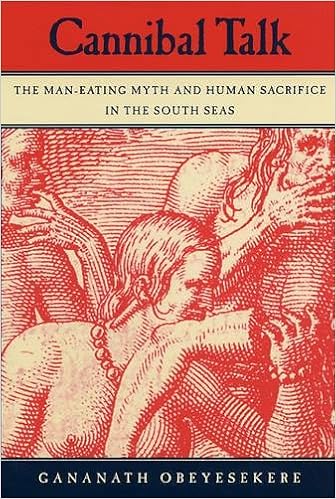
Amazon.com: Cannibal Talk: The Man-Eating Myth and Human Sacrifice in the  South Seas: 9780520243088: Obeyesekere, Gananath: Books

Ganath Obeyesekere’s excellent book on cannibalism in the South Seas makes clear that the oversimplification of Maori culture and mythology (and perhaps humour) probably led to often tragic misinterpretations of local customs. In fact, he says, it is likely that many Maori were convinced that the British were cannibals. And who could blame them? If those aliens mentioned above put down Grimm’s Fairy Tales and took a look inside our industrialised slaughter factories, where 135,000 farmed animals are killed every minute, they would assume we were far more bloodthirsty than they, or the Brothers Grimm, could have imagined. No wonder they don’t make contact.

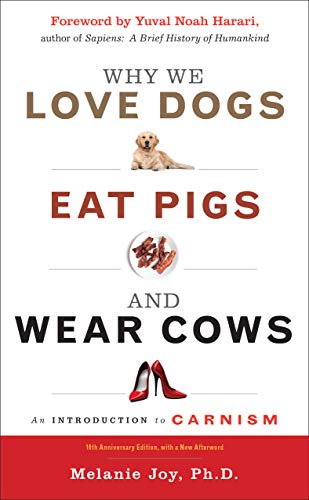
It is interesting to consider the differing responses to cannibalism in the family of this film. Social Psychologist Melanie Joy calls the ideology surrounding and justifying the eating of meat, dairy and eggs “carnism” – a set of largely unconsidered beliefs in three beliefs that start with the letter N: that these products are “normal, natural and necessary“. We drink milk, eat meat, scramble eggs, based on the insouciant assumption that all these things are normal, necessary and natural (and, a fourth N, nice to taste). The family members reflect these views, but in relation to a different food source: Homo sapiens. Dad thinks eating humans is “necessary” in order to absorb the life force of the victims, and make himself immortal. Mother is a celebrated chef; for her, eating meat is “natural”, and where it comes from is not an issue, as long as it cooks well and tastes good. Rina’s brother finds the whole thing “normal” – his parents do it, and he wants to learn from them, and make them proud. Only Rina objects, although she was willing to eat the pies they sent her when she thought they were bits of a different animal. She’s like a vegan at a barbecue, heart-broken to see her family so unthinkingly accepting the death of animals, or at least, those that she can see and talk to.

Why We Love Dogs, Eat Pigs, and Wear Cows: An Introduction to Carnism, 10th  Anniversary Edition - Kindle edition by Joy, Melanie, Harari, Yuval Noah.  Politics & Social Sciences Kindle eBooks @

If you don’t like gore and body parts (and violence and lesbian kissing) then you might want to skip this movie. But if you don’t mind all that, and like a rip-snorting plot, plenty of humour, a little suspense, and lots of intertextual winks to cultural foibles, some (perhaps unintentional) observations on the ideology of carnism, as well as some great acting and direction, then watch Fresh Meat. Recommended.

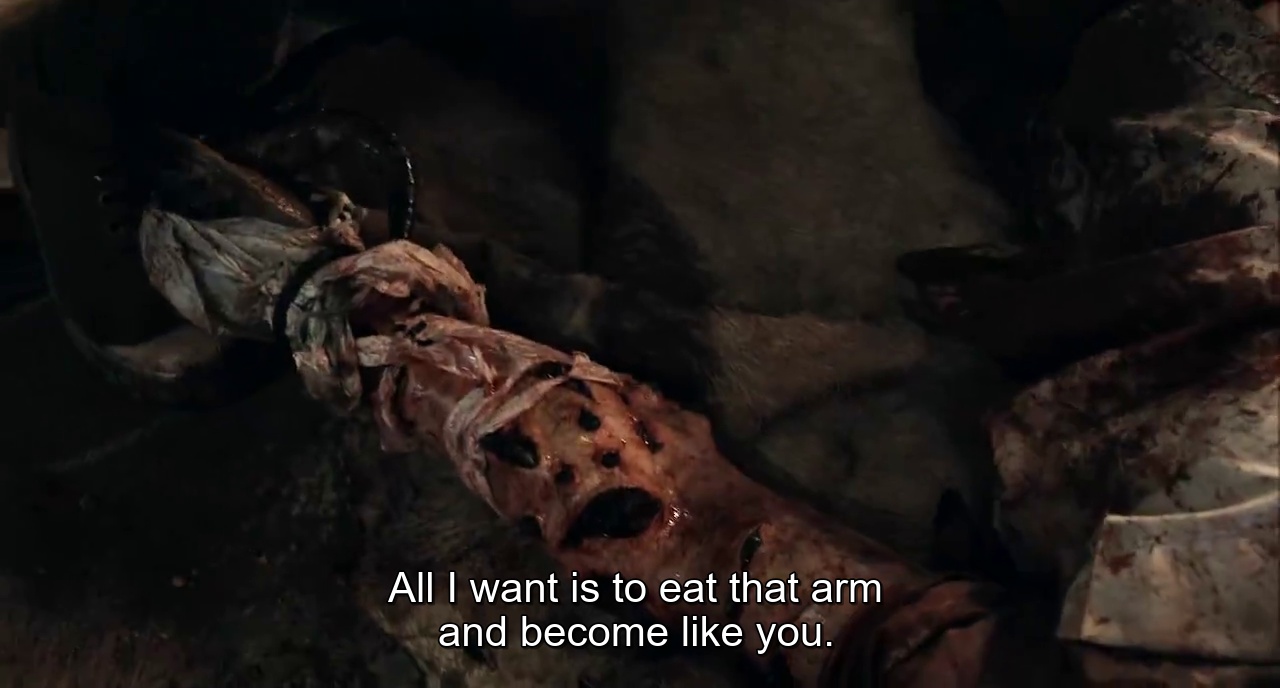
“All I want is to eat that arm and become like you”, DISTRICT 9 (Neill Blomkamp, 2009)

Back in 2009, fifteen years after the end of apartheid, South Africa seemed to be the obvious place to make movies that offered clear metaphors about racism and xenophobia. Today, they’d probably be filmed in Minneapolis, but nonetheless, after more than ten years, this movie works just as well, perhaps even better in this time, when people have to fight for their lives against both racism and an invasive disease.

DISTRICT 9 is directed by Neill Blomkamp and produced by Peter Jackson (yes, that Peter Jackson), and set in Johannesburg, South Africa. It is presented as “found footage” – fictional news stories, CCTV and interviews. District 9 is an internment camp for aliens – not from across the border or across the ocean, but across the universe. A giant UFO hovers above the city showing no signs of life, and when the authorities cut their way inside they find it is full of diseased and starving aliens, who look, as Roger Ebert said, like two metre tall lobsters. They are brought to land and housed in a secure area – District 9 – where they recover, and cause havoc with their love of wrecking stuff and eating lots of cat food.

pic-00006

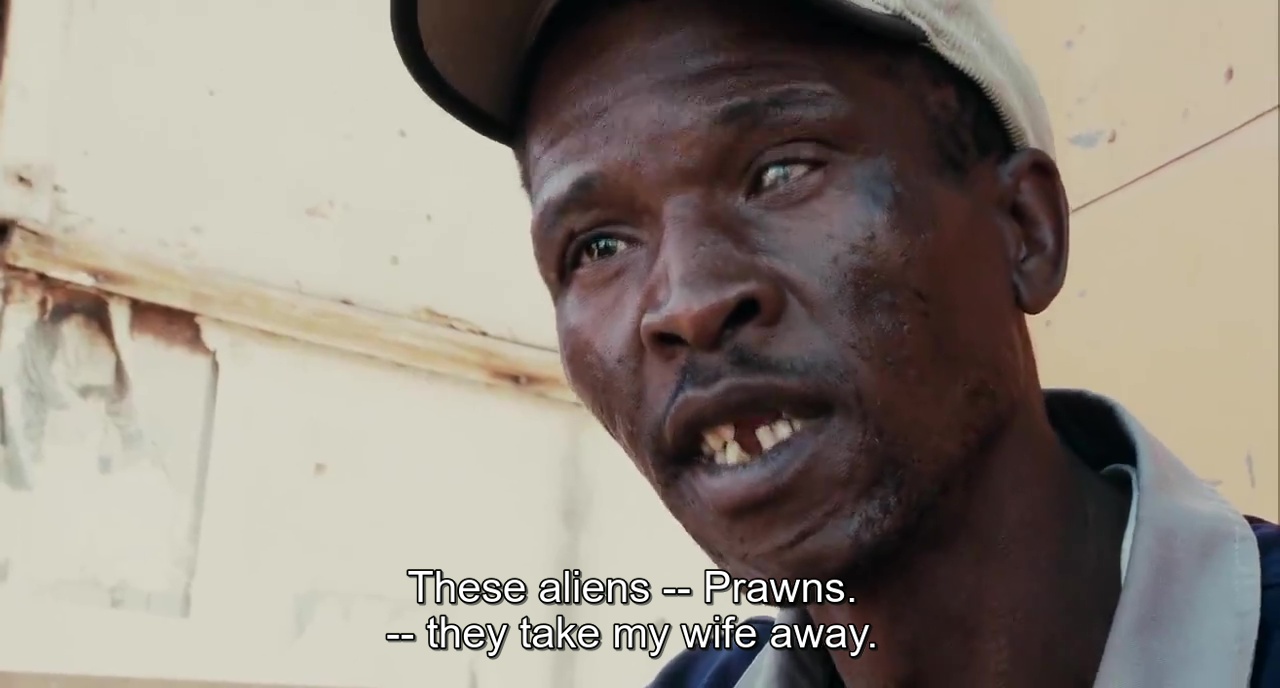
Yes, it’s not without humour. There are “interviews” with people of different races, all saying that these aliens – now known universally as “prawns” – should be sent home or else taken out of the city, away from human contact. Resettlement camp, detention centre, ghetto – those who are different can be separated with just some pernicious circumlocution.

vlcsnap-00012

vlcsnap-00017

The movie follows Wikus van de Merwe (Sharlto Copley), a naïve and nerdy mid-level executive in a huge multi-national corporation called MNU (it stands for Multi National United), which supplies mercenaries for just such situations.

vlcsnap-00001

Wikus heads off with his army and a clipboard, believing that he is going to knock on doors and ask the “prawns” to agree to be moved to a new camp, whereas of course the whole process is aimed at intimidation and terrorising of the populace.

vlcsnap-00028

Searching one building, he finds a tube of alien fuel, which they have been synthesising for twenty years, planning an escape. He opens it, and it sprays all over him.

pic-00017

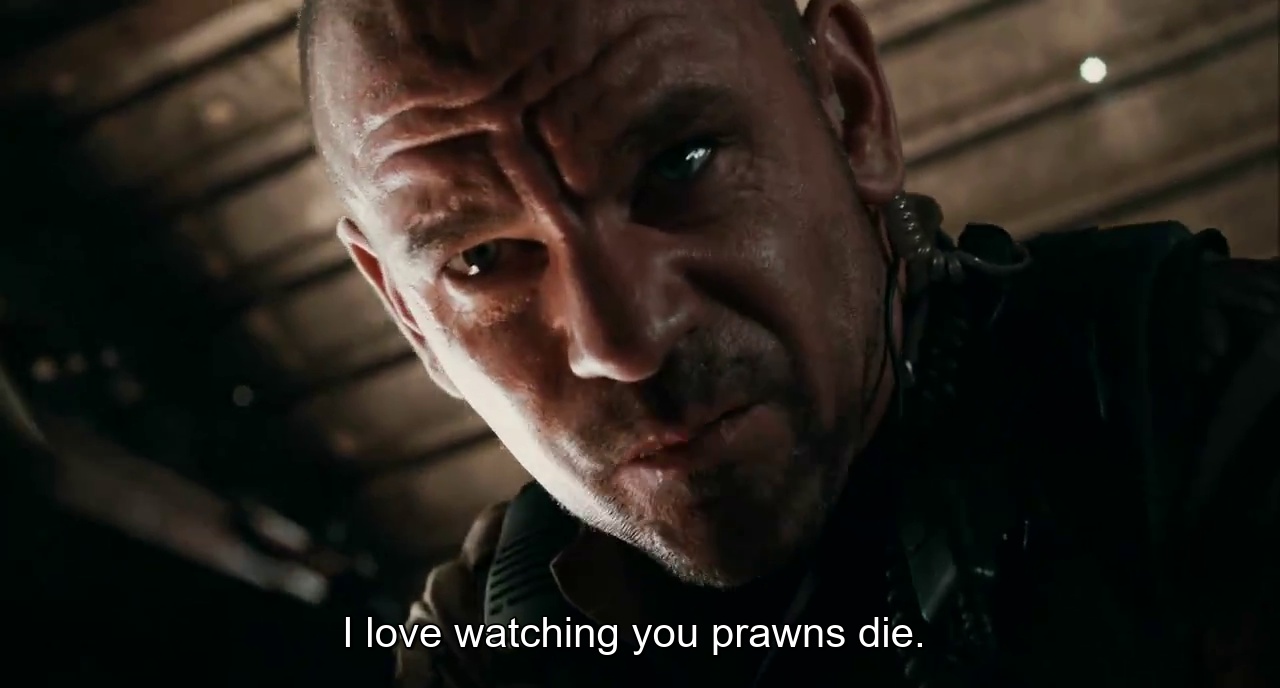
Soon, he starts metamorphosing into a “prawn” – his hand turns into an alien claw, and his teeth and nails start to fall out. This is obviously a big problem – actually two. First, his company, MNU, wants to cut him up and study his organs, desperate to learn how to transmute others, because the aliens have immensely powerful weapons that will only operate in the hands of someone with alien DNA. He escapes back to District 9, pursued by the sadistic head of the corporation’s private army, who personifies white supremacist violence.

pic-00035

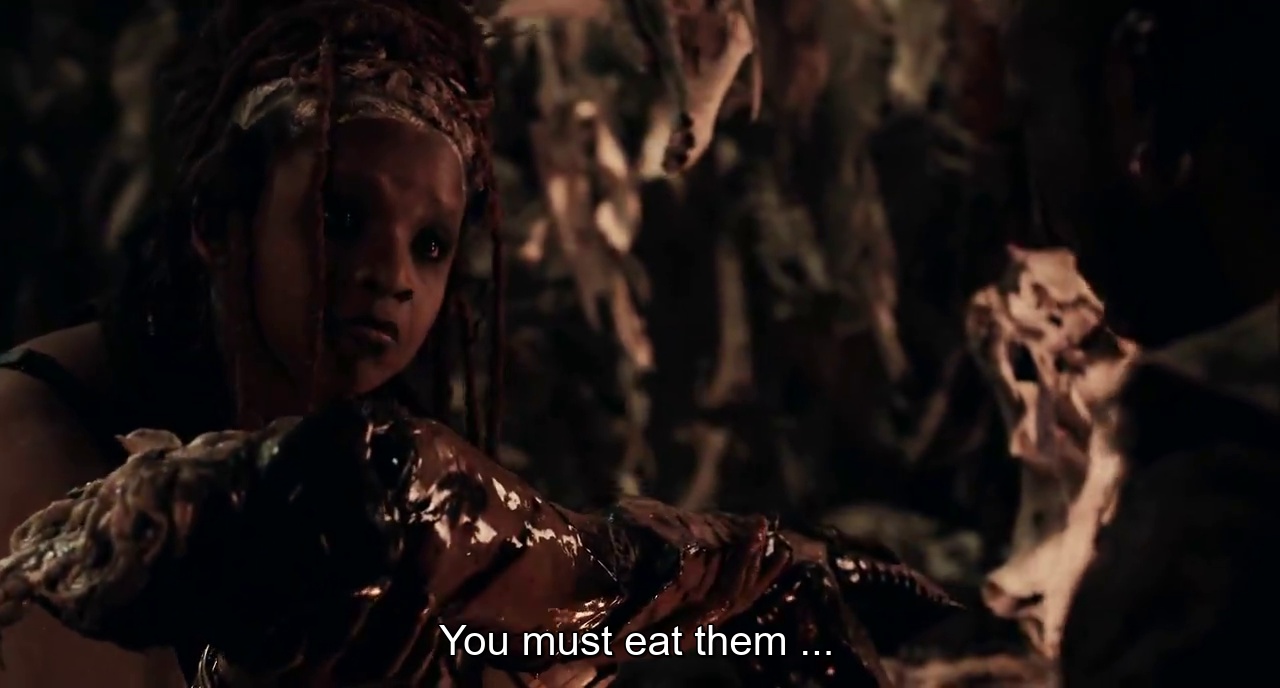
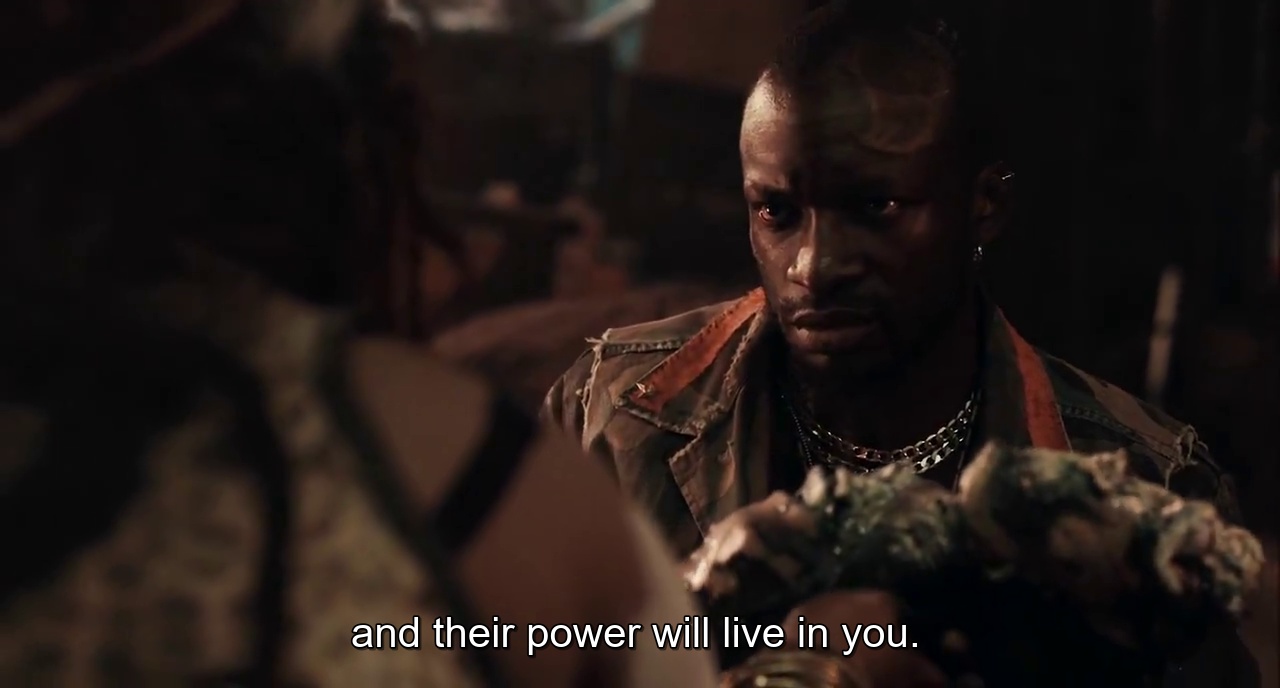
Back in District 9, Wikus is captured by a Nigerian criminal gang, who make their fortune from the aliens, selling them cat food, and offering interspecies prostitution (delicately presented). The Nigerians’ leader, whose name is taken from that of a former President of Nigeria, also wants to control those weapons, and believes eating Wikus’ arm will make him part alien as well. Why not just eat a prawn? Oh, they’ve tried that.

pic-00040

The trope of cannibals taking on the strengths of those they eat has been around pretty much forever. It is used to explain both mortuary cannibalism, where the strength of the ancestors is passed to the descendants through their flesh, and also aggressive cannibalism where the legs of the fastest enemy, or the testicles – you get the idea. It revolves around the idea that “you are what you eat”, but if you believe that, well, what does that say about the trolls who love to write “But BACON!” on vegan social media sites?

The film was shot around Johannesburg, and the squalid hovels shown were in an area of Soweto that was being demolished and the people relocated. The story is based on the true case of District Six in Capetown, where 60,000 inhabitants were forcibly removed during the 1970s by the apartheid regime. But finding a parallel story of forced removals of oppressed populations would not be difficult in most of the world’s nations. A reviewer wrote in an article entitled “District 9 reveals human inhumanity”:

“Substitute “black,” “Asian,” “Mexican,” “illegal,” “Jew,” or any number of different labels for the word “prawn” in this film and you will hear the hidden truth behind the dialogue, echoing what we historically as a species are all too capable of doing.”

Several different facets of cannibalism are presented in District 9. The Nigerians eat “prawns” – is that cannibalism, or if not, what about their plan to eat Wikus as he transforms into a prawn? The big corporation is only interested in the billions of dollars that will come from working out how to operate the alien weapons, and are ready and willing to sacrifice Wikus and use his body parts in pursuit of this goal. The aliens are tall and powerful (pulling people limb from limb in a few scenes) and look a bit reminiscent of the creatures from the Alien movie franchise, even though they don’t eat each other or the humans; but  they are keen on meat from other species like pigs and goats and whoever ends up in the slurry called cat food.

pic-00019pic-00022pic-00023

The formal definition of cannibalism tries to restrict the definition to humans eating humans, but it is always leaking out the sides. What we see in this film is the way that anyone can be abused, objectified and even eaten if they can be reclassified as inhuman or subhuman. Wikus starts the story happy to burn down shacks full of alien eggs, enjoying the sound of the eggs bursting, which sounds like popcorn. Captured by the corporation and made to operate alien weapons, he is happy to destroy pigs but begs not to be made to shoot the aliens. Later, turning into a “prawn”, he is more than happy to use the alien weapons to blow apart various soldiers of his former employer, to protect the prawns. The irony of this film is that Wikus, who is a fully carnophallogocentric human in the terms used by Derrida (“adult white male, European, carnivorous and capable of sacrifice”), only finds his humanity when he begins morphing into something else and becomes one of the outsiders he previously disdained.

It’s well worth seeing – if you don’t dig the message, then there’s plenty of action scenes, car chases and explosions. Some unintended explosions after the movie, too, when the Nigerian Information Minister asked cinemas to ban the film because it depicted Nigerians as criminals and cannibals. Not the first time white people have applied those epithets against Africans, and the film also scored a mention in Salon’s list of “white saviour” movies, since Wikus is white, and desperate to remain so. But the Malawian actor, Eugene Khumbanyiwa, who played the gang leader, said that the Nigerians in the cast weren’t bothered: “It’s a story, you know. It’s not like Nigerians do eat aliens. Aliens don’t even exist in the first place.” Sensible, but not a great look for a film that is slamming racist stereotypes through the metaphor of speciesism.

pic-00001

The direction is adroit and the story buzzes along with never a dull moment. The acting is first rate, even the guys in the alien suits become sympathetic characters, and the special effects are first rate. The film has a 90% “fresh” rating on Rotten Tomatoes. It’s available on Netflix.