Auto-cannibalism: EAT (Jimmy Weber, 2014)

Hollywood, they say, will eat you alive, and stories of those who try to succeed (and fail) are often accompanied by metaphors of incorporation. If the city doesn’t eat you, the people will, or if they don’t, you’ll end up eating yourself. That’s what happens to Novella (Meggie Maddock) in this powerful movie about a struggling actress who just can’t get a break.

No wonder she develops some nervous habits. The one revealed here is auto-cannibalism. She eats herself.

Novella has lost control of her life. She hasn’t won a part for three years. Intending to be a famous movie star, she instead finds herself auditioning for porn movies to make ends meet, and then comes home to find an eviction notice on her door. Her life is out of control, and she tries to reclaim it by auto-cannibalism—eating her own flesh. An illness, an addiction or an obsession is often described as “all-consuming” and Eat takes this to its logical conclusion.

The film explores the desperation and isolation that is so much a part of modern cultures, and the extreme reactions to the feeling of failure. What better way to explore the darkness inside us than by opening ourselves up and looking, feeling and tasting it? As the movie reminds us,

This is the debut feature from Jimmy Weber (Incubator), and he demonstrates a rare talent for showing people things that really turn their stomachs. This is what horror should do—while so many entries that once caused people to pass out or vomit in cinemas have become stale and unremarkable, people eating their own flesh still manages to make the gorge rise for many otherwise hardened reviewers of gore movies. It takes us into our deepest fears and lets them out to play in the (relatively) safe world of the cinema.

Andy Warhol made an underground movie called Eat in 1964 which featured a man eating a mushroom for 45 minutes. This Eat is a lot more graphic, although the French got here first with Marina de Van’s extraordinary 2002 film In My Skin. In that film, the protagonist feels the same appetite for her own flesh as so many people seem to feel when they smell bacon.

If you’re not a gore hound, you probably may not like this film. The special effects are excruciatingly realistic, and reinforced by sound effects of biting and slurping that offer a sometimes exaggerated realism. But although it is a disturbing film, it is beautifully made and makes its point about the human tendency to consume, like the ouroboros, the very environment that sustains us.

Cannibalism, or any kind of carnivory, is ultimately about control. Humans seek to control nature by killing and eating others—usually other species, but sometimes, even often, other humans. There is no greater control of another than taking their life and converting their flesh into food and then into faeces. But doing it to ourselves? That is more an enquiry, an interrogation of the usually unquestioned human/animal binary. Reddit reports that a guy who calls himself Incrediblyshinyshart served his friends tacos, made from his own amputated leg, just to see what we taste like. A Spanish influencer ate part of her knee which had been removed surgically, just because it was her property and she could (much the same argument people use to justify eating other animals). Then there’s the vegan who made meringues out of his own blood, because, he said, it is,

the only ethical source of animal products, because I can give my consent to myself in a way that a sheep can’t.”

Once we look inside our skin, that large sensory organ which identifies us to the world and ourselves, we find meat, the same red meat we find inside other mammals. The only difference between the cannibal who consumes his own flesh and the gourmand who eats that of a pig, cow or sheep is one of consent.

“…would break people’s souls”: AMERICAN HORROR STORIES Episode 3 “Drive In”

American Horror Stories is part of the American Story franchise. It is a 2021 spin-off of the hugely popular American Horror Story, an anthology series created by Ryan Murphy and Brad Falchuk, who were responsible for other terrifying shows like Nip/Tuck and Glee. American Horror Story is currently in its tenth season, and has been renewed for seasons 11-13. Each season is a self-contained mini-series, whereas in this new series, American Horror Stories, each episode is a self-contained narrative.

While there were cannibals in American Horror Story, (the Raspers in season 2 and the Polk family in season 6), the new series seems to be a lot more into them – the first season has two cannibal stories out of the seven episodes, an impressive 28.6% (if anyone is counting).

Episode 3 is called “Drive In” because that’s where most of the gore happens. Kelley (Madison Bailey) and Chad (Rhenzy Feliz) have been arguing about her reluctance to have sex with him, even though he is playing Bob Ross The Joy of Painting on his laptop (he’s been told it’s a sure fire aphrodisiac due to its reputation for causing a relaxed, tingling sensation known as ASMR (autonomous sensory meridian response). Anyway, that trick doesn’t work on Kelley.

Bob Ross is an interesting choice for a horror story opening, as he seems to live on through Twitch and the internet, despite having died in 1995. So much horror is about the undead stalking promiscuous teenagers!

Chad’s friends assure him that ASMR won’t work – what he needs is horror! That’s why horror films are so popular, they are aphrodisiacs, OK? The link between fear and sex – the subject of a whole new dissertation.

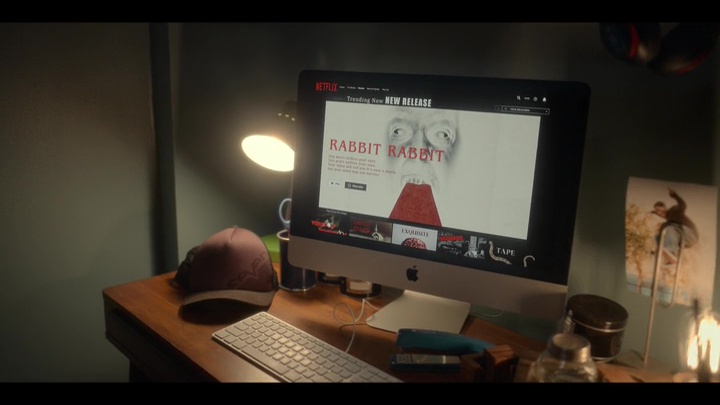
Chad’s friends have one ticket left for the drive-in screening of a film called Rabbit Rabbit. The film was banned by Tipper Gore (Amy Grabow) after the audience at the only showing in 1986 started to massacre each other, and she ordered all prints of the movie destroyed. Except they missed one: the director’s cut. Chad dismisses this whole massacre business as an urban legend, but takes the ticket.

As they drive in, a lone woman is protesting, demanding the screening be stopped. She tells Chad she was at the showing in 1986, where her boyfriend plucked out her eye and ate it before being killed himself. He listens politely, but then Kelley turns up with the biggest bucket of popcorn ever created, and he has to, you know, go. Presumably now full of popcorn, Kelley tells Chad that she is finally ready to have sex with him, and various cannibal metaphors fill the cars before the movie starts – Chad and Kelley pashing in his car, fellatio in his friend’s car next door.

Chad and Kelly’s steamy petting fogs up the car windows, so they cannot see the film, nor do they see the mayhem erupting outside, where people are attacking and devouring each another. They try to drive away when a cannibal smashes through their window but they crash, and have to retreat to the projection room, where we see Chad, who just yesterday was trying to seduce his girlfriend by playing The Joy of Painting, use the last copy of Rabbit Rabbit to cave in the skull of the projectionist, who has just eaten her assistant.

Of course, it’s not the last print. There is a rumour of another print being shown next night. Their mission, should they choose to accept, is to find the director and destroy the NEXT last copy.

So, we finally get to the cannibalism, and it’s plentiful and gory, as we would expect. Those affected by the film get bloodshot eyes, their veins swell, and they are only interested in one thing – human flesh. Chad’s best friend approaches as they leave, eyes bloodshot, veins swollen, and Chad appeals to him to THINK! Remember when we were two little boys, innocently watching porn in the afternoons? Now, according to Aristotle’s theory of the human being as the rational animal, Chad’s appeal to reason, love, friendship, shared porn, should have broken through the spell. Ha!

So what’s with this movie, with the most innocuous title imaginable: Rabbit Rabbit? The rabbit is a gentle, timid, vegan animal who is massacred pretty much everywhere he is found, due to his propensity to breed – a lot! Sounds kind of human?

Chad has done some research before going to the movie; he watched, on YouTube, Tipper Gore’s committee condemning the movie and having it banned after the audience massacre in 1986. Banning things is popular in America due to deep religious convictions, but also not popular due to, you know, the First Amendment. Tipper Gore, married to Vice President Al Gore, was responsible for making music companies add warning labels to songs with explicit content around that time, after finding her 11 year old daughter listening to Darling Nikki by Prince, so this is not just idle chatter – she was seriously into banning stuff.

But why is the government banning Rabbit Rabbit and destroying all copies (or so they imagine)? Well, the director, who glories in the name Larry Bitterman (John Carroll Lynch from Fargo and The Drew Carey Show) is asked by Tipper about his claim in Fangoria Magazine that his movie:

“…would break people’s souls, and anyone who saw it would be damaged forever.”

Publicity hype, laughs Bitterman, but Tipper is worried about the effects of violent content on society, which must be an in-joke for Murphy and Falchuk, after presenting us with ten seasons of violent content, and now this gorefest. Critics have been warning about that sort of thing forever. Civil society has been threatened by the Internet, porn mags, the horror genre, and before that television, movies, radio… hell, conservative Cro-Magnons were probably warning about the evils of cave paintings 40,000 years ago.

Is there any sense to it? Can porn turn us into sex offenders, horror stories into cannibals? The internet certainly turns some people into trolls. Bitterman wants to make cinematic history – he tells the teens that this “was his finest hour” – a cinematic happening, a horror movie where the horror isn’t on screen, it’s in the audience. He refers to Friedkin’s (actual) use of subliminals in The Exorcist – two frames of a demon’s face in reel six had people throwing up in the aisles and women going into labour. Rabbit Rabbit took this to the next level,

“The universal combination of image and sound that would trigger the fear centre of every human brain. I studied intrusive memory formation, the CIA hijinks with MK-Ultra…”

Bitterman had jumped the hearing bench and attacked Tipper Gore when she boasted about destroying the prints of his movie, which resulted in him being locked up for fifteen years for assault. His conclusion: “a society that locks up its artists doesn’t deserve to survive.”

There’s another in-joke – the series was made by FX for Hulu. What if a film like Rabbit Rabbit was to appear on, I dunno, a rival streaming platform – imagine the damage it could do!

But there’s another question for us among all the hacked flesh and explosions. Have you ever felt like you are in a horror movie? Maybe while in the throes of a personal tragedy, or watching a pandemic unfold, or contemplating changing climate. Perhaps you’ve wondered if “they” are playing with your brain. Or perhaps they really are breaking your soul. Or maybe eating you alive. Cannibalism is a brutal metaphor for pretty much every atrocity we visit on our fellow earthlings. A movie, a cataclysm, political upheaval – what would it take to start us eating each other?