Revenge cannibalism: LAST HOUSE ON THE LEFT (Wes Craven, 1972)

“Revenge is a dish best served cold”

Don Corleone said it in The Godfather, as did  Khan Noonien Singh in Star Trek II: The Wrath of Khan, but the saying goes back at least 100 years before that. It doesn’t seem to apply so much in cannibalism movies though, because if you’re really mad at someone, I suppose you’d want him to be warm and watching as you devour him, like Hannibal eating Abel Gideon, after feeding him oysters and acorns and sweet wine to improve his taste. Or Titus feeding Tamora, the queen of the Goths, a pie made of her own sons.

Revenge cannibalism is an exquisite form of retribution, going beyond murder to total destruction of the enemies (or his loved ones), incorporation of their essence, and conversion of their physicality into your excrement. Dante’s Inferno (Canto 33) depicts Count Ugolino in hell, gnawing eternally on the head of Archbishop Ruggieri, the man who had walled him up in a cell with his sons, whom he had eventually cannibalised. Perhaps the earliest narratives of revenge cannibalism appear in Greek legends, particularly that of Thyestes, who was fed the flesh of his sons by his pissed-off brother.

I’m adding this old classic film to the catalogue of cannibal texts as there is some human flesh eaten in anger, although it is not the main course of the film (puns are so hard to avoid in cannibalism blogs). The film starts with a couple of young girls heading to a rock concert, being abducted on the way, raped and murdered. If you are sensitive to such things (I hope most people are) or traumatised by recent news events, you may wish to give this film a miss.

I had forgotten about this movie until the Supernova Festival in which over 260 young people were abducted, raped and murdered, with a savagery reminiscent of that which befalls Mari and Phyllis in this week’s film. The barbaric slaughter of some 1,400 Israelis on October 7 2023 was followed by the IDF’s massive revenge, the extent of which shocked some of the world and impressed the rest. “Well, what would you do?” many online commentators asked.

Well, what would you do if, like the parents of one of the girls, you offered a warm welcome and overnight accommodation to some travellers who, you later discovered, were a gang of escaped criminals who had raped and murdered your child? The film answers that with a shotgun, a chainsaw, and an electric booby-trap.

Not what the UN would call a “proportionate response” (whatever that means), but many in the audience cheered at each gruesome death when it finally made it into cinemas (not until 2004 in Australia). Oh yes, one other form of killing that qualifies this otherwise simple slasher as a cannibal film—the girl’s mother, Estelle, pretends to seduce one of the gang members, then bites off his penis and swallows it.

The film critic Robin Wood spoke of what he called “the return of the repressed”. We repress our animal instincts to live in community, but beneath that veneer of respectability and normative morality lies “the monster”, the one we take out to exercise in the comparative safety of the cinema screen. Horror films such as this one depict the overcoming of repression, the shedding of the façade of respectability, in both the escaped psychopaths and then the vengeful parents, who shed their polite decorum to slash and kill. Craven shows the same thing in his later movie The Hills Have Eyes. Films from the seventies routinely explored a moral equivalence, a Vietnam War era pacifism that assumed any violence was equally appalling. Cannibal Holocaust, made at the end of that decade, sums up this view of the cycle of violence and the moral degeneracy of revenge when the anthropologist asks, “I wonder who the real cannibals are?” Later films from more cynical times tended to depict the killer or cannibal as either an irredeemable monster or a heroic figure, taking on bankrupt social imperatives. Right and wrong has come back into fashion but divides the viewers, depending on what their social media bubble tells them.

The film starts with a statement that it is a true story, which I guess used to be all the fashion—think Punishment Park, Cannibal Holocaust and the Blair Witch Project. The good old days, when truth was optional… oh forget I even started that sentence.

Anyway, this film wasn’t a true story, it was a remake of Ingmar Bergman’s 1960 film The Virgin Spring, in which a father takes merciless vengeance of a group that has raped and murdered his daughter. That was in turn based on a mediaeval Swedish ballad called “Töres döttrar i Wänge” (“Per Tyrsson’s daughters in Vänge”) in which the vengeful father discovers that the rapists he has just killed were actually his sons, sent off by him into the cruel world.

But it was Wes Craven’s film that introduced a bit of cannibalism into the revenge recipe. Wes Craven is best known for the Nightmare on Elm Street franchise and the first films of the Scream franchise. Last House on the Left was his first feature film, and he had such low expectations of its success that he felt he could be as outrageous as he liked and no one would ever hear about it, particularly his conservative family. But it did a lot better than he expected, to the extent that,

“I literally had people who would no longer leave their children alone with me. Or people that would, when they found out I had directed the film, say “That was the most despicable thing I had ever seen,” and walk out of the room.”

Audience members would get into fistfights, have heart attacks, and in many cases invaded the projection room to slash the film. Well, consider yourself warned.

Craven decided he would avoid horror, but was a complete failure at his attempts at more socially acceptable work. He had become known as the master of the slasher, leading him to another revenge cannibalism film in 1977 which became a cult classic, The Hills Have Eyes, in which a group of mutant cannibals kidnap, rape and slaughter (and eat) a ‘normal’ American family, who then inflict massive retaliation on them, adopting their savagery and raising the stakes.

In early 2023, a viral video seemed to show a couple of hunters gloating over a lion they had killed, and then being attacked and eaten by another lion, supposedly the dead lion’s brother.

Well, what would you do?

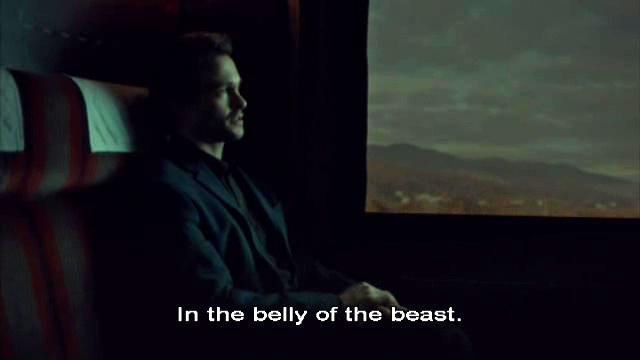
“In the Belly of the Beast” HANNIBAL Season 3 Episode 5 “Contorno”

Cannibalism is at its heart all about food, food from a particular species of animal. This episode, Contorno (Italian for side dishes) is also about food – our choices, our enjoyment, how food affects us and how it identifies us.

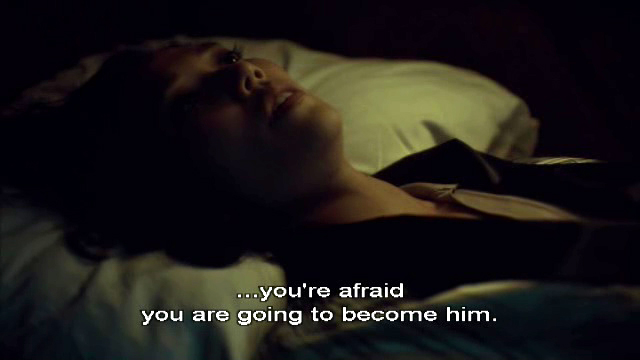
We start with Chiyoh and Will on a train to Italy. Chiyoh fills in a little bit of what we don’t know about the early Hannibal. Chiyoh was sent to be attendant to Hannibal’s aunt, Lady Murasaki. The young Hannibal was there, an orphan. He was meant to be with his sister, but he was alone. We don’t know why, although we will be told (episode 7) that Hannibal ate, but didn’t kill, his sister, Mischa.

They get talking about snails, a side dish of which we know Hannibal is inordinately fond, particularly when they have been snacking on human flesh. Chiyoh observes:

“Birds eat thousands of snails every day. Some of those snails survive digestion and emerge to find they’ve travelled the world.”

vlcsnap-00010.jpg

Then we see Hannibal feeding snails to Bedelia – he explains that, as a young man, he kept sea-snails to attract fireflies.

“Their larvae devour many times their own bodyweight. Fuel, to power a transformation into a delicate creature of such beauty.”

Snails, Hannibal tells Bedelia, follow their nature. She dismisses his metaphor: fireflies live such brief lives. A bit more evidence follows that Hannibal is a Nietzschean:

vlcsnap-00016.jpg

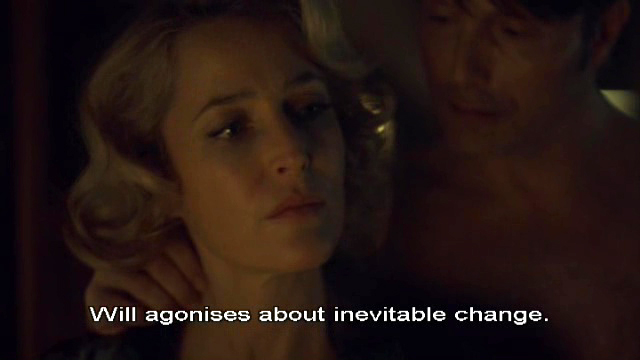
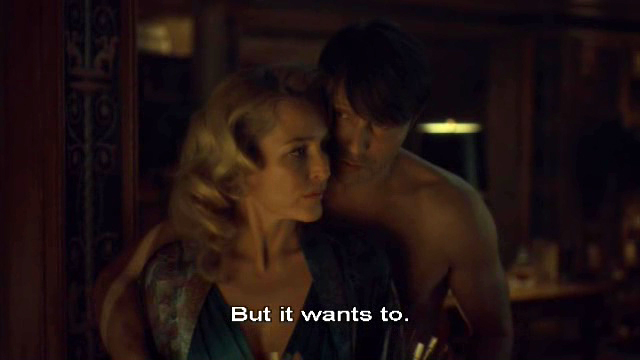
In a scene in which Hannibal is clearly checking whether Bedelia is ready for dinner yet (his), they move on from snails and fireflies, a story about transformation, to a discussion on Hannibal’s other main interest: Will Graham. In particular, Will’s fascinating struggle to retain his ethical certainty in the face of Nietzsche’s amor fati – the love of fate, and his true nature as a hunter.

vlcsnap-00017.jpg

vlcsnap-00018.jpg

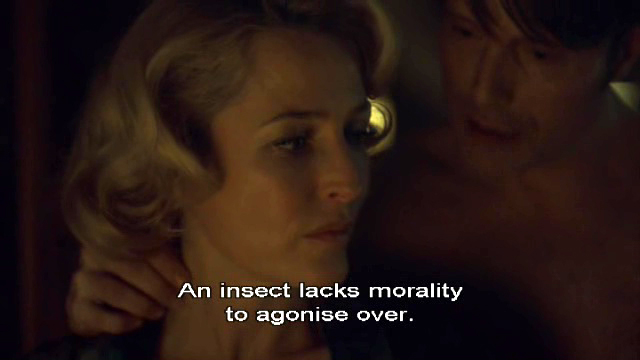
Bedelia protests: “Almost anything can be trained to resist its instincts. A shepherd dog doesn’t savage the sheep.”

vlcsnap-00021.jpg

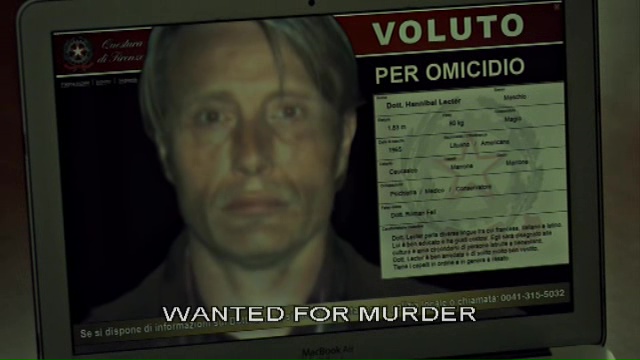
Still on the food theme, Alana has laid out Hannibal’s table setting for Mason Verger – she has worked out that he can be traced through his exquisite purchases, just the way Clarice did in the book Hannibal. She has tracked him to Florence through receipts for Bâtard-Montrachet (Chardonnay) and tartufi bianchi (white truffles). Mason, never one for social niceties, observes that Hannibal must have liked the taste of her too, and perhaps she enjoyed her own taste of him. He offers a double-entendre that the Guardian critic described as

“actually the most disgusting part of the episode. That’s pretty impressive given the extreme close-ups on snails and Pazzi’s bowels flopping to the ground as he is hanged from a window”.

vlcsnap-00037.jpg

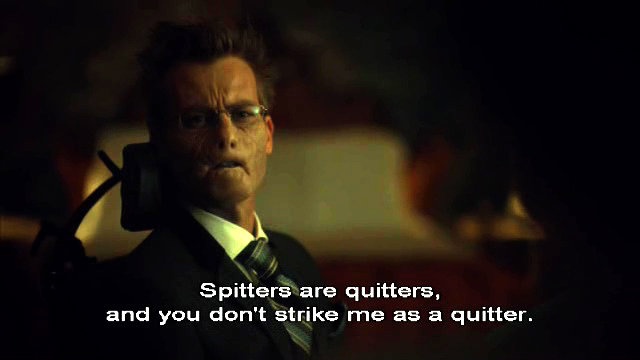
Chiyoh is not really getting Will. She cannot seem to see the attraction between the men, just the shared aptitude for violence: “If you don’t kill him”,

vlcsnap-00056.jpg

He agrees. So she pushes him off the train. As you do.

No humans were eaten in the making of this episode; snails are the man-eaters. But we do get the gory killing of police inspector Pazzi, who goes as his ancestor went – hanged with his bowels out as punishment for treachery. His ancestor tried to kill Lorenzo the Magnificent in 1478; this Pazzi recognised Hannibal and tried to sell him to Mason Verger rather than turn him over to the FBI.

vlcsnap-00062.jpg

Hannibal shows Pazzi a woodcarving of his ancestor’s death, and mentions that the Archbishop bit Francesco.

vlcsnap-00085.jpg

Running out of time, Hannibal just tells Pazzi “I’ve been giving very serious thought to doing the same” (although in the book and film Hannibal, this line was “I’ve been giving very serious thought to eating your wife”).

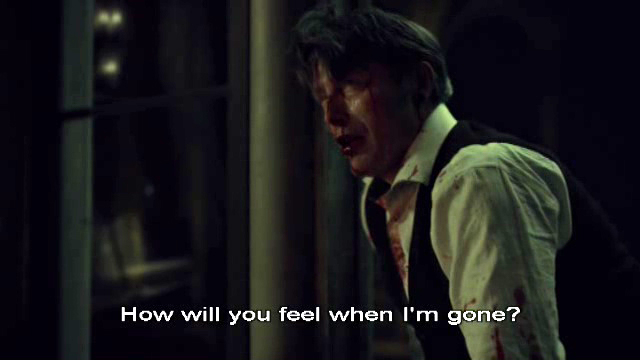
No one actually gets eaten, but Hannibal gets a solid beating from Jack Crawford, who has just dumped his wife’s ashes in the Arno and is fighting mad, particularly after spending the afternoon with Pazzi’s soon-to-be widow. Some readers interpret this scene as Hannibal finally discovering he is not as smart and invulnerable as he thinks, but I hold to the oft-stated theme that Hannibal is always way ahead of the plot. The beating that Hannibal takes is almost without resistance; as if he somehow feels that he owes Jack a chance at revenge for betraying his friendship, a chance to grow into a predator.

vlcsnap-00115.jpg

vlcsnap-00116.jpg

So Jack pushes Hannibal out the window, but he catches himself on Pazzi’s corpse and limps off. The inspector is without his bowels, but not without his uses.

vlcsnap-00093.jpg


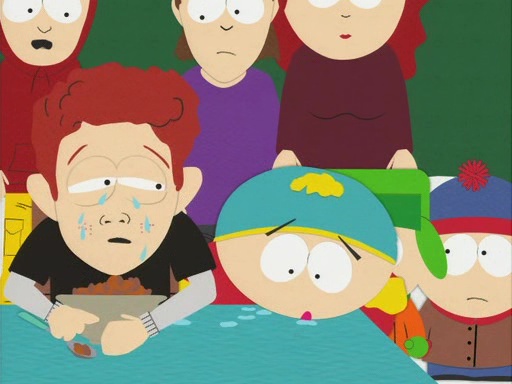
Cartman’s Cannibalism: SOUTH PARK S5E4 “Scott Tenorman Must Die” (Parker & Stone, 2001)

“Scott Tenorman Must Die” was the 69th episode of South Park, and first aired on July 11, 2001. It contains nods to a number of classic cannibal narratives.

Eric Cartman’s cousin, 8th-grader Scott Tenorman, tricks Cartman out of $16.12 in return for some pubic hairs, the possession of which, he tells Cartman, means that he has reached puberty. Realizing that he has been tricked, Cartman swears revenge.

vlcsnap-00004.jpg

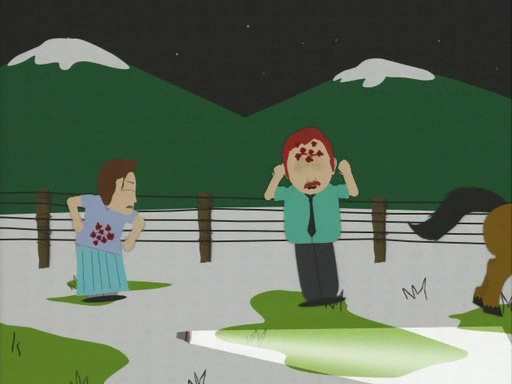
“Did you see that movie Hannibal? Where the deformed guy trained his pigs to eat his enemy alive? Well, if we find a pony, we can train it… to bite off Scott Tenorman’s wiener.”

vlcsnap-00007.jpg

The pony misunderstands the training.

vlcsnap-00008.jpg

Cartman’s schemes become more convoluted, involving a letter to the band Radiohead asking them to visit South Park, where Scott will be humiliated as his favourite group get to watch the pony mutilate his member.

Cartman arranges for Scott’s parents to be killed.

vlcsnap-00010.jpg

He steals the bodies and cooks them up for his “chili con-carnival.”

After Scott eats the chili, Cartman asks him:

“Do you like it, Scott? I call it Mr and Mrs Tenorman chili.
Nyah nyah nyah nyah nyah – I made you eat your parents”.

vlcsnap-00014.jpg

Cartman enjoys licking up Scott’s tears.

vlcsnap-00018.jpg

We have here a passing reference to Hannibal again, in which Mason Verger collects the tears of orphans to make into his favourite cocktail.

But the main reference is to all revenge cannibalism narratives, from the Greek legend of Atreus and Thyestes to Titus Andronicus, to Liver-eating Johnson, John R. Weber and Omaima Nelson, and of course the Tim Burton version of Sweeney Todd.

vlcsnap-00012.jpg

Cartman is not a cannibal in this episode, but he facilitates an act of cannibalism as revenge, just as Sweeney Todd did. Eating a relative, as Scott Tenorman (and Thyestes) unwittingly did, is horrific not because of the flavour – they find the fare delicious. It’s because a life you cared about was snuffed out, not just extinguished, but totally annihilated by digestion, just as we do to those we eat every day, whose lives may have been just as precarious and precious – to someone.