BIDEN AND THE CANNIBALS: the case of Uncle Ambrose

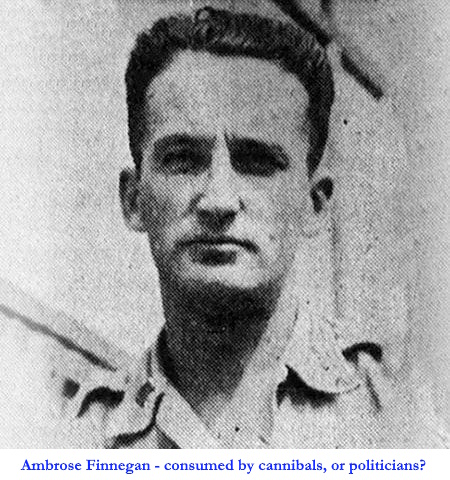
Raising eyebrows is a national sport of the USA during election years, and both Trump and Biden, the contenders, have done their share of the heavy lifting. But Biden really hit his eyebrow-raising stride this week (on April 18 2024) with claims that his uncle, second lieutenant Ambrose Finnegan (known in the family as Bosie), was shot down in the Pacific in 1944, and may have ended up on the dinner menu of Papua New Guineans.

Visiting a missing-in-action war memorial in Scranton, Pennsylvania, Biden put his hand on the engraved name of Ambrose Finnegan, whose plane went down but whose body was never recovered. Biden said,

“He got shot down in New Guinea, and they never found the body because there used to be — there were a lot of cannibals, for real, in that part of New Guinea.”

The Defence Department POW/MIA Accounting Agency saw the case differently:

“For unknown reasons, this plane was forced to ditch in the ocean off the north coast of New Guinea. Both engines failed at low altitude, and the aircraft’s nose hit the water hard. Three men failed to emerge from the sinking wreck and were lost in the crash. One crew member survived and was rescued by a passing barge. An aerial search the next day found no trace of the missing aircraft or the lost crew members.”

Biden’s cannibalism story, told twice during his visit to Pennsylvania, was clearly intended as a gesture of respect for those who died in the war, and a dig at Trump. White House Press Secretary Karine Jean-Pierre stated that Biden’s story presented a contrast with Donald Trump, who reportedly described Americans who died in war as “losers” and “suckers” after refusing to attend the American cemetery in rainy Paris in 2018. Trump also mocked George H.W. Bush who was shot down in 1944 and John McCain who was captured and tortured in Vietnam, claiming real heroes did not get shot down or captured. Trump denies it all, but the Paris story was later confirmed by John Kelly, his longest-serving White House chief of staff.

However, like a lot of off-the-cuff comments, this one may have backfired for Joe Biden. Cannibalism is a convenient excuse for vilifying others, but vilifying Pacific Islanders does not help make any points against Donald Trump, and instead proved a distraction.

Certainly, cannibalism has been reported in Papua New Guinea (PNG), the Pacific nation that occupies the eastern half of the island of New Guinea, off the northern coast of Australia, but not always by the locals. At least 100 cases have been documented in which Japanese soldiers killed and ate the flesh of Allied troops, Asian labourers and indigenous people in Papua New Guinea during WWII. Researcher Toshiyuki Tanaka, an associate professor of political science at the University of Melbourne, reports,

“These documents clearly show that this cannibalism was done by a whole group of Japanese soldiers, and in some cases they were not even starving.”

Cannibalism can be an affirmation of victory, a way of humiliating an enemy beyond death. Historian Gerald Linderman reports that Japanese soldiers would disembowel captured Americans and leave the bodies “with their severed genitals stuffed in their mouths,” not only symbolically gagging the mouth of the victim but declaring him both sterile (castrated) and edible in one metaphorical gesture of contempt. George H.W. Bush, later to be President of the US, was shot down during bombing raids on Chichijima, a tiny island 700 miles (1,100 km) south of Tokyo, in September 1944. Eight of the airmen with him were captured, tortured and executed, and Japanese officers then ate parts of the bodies of four of the men. Bush was the only one to evade capture.
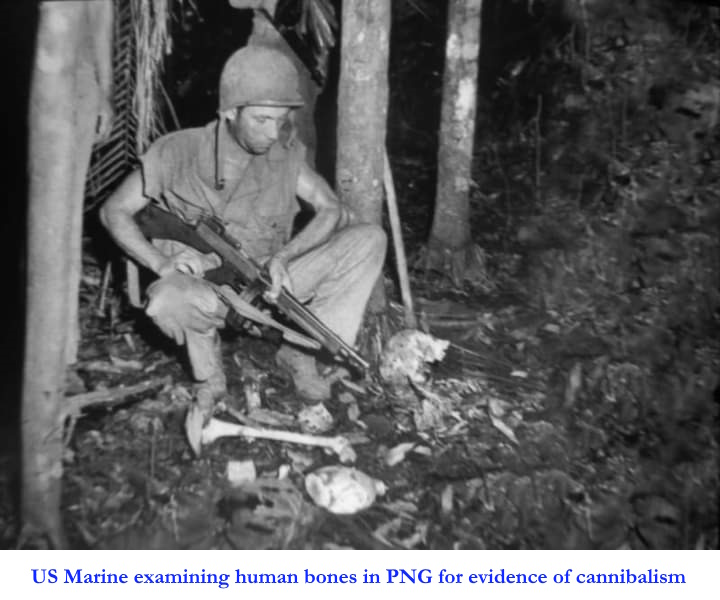
While the Japanese army may have practised cannibalism in PNG for political and psychological ends, those (relatively rare) tribes of local peoples who did so almost certainly were motivated by ritual, reverential reasons. The memory of ancestors is maintained in some cultures by ceremonially eating their flesh. Some tribes have even cashed in on the cannibal mystique, ushering awestruck tourists around monuments to their supposed recent cannibal past.

Local commentators have not been amused by Biden’s colonialist characterisation of their citizens as primitive savages who routinely eat outsiders, a trope that has proved useful throughout the history of imperial conquest as a pretext for invasion, enslavement and extermination. Michael Kabuni, a lecturer in political science at the University of Papua New Guinea, said that the comments were unsubstantiated and poorly judged, particularly when the US has been seeking to strengthen its ties with the country, and counter Chinese influence in the Pacific region.

“The Melanesian group of people, who Papua New Guinea is part of, are a very proud people. And they would find this kind of categorisation very offensive. Not because someone says ‘oh there used to be cannibalism in PNG’ – yes, we know that, that’s a fact. But taking it out of context, and implying that your [uncle] jumps out of the plane and somehow we think it’s a good meal is unacceptable. There was context. They wouldn’t just eat any white men that fell from the sky.”

Biden is right to say that there were some cannibal tribes in PNG last century, but wrong to universalise it as something routine and simply gustatory. His anecdote may have been inspired by the infamous tale of Michael Rockefeller, the 23-year-old Harvard graduate and son of New York governor Nelson Rockefeller, who vanished in western New Guinea in 1961 while on a trip to collect wooden carvings of the Asmat people for a museum. His boat capsized on the way, and he was reported to have swum towards the shore. His disappearance captivated the world’s media, and later led a researcher to claim in a book that Rockefeller made it to shore and was eaten during a ritual by the Asmat. It became fashionable to set cannibal movies in the jungles of PNG, even if they were not actually filmed there.

There is one more aspect of the history of PNG cannibalism that adds insult to injury. One of the most commonly cited examples of modern cannibalism, often used as a reason to avoid the practice, references kuru, the fatal, neurodegenerative disease discovered in PNG and caused by “misfolding and aggregation of a host-encoded cellular prion protein” and purportedly transmitted by cannibalism. Transmissible spongiform encephalopathies became best known during the outbreak of “mad cow disease” caused by human-imposed bovine cannibalism, in which cows were fed bone meal from other cows. It occurs also in sheep as “scrapie” and in humans as Creutzfeldt–Jakob disease, one form of which, kuru, literally the “trembling” disease, peaked among the Fore people of the Eastern Highlands of Papua New Guinea in the late 1950s. It became famous, not least for showing that cannibalism is not something lost in the mists of history – it even won a mention on The Love Boat! The disease mainly affected women and children, who were allegedly the main consumers of brain tissue during funerary rites. Instances of the disease fell off sharply when cannibalism was prohibited by Western administrators, which led to the hypothesis that kuru was a result of the ingestion of human brains and central nervous systems.

But even if cannibalism and kuru are directly related, it seems a stretch to make this a primary reason for avoiding cannibalism. Mad cow disease was far more widespread than kuru, and yet did not significantly affect the sales of bovine flesh in the long term. Nor, as far as I am aware, have any cannibals reported a preference for central nervous system tissue. Nor would they be likely to catch it from white men that fell from the sky.
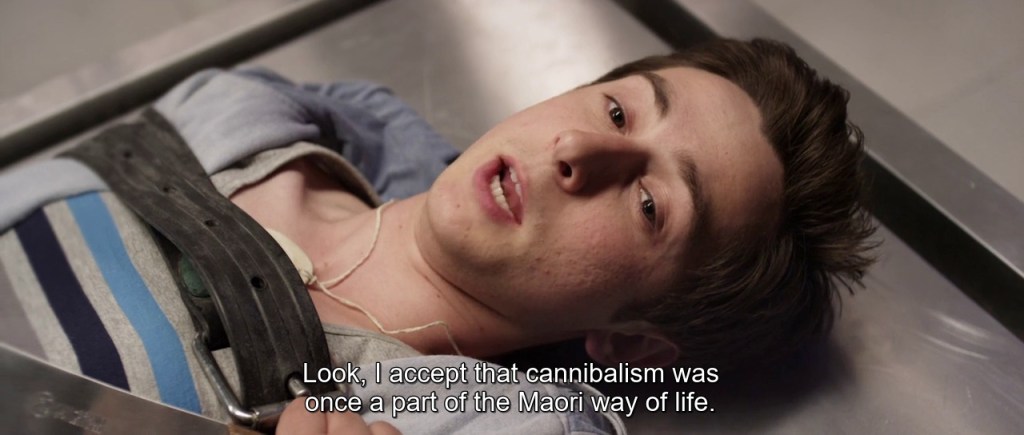
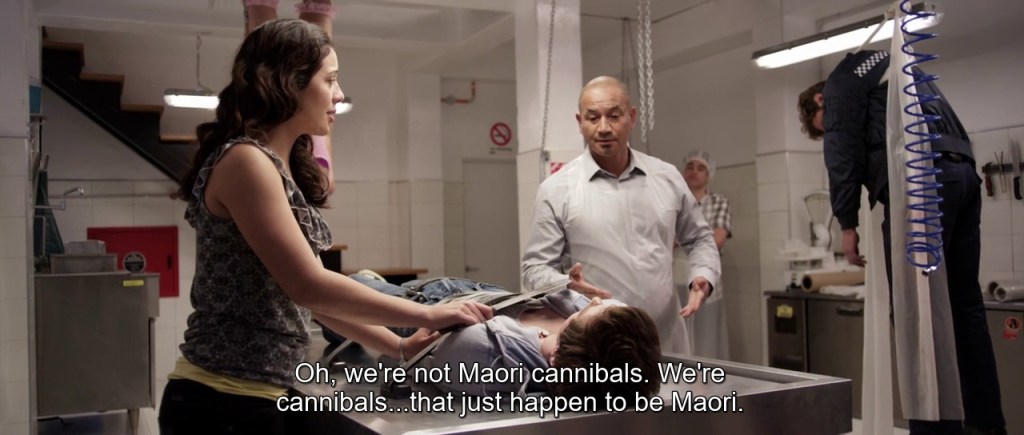
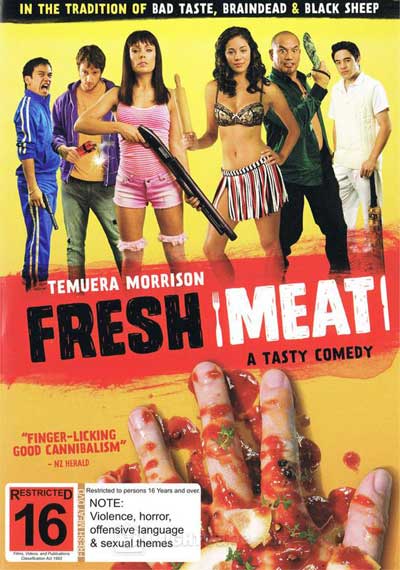
“We’re NOT Maori cannibals”, FRESH MEAT (Danny Mulheron, 2012)

New Zealand has produced some world class directors; think of Jane Campion, or Peter Jackson. Not a lot of cannibal movies unfortunately, considering the country’s reputation – Jackson’s first feature film Bad Taste had a lot of humans being eaten but, unfortunately for this blog, the eaters were space aliens, so not technically cannibals. Jackson’s Braindead was closer, involving zombies. Can you be a cannibal if you are undead? We’ll have to consider that question some time, perhaps when we run out of movies about living cannibals (probably about the time we get to net zero).

But Danny Mulheron gets right into freshly killed, cooked (and sometimes raw) human body parts in this film. Like Jackson’s Bad Taste, Fresh Meat was Mulheron’s first feature film, and it’s an impressive inception.

The plot involves a family of Maoris, recently converted cannibals, being taken hostage by some bumbling criminals. Rina (Hanna Tevita) is home from her lesbian explorations at “St Agnes Boarding School for Young Maori Ladies” when a bunch of criminals break in to her home to hide from the police, having killed some prison guards to free their boss from a prison van.

But that’s Rina’s second shock of the day; the first was finding her parents’ new eating regime in the fridge.

Turns out her Dad (Temuera Morrison from Once Were Warriors and The Mandalorian)  is reviving an “eighteenth century post-colonial religion” – he has found the prophecies of Solomon Smith and become a “Solomonite”; he now believes that eating people (“taking their life-force”) will cause the family to flourish.

Yes, among the satire on Maori and Pakeha cultures, there is the odd dig at Christian transubstantiation.

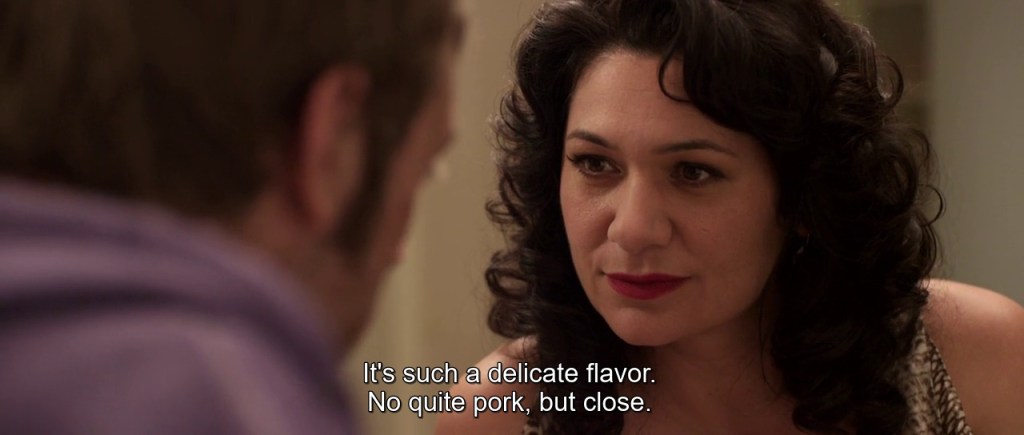
Mum (Nicola Kawana) produces hugely popular cooking shows and books, she’s a Maori Nigella, into marinades, and she describes the meat she uses:

Rina is shocked that her brother (Kahn West) would agree to eat human flesh, until he tells her about the pork and rosemary pies that her family sent to her at school. It wasn’t a choice.

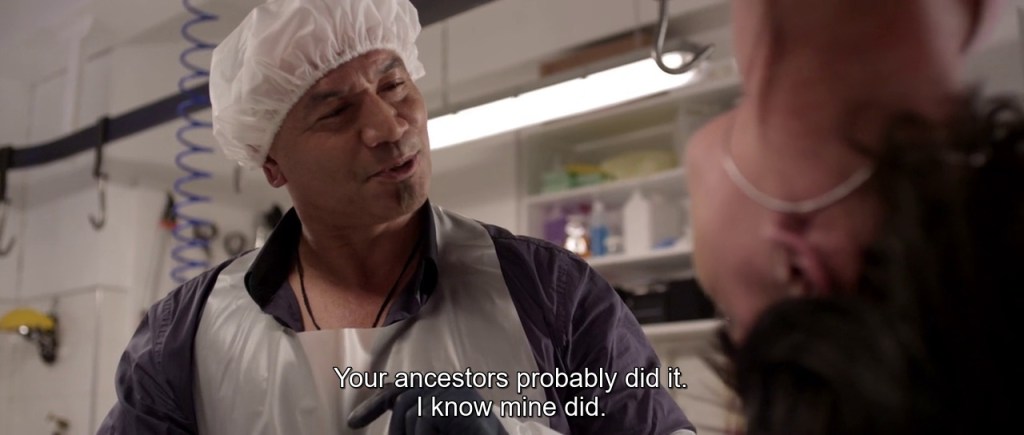
The subsequent bloody altercation with the criminals is set to fill the larder nicely. Dad tells the last living criminal, Gigi (Kate Elliott), who is hanging upside down ready for slaughter, that

“ritualistic cannibalism dates back to 1000BC to the Hun phase in Germany. The Bible itself refers to the siege of Samaria in which two women made a pact to eat their children. The Aztecs, the French, the Brits… Your ancestors probably did it. I know mine did.”

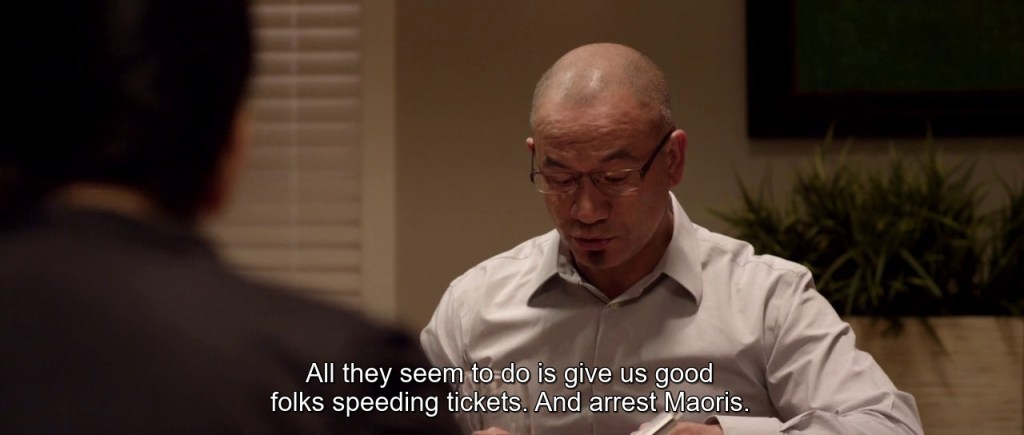
There is lots of Maori humour, and not all relating to cannibalism. Dad is an Associate Professor at the University, and blames white racism for his failure to be given tenure as full professor. When the cops knock at the door, he complains

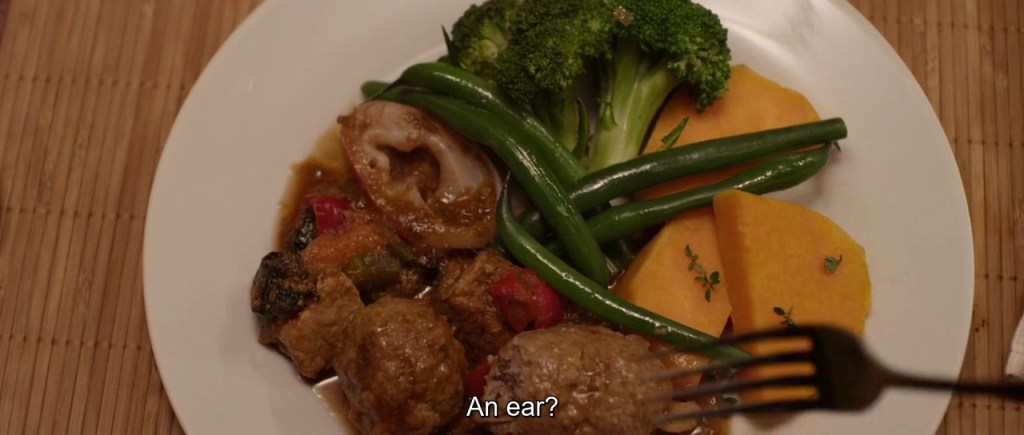
Rina’s neighbour is a white boy who is in love with her. When he appears and is invited in (“we’ll have him for dinner” says Dad – yes, Hannibal lives), he points out that he is a vegetarian, but politely eats what turns out to be a human testicle, only getting suspicious when he spots something else on his plate.

Even when they have him tied up in the basement ready for slaughter, he politely tells them

Dad replies with the best line of the movie:

“Oh, we’re not Maori cannibals. We’re cannibals… that just happen to be Maori.”

But Dad has his own agenda: to become immortal:

“By eating the still-beating heart of my youngest son, I’m halfway towards immortality. But I still need to drink the blood of my virgin daughter.”

Doesn’t quite work out that way, Rina’s not a “virgin” after that scene in the shower with her girlfriend. Or does it?

What is it about virgins and blood sacrifices anyway? Are the rest of us not good enough to sanitise humanity’s sins with our polluted blood? We exploit the innocent and gentle ones, and then expect that, by slaughering them, we somehow clear our guilt at doing so. Remember the line from Leonard Cohen’s song Amen:

Tell me again
When the filth of the butcher
Is washed in the blood of the lamb…

Anyway, the takeaway from this movie is that Maoris, traditionally accused of cannibalism, can be Maoris and cannibals without being “Maori Cannibals”. The two identities can be separated, even as they coexist. There are other families of cannibals who are not defined by their race; consider the Mexican film Somos lo que hay or its American adaptation We are what we are.

In cannibal studies, it is not unusual to be buttonholed by someone who has become aware of your field of interest and told with great solemnity “the Maori were cannibals, you know.” I tend to politely thank the informant for sharing a “fact” that almost everyone “knows”. But if I am feeling feisty, or have had a few drinks, I might invite them to unpack that statement – which Maori, whom did they eat, and what evidence are you presenting for this?

The British invaders of New Zealand were keen on declaring that the indigenous peoples, of wherever they went, were cannibals – it made their job of invading, enlightening and/or exterminating the inconvenient locals so much easier. But there is some evidence that much of the talk of Maori cannibalism was either misinterpretation or just slander – imperialists in the age of expansion tended to use words like “savage”, “barbarian” or “cannibal” pretty interchangeably – if you had dark skin and didn’t speak English, you were probably a cannibal, with no evidence required other than some hearsay from conquistadors or missionaries. But if an alien civilisation invaded Earth and found a copy of the Grimm’s Fairy Tales in a bookshelf, they might well assume that it was a history book, and that we were all cannibals.

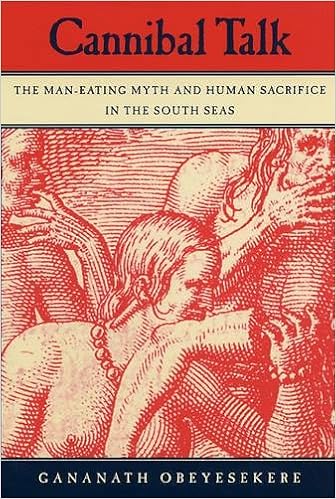
Amazon.com: Cannibal Talk: The Man-Eating Myth and Human Sacrifice in the  South Seas: 9780520243088: Obeyesekere, Gananath: Books

Ganath Obeyesekere’s excellent book on cannibalism in the South Seas makes clear that the oversimplification of Maori culture and mythology (and perhaps humour) probably led to often tragic misinterpretations of local customs. In fact, he says, it is likely that many Maori were convinced that the British were cannibals. And who could blame them? If those aliens mentioned above put down Grimm’s Fairy Tales and took a look inside our industrialised slaughter factories, where 135,000 farmed animals are killed every minute, they would assume we were far more bloodthirsty than they, or the Brothers Grimm, could have imagined. No wonder they don’t make contact.

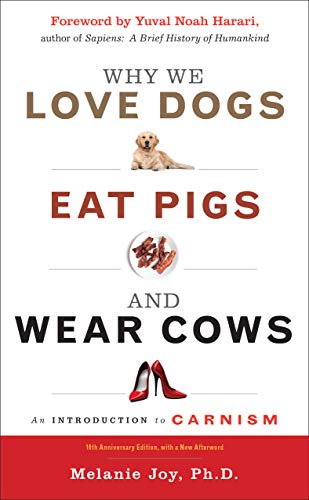
It is interesting to consider the differing responses to cannibalism in the family of this film. Social Psychologist Melanie Joy calls the ideology surrounding and justifying the eating of meat, dairy and eggs “carnism” – a set of largely unconsidered beliefs in three beliefs that start with the letter N: that these products are “normal, natural and necessary“. We drink milk, eat meat, scramble eggs, based on the insouciant assumption that all these things are normal, necessary and natural (and, a fourth N, nice to taste). The family members reflect these views, but in relation to a different food source: Homo sapiens. Dad thinks eating humans is “necessary” in order to absorb the life force of the victims, and make himself immortal. Mother is a celebrated chef; for her, eating meat is “natural”, and where it comes from is not an issue, as long as it cooks well and tastes good. Rina’s brother finds the whole thing “normal” – his parents do it, and he wants to learn from them, and make them proud. Only Rina objects, although she was willing to eat the pies they sent her when she thought they were bits of a different animal. She’s like a vegan at a barbecue, heart-broken to see her family so unthinkingly accepting the death of animals, or at least, those that she can see and talk to.

Why We Love Dogs, Eat Pigs, and Wear Cows: An Introduction to Carnism, 10th  Anniversary Edition - Kindle edition by Joy, Melanie, Harari, Yuval Noah.  Politics & Social Sciences Kindle eBooks @

If you don’t like gore and body parts (and violence and lesbian kissing) then you might want to skip this movie. But if you don’t mind all that, and like a rip-snorting plot, plenty of humour, a little suspense, and lots of intertextual winks to cultural foibles, some (perhaps unintentional) observations on the ideology of carnism, as well as some great acting and direction, then watch Fresh Meat. Recommended.