Peter Jackson’s first feature film: BAD TASTE (1987)

Peter Jackson is a New Zealander, and the fourth-highest-grossing film director of all time, behind only Spielberg, Cameron and the Russo brothers. He is best known for The Lord of the Rings and The Hobbit trilogies, as well as movies like King Kong and the documentary The Beatles: Get Back.

But we all have to start somewhere, and Jackson’s first feature was Bad Taste, a splatter comedy which took years to make as it began life self-funded and only later received a grant from the NZ Film Commission. Many of Jackson’s friends acted and worked on it for no charge. Shooting was mostly done on weekends since Jackson was then working full-time for a newspaper in Wellington, the NZ capital. 

Bad Taste is about aliens who plan to capture humans for food. They take over a (fictional) NZ town called Kaihoro (which means something like “fast food” in Maori) and butcher all the residents.

“There’s no glowing fingers on these bastards. We’ve got a bunch of extra-terrestrial psychopaths on our hands.”

It turns out that they are not just hungry but entrepreneurs from the “Crumbs Crunchy Delights” company, and need to collect human flesh for the home planet market, and get it there before competing alien corporations.

“I am certain  that when the Homo sapiens taste takes the galaxy by storm, as it will, Crumbs Crunchy Delights will be back at the top”

They are disguised as humans until they drop the pretence and, luckily for us, they speak English to each other to reveal their plans. Their plans are foiled by a team of agents from the Astro Investigation and Defence Service (AIDS) entering the town to take down the invaders.

The action sequences are actually very well done, long before Jackson had access to special effects studios, with choreographed fight sequences and buckets of gore and brains and other body parts. Jackson took two roles, a nerdy scientist who is a member of the government agents, and a leader of the aliens, including a famous scene in which he fights himself on top of a cliff.

The film is most famous for its unapologetic gore, including half-eaten bodies, heads coming off, and brains leaking out of skulls. The brave Kiwis mow the aliens down in an interminable gun-fight, which culminates in Derek (Jackson) killing the alien leader, Lord Crumb, by jumping on him from the floor above while wielding a chainsaw, a favourite of cannibal films, cutting the alien’s body in half and disappearing inside the corpse. The film was banned in Queensland briefly, which did wonders for its publicity; the video release proudly proclaimed on the cover “Banned in Queensland”.

But is it cannibalism? It is after all a completely alien species from another world eating humans, or at least trying to. So not strictly cannibalism, but humans being eaten by aliens dressed as humans is a popular narrative in science fiction texts (see for example Under The Skin), and raises some interesting questions. Anthropocentric humanism maintains that we are somehow on a higher level than “animals”, even though we are animals, a species of Hominidae (Great Apes). Because of this ontological division, bolstered in past centuries by religious beliefs about humans being made in the image of the divine, we tend to judge other animals as possessions, inferior beings to whom we can do as we wish, so we kill them, skin them, shear them, eat them, experiment on them, race them, and so on. Not just other animals; the colonisers of Africa, South America and other parts of the world felt the same way about the indigenous peoples who lived in the areas they coveted, and so they were conquered, enslaved, converted or simply exterminated.

What if travellers from another planet, considering themselves far superior to us (not an entirely unreasonable proposition if they have conquered deep space travel), decide to colonise, exploit or even eat us? If we could take them to the Galactic High Court, the learned judges might rule that the aliens were simply doing to us what we do to billions of other earthlings each year. As John Harris wrote:

Suppose that tomorrow a group of beings from another planet were to land on Earth, beings who considered themselves as superior to you as you feel yourself to be to other animals. Would they have the right to treat you as you treat the animals you breed, keep and kill for food?

Bad Taste is well made, entertaining and, if you are not worried by lots of gore and brains, very watchable. It debuted at the Cannes Film Festival in May 1987, which is not bad for a first movie, a splatter comedy, made on a shoestring. It currently has 71% “fresh” rating on Rotten Tomatoes, which is far better than many far better financed films. A number of critics made great sport of the title, saying that “bad taste” described the film well, but that was deliberate, a clever combination that tells the audience that it is bad taste cinema (may leave a bad taste in your mouth) and that human meat tastes bad, which according to all the cannibals who have testified about it, is simply not true. We taste somewhere between veal and pork, and would certainly be very popular in galactic fast-food joints.

“Our women can’t get pregnant” A BOY AND HIS DOG (L.Q. Jones, 1975)

“Dog eat dog” is an odd expression. Dogs generally don’t eat each other. The phrase is really a euphemism for the way humans will exploit and kill (and sometimes eat) each other. Accusing the dogs is more socially acceptable, but the phrase is more about our own predilection for devouring our own kind to satiate our various hungers, particularly in times of societal collapse.

This cannibalism blog has reviewed a number of post-apocalyptic films, the best known being Soylent Green, Delicatessen, The Bad Batch, Snowpiercer, 28 Days Later and The Road. Lesser known films include No Blade of Grass, We Are The Flesh, Cadaver, The Girl With All The Gifts, Tear Me Apart and of course several versions of the H.G. Wells classic, The Time Machine.

Clearly, we love bad things happening, preferably well into the future (800,000 years in The Time Machine), and to other people. It’s Greek tragedy but set in our future, warning us of the inevitable unwinding of society and, as we have found, often the eating of the most vulnerable. In most such movies, food is the obsession of both the protagonist and the various antagonists that must be overcome.

The protagonist of such movies is almost always male, and males, in most cultures, are conditioned to eat meat. If humans are the only meat available, that will often do just fine. Other appetites appear occasionally (there was a controversial rape scene in No Blade of Grass), but Freud’s insistence on the primacy of the sexual urges is put on the backburner (sorry) when it comes to eating.

Not this one though. The film is a post-apocalyptic black comedy (we see mushroom clouds at the start, and are told that World War 4 (in 2007) lasted five days – enough time to empty the missile silos). This film is set in 2024 (well, Soylent Green was set in 2022, so now seems like a good decade for disasters). The humans who survive work together in “rover packs” or else hunt alone as “solos”. There is an implication that the rover packs are happy to engage in a bit of cannibalism, as we see a small child carried, struggling, into a campsite.

The main character is a solo – his name is Vic, and he is played by Don Johnson, who a decade later would become a huge star and win a Golden Globe for his role in Miami Vice.

Did I say main character? Arguably, the star of this film is Blood, a shaggy dog.

Blood is smarter, better informed, has an advanced sense of humour and irony (he calls Vic “Albert”, after the rather more conventional dog stories of Albert Payson Terhune), has a superb sense of smell, and can converse telepathically with Vic. But the genetic modification that allowed this telepathy (designed for war of course) also removed his ability to hunt for food. So, Vic and Blood are symbiotes – Vic hunts for food, while Blood smells out women for the sexually voracious appetite of Vic.

In this ultimate extension of what Barbara Creed calls “aggressive phallicity”, the frontier of the rugged individual, the gun is king and women are purely there as rape targets. In the opening scene, Blood finds a woman, but a rover pack has arrived first, and they have knifed her after they have had their fun. Vic’s anger is purely selfish – that she could have been used a few more times. Blood mocks him “you’re so funny when you’re sexually frustrated.”

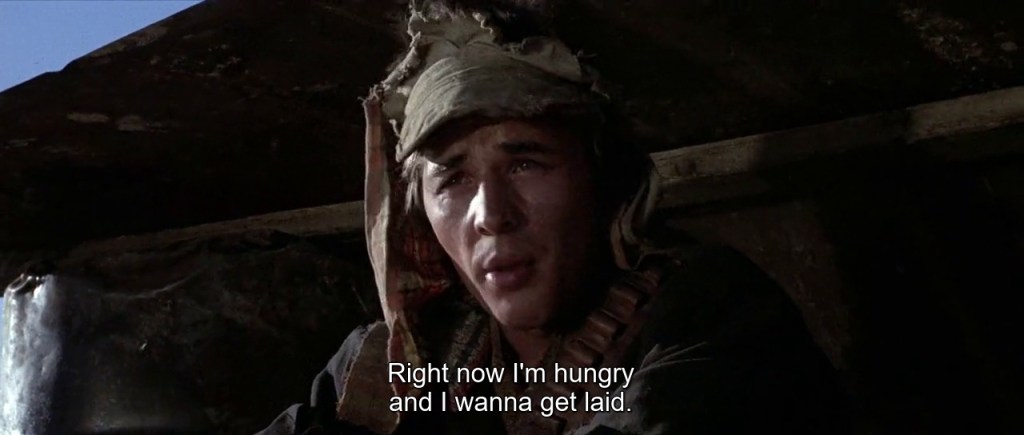
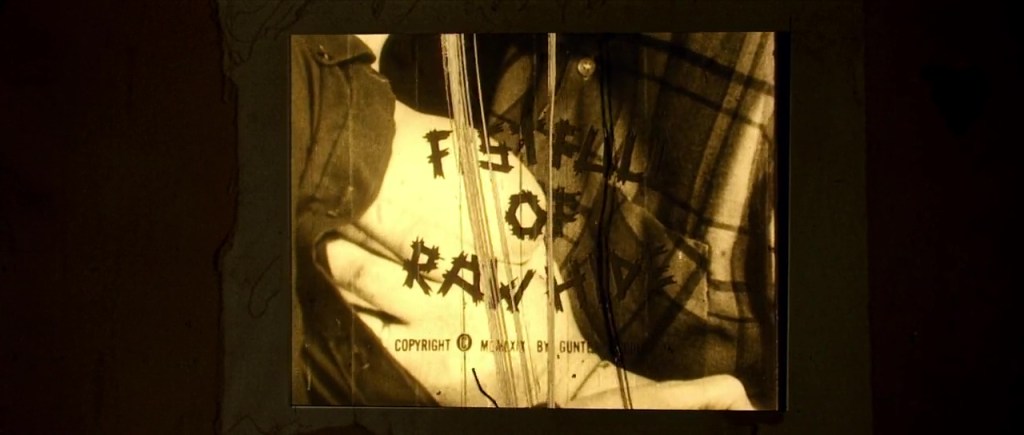
Later, Blood discovers a woman, Quilla (Susanne Benton) in disguise at the movies (there is one rover pack that exists as a sort of neutral space, putting on movies, running a brothel and selling popcorn). They put on old movies and cheesecake for lonely solos to beat off to. They watch Fistfull of Rawhide (it’s a real movie, from 1969) as Vic waits for the girl to leave and head someplace isolated where he can accost her.

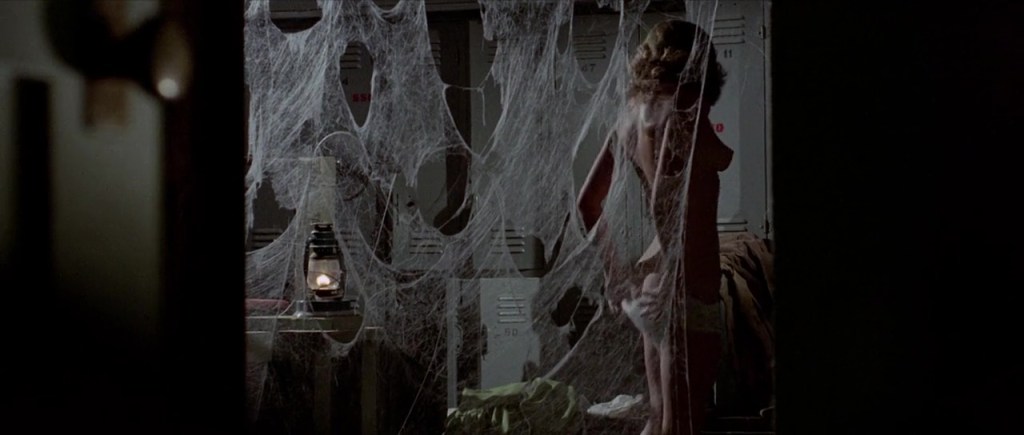
They follow her to a deserted gymnasium, where she is getting changed from her male disguise, and he is enchanted by her youth, beauty and cleanliness.

Quilla comes from a different world, the “Downunder”, a series of underground cities where traditional American values rule – raised hats, marching bands, picket fences, apple pies, civility). Everyone is made up in white-face – everyone is Middle America is white, and seem to need confirmation. Quilla, it turns out, was “the cheese” – she came to the surface to tempt Vic, like Eve tempted Adam, so he would enter the underground world, and bring his sperm with him.

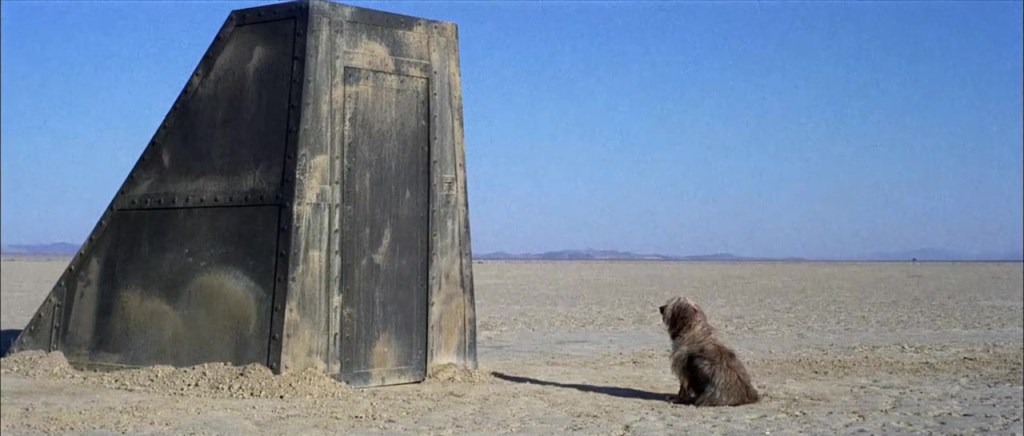
Yes, the solid citizens of the symbolic order or language and laws have become sterile. But Blood, she says, wouldn’t fit in there. Trouble in paradise. Blood, badly wounded defending Vic, who had refused to leave Quilla to a rover pack, waits at the portal as Vic descends like Orpheus in search of Quilla. They want Vic’s sperm, because being underground has made their men sterile, but it’s not going to be the orgiastic event Vic imagines – they strap him down and connect his member to an electro-ejaculation machine, just as modern agriculture does to prize-winning bulls and rams. Such a device is normally inserted into the rectum and positioned against the prostate, and an electric charge causes involuntary ejaculation. To the townsfolk, Vic is an animal to be milked of sperm and then killed when they are done with him.

The film is available on YouTube (at the time of writing) so I won’t give too many spoilers. It’s well acted, the dog is delightful, the plot is pretty faithful to the novella of the same name, which came from the brilliant mind of Harlan Ellison. Ellison published the story is a collection called The Beast That Shouted Love At The Heart Of The World, in the introduction to which he objected to the term “new wave science fiction”, and cast bitter scorn on the “clots” who called his work “sci-fi”. Ellison was known for his brilliant writing but also his outspoken, combative personality; the Los Angeles Times described him as “the 20th-century Lewis Carroll” while Robert Bloch, author of Psycho, called him “the only living organism I know whose natural habitat is hot water”. The story’s concept remains original and the narrative sparkling, even half a century after the book and film were made.

The genius of this story, captured in the film, is the deconstruction of some of the most basic assumptions of our (pre-world war IV) societies. One, Derrida tells us, is common to all philosophers up to now – that we look at animals, but assume they do not look back. It is the basis of anthropocentrism (human supremacism) to assume that only humans are aware, are subjects who think and observe. But in this film Vic is the dumb animal that only knows how to fight and fornicate, while the “rational animal” who keeps him alive, teaches him and cares for him, is Blood, the dog.

Then there is the myth of the hero, the man of action – men like Vic seem to be a dying breed. Vic is only interested in “getting laid” – and believes that is only possible through violent rape. But Quilla is smarter than Vic, manipulative and calculating, as well as having a stronger libido – “I’m the one who’s supposed to want it” he complains. Socially too the dominant male is an anachronism. Above ground, the solos are being recruited into rover packs or killed, while below ground, the patriarchal symbolic order that is trying to recreate America of the 1950s is dying out – the males infertile.

Finally, I need to address the question of cannibalism, because, hey, this is a cannibalism blog. There is an implication in the film that the rover packs are kidnapping children from other packs for dinner (we all know that babies taste best). That’s what happens after an apocalypse – check out the gangs in The Road. But there is an implication that the society below ground also eats meat, and the only animals we see are humans, plus one small white dog. Those who disobey “The Committee”, a triumvirate who rule the place, are sent to “the farm”, to be killed and perhaps eaten. That’s what farms do – provide food.

And what about Blood and the other dogs – dogs are scavengers, but they usually prefer meat. While Vic collects pre-war cans of food, and Blood is very pleased to eat popcorn at the movies, there are certainly a lot of bodies lying around. But we see no evidence of anyone, human or canine, eating (adult) humans, until, like most apocalypse movies, there is no choice.

Or rather there is a choice – sex or love.

There is a popular ethical question about whom you would save from a burning building – a human stranger, or your dog? I suspect most people who have dogs would feel required to answer “the human”, but sotto voce would answer “my dog of course”. When Vic emerges from the Downunder with Quilla, he finds Blood badly injured and starving. Quilla tells Vic she loves him, tells him to leave the dog and go live with her. There’s lust, and there’s love. What will a boy do for his dog?

“I know that babies taste best”: SNOWPIERCER (Bong Joon-ho, 2013)

download.jpg

Verschlimmbesserung: a word I found in the Urban Dictionary. It means an attempted improvement, which just makes things worse.

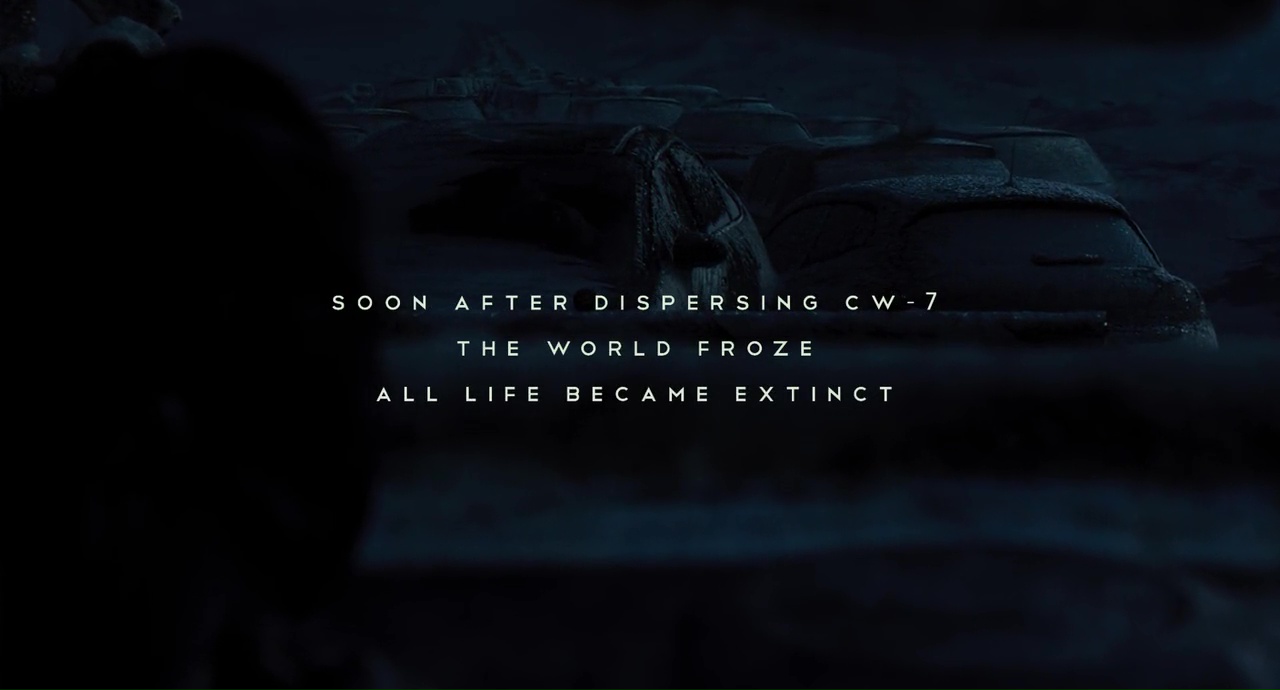
How can we make the frightening prospects of global catastrophe due to climate change even worse? Well, apparently the best way is to come up with a half-arsed way of fixing it. In Snowpiercer, a corporation has come up with a substance, CW-7, which is sprayed into the atmosphere to deflect the sun’s rays and cool the planet. It succeeds brilliantly:

Pic-00001.jpg

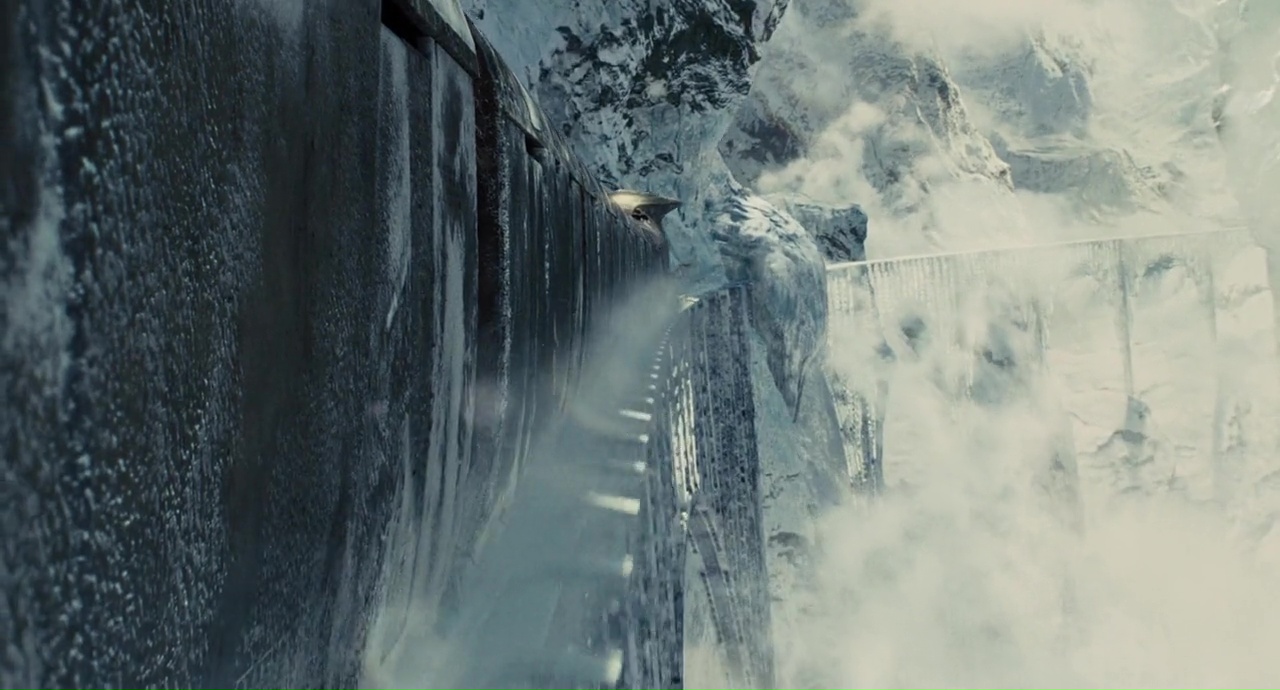
The only humans left alive are on a train, the SNOWPIERCER, which dashes through the snow, circumnavigating the earth once a year. The grateful survivors form a happy band of brothers who work together to survive.

Just kidding!

Pic-00002.jpg

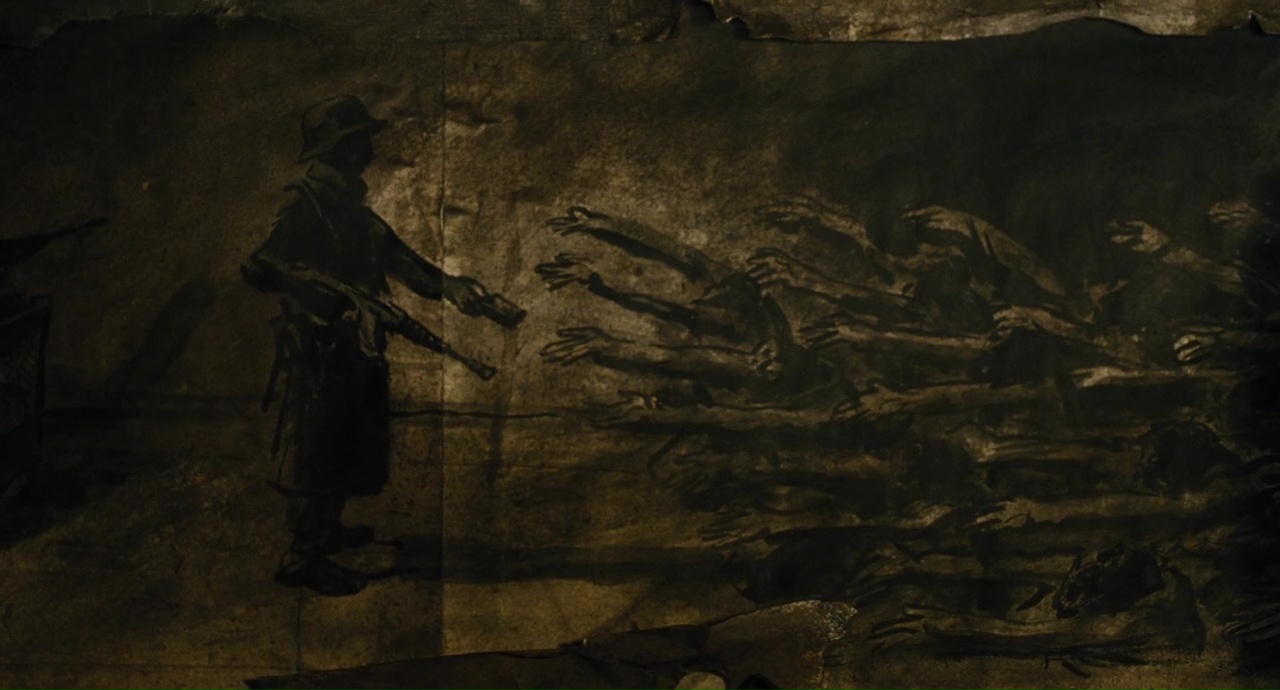
There is, as in all human society, a strict hierarchy of power and privilege. It’s the year 2031. The rich, including the train’s inventor Wilford (Ed Harris) live in luxury at the front of the train, the “scum” live at the back in squalor, beaten and tormented by armed soldiers and fed a mysterious protein bar made of what?

Pic-00008.jpg

There is revolution brewing though, led by Curtis (Chris Evans, in a far meatier role than Captain America ever offered him).

Pic-00012.jpg

There’s a lot to like in this movie – the plot is interesting, the action plentiful, the cast are stellar (including also John Hurt, Octavia Spencer, Song Kang Ho, and Tilda Swinton, as well as Paul Lazar, who played a nerdy scientist in Silence of the Lambs) and the photography, particularly of the frozen world and the train, is superb.

Pic-00004.jpg

Pic-00015.jpg

Bong Joon-ho is one of the most exciting filmmakers working today. Metacritic has ranked him one of the 25 best film directors of the 21st century, and he recently became the first Korean director to win the top prize at Cannes – the Palme d’Or, for his 2019 film Parasite, which also explores class and social divisions. Parasite went on to win four Oscars at the 92nd Academy Awards for Best Picture, Best Director, Best Original Screenplay and Best International Feature Film.

The film between Snowpiercer and Parasite was Okja, an animated piece that was also nominated for a Palme d’Or but was voted down, perhaps because it was released on Netflix. Okja crossed the anthropocentric line of privilege, featuring cruelty to a giant pig specially bred for human consumption (like so many animals today) and the horrors she faces in the slaughterhouse.

Pic-00020.jpg

Snowpiercer also explores some fascinating ethical issues to do with leadership, biopolitics, class privilege, revolution, violence, the Holocaust, our reliance on technology and yes, finally, cannibalism.

Pic-00023.jpg

Wilford explains to Curtis: “You’ve seen what people do without leadership.”

Pic-00074.jpg

Look, this is a pretty recent movie and got a woeful cinematic release, so you may still be planning to see it. Therefore, I won’t disclose the ending. But you need to know the cannibalism angle, because you are, after all, reading this blog on cannibal films and TV shows.

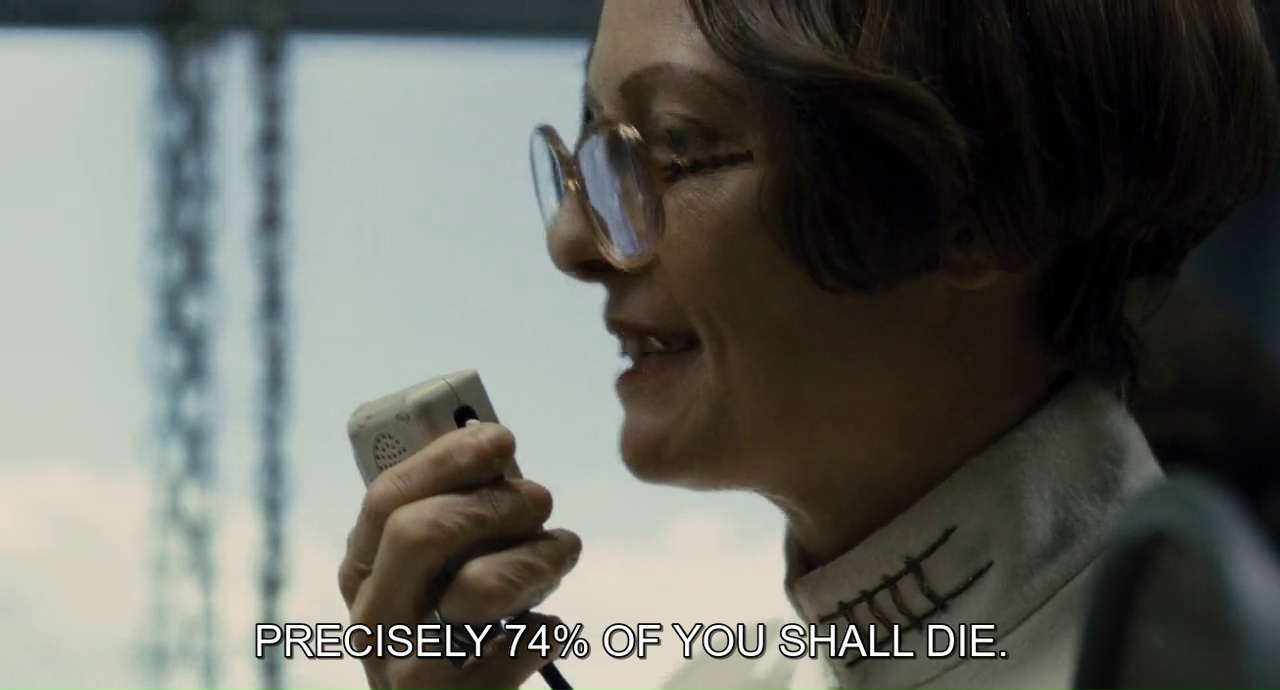
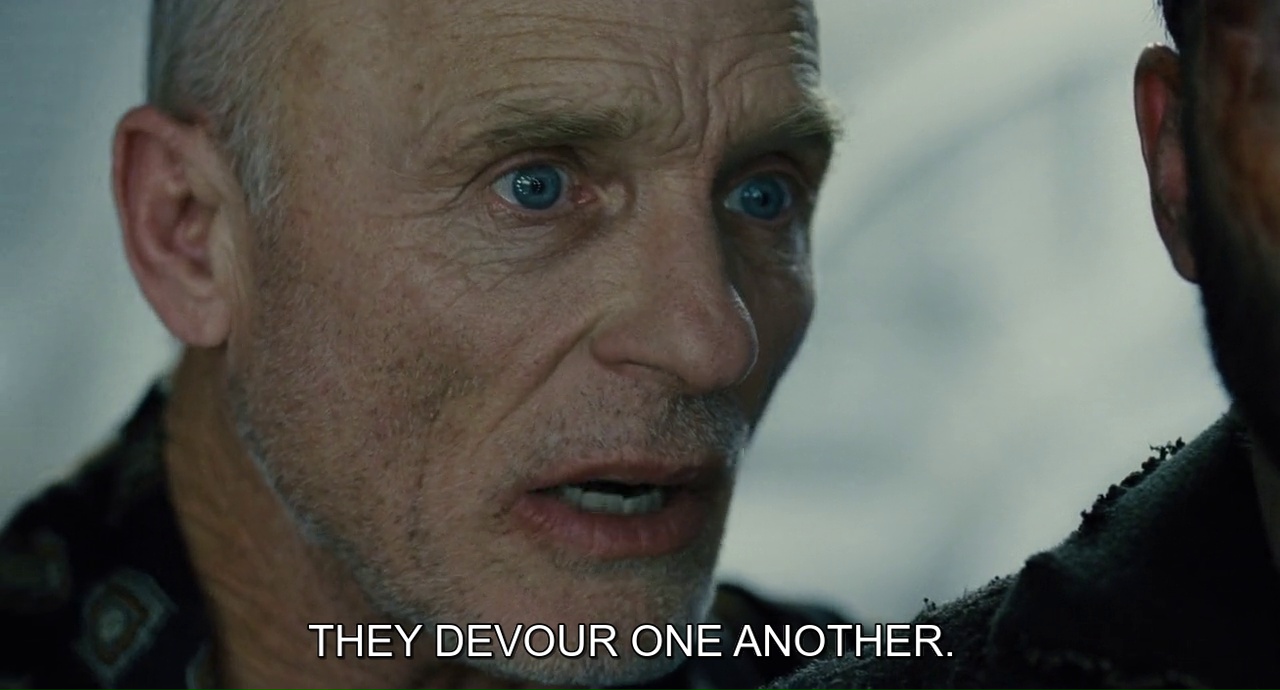
There are hints in the first half of the film, discussions about the number of arms people have, and then more food references as they march their prisoner Mason (Tilda Swinton), who previously lectured them on their place at the bottom of society, through the front cars. First they go through a greenhouse, then an aquarium, and we hear Bach’s Goldberg Variations, a tribute (one hopes) to Silence of the Lambs.  At the front of the aquarium, ecological balance is maintained by eating the fish twice a year as sushi. They sit down for this elite meal, but make their captive eat the protein bars that are the only food given to the “scum”.

Pic-00032.jpg

Curtis and his dwindling band of fighters go through a butchery, then a school, where the children are taught that tail-enders

Pic-00034.jpg

And that we, the pre-trainers,

Pic-00035.jpg

There are dentists, tailors, hairdressers, a fancy dining-car, an aquatic centre, a disco, a drug lounge – all the things that make up decadent, modern society.

Pic-00036.jpg

We are socially and culturally determined in large part by what we eat. The food is always better in first or business class. The higher classes eat beautifully prepared, gourmet tidbits. The lower classes, the starving and the deranged eat what they are given, or what they can hunt.

Just before the showdown, Curtis reveals what it was like when they first boarded the train: “A thousand people in an iron box. No food, no water.”

Pic-00042.jpg

“There was a woman. She was hiding with her baby. And some men with knives came. They killed her and they took her baby.”

Then an old man took the knife and cut off his own arm, offering them that as food, to save the baby. Then others started doing the same. Sacrificing to the cannibals to save the next generation. Then the rich started sending through protein bars. And we thought they were going to be the cannibals!

Things Curtis hates about himself:

Pic-00044.jpg

Pic-00045.jpg

Well, there’s a lot more to the story, and a lot more to like, but you can find out by watching the movie. It’s worth it.

Here’s the trailer:

IF YOU LIKE MY BLOG, PLEASE FEEL FREE TO RECOMMEND IT (WITH DISCRETION) TO FRIENDS ON SOCIAL MEDIA.
IF YOU HAVE ANY QUESTIONS OR COMMENTS, YOU CAN USE THE TAG, OR EMAIL ME ON CANNIBALSTUDIES@GMAIL.COM.