Cannibalism news – the 2024 round-up

‘There will be cannibalism, and rumours of cannibalism”

Yes, I paraphrased the Book of Matthew. Although not all that many people got eaten, the media was full of cannibal stories, and here are a few of them, sorted by their places of occurrence.

Australia

One of the men imprisoned for the so-called Snowtown murders (which mostly did not take place in the little town of Snowtown) was released. Mark Haydon was charged with assisting the men who did the actual killing and who ate part of one victim’s leg some 25 years earlier.

Brazil

Influencer Israel dos Santos Assis, better known online as Pinguim (Penguin) was arrested for desecrating graves in the cemetery of San Francisco the Count in the Salvador Metropolitan Region, stealing human bones, and using human flesh from the corpses to cook his most popular dish: feijoada, a bean stew usually involved simmering beans with beef or pork. Seems rotting human is a good substitute for pork.

Canada

Robert Pickton, the pig farmer convicted of six counts of second-degree murder (although he was charged with at least twenty others), was attacked by another inmate in prison and died a few weeks later. Pickton allegedly “processed” the meat of his rape and murder victims by feeding them to his pigs and, police said, possibly mixing them up with pork products he sold to his neighbours for their personal consumption.

China

Netflix released a new version of the classic science fiction book 3 Body Problem and ran into a storm of criticism from China for its depictions of the extreme violence of the Cultural Revolution. Although most of the victims of the purges were killed by shooting, live burial, drowning, boiling alive, and disembowelling, there is evidence that several hundred had been cannibalised, as the ultimate in humiliation.

The General who presided over a Cultural Revolution massacre that included cannibalism of those deemed “enemies of the people”, Wei Guoqing, was reburied (or at least his ashes were) with full honours in Beijing’s Babaoshan Revolutionary Cemetery – the resting place of China’s high-ranking leaders and revolutionary heroes. Wei’s name is most strongly linked in the public mind with cannibalism during the massacre period in Guangxi’s Wuxuan and Wuming counties and Nanning city. Researchers have found that at least 137 people were eaten, with thousands participating. “Paying tribute to a legendary gourmet,” wrote one wag on social media.

Cuba

Stories began circulating this year that the extreme food shortages in Cuba were leading to the danger, or actual occurrence, of cannibalism. This was bolstered by reports from 2022 of two hospital workers who had been stealing hearts and fat from human bodies and selling them as mince.

Haiti

Rumours circulated that the natural disasters and gang violence in Haiti was leading to starvation cannibalism. Jimmy Cherizier, a gang leader called Barbecue (“Babekyou” in the local parlance) was known for his penchant for burning people alive, and there was at least one video on Twitter/X of one gang member supposedly “tearing flesh from the leg of a burning corpse and eating it.” Such stories cannot be selfishly maintained by one little country, so of course it was not long before Bill and Hillary Clinton were accused of joining the cannibal feast. To add to the hilarity, Elon Musk posted on his own site, X, that a picture of a man near a fire was evidence of cannibalism, only to have the post removed by his own team for violating community standards. The fact-checking website Snopes pointed out that videos of bodies in Haiti being roasted on spits had previously appeared as accusations against a Nigerian restaurant, and were in fact from a Halloween prank in China in 2018. Still, you know, voodoo and all. Meanwhile, Trump ally Laura Loomer supplied conclusive proof that Haitians were cannibals: apparently, if you Google it, you will see a lot of results. The Prosecution rests its case.

India

India’s top court put a temporary stay on the execution of a man convicted of killing his mother and eating her remains in what is being deemed as the “rarest of rare” cases of cannibalism. Sunil Rama Kuchkoravi of western Maharashtra state’s Kolhapur district was handed a death penalty by a lower court in 2021 for killing his 63-year-old mother in 2017. The High Court in October this year upheld the death sentence against Kuchkoravi, stating that the convict possibly has a “syndrome of pathological cannibalism”. The execution has been delayed until the case is reheard in April 2025.

Israel (and around there)

Francesca Albanese, the U.N. special rapporteur for Palestinian rights, has been condemned for antisemitic rhetoric by the governments of the U.S., France and Germany among others. Albanese, known for accusing Israel of genocide (an odd charge seeing that the population of Gaza has increased in the last twelve months), wrote that the Israeli army was “rotten to the core”. A follower immediately introduced the classic blood libel: “Jews are capable of eating human flesh”, to which Albanese replied along the lines of “not all Jews”. Reassuring to note that a person paid by the taxpayers of the West, who finance the UN, can admit that some Jews are not cannibals!

A Yazidi woman was rescued from Gaza by Israeli troops. She revealed that, after being captured by ISIS in 2014 and forced to be sex slaves, the women were starved and finally fed meat which, they later told her, was from the bodies of a beheaded Yazidi baby, the child of one of the women. They told her:

We cooked your one-year-old son that we took from you, and this is what you just ate’.

Indonesia

Police investigated a suspected cannibalism case in West Java Province. The Head of the Criminal Investigation Unit confirmed that a video on social media showed the alleged perpetrator consuming a small portion of the victim’s flesh. He said that police had found 12 body parts of the victim at the crime scene.

Italy

An inmate in the notorious Poggioreale Prison in Naples tore the finger off another inmate and ate it. The Campania Guarantor, Samuele Ciambriello, observed that “it is now clear that the Poggioreale prison needs a structure suitable for hosting inmates suffering from mental disorders.” Seems like a good idea.

Mexico

A podcast called Mexico Unexplained revisited this year the story of Gabriela Rico Jiménez, a 21-year-old model from Mexico who disappeared some 15 years ago, after raging against the machine outside a fancy hotel in Monterrey Nuevo Leon. Ranting about the elites, including oddly the Queens of England and Germany (which is a Republic), she had shouted that “They ate humans! Disgusting!… They smell like human flesh!”

Nigeria

A man accused of being a sorcerer was blamed by villagers of the small town of Kirikiri for the disappearance of several children and elderly people. He was supposed to be “feeding on the flesh of the innocent.” Several claimed to have located the individual on the edge of a forest, wearing clothes “stained with blood” and mumbling mysterious incantations. A group of villagers beat the man and left him for dead.

Russia

Erkinzhon Abdurakhmanov, 47, intended to cure his own heart problems ‘after making a pact with the devil’, he told police. He killed a 65-year-old male pensioner in the Kuyurgazinsky district of Russian region Bashkortostan by striking him three times with an axe, according to reports. He then then cut out the heart and ‘ate the meal’ as he waited at a bus stop. He gave the uneaten remains to a woman also waiting for a bus ‘and asked her to bury it’. He was not arrested, however, until he headed into a liquor store and tried to steal some drinks. Cannibalism is not against the law in Russia, but murder and stealing alcohol is.

Vladimar Putin’s policy of giving pardons to criminals who agreed to fight in Ukraine in lieu of serving their sentences, was honoured in a pardon to a charmer named Denis Gorin, who had been convicted of at least four murders, and had eaten the flesh of his victims.

Another pardon involved Dmitri Malyshev. Malyshev was sentenced to 25 years in prison in 2015 for multiple criminal offences. Ten years ago, he murdered an acquaintance, a Tajik native, and then filmed himself cutting the heart out of the victim and roasting it in a frying pan and eating it. Neighbours seemed uneasy about his imminent return home.

South Africa

On December 26, 2024, eight illegal miners known as zama zamas emerged from Shaft 10 of a mine near Stilfontein, located in Northwest South Africa. They were taken by police, who confirmed that twelve bodies remained trapped beneath the ground, with miners reportedly resorting to eating human flesh due to severe food shortages.

Ukraine

Novosibirsk Archpriest Alexander Novopashin became notorious for claiming that Ukrainians are “cannibals”. Although conspiracy theories about cannibals are becoming more common, this particular Archpriest is taken seriously in Russia, and regularly lectures Russian security forces and soldiers.

UK

Marius Gustavson, who called himself “the eunuch maker”, offered a service where he charged men to destroy or remove their testicles, and then charged subscribers to his website to see him perform the operations. The court heard that that there was “clear evidence” of cannibalism and that Gustavson had “cooked testicles for lunch in an artfully arranged salad platter”.

Meanwhile, a candidate from a party called Reform UK was suspended for saying that meat-eaters should “eat other humans” and said humanity should be “obliterated”. Just saying what many are thinking, perhaps.

USA

The cannibal story of the year was the President, Joe Biden, claiming that his uncle had been eaten by cannibals in New Guinea. The leaders of PNG took exception to the stereotyping of their people as cannibals. Apparently, only some of them had been.

Speaking of Presidents, Donald Trump embellished his rhetoric on immigration by pointing out that some of the undocumented people pouring over the border were from insane asylums, and called that “Silence of the Lambs stuff”. Trump had previously claimed that Hannibal Lecter had endorsed his candidacy, which is a bit odd since Hannibal is a fictional character, but by far not the oddest claim in the 2024 election.

In March, a homeless man in Kern County was arrested for picking up the leg of a person who had been killed in a train accident and chowing down on it. California has no laws against cannibalism, but he was charged with “mutilating the body” which is a bit odd, since the train had already done that.

In Utah, which also has no law against cannibalism (Idaho is the only state that does), a law was passed to criminalise the ‘ritual abuse of a child’, which apparently regularly includes making the little ones eat “organic substance or material” (i.e. bits of people) before they are allowed to have their desserts. This in addition to claims that such rituals would sometimes involve eating the children instead.

A keen-eyed traveller pointed out that the road once taken by the Donner Party, which ended up in them getting lost and eating each other, was now signposted with a sign indicating dining was available. Much hilarity ensued on social media.

Conservative political commentator Candace Owens managed to link transexuals, Native Americans and cannibals, all in one sentence. No wonder she is so widely admired.

Much to the relief of the good people of Idaho (the only State in the Union with laws against cannibalism), the law was amended to ensure that giving someone else human flesh to eat was also prohibited. This led, on its long road to farce, to the accusation that bodies were being turned into compost which could be used to grow food for humans to consume. Rather than DNA test all compost, the law confined itself to banning the act of deliberately giving human flesh to another person. The legislator who introduced the bill cited a disturbing case on the show TruTV, which she admitted might have been a prank (it was) in which diners were told they had been eating human flesh, just to whet their appetites perhaps.

Ariana Grande raised some eyebrows when she was asked on a podcast whom she would most like to dine, and named Jeffrey Dahmer. Not sure Dahmer would have agreed – he was more into man-flesh, and there’s not much meat on Ariana anyway.

In April, a man was arrested in Las Vegas for eating a victim’s eyeballs and ears. The victim was pronounced dead. What happens in Vegas stays – internal.

Talking of ears, Mike Tyson, famous for biting the ear of Evander Holyfield in a fight in (where else) las Vegas in 1997, released a line of marijuana gummies shaped like nibbled ears.

Allegations were raised that Gilgo Beach ‘serial killer’ Rex Heuermann’s family was involved in the murders, which took place near the remote beach town of Gilgo in Suffolk County, New York from the 1990s to 2011. His daughter, who likes to paint the odd Satanic scene including body parts and cannibal feasts, was accused of being involved in his depredations. Homicide experts said that was insane, a word that gets tossed around a lot in cannibal stories. Heuermann was charged with a seventh murder last week.

On October 9, a woman in Kentucky, Torilena May Fields, was arrested after a dismembered body was found behind a home in Northern Kentucky and cooked human body parts were found in the oven. The body, and its parts, turned out to have been her mother. She was also charged with cruelty in that she “intentionally tortured and killed a domestic dog.”. A contractor found the dismembered body of the mother, and told police the perp had been “casting spells.” Her bail was set at $1.5 million. Her next court appearance is set for March 10, 2025 in Robertson County.
Some people just give cannibalism a bad name.

Another Kentucky woman, a former youth counsellor, was arrested for allegedly discussing cannibalism and other hobbies with a convicted murderer.

In Oklahoma, Kevin Ray Underwood was executed by lethal injection in December (on his 45th birthday, the press gleefully informed us) for killing a ten-year-old girl in a “cannibalistic fantasy.” The man admitted to luring the girl into his apartment and beating her over the head with a cutting board before suffocating and sexually assaulting her. He told investigators that he nearly beheaded her in his bathtub before abandoning his plans to eat her. So not really a cannibalism story, but near enough.

International

Citizen of the world, Donald Duck, appeared on the interview show Hot Ones on the Internet (which is global), where guests eat chicken wings with hot sauce. Turns out Donald is a vegan though, preferring cauliflower, and since ducks aren’t chickens, the controversy that ensued over whether he was (or would have been) a cannibal by partaking of chicken was just silly.

HAPPY NEW YEAR, and may your worst problems be mild gastro-oesophageal reflux.

And don’t forget to go to the dentist.

Need to feed, need to breed: THE DYING BREED (Jody Dwyer, 2008)

Two hundred years ago (July 19 1824), Alexander Pearce was hanged in Hobart, Tasmania, and his body dissected for research. He was a cannibal.

Australia has a bit of a dearth of cannibal stories (compared to places like the USA and Russia). Ask Aussies about cannibalism and they will often make a joke about state or federal politicians. Then they may search their memories and come up with Katherine Knight, a slaughterhouse worker who in 2000 had passionate sex with her partner John Price, then stabbed him 37 times, professionally skinned him, hung his hide on a meat hook over the lounge room door, decapitated him, butchered his corpse and cooked some of his flesh. She served up his meat with baked potato, carrot, pumpkin, beetroot, zucchini, cabbage, squash and gravy in neat settings at the dinner table, putting beside each plate placenames for Price’s children. Another meal was tossed into the backyard; it appears she intended to eat it but decided against it. So, no points on that one I’m afraid – no one got eaten, so no cannibals. More recently, the Snowtown bodies in the barrels case was revealed to have an element of cannibalism in the final murder, but this was very much an afterthought to the killings, and not even mentioned in the film of the events.

Most of the real cannibals in Australian history were in fact convicts sent to the worst penal settlements the British could devise (and they were very good at that) then escaping, only to eat their comrades when other food sources were exhausted. Edward Broughton did just that in 1830, as did Thomas Jeffrey, who became a murderous bushranger, in 1836. But before them, a cannibalistic pioneer one might say, there was Alexander Pearce.

Pearce escaped the brutal penal colony only to eat his companions, not once but twice (he confessed when recaptured the first time, but the authorities didn’t believe him). He is shown very briefly in this movie as a historical flashback before the opening title, an escapee who is cornered by a very angry soldier whose gun misfires. Pearce tears the man’s throat out, swallows some and throws a bit to a thylacine (Tamanian Tiger) who is stalking him, to allow him time to escape.

The thylacine was a carnivorous marsupial who was endemic only to Tasmania, until wiped out by European colonists, the last one dying in Hobart zoo in 1936. There is no evidence of them eating humans. Thylacines were not the only targets of white settlers: Tasmanian Indigenous peoples were also rounded up and subjected to genocide in the first half of the nineteenth century.

Anyhow, the plot of this movie revolves around a biologist named Nina and her friends, who are trying to find proof that the thylacine is not extinct – her sister found a paw print, but was killed mysteriously near the Pieman River on the west coast. The film and other sources often claim that Alexander Pearce was known as the pieman due to his love of the meat of a wide variety of animals, although in fact it seems it was named after a pastry cook named Thomas Kent.
They get a punt across the river, driven by a cranky old man with a small girl who is playing with bones and reciting bloodthirsty rhymes. She bites the boyfriend.

They get to the town, where the locals are killing puppies and who knows who else.

Long story short, as they say, these are a cannibal family descended from Alexander Pearce, who they call the Pieman. The city slickers, mocking the locals as they depart, head down the river where, at the midpoint of the film (where the really good or really bad stuff happens) Nina finally but briefly sights a thylacine!

Of course, she doesn’t have her camera, so she grabs it and they go look for the animal, splitting up to search, proving without a doubt that none of them has ever watched a horror film before. You don’t split up! The other girl meets the creepy child from the punt, then is grabbed from behind and killed, and we get to watch her tongue torn out and eaten. The others find her strung up on a meat hook and butchered like any prey animal.

There’s plenty of gore and somewhat predictable jump scares (or maybe I’ve just seen too many of these types of movies) but the plot is interesting, the acting great, the direction and photography first-rate, and the scenery is spectacular, although the depiction of the Deliverance-like locals may reduce the usefulness of this film for promoting Tasmanian tourism.

“What did you hope to find? We’ve been here a long time. Almost as long as the nation. We have a life to protect, a tradition. You tourists have no tradition.”

The cannibals in this film capture tourists and either eat them or breed them, not that different to what humans do to other animals. When modern twenty-first century humans eat others they are often referred to as degenerate cannibals – they are accused of devolving into the cannibalistic savages that early humans are portrayed as, even though there is little evidence that earlier cultures were into cannibalism or that modern ones have outgrown it.

Humans often turn to cannibalism when food runs out. The Biblical story of the siege of Samaria in Israel some 3,000 years ago (2 Kings 6) relates that, unable to afford asses’ heads and doves’ dung, two women agreed to boil their babies for sustenance. But after they’d eaten the first one, his mother found that the second woman had hidden her child, a shocking breach of contract.  Such starvation cannibalism became common in the day of sailing ships, but even on land, Sawney Bean in fifteenth or sixteenth century Scotland is supposed to have stopped tourists as they passed through his wild lands and taken them home for dinner. Some of these stories seem to stray from cannibalism into something like an aversion to getting a job, which is how the modern versions like Texas Chain Saw Massacre and Hills Have Eyes are sometimes framed. We eat flesh because we need to or want to, and because we can. That still applies in the meat section of every supermarket. We don’t degenerate to cannibalism, we simply objectify the prey, be it human or any other animal. This objectification is at the heart of all politics.

The moral of these stories (they all have one, even the most basic slasher), is that there are other worlds out there, away from what we are used to in our own little niche. There are people outside our ways of understanding life and morality, whose daily existence may be inconceivable to those looking in. Coetzee said that the “upper intelligentsia” (Nina is a scientist) live lives irrelevant to most people, who may be “devoted to brawling and guzzling and fucking”. That’s whom we meet in the unexplored wilderness of Deliverance or Sawney’s Scotland or the Texas of the forgotten, and in this film; they fight, they kill, they eat and they reproduce. They survive and breed: the basis of all evolution. It’s what animals do, and a good cannibal film like this reminds us that we are, beneath our veneer of civilisation, just another brawling, guzzling, fucking animal.  

Mark Haydon, who was involved in Snowtown murders, being released from jail. SNOWTOWN (Justin Kurzel, 2011)

SNOWTOWN is back in the news at the moment, due to one of the perpetrators being granted parole after serving his 25-year sentence. Mark Haydon was convicted of assisting John Bunting and Robert Wagner in the murders of 11 people, including his wife, between 1992 and 1999.

Haydon reportedly rented the abandoned state bank building at Snowtown in which the bodies were stored in barrels of acid. A jury deadlocked on the charge that he was involved in the murders of his own wife, Elizabeth Haydon, and of Troy Youde, and he was never retried. His 25-year sentence was completed this year, and he will be freed into the community with no restrictions in May 2024 (unless the government succeeds in attempts to change the law to broaden the definition of a “high-risk offender”).

Above: the real Mark Haydon – then and now.

Relatives of the victims have long voiced their anguish and fear at any prospect of any of the perpetrators being released.

The film Snowtown is a recreation of this case, the most famous serial killer case in Australia (with the exception of the attempted genocide of the Indigenous population). A total of twelve victims were identified, and eight of the bodies were eventually found by police in barrels filled with acid, which were stored in an abandoned bank vault in the small town of Snowtown, in South Australia.

Although the press called this the “bodies in barrels” murders, it soon became known, to the sorrow of that little town, as THE SNOWTOWN MURDERS, even though only one of the murders had taken place there, the rest happening in the big city, Adelaide, between 1992 and 1999.

The final murder that took place in Snowtown, however, involved CANNIBALISM. We’ll have a look at that in this blog, although unfortunately the film doesn’t.

The film is a true Crime retelling, which means that none of the names have been changed to protect – anyone, and of course the dialogue has to be imagined to some extent. But we know a lot of what went on, and so did the film makers.

True Crime has been a popular genre for centuries, and transgressed the line between fiction and non-fiction in 1965, when Truman Capote released In Cold Blood, a “non-fiction novel”, relating or interpreting a 1959 Kansas murder. Modern versions of the genre extend beyond literature to films, podcasts, vodcasts and television shows. They tend to concentrate on the most sensationalistic cases and are grittily and brutally realistic in portraying the violence and gore.

In Australia, where this film originates, a survey found that some 44 percent of podcast listeners had listened to true crime podcasts, with an considerable proportion of them being women.

The protagonist of the film is Jamie Vlassakis, a teenager living with his single mother and two siblings. The mother’s boyfriend is a helpful sort of bloke who makes the kids dinner when mum has to go out, then strips them and takes photos of them for his own gratification. The mother deals quite effectively with this, beating him up and kicking him repeatedly, but soon a new man comes into their lives – John Bunting.

Bunting has a winning smile and a certitude that gets him into the family, and he takes Jamie under his wing. John also has a burning hatred of gay men and paedophiles, two rather different beasts whom he conflates into one evil figure. When Jamie tells him that he was raped by his older half-brother Troy, John tells Jamie he needs to “grow a pair” and take revenge. He involves Jamie in his plans to identify, capture and kill a range of people he considers monsters. He collects detailed information on a “spider wall” in his house. “Rock spider” is Australian slang for a paedophile.

But John Bunting has clearly not read Nietzsche:

He starts by involving Jamie in his plans to drive the erring boyfriend out of town. Jamie finds him in the garden, chopping up and mincing kangaroo body parts to toss onto the neighbour’s front door and sofa.

He involves Jamie in a raucous discussion of paedophile teachers, asking him what he thinks should be done with them. Jamie follows the fatal logic.

John takes Jamie under his wing, teaching him to ride a bike, shaving his head, showing him the spider wall, giving him a gun, and getting him to shoot John’s dog, a brutal blooding. When he introduces Jamie to the act of killing humans, there is also the accompanying deception: each victim is made to record a message that will be played on the answering phone of their loved ones. Jamie’s mum hears Troy say he hates her, and Jamie lies to her, letting her believe that forced call was true. Jamie goes off to doctors and government offices to collect payments, posing as the people they have killed. He doesn’t look happy about it, but he is sinking deeper and deeper into John’s machinations. After a while, collecting the government support payments becomes the motive as in the murder of Gary O’Dwyer; the vigilante pretext is forgotten. O’Dwyer invites the men to his place to watch him feed rats to his python, a process we see in slow motion in which the snake unhinges his jaw to swallow the prey whole, just as the men become unhinged in their growing lust to kill.

So John makes a man of Jamie, in the most toxic sense. He teaches him carnivorous virility – in order to be a man, you have to kill and eat. Not always the same carcass, but that does seem the logical consequence of the objectification of all victims.

The film traces the increasingly violent actions in which Jamie becomes involved, unwillingly at first, but totally under the control of John. He is made to watch them torture his half-brother Troy, who was earlier shown sodomising Jamie, and he finally steps in to finish the killing, tears rolling down his face, while John strokes his cheek and murmurs “good boy.”

Jamie is now a fully-fledged killer and a vigilante, not just an observer and helper the way Mark Haydon (the man currently being released on bail) is portrayed. Mark is a minor character, buying rubbish bags and digging holes for corpses, until near the end of the film, when he tells John he got into a fight with his wife, who called him a pussy. He told her what a big man he was – burying bodies. John brushes the story off, but we know she is next.

Although this murder is not shown in the film, evidence was given that Haydon saw his wife’s body and laughed. Her body was one of the ones found in barrels in the Snowtown bank building.

The final murder was Jamie’s half-brother (through a different father) David Johnson, whose only offence was his fastidiousness and unwillingness to go along with John’s rhetoric of violence. The final scene of the movie shows Jamie persuading David (one of the few wholesome characters in the film) to check out a computer supposedly offered for sale in Snowtown. They stop for a beer, they stop again so Jamie can urinate in a creek. He runs back to the car to accompany David to his death; the car is parked at a crossroads, clearly a symbol, a suggestion that Jamie, who is depicted as hating all the violence, could have chosen a different path at any time.

John Bunting, Australia’s most prolific serial killer, was convicted of eleven murders and sentenced to life imprisonment without the possibility of parole. Robert Wagner, his main accomplice, was convicted of ten murders and sentenced also to life without parole. Mark Haydon was initially charged with two murders but was only convicted on five counts of assisting. The jury did not come to a decision on two murder charges against Haydon, and another charge of assisting murder, which never came to retrial.

More than 250 suppression orders originally prevented publication of the details of this case at the time. In early 2011, a judge lifted the remaining orders in response to a request by the producers of the film Snowtown. Haydon was sentenced to 25 years, which he has now completed; he is back in the community on parole, with the head of the parole board saying he’s well behaved and poses no risk to the community. He has been moved to the Adelaide Pre-Release Centre – a low security facility where prisoners can participate in accompanied and unaccompanied leave, including for work and education. The usual conditions of parole apply (no binge drinking – yet), but he will be a free man in May 2024 when his sentence expires.  

Jamie, presented in the film as an unwilling and even sympathetic killer, pleaded guilty to four murders and provided testimony against the other men, in exchange for a lesser sentence. He testified about the cannibalism that is not shown in this film — that Bunting and Wagner hacked at David’s body to make sure it would fit in the barrel and then sliced off a sliver of flesh from the right thigh. They heated a frying pan, cooked the flesh, and handed it around. Jamie’s testimony was the only evidence police had that cannibalism had taken place, and was presented by his attorney as proof that he was fully cooperating and deserved a lighter sentence. In 2005, when Haydon’s murder charges were dropped by the Director of Public Prosecutions, several suppression orders were lifted. These detailed the murder and cannibalism of the final victim, David Johnson.

Jamie Vlassakis was sentenced to four consecutive life sentences with a non-parole period of 26 years, which means it is possible he could be released on parole in 2025. He will be 45 years old.

The film is gritty and brutal, particularly the scenes of Jamie’s rape, and the torture of their victims. But it is compelling watching, and the acting and directing are quite brilliant, capturing the loss of innocence that starts with abuse and ends with brutality. Bunting’s early life reportedly was very rough; he said he enjoyed killing ants with acid, an idea he later transposed to those humans he saw as vermin. When he grew up, he worked at a slaughterhouse, where he would brag about slaughtering animals, saying that’s what he enjoyed the most. Later, when he moved in on Jamie’s family, he would kill cats and dogs and skin them while making Jamie watch. We see Jamie transform from the innocent teenager who stands around smoking at the start of the film to a shaven-headed killer, and even his little brother is shown with his head shaved, starting his short journey from childhood abuse to callousness.

The film is all about that loss of innocence. At an early age, these kids are introduced to poverty, abuse and violence that is a hallmark of violent, carnivorous society. Children famously love “animals” when they are little, recognising their own infant state of being helpless and unable to communicate, yet are socialised into carnivory by the peer pressure to conform and their recruitment into the ceaseless human war on nature. Animals, particularly the chattel slave animals generally referred to by their monetary value, “livestock”, are nothing and nobody. It is only a small step for John Bunting to assume the same about those he hunts, and so why would he flinch at eating them? It is the logical next step.

The film closes as Jamie shuts the door of the vault, trapping the unfortunate David Johnson with the killer gang. We don’t see the murder, or the frying pan. Unfortunately, that final step over the thin red line between humans and other animals appears to have been a bridge, or a meal, too far for this film.

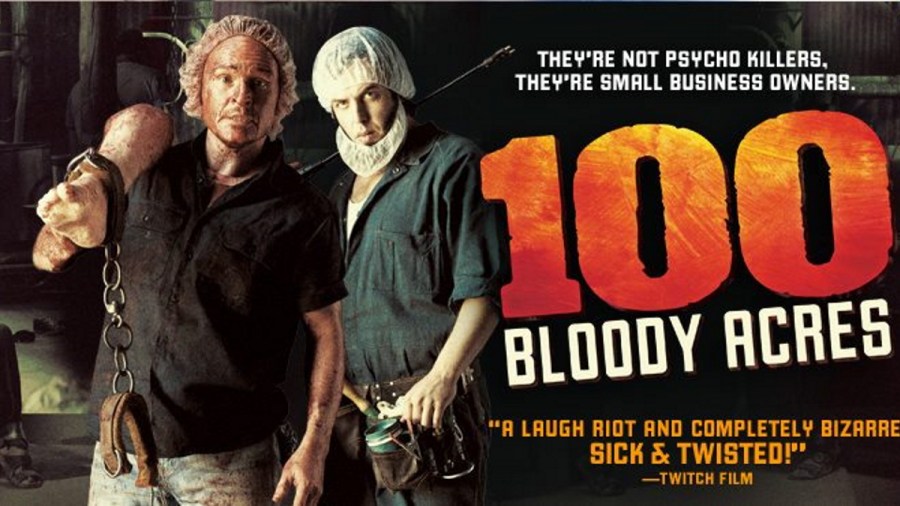
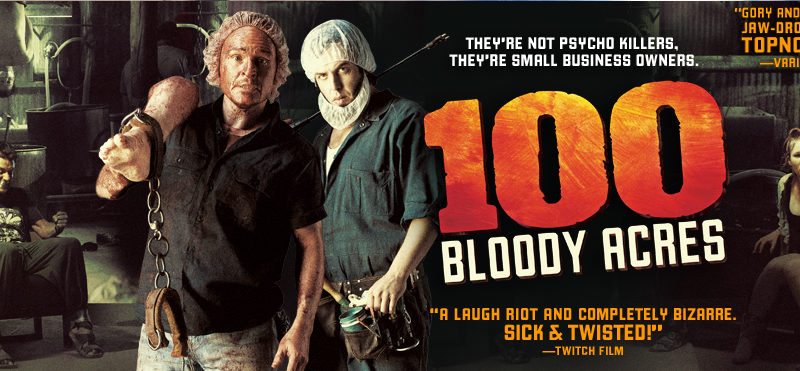
“They’re not psycho killers, they’re small business owners” 100 BLOODY ACRES (Colin and Cameron Cairnes, 2012)

There just aren’t enough Aussie cannibalism films (IMHO), particularly since the earliest movie I could find showing (purported) cannibalism, The Devil’s Playground, was made in Australia, way back in 1928. What few have been made are pretty great, including movies like The Last Confession of Alexander Pearce (about a cannibal convict) and more recently Two Heads Creek, which saw immigrants to the Australian outback being cooked and eaten. There was also a movie made about the so-called Snowtown murders (most of which did not take place in the town of Snowtown) but it avoids mentioning the cannibalism of the last victim, for some reason.

Presenting country folk as hicks, rednecks, hillbillies, etc is certainly not exclusive to Australian films. In the US, such plots are usually presented as slasher horror, such as The Texas Chain Saw Massacre and The Hills Have Eyes, and their endless sequels and prequels. In Italy during the “Cannibal Boom”, the primitives were tribes of savages, eating people for revenge, but also because they were yummy. But Australians love to see the humour, even (especially?) in a rapidly mounting body count and spurting arterial blood. 100 Bloody Acres is right in that tradition, filled with colourful rural characters who mispronounce words and aren’t that smart, taking it out on city slickers who stray into their territories.

This one stars two brothers, Reg (Damon Herriman, who (fun fact) played Charles Manson in both the Netflix series Mindhunter and in the Quentin Tarantino film Once Upon a Time in Hollywood) and Lindsay (Angus Sampson who was in Mad Max: Fury Road, Fargo and most recently The Lincoln Lawyer). The Morgan brothers own and operate a small blood and bone fertiliser business in South Australia, the motto of which is:

“We’ll fertilize ya!”

Their business has been booming in the area, we are told, where six Salvos (Salvation Army workers – everything in Aust. is abbrev’ed) have disappeared without trace – not hard to see where this plot is going. Reg is on his way to deliver blood and bone fertiliser when he sees a road accident, hauls out the body of a man and puts him into the back of his van, less a few fingers, due to his clumsiness in closing the doors. Meant to be shocking or hilarious? Subjective I guess. Reg then picks up a young woman and her two male companions whose car has died on the way to a music festival, because he fancies the woman. The men go in the back of the truck with the bags of fertiliser and the car crash victim, and predictably freak out when the body is revealed by the bumpy road. Reg takes the trio to the factory, where they are tied up and made to watch the car accident victim, who turns out to be alive, lowered into the meat grinder.

Reg tries to rescue him, but ends up covered in blood and holding just his legs and, perhaps the area between them that attracts his befuddled gaze. There is a theory that movies, particularly thrillers and horror stories, are aimed at 14-year-old boys, and I’m sure they would find this scene side-splitting.

Turns out that blood and bone made from humans is far better (as fertiliser) if they are alive and scared and in agony; it’s all in the hormones. This why torment is a crucial part of the dog-meat industry, and also not far from the way we treat other animals we confine and slaughter.

The older brother, Lindsay, tests the blood from the mixture and declares it “liquid gold”.

The rest of the movie is slapstick gore involving chases, more victims being killed or losing body parts, and other merriment. Rotten Tomatoes gave it a 77% fresh rating, and Matt Zoller Seitz of RogerEbert.com called it:

“a smartly written and acted and exceptionally well-directed movie.”

The Guardian’s Australian Editor, Lenore Taylor, was not so enthusiastic, declaring it,

“a splatterfest that abandons suspense in favour of sniggers.”

100 Bloody Acres is not nearly as shocking as it imagines itself to be (unless maybe I’ve watched too many cannibal movies) but it is entertaining, well made, stylishly directed, and the actors are top-notch. It hums along, and may even be seen as satirising the more strait-laced and dour cannibalism films from the USA and elsewhere. If you like black comedy and gore, this one may impress.

From the point of view of Cannibal Studies, it raises some interesting questions.

  • Is it still cannibalism is you kill someone not to eat, but to use, for example, as blood and bone (or for their skin and bones, like Ed Gein or Jame Gumb)? Does cannibalism require oral ingestion, or does any use of the human body count?
  • Is cannibalism of the dead less repugnant if the intended meal is already dead? In this film, the brothers collect dead bodies from road accident sites (human roadkill) and grind them up into blood and bone. While roadkill of wild animals is not a hugely popular source for food or other uses, it is actually more acceptable to some animal activists than confinement and slaughter, in that the animals may not have known what hit them, and in any case are killed without murderous intent. So why not human roadkill (maybe making sure they’re actually dead)? Is it really worse to eat (or otherwise utilise) a dead human, who can feel no pain, than a living, terrified cow or pig? Consider the outrage in Illinois when a satirical site claimed the local morgue assistant was using body parts from deceased men to help her win a spaghetti-cooking competition. It was a hoax, but there have been other cases, such as journalist William Seabrook, who purchased human flesh from a hospital and cooked it just to see what it tasted like. What exactly is the problem?
  • And most intriguingly, why do we stroll nonchalantly past the blood and bone bags in the hardware store, yet can be shocked at the thought of human blood and bone? As Shylock asked, “if you prick us, do we not bleed?”

We are all made of blood and bone.