Dmitri Malyshev was recently released from a 25-year sentence for murder and cannibalism to fight on the Ukrainian front for the Russian “Storm V” and “Storm Z” forces.
The enormous number of casualties and shortage of Russian volunteer troops in Ukraine inspired Yevgeny Prigozhin, an oligarch known as “Putin’s chef” because he rose from being a restaurateur and caterer for the Kremlin, to scour the worst prisons in Russia and recruit murderers, rapists and cannibals for his army, the Wagner Group. They were dropped into the thick of the fighting, and promised a full pardon if they survived six months against the Ukrainian army. Prigozhin has since been killed, but the scheme apparently survives, now run by the Russian military.
The latest recruit is Dmitri Malyshev. Originally from Volgograd, Malyshev was sentenced to 25 years in prison in 2015 for multiple criminal offences. Ten years ago, he murdered an acquaintance, a Tajik native, and then filmed himself cutting the heart out of the victim and roasting it in a frying pan and eating it. Malyshev, part of an organized criminal group, had previously killed two businessmen for their money.
In the video, Malyshev said:
“We’re roasting a human. Here it is – a heart. I’ve already added the onion.”
Malyshev subsequently apologized for his actions, “carried out under the influence of alcohol.” Well, that’s OK then. Who hasn’t acted ill-advisedly after a few drinks and eaten a friend?
In March 2024, Malyshev took a photo in Ukraine with another participant in the war, Alexander Maslennikov from Volzhsky, who was convicted in 2017 for stabbing to death two girls he met at a karaoke joint, dismembering them, and hiding them in the forest, for which he received a 22-year sentence. In 2023, residents of Volgograd and Volzhsky expressed their fear on social media about Maslennikov’s potential return to the region.
A cannibal and a serial killer were released from prison and went to the front line
The cannibal Dmitry Malyshev, who ate Tajik’s heart and recorded the whole process on camera, was released from prison and went to war in Ukraine to "fight" sex education in school and gays. At… pic.twitter.com/R26pDYHAMh
During his conversation with V1 journalists, Malyshev confirmed that he had served his prison term alongside Maslennikov, and they both signed a military contract in October 2023. Malyshev was deployed to the ‘Storm V’ unit. The cannibal asserted that he had decided to “fight for the preservation of traditional Russian values.” He added that he came to Ukraine to “fight” against sex education in schools and gays.
Malyshev is currently in hospital. He told reporters:
“A grenade landed on me during an assault manoeuvre. I have a broken jaw, shrapnel in my knee and left hand and my left eardrum burst. Nothing to see here.”
Other cannibals purportedly sent to fight in Ukraine include:
Nikolai Ogolobyak, a Satanist who, with his followers, killed four college students and ate their internal organs in a ritual feast
Denis Gorin, who killed and ate parts of at least three victims, although parts of around twelve bodies were found
From Putin’s point of view, it’s an ideal solution. Why feed these guys (even if not very lavishly) for the next twenty years or so, when they can go off and be killed or else fend for themselves, finding their own sources of meat and onions? And, if they happen to survive the hellish battles in which they are dropped, then they are ‘pardoned’ and sent home where, more than likely, their victims’ relatives may have plans for them. From a military point of view, too, they have proved that the life of a human is worth no more to them than any other kind of edible animal, which, together with having nothing to lose, makes them ideal killing machines.
“…there is no article ‘cannibalism’ in the legislation of the Russian Federation. Perhaps that is why the dehumanization of Russians has already acquired a literal meaning.”
Meat the twenty-first century version of super-soldiers.
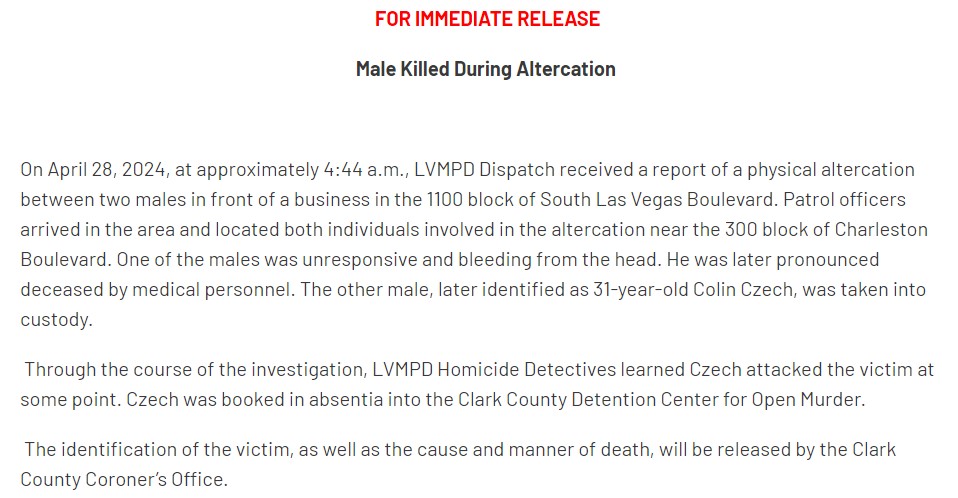
A 31-year-old man is in custody on suspicion of killing a man and eating parts of the victim’s face last weekend at East Charleston Boulevard and 3rd Street Las Vegas.
The Las Vegas Metropolitan Police Department released this report:
Police advised that the alleged perp, Colin Czech, had “biological matter in his hair, mouth, and on his clothing.” “Biological matter” is a euphemism for blood, flesh and other bodily substances.
Czech reportedly claimed the victim had attacked him. Police said the victim, identified as Kenneth Brown, was bleeding from head wounds and one of his eyes was missing. He was transported to the hospital, where a doctor pronounced him deceased.
During an interview, Czech allegedly said he was homeless and had been awake for several days because something was “possessing him.” Reports say Czech told detectives he “used his teeth to eat the victim’s eyeballs and ears.”
Police booked Czech into the Clark County Detention Center in absentia on a charge of open murder. Clark County District Attorney Steve Wolfson said it was one of the most unusual cases he has ever seen in more than 40 years as a defence attorney and prosecutor. He says the competency of the defendant will no doubt be addressed, adding “It is not uncommon for some of these cases to take years. Sometimes people never become competent.”
Czech was set to appear in court on Monday, April 29, but was hospitalised. In his eventual court appearance, he appeared dazed and uncomprehending.
Eating faces is not unknown in the annals of Cannibal Studies. In 2012, Rudy Eugene, “the Causeway Cannibal”, bit off the face off a homeless man in Miami, Florida before being shot to death by Miami police. In Wales in 2014, Matthew Williams lured a young woman back to his hotel room and began eating her face, apparently under the influence of amphetamines. Williams had been released from prison just two weeks before the killing and was described by police officers as “demonic”. Again in Florida in 2016, Austin Harrouff killed a couple he didn’t know and chewed off a victim’s face. He was found not guilty by reason of insanity.
Why all the faces? There is not much flesh on a face, yet it is considered a delicacy in some cultures. In the movie Eye without a Face, the protagonist watches on a hacked computer camera as a woman prepares a Persian dish called kale pache, literally “head and hooves”. It’s usually from a sheep, but whose head is it this time? Is she a cannibal serial killer? No spoilers here – you’ll have to watch it to find out.
Meanwhile, back in California, the man this blog reported on a few weeks back who found a human leg on the street in Bakersfield and started chewing on it has been sentenced to one year in jail in a Kern County courtroom. With good behaviour (and eating all his veggies?) he could be out in a lot less than that.
Under the dominant ideology of anthropocentrism or “speciesism”, buying the head or leg of a sheep for consumption is considered perfectly legal, if a bit quirky (or repulsive to some), yet eating a human face is headline material. But is there really that huge a difference between two species of mammals?
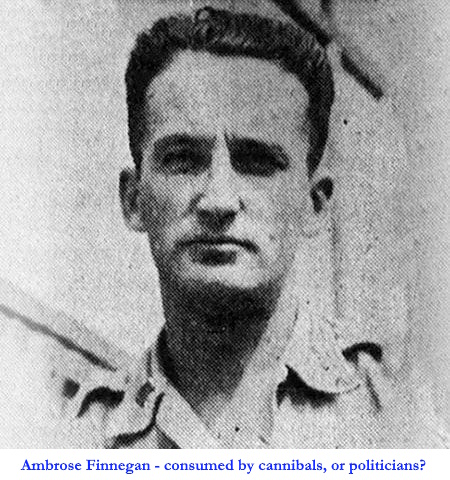
Raising eyebrows is a national sport of the USA during election years, and both Trump and Biden, the contenders, have done their share of the heavy lifting. But Biden really hit his eyebrow-raising stride this week (on April 18 2024) with claims that his uncle, second lieutenant Ambrose Finnegan (known in the family as Bosie), was shot down in the Pacific in 1944, and may have ended up on the dinner menu of Papua New Guineans.
Visiting a missing-in-action war memorial in Scranton, Pennsylvania, Biden put his hand on the engraved name of Ambrose Finnegan, whose plane went down but whose body was never recovered. Biden said,
“He got shot down in New Guinea, and they never found the body because there used to be — there were a lot of cannibals, for real, in that part of New Guinea.”
“For unknown reasons, this plane was forced to ditch in the ocean off the north coast of New Guinea. Both engines failed at low altitude, and the aircraft’s nose hit the water hard. Three men failed to emerge from the sinking wreck and were lost in the crash. One crew member survived and was rescued by a passing barge. An aerial search the next day found no trace of the missing aircraft or the lost crew members.”
Biden’s cannibalism story, told twice during his visit to Pennsylvania, was clearly intended as a gesture of respect for those who died in the war, and a dig at Trump. White House Press Secretary Karine Jean-Pierre stated that Biden’s story presented a contrast with Donald Trump, who reportedly described Americans who died in war as “losers” and “suckers” after refusing to attend the American cemetery in rainy Paris in 2018. Trump also mocked George H.W. Bush who was shot down in 1944 and John McCain who was captured and tortured in Vietnam, claiming real heroes did not get shot down or captured. Trump denies it all, but the Paris story was later confirmed by John Kelly, his longest-serving White House chief of staff.
However, like a lot of off-the-cuff comments, this one may have backfired for Joe Biden. Cannibalism is a convenient excuse for vilifying others, but vilifying Pacific Islanders does not help make any points against Donald Trump, and instead proved a distraction.
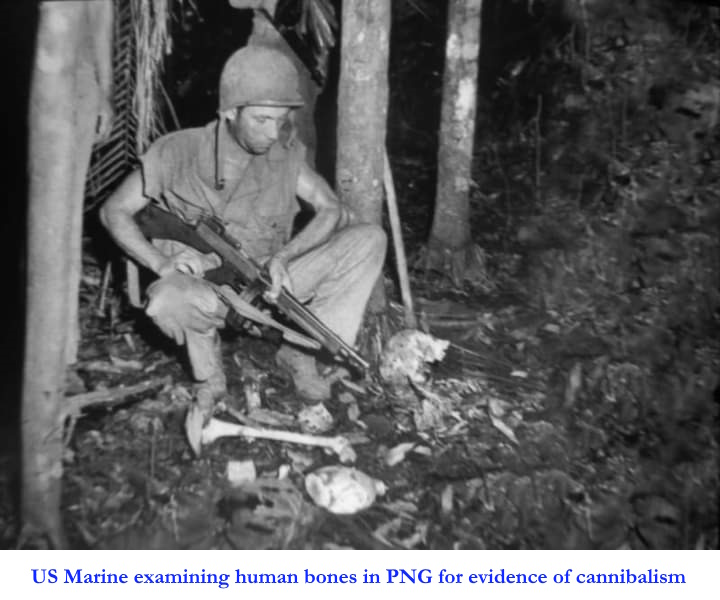
Certainly, cannibalism has been reported in Papua New Guinea (PNG), the Pacific nation that occupies the eastern half of the island of New Guinea, off the northern coast of Australia, but not always by the locals. At least 100 cases have been documented in which Japanese soldiers killed and ate the flesh of Allied troops, Asian labourers and indigenous people in Papua New Guinea during WWII. Researcher Toshiyuki Tanaka, an associate professor of political science at the University of Melbourne, reports,
“These documents clearly show that this cannibalism was done by a whole group of Japanese soldiers, and in some cases they were not even starving.”
Cannibalism can be an affirmation of victory, a way of humiliating an enemy beyond death. Historian Gerald Linderman reports that Japanese soldiers would disembowel captured Americans and leave the bodies “with their severed genitals stuffed in their mouths,” not only symbolically gagging the mouth of the victim but declaring him both sterile (castrated) and edible in one metaphorical gesture of contempt. George H.W. Bush, later to be President of the US, was shot down during bombing raids on Chichijima, a tiny island 700 miles (1,100 km) south of Tokyo, in September 1944. Eight of the airmen with him were captured, tortured and executed, and Japanese officers then ate parts of the bodies of four of the men. Bush was the only one to evade capture.
While the Japanese army may have practised cannibalism in PNG for political and psychological ends, those (relatively rare) tribes of local peoples who did so almost certainly were motivated by ritual, reverential reasons. The memory of ancestors is maintained in some cultures by ceremonially eating their flesh. Some tribes have even cashed in on the cannibal mystique, ushering awestruck tourists around monuments to their supposed recent cannibal past.
Local commentators have not been amused by Biden’s colonialist characterisation of their citizens as primitive savages who routinely eat outsiders, a trope that has proved useful throughout the history of imperial conquest as a pretext for invasion, enslavement and extermination. Michael Kabuni, a lecturer in political science at the University of Papua New Guinea, said that the comments were unsubstantiated and poorly judged, particularly when the US has been seeking to strengthen its ties with the country, and counter Chinese influence in the Pacific region.
“The Melanesian group of people, who Papua New Guinea is part of, are a very proud people. And they would find this kind of categorisation very offensive. Not because someone says ‘oh there used to be cannibalism in PNG’ – yes, we know that, that’s a fact. But taking it out of context, and implying that your [uncle] jumps out of the plane and somehow we think it’s a good meal is unacceptable. There was context. They wouldn’t just eat any white men that fell from the sky.”
Biden is right to say that there were some cannibal tribes in PNG last century, but wrong to universalise it as something routine and simply gustatory. His anecdote may have been inspired by the infamous tale of Michael Rockefeller, the 23-year-old Harvard graduate and son of New York governor Nelson Rockefeller, who vanished in western New Guinea in 1961 while on a trip to collect wooden carvings of the Asmat people for a museum. His boat capsized on the way, and he was reported to have swum towards the shore. His disappearance captivated the world’s media, and later led a researcher to claim in a book that Rockefeller made it to shore and was eaten during a ritual by the Asmat. It became fashionable to set cannibal movies in the jungles of PNG, even if they were not actually filmed there.
There is one more aspect of the history of PNG cannibalism that adds insult to injury. One of the most commonly cited examples of modern cannibalism, often used as a reason to avoid the practice, references kuru, the fatal, neurodegenerative disease discovered in PNG and caused by “misfolding and aggregation of a host-encoded cellular prion protein” and purportedly transmitted by cannibalism. Transmissible spongiform encephalopathies became best known during the outbreak of “mad cow disease” caused by human-imposed bovine cannibalism, in which cows were fed bone meal from other cows. It occurs also in sheep as “scrapie” and in humans as Creutzfeldt–Jakob disease, one form of which, kuru, literally the “trembling” disease, peaked among the Fore people of the Eastern Highlands of Papua New Guinea in the late 1950s. It became famous, not least for showing that cannibalism is not something lost in the mists of history – it even won a mention on The Love Boat! The disease mainly affected women and children, who were allegedly the main consumers of brain tissue during funerary rites. Instances of the disease fell off sharply when cannibalism was prohibited by Western administrators, which led to the hypothesis that kuru was a result of the ingestion of human brains and central nervous systems.
But even if cannibalism and kuru are directly related, it seems a stretch to make this a primary reason for avoiding cannibalism. Mad cow disease was far more widespread than kuru, and yet did not significantly affect the sales of bovine flesh in the long term. Nor, as far as I am aware, have any cannibals reported a preference for central nervous system tissue. Nor would they be likely to catch it from white men that fell from the sky.
Mike Tyson, sometimes called “The Baddest Man on the Planet”, is nonetheless regarded as one of the greatest heavyweight boxers of all time. He was the world heavyweight champion from 1987 to 1990. After a spell in prison from 1992-95 for raping a young woman, Tyson made a comeback, and briefly held the championship again in 1996.
In 1997, Tyson fought Evander Holyfield at the Las Vegas MGM Grand Garden Arena in a fight that grossed $100 million. Tyson famously bit off a piece of Holyfield’s ear, which was later found on the floor of the ring. When he subsequently bit Holyfield’s other ear, he was disqualified, the first time in over fifty years a heavyweight fight had ended in disqualification. Tyson’s boxing licence was revoked by the Nevada State Athletic Commission and he was fined $3 million. Tyson claimed he was angry because Holyfield had been headbutting him without suffering any penalties for that.
In an interview with Fox News in 2013, Tyson was asked about his history, his fights, his religion, and becoming a vegan, a claim he had made on the Ellen DeGeneres show. He admitted to eating chicken occasionally, but said he never ate red meat.
“None at all, no way! I would be very sick if I ate red meat. That’s probably why I was so crazy before.”
Now, we are forced to admit that Tyson cannot really be called a cannibal since he did not swallow the piece of Holyfield’s ear. But he did make that significant connection between eating meat of other animals and biting (and almost eating) human meat. Had he been a vegan in 1997, he probably would not have aimed for that ear, unless it was an ear of corn.
The notoriety of that fight night has followed Tyson ever since, and now he is making money from it. He has created a cannabis company called Tyson 2.0 and is selling edibles in the shape of nibbled ears. Flavours include black eye berry, sour apple punch and watermelon (none of the products claim to taste like Evander Holyfield). The edibles are available from the company’s online store and have been sighted in dispensaries in New York. His website calls it “undisputed hemp.” No pun is out of bounds in the worlds of hemp or cannibalism.
In March 2024, Tyson announced he will be fighting YouTuber-turned-boxer Jake Paul in a bout that will be shown live on Netflix later this year. No doubt many people will be watching his teeth as closely as his gloves.
A man was arrested on Friday March 22 in Kern County (north of Los Angeles in the San Joaquin Valley) and charged with the “removal of human remains from other than a cemetary” (sic) according to the Sheriff’s office.
Construction workers in Wasco reported seeing the man near the Amtrak station.
“I’m not sure from where, but he walked this way and he was waving a person’s leg. And he started chewing on it over there, he was biting it and he was hitting it against the wall and everything.”
It seems a pedestrian (unidentified so far, some reports say male, others female) was killed by a train on Friday morning near 7th and G streets in Wasco. According to eyewitnesses, a man was subsequently seen eating a human leg that had been torn off in the accident.
The video shows the man in a red hoodie and black pants bending over something. He turns around and laughs at the person taking the video and then walks away. Shortly afterwards, the video shows the police responding and the man waving the leg at the officers.
A voice can be heard on the video saying, “He’s eating that shit!” in English and then in Spanish. Most of the news reports edit out the parts where it looks like he might be eating the leg.
Other news footage from KERO-TV showed what appeared to be bloodstains on the sidewalk at the scene of the incident. Some reports say he was charged with mutilating the body, supporting claims that he had consumed some of the limb.
The sheriff’s office later confirmed that they had arrested the man and identified him as 27-year-old Resendo Tellez. He was charged with six offences including possession of controlled substance paraphernalia.
Social media commentary varied from reflecting on drugs, homelessness and poverty to accusations of demonic possession and culture war accusations against California liberals allowing a “breakdown of societal norms”. One headline stated, “Cannibals Are Alive and Well in Newsom’s California.”
JUST IN: California man arrested for allegedly eating a severed leg that he took from a pedestrian who was struck by a train.
The incident happened in Wasco, California.
According to police, 27-year-old Resendo Tellez removed a leg from an Amtrak Station.
News footage of the story often contains warnings of “distressing material” and in most cases blur the leg when showing the video. Is there something weird about all this shock and horror?
If the same person had not been hit by a train, it would have been perfectly normal to show that person’s leg in a program on, say, beach holidays. On a porn site, the leg would have been the least of what we might have seen. Yet once detached from the torso, a human limb becomes so abject it must be blurred, and even then, warnings issued. The reason seems to be that we are terrified to admit our animality. We can go to a supermarket and push a trolley around containing the leg of a cow or a lamb, with the overt understanding that we will be eating it later, just as Tellez allegedly did with what he identified as a piece of meat lying on the ground. Yet because it is a human body part, it becomes obscene, repulsive, horrifying, because it reminds us that we, too, are mortal, edible animals, made of meat.
Way back in 2015, when first campaigning for the presidency, Donald Trump announced he would build a wall on the border with Mexico to keep out:
“…people that have lots of problems. They’re bringing drugs. They’re bringing crime. They’re rapists. And some, I assume, are good people.”
That seems quite tame now, doesn’t it? Warning about rapists have lost their power, especially given Trump’s own personal legal struggles regarding sexual assault.
So he has turned, dear reader, to our fave subject. Speaking on Right Side Broadcasting Network from Mar-a-Lago, a resort that relies heavily on immigrant labour, he upped the ante on border crossers by calling them cannibals released from mental institutions.
“They’re rough people, in many cases from jails, prisons, from mental institutions, insane asylums. You know insane asylums. That’s ‘Silence of the Lambs’ stuff. Hannibal Lecter, anybody know Hannibal Lecter?”
This is not the first time that Trump has quoted Hannibal. At a rally in Iowa in October 3023, he also spoke of people from insane asylums sneaking into the country, and again quoted Hannibal. He added a rather strange endorsement.
Trump on Hannibal Lecter: You know why I like him? Because he said on television “I love Donald Trump” so I love him pic.twitter.com/1jYyXKFkjI
“Hannibal Lecter, how great an actor was he? You know why I like him? Because he said on television on one of the – ‘I love Donald Trump.’ So I love him. I love him. I love him. He said that a long time ago and once he said that he was in my camp, I was in his camp. I don’t care if he was the worst actor, I’d say he was great to me.”
Hannibal Lecter is, of course, not in a position to comment on politics as he is a fictional character born in the mind and the novels of Thomas Harris and born again, we might say, in the films of those books in which Hannibal was played by Brian Cox and then by Anthony Hopkins. Then, in a third coming, Hannibal was rebooted as a Gen-X queer icon in the TV series Hannibal, played by Mads Mikkelsen.
Which of these Hannibals loves, or loved, Donald Trump?
Mads Mikkelsen told CBS News in 2016 that though he could “definitely laugh at some of the stuff [Trump] says, he can also go, ‘Oh my God, did he say that?’ I think he’s a fresh wind for some people.”
Hopkins, who was born in Wales and became a U.S. citizen in 2000, told The Guardian that he doesn’t care for Trump and explained that he doesn’t vote anyway, because he doesn’t “trust anyone.”
“We’ve never got it right, human beings. We are all a mess, and we’re very early in our evolution.”
Nietzsche wrote of an Übermensch, a super-man who was as superior to ordinary people as they feel themselves to be to pigs. Hannibal clearly sees himself in this role. The mantra of the Übermensch is “Adapt, evolve, become”. But, as Charles Darwin would tell you (if he had not himself become extinct), evolution does not describe a ‘great chain of being’, an evolutionary ladder toward perfection. It is simply about best fitting a niche, surviving a hostile environment while competitors become extinct. The art of evolution is to out-run, out-fight, out-eat the other – to be the last one standing. And the only one eating. Perhaps eating the loser. As Frederick Chilton tells us, “Cannibalism is an act of dominance.”
Early humans seem to have practised cannibalism (according to some palaeontologists), although it may have been more for ritual purposes than for the protein. But in the modern age, protein is king, or at least those who eat the most protein consider themselves therefore superior to nature, and to other humans. Meat is a fetish, an addiction, a way of declaring human, particularly male, supremacy. We confine, torment and slaughter around 80 billion land animals each year (that’s 80,000,000,000) to feed this fetish.
But supremacism does not depend on species – those of another race, another origin, another gender, another age-group may all be dehumanised, objectified like farmed animals, and cannibalism is famously the accusation used to dehumanise colonised people, giving invaders the excuse to enslave or exterminate them. Trump dehumanises immigrants by accusations of cannibalism, just as his political opponents dehumanise him. When American comedian Jon Stewart was asked in 2017 by Late Show host Stephen Colbert to say something nice about then President Donald Trump, he hesitated and eventually blurted, “He’s not a cannibal”. Colbert followed this up a year later suggesting Trump eats human flesh, but only “it’s very well done with some ketchup”.
Consuming the appropriated assets of those considered foreign or inferior is standard operating procedure in human history. In the absence of now largely abandoned concepts of (some) humans being semi-divine creatures, created in the “image of God”, what is to stop the actual consumption of those on the next rung down? As the huge population of humanity consumes the environment, leading to climate change and famine, could cannibalism be the next phase of human evolution?
As anthropologist Harold Monroe asks in Cannibal Holocaust, “I wonder who the real cannibals are?”
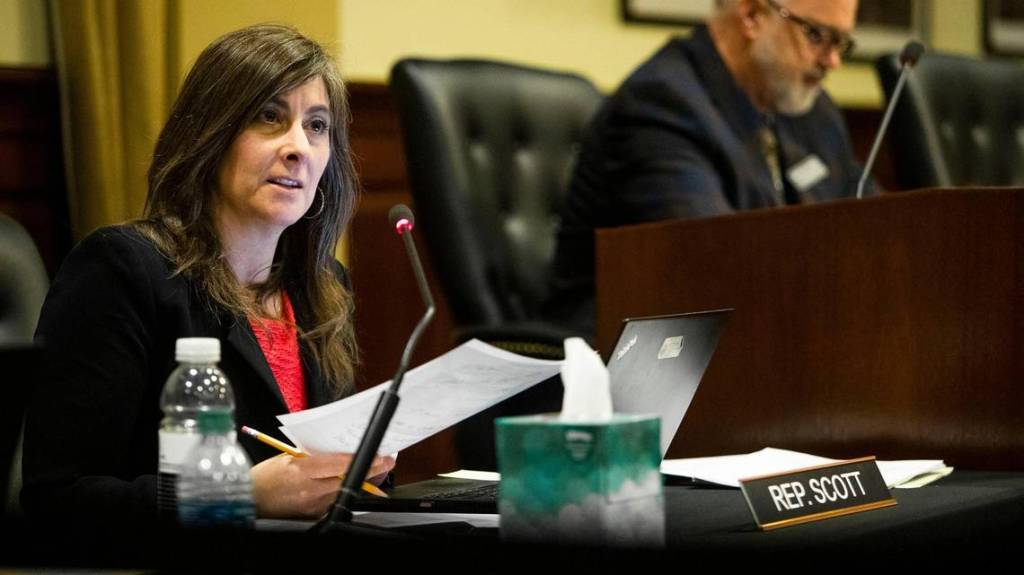
Idaho lawmakers have voted to expand a law that bans cannibalism because of fears about the popularity of human composting. Rep. Heather Scott introduced a bill in February 2024 to expand the state’s cannibalism ban and told a legislative committee that she’s worried about the possibility that people are eating other people.
Scott said:
“This is going to be normalized at some point, the way our society’s going and the direction we’re going.”
People are often surprised to hear that Idaho is the only state in the USA to have outlawed cannibalism. Other states have laws which target abuse or desecration of a corpse, making cannibalism legally impractical and problematic. Idaho introduced its law during the frenzy called the “Satanic Panic” last century.
The US is not unique in this – most countries do not have specific laws banning cannibalism. Germany didn’t, until Armin Meiwes ate his new social media friend.
The new bill, 522, adds to Idaho’s existing prohibition of cannibalism a ban on giving someone else “the flesh or blood of a human being” without that person’s “knowledge or consent.” Scott said she is “disturbed” by the practice of human composting, which is legal in several states as an option for disposing of the dead that is more sustainable than other burial methods and reduces a funeral’s carbon footprint. Human composting involves decomposing human remains like other organic matter and turning it into soil that can be returned to the family or used to make land more fertile. But Scott said outlawing composting would require overhauling rules for morticians, and so instead she focused on banning the act of deliberately giving human flesh to another person.
“I didn’t want to see that in my Home Depot stores.”
Scott said she was on a plane and watched a clip from a TV show displaying a chef feeding human flesh in sausage to contestants, which inspired her to take action. The clip, which she sent to the Idaho Statesman, is from a TruTV prank show, in which they pretend to feed people flesh. “They didn’t tell the people, they fed it to them,” Scott told the Statesman, though she noted it may have been a spoof.
Scott also submitted a link to a video featuring a Chinese official denying that his country had sold canned human flesh to people in Zambia. The canning claim was a hoax, spread with fake photos of butchery, according to news reports from 2016. Scott additionally pointed to a North Idaho man who pleaded guilty to murder last year and was initially also charged with cannibalism after investigators found postmortem mutilation and a bloodied bowl at the crime scene. The cannibalism charge was later dropped, meaning that the Idaho anti-cannibalism laws have still not been tried in court.
But that’s where we are in Idaho: Unhinged, unreal legislators can bring forth just about any crazy idea and get a bill printed.
But imagining that humans might unwittingly eat other humans is not so far-fetched. Mythology is full of innocent cannibals—Agave eating her son Penteus, Thyestes eating his sons at his brother’s feast, Tereus eating Itys. Becoming “innocent” cannibals make us squirm, writes Donald Tuzin, because it denies us the escape of declaring the cannibal a maniac or monster—anyone can become a cannibal. In the movie The Farm, humans are treated as “living meat” exactly the way cattle are regarded on factory farms—the men are slaughtered for meat, the women bred and their infants pitilessly killed in front of the mother (as often happens in the dairy industry) so the farmers can sell the mothers’ milk. The final commodities are sold to innocent cannibals, who occasionally ring up, horrified to find residues such as a human tooth in their meat. Inverting the agricultural business plan, the “livestock” are human, while the farmers are dressed in animal masks.
But it doesn’t only happen in fiction. The Farm may be based on the Canadian pig farmer and serial killer Robert Pickton who confessed to 49 murders in the 1990s, and allegedly “processed” the meat of his rape and murder victims by feeding them to his pigs and, police said, possibly mixing them up with the pork products he sold to neighbours.
Joe Metheny claimed to have killed 13 people in the Baltimore area in the 1990s and turned them into burgers. He reported:
“Over the next couple weeks on the weekends I opened up a little open-pit beef stand. I had real roast beef and pork sandwiches and why not they were very good. The human body tastes very similar to pork. If you mix it together no one can tell the difference.”
In 2007, two men in England were arrested for the murder of a 14-year-old girl, with the prosecution claiming that her body had been cut up and minced into kebabs in a Blackpool takeaway called “Funny Boys”.
On April 9, 2012, police in Garanhuns, Brazil, arrested for murder Jorge Beltrao Negromonte da Silveira, his wife, Isabel Pires, and his mistress, Bruna Cristina Oliveira, who all lived together in a group they called “The Cartel”.
Residing with the Cartel was a small child named Vitória, who had been the daughter of their first victim. The child’s mother was a seventeen-year-old homeless woman whom the Cartel had invited into their home in Olinda in May 2008. She had been murdered by the Cartel, who then dismembered and skinned her body, storing the meat in their refrigerator before seasoning it with salt and cumin, grilling and eating it. The woman’s daughter was fed some of her mother’s flesh.
The worldwide public interest in the crimes did not stem from their murder of three young mothers, but from the fact that the Cartel had baked the victims’ flesh into salgados, salty, deep-fried pastries, which they then sold to the unsuspecting public. To the disappointment of the media, the pictures of the perpetrators showed them as three ordinary Brazilians, not the monsters the public had expected.
Back to Idaho, where Rep Heather Scott’s bill 522 sailed through the House and is heading to the Senate. She quoted in support of her bill from a recent article in The New Scientist which reviewed the human history of cannibalism (they concluded that it happened a lot) and stated:
“Ethically, cannibalism poses fewer issues than you might imagine. If a body can be bequeathed with consent to medical science, why can’t it be left to feed the hungry? Our aversion has been explained in various ways. Perhaps it is down to the fact that, in Western religious traditions, bodies are seen as the seat of the soul and have a whiff of the sacred. Or maybe it is culturally ingrained, with roots in early modern colonialism, when racist stereotypes of the cannibal were concocted to justify subjugation.”
We don’t have to buy mulch to end up cannibals. Any sausage or burger might have human flesh in it, and no one would know the difference. We are animals, large mammals, made of red meat like cows, pigs and sheep. Unless you think we have some sort of supernatural dissimilarity from other animals, the thin red line between different species can only be identified as a cultural construct.
Videos such as the one above by freelance journalist Jonathan Petramala show hundreds of cars and trucks bogged in deep snow on the infamous Donner Pass, a stretch of road 7,088 feet above sea level over the Sierra Nevada mountains in Nevada County, California. On Saturday March 2 2024, more than three feet of snow fell on and around Interstate 80 northwest of Lake Tahoe, according to the Weather Channel. In winter, the old Donner Pass, now the historic US40, is often at risk of snow avalanches and blizzards, but this one was the strongest blizzard in California in years, and is being called a
“‘Snowpocalypse”
Blizzard warnings have been issued with snowfall of up to twelve feet expected in some higher elevation locations.
This is Donner Pass, covered in snow and looking a lot like it did when the Donner Party made their way through it over a century ago. pic.twitter.com/wC9jVdsaKL
Many people would not associate the words “California” and “Snowpocalypse”, but that is exactly what happened in 1846-7 when a group of pioneers became snowbound in the Sierra Nevada over winter, and famously turned to cannibalism to survive. Only 48 of the original 87 members of the party survived. Many of the others were eaten after they died, and when they ran out of corpses, they murdered two of the Native American guides to use as protein.
There have been quite a few films and books about the events of that winter in 1846. Most emphasise the cannibalism that became inevitable, but omit any ethical discussion (probably no record was kept of it anyway) and gloss over the clearly racist decision to kill and eat the Native American guides in preference to “white” meat, even where the potential victim had volunteered. The movie Alivecovered this rather better, showing a group of young men, all devout Catholics, debating how to justify eating their dead fellow passengers after the crash of a Uruguayan Air Force plane chartered by their football team in the Andes in 1972.
Back to the future – March 2024. The California Highway Patrol issued an appeal to people not to head out there, for obvious reasons.
The skiers, in particular, were not interested in listening to warnings – they wanted powder, and plenty of it. Despite snowfall of up to 12 feet being expected in some higher elevations, people headed out from San Francisco and all parts of the USA to find a mountain they could slide down. Many of them promptly got stuck in cars that would not respond in the freezing temperatures, and ski resorts had to shut down anyway. Big rigs also were stranded, blocked from moving (even if they had chains) by the inactive cars, or jack-knifing in the treacherous conditions.
Like 1846, this was a recipe for disaster. Residents of Truckee, California, one of the closest towns to Donner Pass, reported having inches of snow in front of their houses making it difficult to get out.
It did not take long for social media to pick up those reports of a “significant number of vehicles stranded over Donner Summit”. One headline read:
Untold Number of People Trapped at Site of Great American Tragedy
Some, of course, made the inevitable logical leap:
Sorry to disappoint, but there have been no reports of cannibalism from the stranded cars, trucks or town-folk. Unlike 1846, there are now emergency services available, including all sorts of technology from drones to snowploughs, and in fact emergency teams and tow services worked tirelessly to reach those affected.
While many had to leave their cars behind, no gnawed bones have been discovered so far. Maybe when the snow melts…
SNOWTOWN is back in the news at the moment, due to one of the perpetrators being granted parole after serving his 25-year sentence. Mark Haydon was convicted of assisting John Bunting and Robert Wagner in the murders of 11 people, including his wife, between 1992 and 1999.
Haydon reportedly rented the abandoned state bank building at Snowtown in which the bodies were stored in barrels of acid. A jury deadlocked on the charge that he was involved in the murders of his own wife, Elizabeth Haydon, and of Troy Youde, and he was never retried. His 25-year sentence was completed this year, and he will be freed into the community with no restrictions in May 2024 (unless the government succeeds in attempts to change the law to broaden the definition of a “high-risk offender”).
Above: the real Mark Haydon – then and now.
Relatives of the victims have long voiced their anguish and fear at any prospect of any of the perpetrators being released.
The film Snowtown is a recreation of this case, the most famous serial killer case in Australia (with the exception of the attempted genocide of the Indigenous population). A total of twelve victims were identified, and eight of the bodies were eventually found by police in barrels filled with acid, which were stored in an abandoned bank vault in the small town of Snowtown, in South Australia.
Although the press called this the “bodies in barrels” murders, it soon became known, to the sorrow of that little town, as THE SNOWTOWN MURDERS, even though only one of the murders had taken place there, the rest happening in the big city, Adelaide, between 1992 and 1999.
The final murder that took place in Snowtown, however, involved CANNIBALISM. We’ll have a look at that in this blog, although unfortunately the film doesn’t.
The film is a true Crime retelling, which means that none of the names have been changed to protect – anyone, and of course the dialogue has to be imagined to some extent. But we know a lot of what went on, and so did the film makers.
True Crime has been a popular genre for centuries, and transgressed the line between fiction and non-fiction in 1965, when Truman Capote released In Cold Blood, a “non-fiction novel”, relating or interpreting a 1959 Kansas murder. Modern versions of the genre extend beyond literature to films, podcasts, vodcasts and television shows. They tend to concentrate on the most sensationalistic cases and are grittily and brutally realistic in portraying the violence and gore.
In Australia, where this film originates, a survey found that some 44 percent of podcast listeners had listened to true crime podcasts, with an considerable proportion of them being women.
The protagonist of the film is Jamie Vlassakis, a teenager living with his single mother and two siblings. The mother’s boyfriend is a helpful sort of bloke who makes the kids dinner when mum has to go out, then strips them and takes photos of them for his own gratification. The mother deals quite effectively with this, beating him up and kicking him repeatedly, but soon a new man comes into their lives – John Bunting.
Bunting has a winning smile and a certitude that gets him into the family, and he takes Jamie under his wing. John also has a burning hatred of gay men and paedophiles, two rather different beasts whom he conflates into one evil figure. When Jamie tells him that he was raped by his older half-brother Troy, John tells Jamie he needs to “grow a pair” and take revenge. He involves Jamie in his plans to identify, capture and kill a range of people he considers monsters. He collects detailed information on a “spider wall” in his house. “Rock spider” is Australian slang for a paedophile.
But John Bunting has clearly not read Nietzsche:
He starts by involving Jamie in his plans to drive the erring boyfriend out of town. Jamie finds him in the garden, chopping up and mincing kangaroo body parts to toss onto the neighbour’s front door and sofa.
He involves Jamie in a raucous discussion of paedophile teachers, asking him what he thinks should be done with them. Jamie follows the fatal logic.
John takes Jamie under his wing, teaching him to ride a bike, shaving his head, showing him the spider wall, giving him a gun, and getting him to shoot John’s dog, a brutal blooding. When he introduces Jamie to the act of killing humans, there is also the accompanying deception: each victim is made to record a message that will be played on the answering phone of their loved ones. Jamie’s mum hears Troy say he hates her, and Jamie lies to her, letting her believe that forced call was true. Jamie goes off to doctors and government offices to collect payments, posing as the people they have killed. He doesn’t look happy about it, but he is sinking deeper and deeper into John’s machinations. After a while, collecting the government support payments becomes the motive as in the murder of Gary O’Dwyer; the vigilante pretext is forgotten. O’Dwyer invites the men to his place to watch him feed rats to his python, a process we see in slow motion in which the snake unhinges his jaw to swallow the prey whole, just as the men become unhinged in their growing lust to kill.
So John makes a man of Jamie, in the most toxic sense. He teaches him carnivorous virility – in order to be a man, you have to kill and eat. Not always the same carcass, but that does seem the logical consequence of the objectification of all victims.
The film traces the increasingly violent actions in which Jamie becomes involved, unwillingly at first, but totally under the control of John. He is made to watch them torture his half-brother Troy, who was earlier shown sodomising Jamie, and he finally steps in to finish the killing, tears rolling down his face, while John strokes his cheek and murmurs “good boy.”
Jamie is now a fully-fledged killer and a vigilante, not just an observer and helper the way Mark Haydon (the man currently being released on bail) is portrayed. Mark is a minor character, buying rubbish bags and digging holes for corpses, until near the end of the film, when he tells John he got into a fight with his wife, who called him a pussy. He told her what a big man he was – burying bodies. John brushes the story off, but we know she is next.
Although this murder is not shown in the film, evidence was given that Haydon saw his wife’s body and laughed. Her body was one of the ones found in barrels in the Snowtown bank building.
The final murder was Jamie’s half-brother (through a different father) David Johnson, whose only offence was his fastidiousness and unwillingness to go along with John’s rhetoric of violence. The final scene of the movie shows Jamie persuading David (one of the few wholesome characters in the film) to check out a computer supposedly offered for sale in Snowtown. They stop for a beer, they stop again so Jamie can urinate in a creek. He runs back to the car to accompany David to his death; the car is parked at a crossroads, clearly a symbol, a suggestion that Jamie, who is depicted as hating all the violence, could have chosen a different path at any time.
John Bunting, Australia’s most prolific serial killer, was convicted of eleven murders and sentenced to life imprisonment without the possibility of parole. Robert Wagner, his main accomplice, was convicted of ten murders and sentenced also to life without parole. Mark Haydon was initially charged with two murders but was only convicted on five counts of assisting. The jury did not come to a decision on two murder charges against Haydon, and another charge of assisting murder, which never came to retrial.
More than 250 suppression orders originally prevented publication of the details of this case at the time. In early 2011, a judge lifted the remaining orders in response to a request by the producers of the film Snowtown. Haydon was sentenced to 25 years, which he has now completed; he is back in the community on parole, with the head of the parole board saying he’s well behaved and poses no risk to the community. He has been moved to the Adelaide Pre-Release Centre – a low security facility where prisoners can participate in accompanied and unaccompanied leave, including for work and education. The usual conditions of parole apply (no binge drinking – yet), but he will be a free man in May 2024 when his sentence expires.
Jamie, presented in the film as an unwilling and even sympathetic killer, pleaded guilty to four murders and provided testimony against the other men, in exchange for a lesser sentence. He testified about the cannibalism that is not shown in this film — that Bunting and Wagner hacked at David’s body to make sure it would fit in the barrel and then sliced off a sliver of flesh from the right thigh. They heated a frying pan, cooked the flesh, and handed it around. Jamie’s testimony was the only evidence police had that cannibalism had taken place, and was presented by his attorney as proof that he was fully cooperating and deserved a lighter sentence. In 2005, when Haydon’s murder charges were dropped by the Director of Public Prosecutions, several suppression orders were lifted. These detailed the murder and cannibalism of the final victim, David Johnson.
Jamie Vlassakis was sentenced to four consecutive life sentences with a non-parole period of 26 years, which means it is possible he could be released on parole in 2025. He will be 45 years old.
The film is gritty and brutal, particularly the scenes of Jamie’s rape, and the torture of their victims. But it is compelling watching, and the acting and directing are quite brilliant, capturing the loss of innocence that starts with abuse and ends with brutality. Bunting’s early life reportedly was very rough; he said he enjoyed killing ants with acid, an idea he later transposed to those humans he saw as vermin. When he grew up, he worked at a slaughterhouse, where he would brag about slaughtering animals, saying that’s what he enjoyed the most. Later, when he moved in on Jamie’s family, he would kill cats and dogs and skin them while making Jamie watch. We see Jamie transform from the innocent teenager who stands around smoking at the start of the film to a shaven-headed killer, and even his little brother is shown with his head shaved, starting his short journey from childhood abuse to callousness.
The film is all about that loss of innocence. At an early age, these kids are introduced to poverty, abuse and violence that is a hallmark of violent, carnivorous society. Children famously love “animals” when they are little, recognising their own infant state of being helpless and unable to communicate, yet are socialised into carnivory by the peer pressure to conform and their recruitment into the ceaseless human war on nature. Animals, particularly the chattel slave animals generally referred to by their monetary value, “livestock”, are nothing and nobody. It is only a small step for John Bunting to assume the same about those he hunts, and so why would he flinch at eating them? It is the logical next step.
The film closes as Jamie shuts the door of the vault, trapping the unfortunate David Johnson with the killer gang. We don’t see the murder, or the frying pan. Unfortunately, that final step over the thin red line between humans and other animals appears to have been a bridge, or a meal, too far for this film.
Utah lawmakers are attempting to pass a bill to criminalise the ‘ritual abuse of a child,’ bringing back memories of the satanic panic of the 1980s, when other states passed similar laws.
Critics of the bill, however, say it is unnecessary and potentially harmful.
Republican state Rep. Ken Ivory is sponsoring the bill, House Bill 196. It defines ritual abuse as abuse that occurs as “part of an event or act designed to commemorate, celebrate, or solemnize a particular occasion or significance in a religious, cultural, social, institutional, or other context.” The bill lists specific actions that fall under the proposed definition: abuse against children that includes rape and sodomy, involving them in animal torture, bestiality or cannibalism, or forcing a child to ingest urine or faeces, enter a coffin or grave containing a corpse, or take drugs as part of a ritual.
A hearing of the House Judiciary Committee on February 21 heard from several adults who described themselves as survivors of ritualistic child sexual abuse. They described devil worship, animal torture, forced bondage, rape, cannibalism, child prostitution and mind control, saying that the abuse was so physically and emotionally traumatic that they had repressed memories of it.
Kimberli Raya Koen, President and Founder of The Healing Center for Complex Trauma in Salt Lake City, told the Committee that she was trafficked into a family that ritually abused her for more than two decades.
She told them:
“I see the light and I have fought to be in this chair, to be in this moment, to have a chance to say this is real and this is happening.”
Utah County Sheriff Mike Smith spoke in favour of the bill, telling the committee that he began investigating a high-profile “ritual sex abuse” case two years ago.
The investigation (covered by this blog at the time) became embroiled in politics after then-Utah County Attorney David Leavitt accused him of dredging up an old, unverified witness statement that accused Leavitt and 14 others of “cannibalizing young children” and participating in a “ritualistic” sex ring. Leavitt subsequently lost his re-election bid.
Several states passed similar laws in the 1980s and 1990s, during the height of furore over satanic ritual abuse, but few, if any, prosecutions came from them. Since then, federal law enforcement agencies, scholars and historians have pointed to the scarcity of evidence for the claims of widespread ritual abuse and warned that such legislation risks generating false allegations, wrongful imprisonments and wasting law enforcement resources.
Mary deYoung, professor emeritus of sociology at Grand Valley State University, has documented the harms of the satanic panic.
“This bill is a very good example of panic legislation, hastily cobbled together, on the basis of testimony from a couple of women recollecting childhood histories of satanic ritual abuse. It’s a bill that responds with the kind of approach where we get really angry and say, ‘There ought to be a law.’ And we don’t think about whether it can be enforced in such a way that adds any benefit to society or that ensures that justice is done.”
County Sheriff Smith acted on the reports, but his prosecutions have lagged in court for years, plagued by accusations that investigators mishandled witness statements and that the investigation was politically motivated from the start. He says:
“I was attacked, I was ridiculed, I’ve had memes made about me because of it. Without a doubt, these things do happen in Utah. I believe they’re happening, I believe they have happened.”
Utah’s proposed bill and the county sheriff’s investigation have attracted national interest from conservative media and online conspiracy theorists who believe this case will prove that the allegations in the satanic panic of the 1980s were true, and that cabals of satanists are still sexually abusing, murdering and cannibalising children. Several self-described internet investigators have, in blogs, videos and podcasts, accused hundreds of Utahns of participating in satanic ritual abuse rings.
Many of the claims in the 1980s were made in Utah, amid claims that local therapists used hypnosis and manipulative interview techniques to recover memories from alleged child victims. These were some of the earliest claims of widespread satanic ritual abuse.
Utah’s governor formed a task force in 1990 which spent $250,000 to address pervasive ritual abuse. Investigators interviewed hundreds of victims in more than 125 alleged cases, only one of which ended in prosecution. A final report from the state’s Attorney General in 1995 suggested that there was evidence of isolated instances of abuse involving rituals, but not a widespread plot to abuse children in this way.
National studies from the Department of Justice and the National Center on Child Abuse and Neglect found no evidence to support claims of widespread ritual abuse. Child sexual abuse, however, is staggeringly common; about 1 in 4 girls and 1 in 20 boys in the United States are victims, according to the Centers for Disease Control and Prevention.
In Utah, the Judiciary Committee voted 10 to 1 to advance the ritual abuse bill to the full House; if passed there, it will advance to the Senate. No one testified in opposition to the bill. Rep. Brian King, one of the two Democrats on the committee, cast a dissenting vote and questioned its necessity, noting that state law already criminalises physical and sexual child abuse. Ivory, the sponsor, conceded the offenses were already criminal, but said a specific law was necessary because the crimes are “so heinous.”
Rep. Kera Birkeland, a Republican, cried as she addressed the people who spoke during the hearing.
“I had no idea that this was happening in our state. We believe you.”
Do we? Are children in Utah or elsewhere being forced to eat human flesh (the focus of this blog) or other matter usually considered inedible in polite society? One of the most famous allegations is the conspiracy theory #Frazzledrip which maintains that a video is circulating showing Hillary Clinton and Huma Abedin, a former aide, ripping off a child’s face and wearing it as a mask before drinking the child’s blood in a satanic ritual sacrifice. No claims were made about making the child eat flesh though. So I guess that’s not covered by the bill.
Utah has a bit of a record here, with the ill-fated team eaten by Alferd (or Alfred) Packer leaving from the Bingham Canyon mines near Salt Lake City in November 1873 for the gold fields of Breckenridge in the Colorado Territory. They met Packer some 25 miles from their starting point, near Provo. Unrelated (I guess) is the story of a Utah man who was charged in September 2021 over the Capitol riots and later threatened to “eat the flesh” of a probation officer.
We might also wonder if these laws might be used against churches that practise the Eucharist, the eating and drinking of the wafer and wine in church, which is seen by some (particularly the Catholics) as a literal transubstantiation of wafer and wine into the flesh and blood of Christ. Children are usually expected to take communion, that is, eat the flesh and blood of Christ (in the form of wafer and wine), from the age of about seven. This does sound a lot like what the bill describes as “ingestion… of human bones, blood, or flesh”. I wonder what the churches might say about that?
Idaho is the only state to have a law against cannibalism, but it has never been used. Seems a terrible oversight, really, and perhaps the good folk of Utah can set it right.


















 The Cannibal Guy