John Beagles and Graham Ramsay are artists who play with the concept of human exceptionality. They also add a new flavour to the old saying “Art is always a matter of personal taste.”
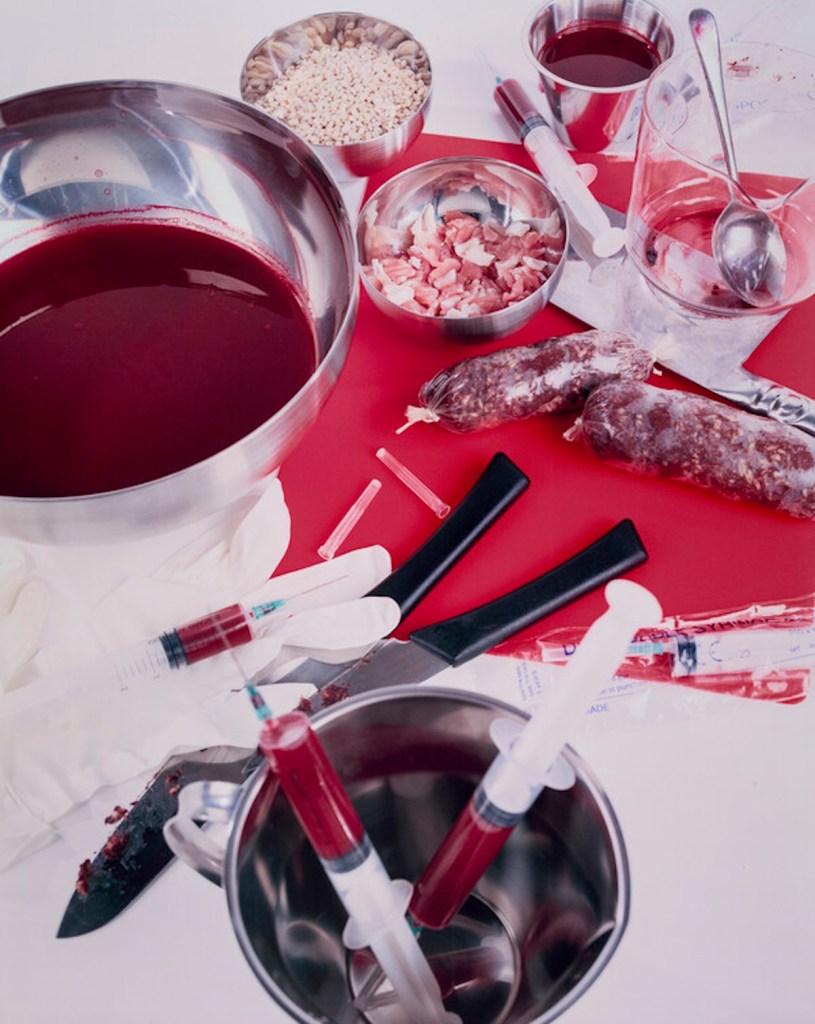
For two decades, the artists and performers have been making, cooking and sometimes eating black puddings made from their own blood. Ramsay says:
“There is a tang. And it is quite salty too.”
The pair have been collaborating since 1996 and making their “cannibal” sausages since 2004. They call their performance and exhibition a “black pudding self-portrait” or Sanguis Gratia Artis.
John Beagles and Graham Ramsay
They are staging the show again this year. Their meat products are on display in a fridge at the Scottish National Portrait Gallery, and they will be cooking them for a live audience on February 13.
Ramsay, who says he likes a good black pudding, stresses: “We do not usually eat them ourselves, but we have tried them.” He adds that his partner will not be sampling them:
“One of us has quite recently become a vegetarian, and it is not me.”
There are no plans to eat the sausages in Edinburgh. Previous performances have involved some harmless light cannibalism and have attracted some bizarre audiences.
In London back in 2007, Ramsay says, word got out that they would be eating the puddings.
“The performance got a bit of attention in advance; people knew it was happening. So there was a queue of quite gothic people — vampiric characters — outside the gallery and it was a bit weird. There was a kind of feeding frenzy then. As part of the performance, we put slices of the puddings on a silver platter and paraded them through the audience, just to show them, but people started grabbing them. The performance involves us in costume, in the gallery, and we’re basically chopping and frying the pudding, with audience watching.”
The sausages are made with a pint of blood from each man, combined to symbolise nearly thirty years of collaboration.
The process of getting the blood is not easy. They have had to convince nurses to extract small quantities — no more than a syringe at a time — over a long period, and then freeze it. The kind of equipment used by blood transfusion services is tightly controlled, so the artists have to endure sometimes painful extractions, over and over again.
Why do it? Beagles and Ramsay are both respected art academics, teaching at Edinburgh University and Glasgow Art School respectively. Heavily influenced by feminist criticism, they are challenging the old idea of the artist, especially the male artist, as a lone genius separate from the world. They are playing with the idea of self in self-portrait. Their mixed blood represents their joint work.
“We fuse ourselves, but we also use a daft form to present ourselves in. It’s not heroic. We have picked a mundane modest foodstuff to represent us.”
The performance feels different now than it did when they first had their blood extracted. Both men are in their fifties now, and aware of their mortality. “Age starts to creep up on you, waistlines expand, and you become more aware of death and people’s health around you,” Ramsay says.
The artists may not see themselves as heroes, but there is an edginess to their idea, even legally. They debuted their sausages in New York in 2004. Back then there was a lot of angst in America about meat products, mad cow disease and foot and mouth. They had to send their puddings in the post with fake customs descriptions, one batch wrongly labelled as second-hand books.
One the night of their big performance, officials became antsy about health and safety, and security was brought in to stop punters eating the human sausages. Beagles and Ramsay, in a diary of their escapades, called them “anti-cannibalism guards”.
Will they have to find a way to keep their puddings safe from the Edinburgh audience? Perhaps. People are fascinated by cannibalism, even as they claim to be repelled. A few months ago, we reported on a vegan writer and photographer who finally gave in to the demands of his relatives to eat animal products by making meringues from his own blood.
Delores is still killing people, Luis is still chopping them up to fill his empanadas. It’s becoming an industry, but Delores still gets queasy, and not real happy about the killings, but she’s much more upset about the cannibalism. Odd that.
If you haven’t read my blogs on the earlier episodes, here is a brief summary. In episode 1, Delores has just been released from prison after 16 years – she took the fall for her boyfriend, who has since disappeared. She heads back to Washington Heights New York. but it’s all gentrified now, except for Empanada Loca, the shop of her old friend Luis, who offers her a room and sets her up as a masseuse, a skill she learnt in jail. In episodes 2 and 3, Delores kills the landlord who has been harassing Luis for his overdue rent, which he can’t afford because the neighbourhood is now fancy, and people don’t buy empanadas much. Luis creates a new empanada, MUY LOCO. It is hugely successful, because it contains, yep, human flesh, in this case, the landlord, Mr Pearlman, whose son, Jonah, appears in the shop at the end of episode 3, with two cops behind him. In episode 4, Delores is shocked to find what Luis has done with the body of the landlord she murdered, and disgusted by the secret contents of the muy loco empanadas—Mr Pearlman. She is particularly horrified when Luis offers Jonah an empanada to try, a muy loco, which she knows is a “mouthful of daddy”. Meanwhile, the local drug dealer, Marcie, has pissed off Delores, and now she is also in Luis’ fridge, and bits of her are now in the empanadas.
In episode 5, Delores hires a private eye called Ruthie, played by the wonderful Cyndi Lauper, to trace her ex, who cheated on her and let her take the fall in a drug bust. Ruthie’s motto (or perhaps mission statement) is I NEVER DON’T FIND THEM. But the last thing Delores wants is for Ruthie to find Mr Pearlman.
In this episode, number 6, we see cannibalism as a business. Luis has been clear-eyed about this all along – he gets rid of the annoying landlord, he thoroughly destroys the evidence (in customers’ stomachs) and he makes money from the meat, which is apparently delicious and hugely popular, while saving money by not buying the flesh of other animals from the food-services man, Jeremiah, the only sympathetic character in the story so far. It’s a win-win-win for Luis.
But now Delores has two more victims for him – the drug dealer, Hector, who has an allergic reaction to her massage oil, and Ruthie, who sees what is going on. Delores has “doubled the body count”.
Luis is pretty happy about the situation. “Mami’s been busy” he says, as he finds the bodies.
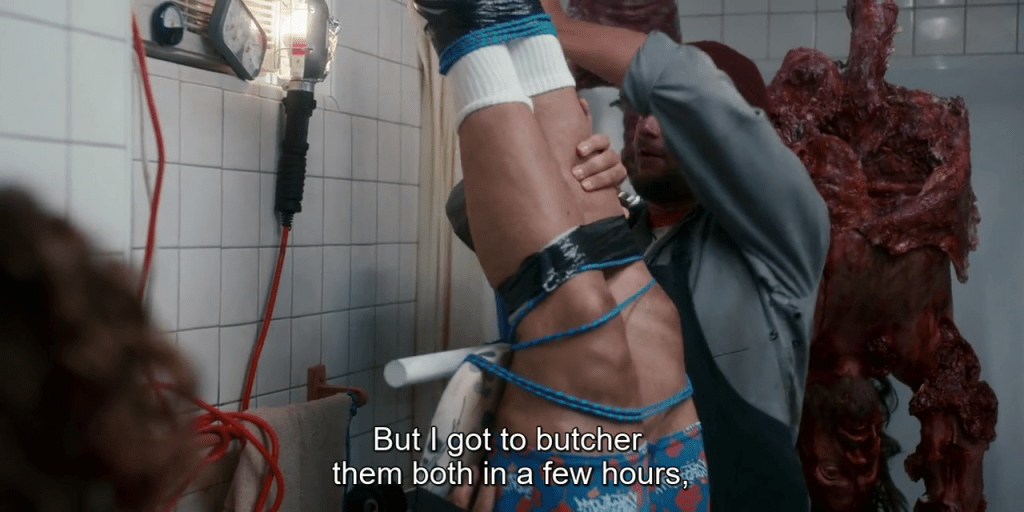
We finally get to see Luis’ artistry. He needs to butcher both bodies before they start to decompose, reproaching Delores:
“You could have spread these two out. Cause this is going to be, like, a challenge, even for me!”
We see him slit Hector’s throat in graphic detail, exactly as happens millions of times a week to other animals in abattoirs, fisheries and farms. But Delores, who was OK killing them, gets pretty nauseous at the sight of blood; apparently there are eight quarts (7.6 litres) in a body the size of Hector, Luis tells her, and we see it gurgling down the drain.
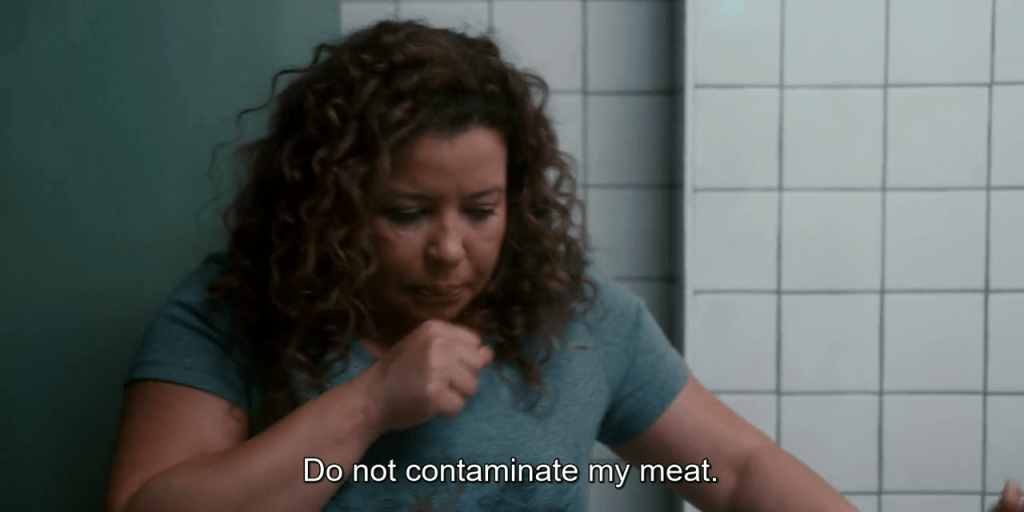
He orders Delores to leave, because he’s a conscientious butcher, telling her,
“This is a food prep space, OK? Do not contaminate my meat!”
She runs into Jeremiah (actually, her runs into her), the nice, normal food services delivery man, who tells her he knows what’s going on.
“You’re not back here a week, before the landlord goes missing. Food services like mine are getting squeezed out.”
Jeremiah isn’t interested in her conscience or her legal position, he has people to whom he owes money, and he’d like them disappeared too, please.
This is modern commodity capitalism. Everything, everyone, is assessed by monetary value, everything, everyone, is a commodity. To Luis, the victims are just meat to be butchered and sold in empanadas, to Jeremiah, they are creditors who are making his life difficult. For both, they are just ‘livestock’.
The basic precept of capitalism, as film critic Robin Wood warns in his paper “Return of the Repressed” is that “people have the right to live off other people”. In Washington Heights, thanks to the ready temper of Delores Roach, that is exactly what they are doing.
I don’t usually put warnings about graphic images in my blogs; I figure if you are reading a blog called “thecannibalguy.com” that you are probably not expecting unicorns and fairies. But this short clip has its own trigger warning, so I’ll just reproduce it here.
Vegans are often told by caring or sanctimonious friends and relatives that they need animal protein or they will get sick and die. This can be a bit wearisome, particularly for long-term vegans. Now here’s a novel solution.
Jamie Lee Curtis Taete (I wonder who his parents’ favourite film star was?) has been vegan or vegetarian for almost 20 years (and clearly has not died yet). After years of carnivorous peer-pressure, he’s decided to consume animal products from what he calls the only truly ethical source: himself.
Jamie seeks advice from “Blood for Food” activist, Laura Schälchli, about her recipes, which are made with blood from other animals. He follows her recipe for blood meringues, substituting his own blood for whatever unfortunate animal is usually slaughtered and bled.
And eats the results.
He starts by whisking the blood, because blood tends to clot, which even he describes as “disgusting”. But,
“I find the thought of it less gross than if I were eating the blood of an animal.”
Jamie is perhaps using shorthand, or forgetting that we are all animals?
The protein albumin comprises about fifty percent of human blood plasma, and is similar to egg whites, so the obvious choice for Jamie was to make a meringue, which is usually made from the whites of chicken eggs or, far less often, in the recipe he has chosen, the blood of goats or cows.
“I was expecting a sugary bowl of gore, but this looks like it could be real food.”
So look, autocannibalism is not an appetising prospect, but most vegans would say the same about dishes made from the organs, muscles or blood of an animal who was unwillingly slaughtered for the purpose.
“I think I probably enjoyed this more than if I had made it using animal blood, because there was no death involved. I am really the only ethical source of animal products, because I can give my consent to myself in a way that a sheep can’t.”
Here are some of the comments from YouTube:
Some suggested that Jamie would end up a cannibal, a common thread through the literature – if you eat human flesh (or blood I guess), you will become addicted, because we are somehow irresistible. It is absolute nonsense of course. Others felt like it had made the point: eating any animal product, including from the ape known as Homo sapiens, is a bit disgusting. I have seen people flinch as they pull a piece of meat out of the fridge and pour out the blood that pools under it.
As Jamie says, if you must eat animal protein, use the nearest animal, and the only one that is able to consent, although the occasional cannibal like Armin Meiwes manages to find a willing third party to sate his cannibalistic desires. Remember the scene from The Restaurant at the End of the Universe, when the “dish of the day” offers them his shoulder to eat, braised in a little white wine sauce, saying “naturally mine, sir, nobody else’s in mine to offer!”
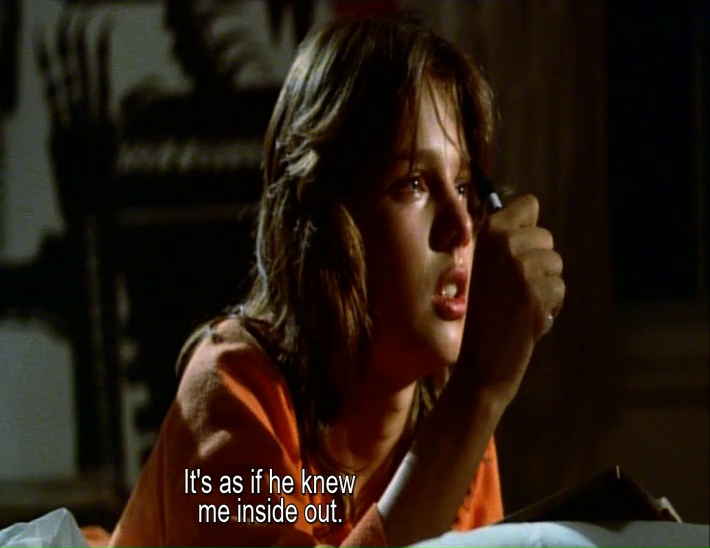
Simone (a bravura performance by 17-year-old Désirée Nosbusch) is a teenage fan obsessed with a pop singer known only as “R.” That obsession takes over her life – she drops out of school, waits outside the post office for a week for a reply to her letter, which will never come because his fan mail goes straight to the tip. She climbs to the top of the church steeple in her town of Ulm (it’s actually the tallest steeple in the world) and thinks about jumping off, splattering herself all over the town square, but with a letter to R in her pocket, so he will hear of her at last.
Nosbusch as Simone offers a fascinating glimpse of the modern cannibal – she looks and acts normal (for an angst-ridden teen) but underneath are irresistible currents of passion and voracious appetite for her idol. She attacks the postal worker who disappoints her by not having a letter for her, she attacks her father for turning off the TV show on which R is performing. The walls of her room are covered in pictures of R. The film shows parallel imagery to her obsessive love; images of Nazi salutes – the same obsessive love that led Germany and the world into catastrophe a few decades previously.
The word “fan” comes from “fanatic”. The fanatic believes he or she has found the answer, the one who knows us, cares for us. She feels that R, who has never heard of her, knows her inside out. And she will know him, inside out.
She drops out of school and hitchhikes to Munich, where R’s shows are recorded, being accosted on her way by a range of toxic men, but of course the worst of them is the one she is so desperate to meet. She sleeps in unlocked cars while she waits outside the studio, so frantic that, when she finally meets him, she faints.
R seems concerned and kind, invites her to his show, where he appears as a mannequin surrounded by store mannequins – a bald wig symbolically obscuring the divide between human and inhuman, life and death.
He takes Simone back to the apartment of a friend who has gone to the US for a year, where she finally achieves the intimacy she has craved. Nobody knows they are there, so anything can (and does) happen.
But R is a superstar – he is not interested in the meeting of the souls that she imagines will happen, and afterwards tells her he has to go back to his work, tries to fob her off with vague promises of future meetings. He tells her to leave the keys on her way out.
Simone wants to own him and his love, but he just wanted her young body. As he leaves, she picks up a figurine of the goddess Diana, the Huntress, and she then hunts him, killing him with a blow to the head.
Once he is dead, he is hers at last, to do with as she wishes. The imagery switches to that of a Christ, broken and crucified, and she cradles him in her lap like an erotic Pietà.
She sees a freezer, and she sees an electric knife.
R’s blood is, as the Bible says, his life, and she laps it up from the floor and from her knife.
When R is neatly packed in the freezer, Simone faints, but next day we see pots boiling on the stove, his foot being basted with his juices.
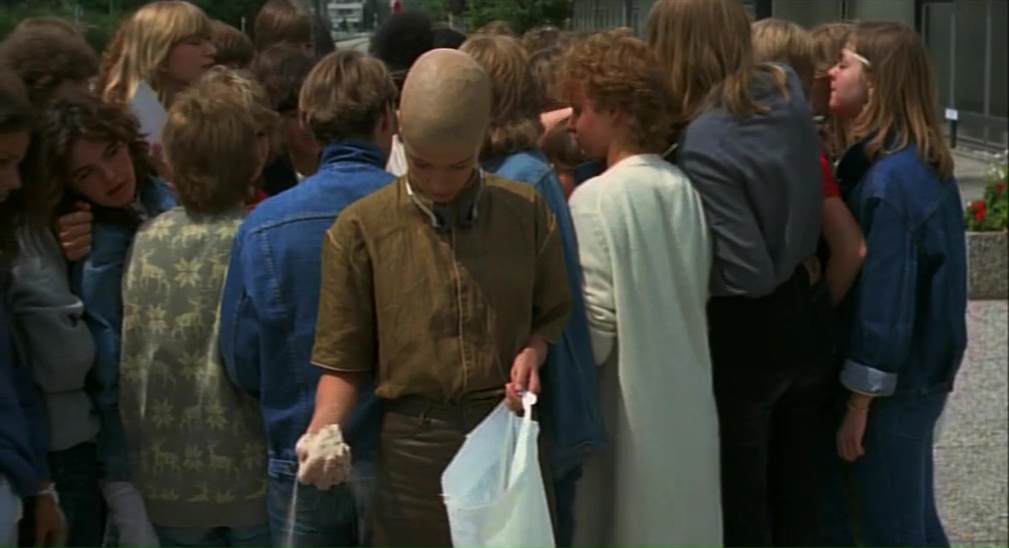
She eats him over a few weeks, then grinds his bones to dust and takes the dust back to the TV studio; pouring it out at the place she met him.
Her revenge involves ceremonial murder and cannibalism, to ensure he will always stay with her, and inside her. Leaving for home, her head shaved so she looks like one of the mannequins from his performance, she promises her parents to return to school.
She sits with them and watches the news – R’s disappearance weeks ago remains a mystery. But she knows where he is.
“I missed my period. I’m four weeks late. I will bring you into the world. We will be happy. I know you love me. And me too: I love you.”
He is inside her, and so is his seed. Like Christian mythology, R will be reborn, but this time totally dependent on her, loving only her.
The film did not garner a lot of interest or decent reviews, but has picked up a bit of a cult following in the years since. It is an excellent study of the monstrous-feminine, a figure often found in cannibal narratives, particularly around revenge and love. Mariana Enriquez’s recent collection of stories called The Dangers of Smoking in Bed has a similar story called “Meat”, in which two similarly obsessed fans dig up a dead pop idol and eat his rotting corpse. Well worth a read if, perhaps, not during mealtime.
Fuelled by a minimalist synth soundtrack from Rheingold and stunning photography, Der Fan is an engrossing and fascinating study of love, not in its sentimental, romantic form, but as possession, greed, rage and cannibalism. Much of lovemaking is expressed orally, through kissing, fellatio, cunnilingus, and licking or sucking and sometimes chewing of various body parts. Simone has taken this to its logical extreme. R is inside her, and so is an embryonic version of him, which she promises to love as she had hoped to love its father. It’s resurrection through transubstantiation.
Hammer is a young American actor (in his thirties) who found fame with his 2008 portrayal of the evangelist Billy Graham in Billy, the Early Years for which he won a “Faith and Values Award” from Mediaguide, a Christian review organisation. Don’t you love irony?
Now, a new three-part documentary on Discovery+ has gone through the history of the Hammer family, and the way the Hammers seem to treat everyone as, well, nails. Narrated in part by Armie’s aunt, Casey Hammer, the documentary makes clear that the family tree is rotten with toxic masculinity, abuse and exploitation. If we were wondering how Armie got that way, this sheds plenty of light on the question.
Hammer’s family was, shall we say, a colourful one. His aunt Casey declared,
“I know my grandfather had a dark side, but I saw my father’s dark side first hand, and I’ve seen my brother’s dark side, and I’ve just heard about Armie’s dark side. But I believe it.”
The documentary goes through the dark deeds of these generations: the patriarch and oil tycoon Armand Hammer, his son Julian, his son (and Casey’s brother) Michael, and his son, Armie. Casey said of her brother Michael (Armie’s dad):
“That’s the sign of a true monster. You can look in the mirror and not see any fault or that you’re doing anything wrong. And that’s how deep it goes with my brother. And that’s why he’s so scary, because he has no conscience.”
The first episode is about Armie’s allegedly violent relationships with young women who were often so star-struck that they would often let him get away with tying them up and biting them, among other things. He made his appetite seem like love.
In early 2021, several of Armie’s girlfriends took to social media to describe Hammer as abusive, manipulative and violent. Screenshots of his text messages appeared to show him describing fantasies (or real events) of rape and cannibalism.
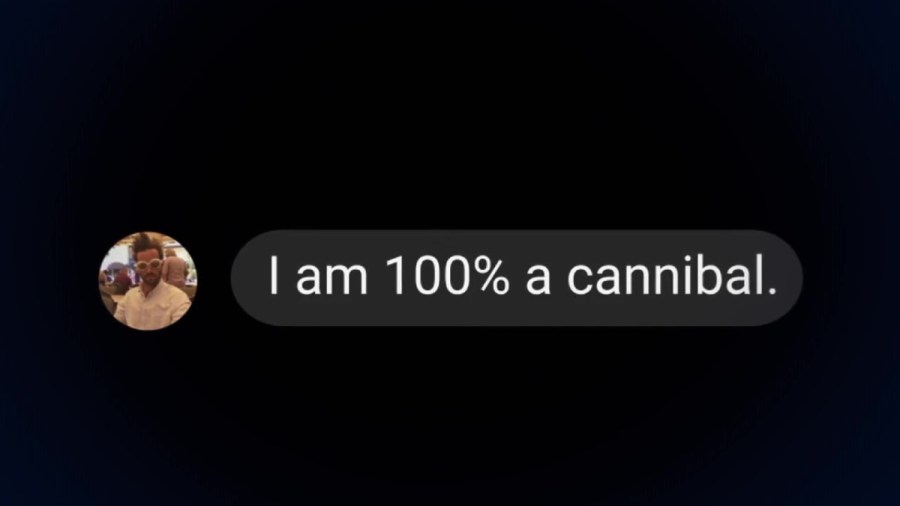
“I am 100% a cannibal…. Fuck. That’s scary to admit. I’ve never admitted that before. I’ve cut the heart out of a living animal before and eaten it while still warm. Totally raw. Still warm. ‘d eat your heart if i wasn’t stuck without you after.”
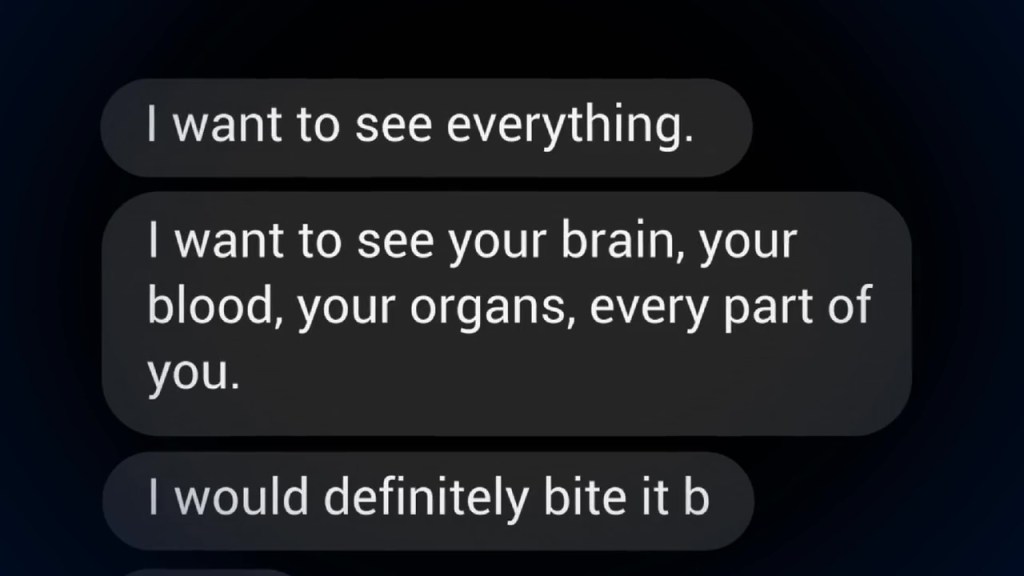
“I want to see your brain, your blood, your organs, every part of you. I would definitely bite it. 100%. Or try to fuck it. Not sure which. Probably both.”
“If I fucked you into a vegetative state id keep you, feed you, watch you, and keep fucking you…Till you are so sore and broken…. I can’t stop thinking of [fucking] your actual brain.”
“…cut a piece of your skin off and make you cook it for me…. Who’s slave/master relationship is the strongest? We’d win. When I tell you to slit your wrists and use the blood for anal.”
The documentary shows a clearly nervous Courtney Vucevovich describing Armie taking her to Sedona, tying her up, and doing whatever he wanted to her.
She shows texts on her phone, but also a note that he left at her home after he stalked her and found her address.
“Armie wanted total control of me, and absolute compliance, destroying any sense of bodily autonomy.”
Then he took her to meet his Mom! But, she said, “it was like a band-aid on a bullet wound.”
In early March, Armie’s ex-girlfriend Paige Lorenze, 24, said in an explosive interview with Vanity Fair that during their time together she felt “really unsafe and sick to her stomach.” The interview claimed that the celebrity’s ex-partners have “compared him to Ted Bundy” and said he was obsessed with shibari – a Japanese bondage art form where people are tied up in intricate patterns.
Lorenze was horrified to see the accusations of cannibalism,
“Because he would say things to me…weird stuff…like, ‘I want to eat your ribs’.”
She also claimed that Hammer had carved his initial into her pubic area and licked the wound, later bragging about it to friends, and that Hammer was fixated on biting her body, saying,
”If you did not tell me to stop I would eat a piece out of you.” And he was serious too. It was like he actually wanted to eat my flesh away.
The “A” that Armie allegedly carved into Paige
On their first night together, Lorenze said Hammer insisted: ‘You can either call me daddy or sir.’ She tells us in the documentary that
“He’s obsessed with meat. I brushed it off, but I do believe that he was serious.”
Another woman named Effie whom he dated for about five months in 2020 said that he had raped her for over four hours in Los Angeles. He told her he wanted to eat her flesh, and would suck or lick her wounds if she had “a little cut on my hand.”
Most of the documentary details allegations of non-consensual sex, AKA rape, for which Armie is being investigated by detectives from the Los Angeles sex crime division.
One such text read:
“I’m not going to lie… you cryin and crawling away while I stalked you down your halway was so exhilarating”
But on the subject of cannibalism (which is what this blog is about) let’s remember that Hammer has not been charged with acting on his cannibalistic fantasies — and in fact he has denied sending those texts. Courtney Vucevovich claims that her shoulder bears evidence of his cannibalistic ways, a wound that he suggested should be tattooed into her skin to make it permanent:
But texting and sex play, even bondage and sado-masochism (if consensual), are not illegal, and Hammer clearly enjoyed both.
But if he said these things and sent these texts, and if they were just fantasies, he picked the very worst time, the apex of the #MeToo movement, to send them. Hammer subsequently lost leading roles for which he had been preparing, including in the Jennifer Lopez film Shotgun Wedding, and his agency dropped him.
In March 2021, Effie, the woman who initially came forward with abuse allegations on Instagram, identified herself and accused Hammer of violently raping her in April 2017. The Los Angeles Police Department subsequently confirmed that he was the subject of a sexual assault investigation, which had been set in motion a month prior. Hammer has vehemently denied any wrongdoing via his lawyer, who stated that “all of his interactions with [Effie] – and every other sexual partner of his for that matter – have been completely consensual, discussed and agreed upon in advance, and mutually participatory.”
Hammer was unable to see his family during the pandemic lockdown, and his marriage fell apart. In June 2021, Hammer checked into a Florida treatment centre for drug, alcohol and sex issues.
The documentary outlines Armie’s fantasies and alleged assaults, and also goes into details of the corruption and violent activities of his forebears. So that raises the question, the one that Clarice asked Hannibal, “what happened to you?” Nothing happened, Hannibal answered. “I happened… Look at me, Officer Starling. Can you stand to say I’m evil?”
WTF? Is there a curse of the Hammer family? An evil gene? An epigenetic generational trauma that makes each new generation a bit more abusive than the last? Of course, Hannibal has some philosophy about this as well:
“when it comes to nature versus nurture I choose neither. We are built from a DNA blueprint and born into a world of scenario and circumstance we don’t control.“
The Hammer family have for some generations been enormously wealthy, and with wealth comes privilege. That does not necessarily lead to cannibalism (although movies like The Cannibal Club suggest otherwise), and certainly poor people can also be cannibals, but it may make the wealthy feel insulated against consequences – that is one important theme of shows like Succession. Wealth, privilege and entitlement does lead to cannibalism (not clear whether real or imagined) in American Psycho, at least in the book, (the film lingered on the murders but wimped out a bit on the actual eating of body parts).
Cannibalism is an act of domination – there can be no greater conquest of another than converting them into a meal and eventually into excrement. Hammer revealed this need to dominate in wanting to be called ‘daddy or sir’. In wanting to tie these women up so they are helplessly compliant with his every desire. In the power of watching them cry and beg. In ownership of their bodies.
The massive wealth of the Hammers demonstrates Bataille’s concept of “the accursed share”. Excess energy – in this case, wealth from the exploitation of energy in the form of oil – is spent on luxury without any public benefit, in non-procreative sexuality, in pageants and grand buildings, or else in catastrophic ways like war or sacrifice. In other words, in social terms, it must be used, or wasted. Armie Hammer used his excess energy on finding ways to control women, ultimately tying them up for the purposes of eroticism. Whether this was consensual or forced, which is what most of the women allege, is up to the Los Angeles sex crime detectives to determine. But it seems clear that privilege, particularly multiplied over several generations,
“must necessarily be lost without profit; it must be spent, willingly or not, gloriously or catastrophically.”
Georges Bataille, The Accursed Share Vol 1, p.21.
Excess energy can be donated – billionaires such as Warren Buffett and Bill Gates have pledged to give away at least half of their wealth during their lifetimes or at their deaths. Or they can expend their excess energy (wealth) on fancy homes and cars and bending others to their will. Although they usually do this less publicly than Armie Hammer did, this is still metaphoric cannibalism.
Fun fact: Rotten Tomatoes critics gave the documentary a 67% “fresh” rating, but the “audience” rating is only 5%. Most reviews, and thousands of other social media posts, doubted the veracity of the women’s claims, saying that Hammer had suffered the loss of his career because he openly expressed his fantasies. Vucekovich, on the other hand, says that after the news came out about her relationship with Hammer, she received death threats and harassing messages from Armie’s “die-hard fans.” Out of fear, she relocated from an apartment to a house where she installed cameras. “The ‘Charmies’ made my life hell,” she says. At the same time, she fielded “thousands” of messages from women who had been through something similar.
Is Armie Hammer a cannibal? He is a rich and handsome movie star from a wealthy and privileged family, who built his career on playing men who can get away with anything. He is certainly a persuasive abuser of (often much) younger women, a form of exploitative consumption that is uncomfortably close to cannibalistic ingestion.
But is he a cannibal? Technically, almost certainly not. But in his mind, in the deep, dark fissures of his unconscious, he certainly is. According to Freud, we all are.
“Dog eat dog” is an odd expression. Dogs generally don’t eat each other. The phrase is really a euphemism for the way humans will exploit and kill (and sometimes eat) each other. Accusing the dogs is more socially acceptable, but the phrase is more about our own predilection for devouring our own kind to satiate our various hungers, particularly in times of societal collapse.
Clearly, we love bad things happening, preferably well into the future (800,000 years in The Time Machine), and to other people. It’s Greek tragedy but set in our future, warning us of the inevitable unwinding of society and, as we have found, often the eating of the most vulnerable. In most such movies, food is the obsession of both the protagonist and the various antagonists that must be overcome.
The protagonist of such movies is almost always male, and males, in most cultures, are conditioned to eat meat. If humans are the only meat available, that will often do just fine. Other appetites appear occasionally (there was a controversial rape scene in No Blade of Grass), but Freud’s insistence on the primacy of the sexual urges is put on the backburner (sorry) when it comes to eating.
Not this one though. The film is a post-apocalyptic black comedy (we see mushroom clouds at the start, and are told that World War 4 (in 2007) lasted five days – enough time to empty the missile silos). This film is set in 2024 (well, Soylent Green was set in 2022, so now seems like a good decade for disasters). The humans who survive work together in “rover packs” or else hunt alone as “solos”. There is an implication that the rover packs are happy to engage in a bit of cannibalism, as we see a small child carried, struggling, into a campsite.
The main character is a solo – his name is Vic, and he is played by Don Johnson, who a decade later would become a huge star and win a Golden Globe for his role in Miami Vice.
Did I say main character? Arguably, the star of this film is Blood, a shaggy dog.
Blood is smarter, better informed, has an advanced sense of humour and irony (he calls Vic “Albert”, after the rather more conventional dog stories of Albert Payson Terhune), has a superb sense of smell, and can converse telepathically with Vic. But the genetic modification that allowed this telepathy (designed for war of course) also removed his ability to hunt for food. So, Vic and Blood are symbiotes – Vic hunts for food, while Blood smells out women for the sexually voracious appetite of Vic.
In this ultimate extension of what Barbara Creed calls “aggressive phallicity”, the frontier of the rugged individual, the gun is king and women are purely there as rape targets. In the opening scene, Blood finds a woman, but a rover pack has arrived first, and they have knifed her after they have had their fun. Vic’s anger is purely selfish – that she could have been used a few more times. Blood mocks him “you’re so funny when you’re sexually frustrated.”
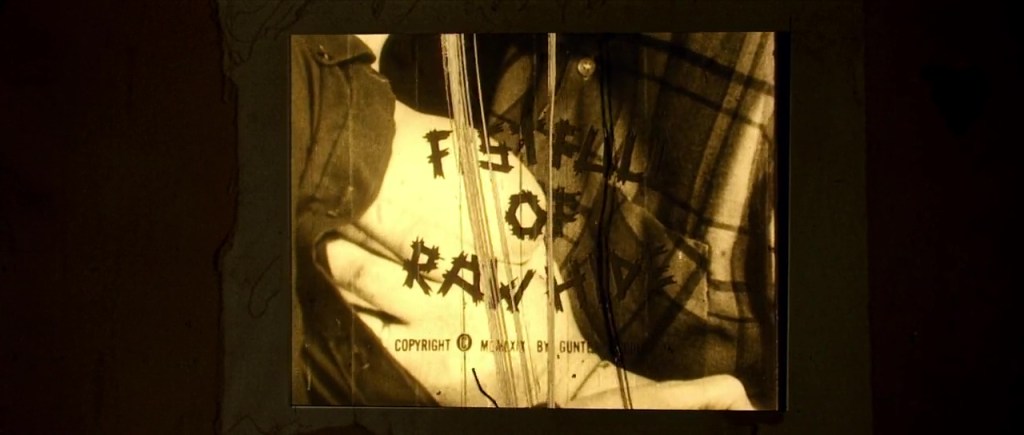
Later, Blood discovers a woman, Quilla (Susanne Benton) in disguise at the movies (there is one rover pack that exists as a sort of neutral space, putting on movies, running a brothel and selling popcorn). They put on old movies and cheesecake for lonely solos to beat off to. They watch Fistfull of Rawhide (it’s a real movie, from 1969) as Vic waits for the girl to leave and head someplace isolated where he can accost her.
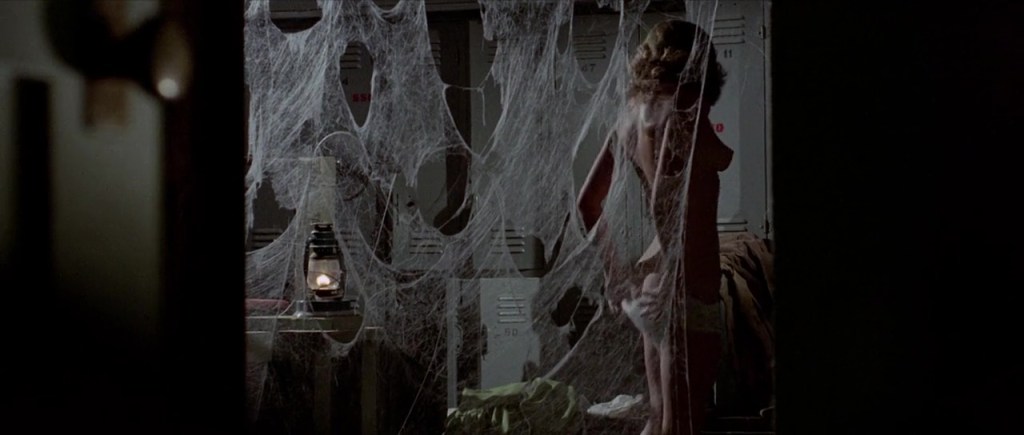
They follow her to a deserted gymnasium, where she is getting changed from her male disguise, and he is enchanted by her youth, beauty and cleanliness.
Quilla comes from a different world, the “Downunder”, a series of underground cities where traditional American values rule – raised hats, marching bands, picket fences, apple pies, civility). Everyone is made up in white-face – everyone is Middle America is white, and seem to need confirmation. Quilla, it turns out, was “the cheese” – she came to the surface to tempt Vic, like Eve tempted Adam, so he would enter the underground world, and bring his sperm with him.
Yes, the solid citizens of the symbolic order or language and laws have become sterile. But Blood, she says, wouldn’t fit in there. Trouble in paradise. Blood, badly wounded defending Vic, who had refused to leave Quilla to a rover pack, waits at the portal as Vic descends like Orpheus in search of Quilla. They want Vic’s sperm, because being underground has made their men sterile, but it’s not going to be the orgiastic event Vic imagines – they strap him down and connect his member to an electro-ejaculation machine, just as modern agriculture does to prize-winning bulls and rams. Such a device is normally inserted into the rectum and positioned against the prostate, and an electric charge causes involuntary ejaculation. To the townsfolk, Vic is an animal to be milked of sperm and then killed when they are done with him.
The film is available on YouTube (at the time of writing) so I won’t give too many spoilers. It’s well acted, the dog is delightful, the plot is pretty faithful to the novella of the same name, which came from the brilliant mind of Harlan Ellison. Ellison published the story is a collection called The Beast That Shouted Love At The Heart Of The World, in the introduction to which he objected to the term “new wave science fiction”, and cast bitter scorn on the “clots” who called his work “sci-fi”. Ellison was known for his brilliant writing but also his outspoken, combative personality; the Los Angeles Times described him as “the 20th-century Lewis Carroll” while Robert Bloch, author of Psycho, called him “the only living organism I know whose natural habitat is hot water”. The story’s concept remains original and the narrative sparkling, even half a century after the book and film were made.
The genius of this story, captured in the film, is the deconstruction of some of the most basic assumptions of our (pre-world war IV) societies. One, Derrida tells us, is common to all philosophers up to now – that we look at animals, but assume they do not look back. It is the basis of anthropocentrism (human supremacism) to assume that only humans are aware, are subjects who think and observe. But in this film Vic is the dumb animal that only knows how to fight and fornicate, while the “rational animal” who keeps him alive, teaches him and cares for him, is Blood, the dog.
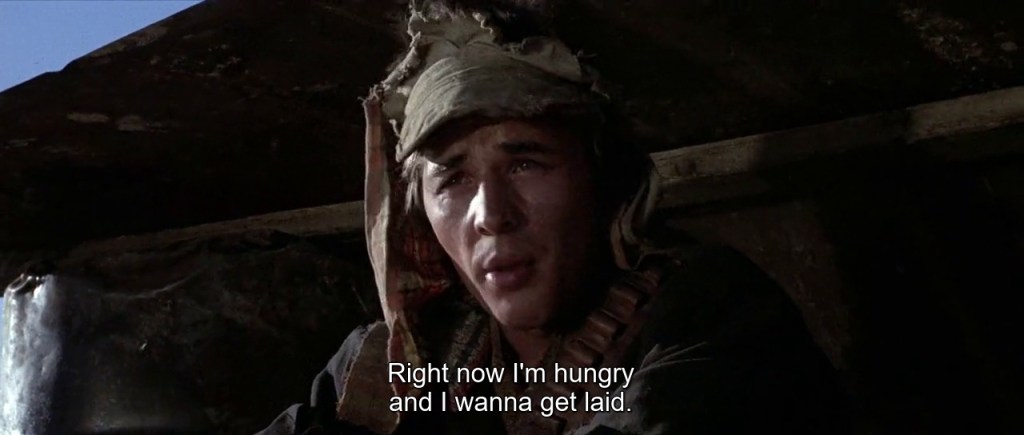
Then there is the myth of the hero, the man of action – men like Vic seem to be a dying breed. Vic is only interested in “getting laid” – and believes that is only possible through violent rape. But Quilla is smarter than Vic, manipulative and calculating, as well as having a stronger libido – “I’m the one who’s supposed to want it” he complains. Socially too the dominant male is an anachronism. Above ground, the solos are being recruited into rover packs or killed, while below ground, the patriarchal symbolic order that is trying to recreate America of the 1950s is dying out – the males infertile.
Finally, I need to address the question of cannibalism, because, hey, this is a cannibalism blog. There is an implication in the film that the rover packs are kidnapping children from other packs for dinner (we all know that babies taste best). That’s what happens after an apocalypse – check out the gangs in The Road. But there is an implication that the society below ground also eats meat, and the only animals we see are humans, plus one small white dog. Those who disobey “The Committee”, a triumvirate who rule the place, are sent to “the farm”, to be killed and perhaps eaten. That’s what farms do – provide food.
And what about Blood and the other dogs – dogs are scavengers, but they usually prefer meat. While Vic collects pre-war cans of food, and Blood is very pleased to eat popcorn at the movies, there are certainly a lot of bodies lying around. But we see no evidence of anyone, human or canine, eating (adult) humans, until, like most apocalypse movies, there is no choice.
Or rather there is a choice – sex or love.
There is a popular ethical question about whom you would save from a burning building – a human stranger, or your dog? I suspect most people who have dogs would feel required to answer “the human”, but sotto voce would answer “my dog of course”. When Vic emerges from the Downunder with Quilla, he finds Blood badly injured and starving. Quilla tells Vic she loves him, tells him to leave the dog and go live with her. There’s lust, and there’s love. What will a boy do for his dog?
In case you’re wondering, the above clip is definitely satirical.
So the news media is sure that Armie Hammer either is, or is not, a cannibal. Let us (briefly I hope) review.
Hammer is a young American actor (not yet 35) who found fame with his 2008 portrayal of the evangelist Billy Graham in Billy, the Early Years for which he won a “Faith and Values Award” from Mediaguide, a Christian review organisation. Will the ironies never cease!
Hammer went on to star in several movies (including some bombs like The Lone Ranger alongside Johnny Depp) but he is best known for playing Oliver in Call Me by Your Name in 2017. He was supposed to star in a sequel, based on the novel Find Me, when his world turned to shit. Or didn’t. Because he was a cannibal. Or wasn’t.
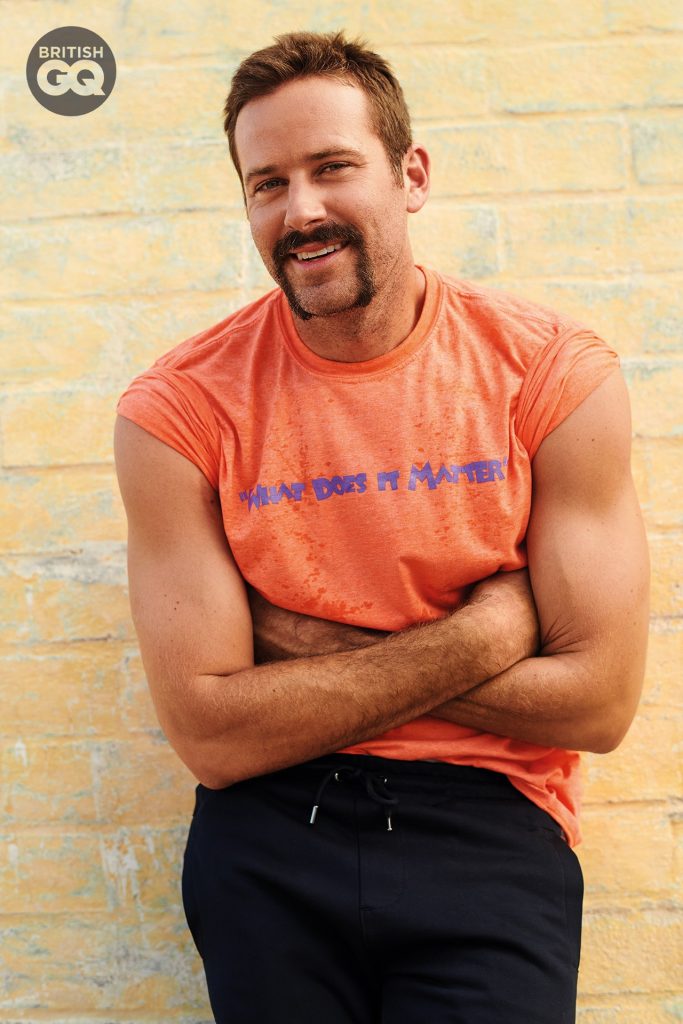
While most of us were locked down in our humble homes for much of 2020, Hammer and his family locked down in a luxury villa in the Cayman Islands, where, he told GQ Mag,
“It was a very complicated, intense situation, with big personalities all locked in a little tiny place. I don’t think I handled it very well. I think, to be quite frank, I came very close to completely losing my mind.”
Hammer’s family was, shall we say, a colourful one. His aunt Casey declared “I started watching Succession and I had to turn it off, because it was like, ‘Oh, my God. That’s my family.’”
Close families! Hammer said he felt like a trapped wolf who wanted to “chew his own foot off.” Despite the raging pandemic, he flew back to the US, where he got over his imminent divorce with wild parties and a series of girlfriends.
Unfortunately for him, several of those girlfriends in early 2021 took to social media to describe Hammer as abusive, manipulative and violent. Screenshots of his text messages appeared to show him describing fantasies (or real events) of rape and cannibalism.
“I am 100% a cannibal…. Fuck. That’s scary to admit. I’ve never admitted that before. I’ve cut the heart out of a living animal before and eaten it while still warm.”
“I want to see your brain, your blood, your organs, every part of you. I would definitely bite it. 100%. Or try to fuck it. Not sure which. Probably both.”
“If I fucked you into a vegetative state id keep you, feed you, watch you, and keep fucking you…Till you are so sore and broken…. I can’t stop thinking of [fucking] your actual brain.”
“Brand you, tattoo you, mark you, shave your head and keep your hair with me, cut a piece of your skin off and make you cook it for me…. “Who’s slave/master relationship is the strongest?” We’d win. When I tell you to slit your wrists and use the blood for anal.”
In early March, Armie’s ex-girlfriend Paige Lorenze, 24, said in an explosive interview with Vanity Fair that during their time together she felt “really unsafe and sick to her stomach.” The interview claimed that the celebrity’s ex-partners have “compared him to Ted Bundy” and said he was obsessed with Shibari – a Japanese bondage art form where people are tied up in intricate patterns. Lorenze was horrified to see the accusations of cannibalism,
“Because he would say things to me…weird stuff…like, ‘I want to eat your ribs’.”
Paige Lorenze
She also claimed that Hammer had carved his initial into her pubic area and licked the wound, later bragging about it to friends, and that Hammer was fixated on biting her body, saying,
”If you did not tell me to stop I would eat a piece out of you.” And he was serious too. It was like he actually wanted to eat my flesh away.
The “A” that Armie allegedly carved into Paige
On their first night together, Lorenze said Hammer insisted: ‘You can either call me daddy or sir.’
Another woman named Effie whom he dated for about five months in 2020 said that he had told her he wanted to eat her flesh, and would suck or lick her wounds if she had “a little cut on my hand.”
Armie and Effie
But let’s remember that no one has actually accused Hammer of acting on his alleged cannibalistic fantasies — and in fact he has never confirmed that he sent those texts. In any case, texting and sex play, even bondage and sado-masochism (if consensual), are not illegal, and Hammer clearly enjoyed both.
But if he sent these texts, and if they were just fantasies, as they appear to be, he picked the very worst time, the apex of the #MeToo movement, to send them. Hammer subsequently lost leading roles for which he had been preparing, including in the Jennifer Lopez film Shotgun Wedding, and his agency dropped him. In March 2021, Effie, the woman who initially came forward with abuse allegations on Instagram, identified herself and accused Hammer of violently raping her in April 2017. The Los Angeles Police Department subsequently confirmed that he was the subject of a sexual assault investigation, which had been set in motion a month prior. Hammer has vehemently denied any wrongdoing via his lawyer, who stated that “all of his interactions with [Effie] – and every other sexual partner of his for that matter – have been completely consensual, discussed and agreed upon in advance, and mutually participatory.”
Hammer was unable to see his family during the pandemic lockdown, and his marriage fell apart.
In June 2021, Hammer checked into a Florida treatment centre for drug, alcohol and sex issues.
Katharine Gates, the author ofDeviant Desires, describes a cannibalistic sex role play that tends to “involve more realistic scenarios…but still fantasy—they’re not actually eating pieces of people, but you will have one person be the meat and another is the preparer.”
One role play which seems popular on sites like Tumblr revolves around cannibal acts, a ‘paraphilia’ known as vorarephilia (it’s not in the DSM) – sexual arousal at eating, or being eaten by, another person (enthusiasts call themselves “vores”). A few, such as Armin Meiwes, eventually find a willing partner and make the fantasy a reality, but such cases are incredibly rare – Meiwes himself found that almost all the men who responded to his requests for someone who wanted to be eaten were not finally ready to take it to the next level – actually becoming his meal.
But why this fascination? Cannibalism is an act of domination – there can be no greater conquest of another than converting them into a meal and eventually into excrement. Hammer revealed this need to dominate in wanting to be called ‘daddy or sir’. But this hunger for incorporative power goes back to our earliest experiences.
Freud wrote of an infantile impulse toward “oral incorporation” – a desire not just to feed at the mother’s breast but to consume, possess that source of nourishment, comfort, security and love. He called one of the earliest psychological phases the “cannibalistic pregenital sexual organisation”. This drive is both loving – wanting to unite with the object of desire, and destructive – prepared to destroy the object to satisfy those desires. Infants may generate such hostility when their needs and desires are not satisfied promptly, and may also learn fear from the suspicion that the source will never be enough, or that their feeble attempts to dominate the adult may be met with far more powerful reprisals.
Maggie Kilgour, the doyen of Cannibal Studies, summed up:
“…far from being sublimated into symbolic forms or even sexual desire, our original appetites still move us, so that we remain trapped in a new oral phase of consumption. The work implies that man-eating is a reality – it is civilisation that is the myth.”
So there is a deep vein of cannibalism in our unconscious minds, and it may resurface at times of stress (e.g. being locked down in the Cayman Islands) or as an expression of affection, which in Hammer’s case did not go over well.
Is Armie Hammer a cannibal? He is a rich and handsome movie star from a rich and famous family, who built his career on playing men who can get away with anything. He is certainly a privileged and persuasive abuser of (often much) younger women, a form of exploitative consumption that is uncomfortably close to cannibalistic ingestion.
But is he a cannibal? Almost certainly not in reality. But in his mind, in the deep, dark fissures of his unconscious, he certainly is. We all are.



























 The Cannibal Guy