“Do you want to eat me?” TEAR ME APART (Alex Lightman, 2015)

This is an English film, unlike most of the reviews in this blog, which overwhelmingly come from the USA or, if we are thinking real video nasties, Italy. It falls into the delightful genre of dystopian cannibalism films, in which some disaster, often unnamed, has stripped the thin veneer of civilisation from the survivors and left them with one option to survive – human flesh. There are lots of films in the survivor genre – The Time Machine is a classic, set thousands of years in the future, but most are set in the very near future or even an alternative present – think Soylent Green (set in 2022), 28 Days Later or Delicatessen.

The closest to Tear Me Apart, though, is the chilling 2009 film version of Cormac McCarthy’s The Road, in which an unnamed man and boy travel through a world stripped of all animals and plants except for a few humans, most of whom have become cannibals to survive. Will they maintain their anthropocentric belief in the sacredness of human life and flesh?

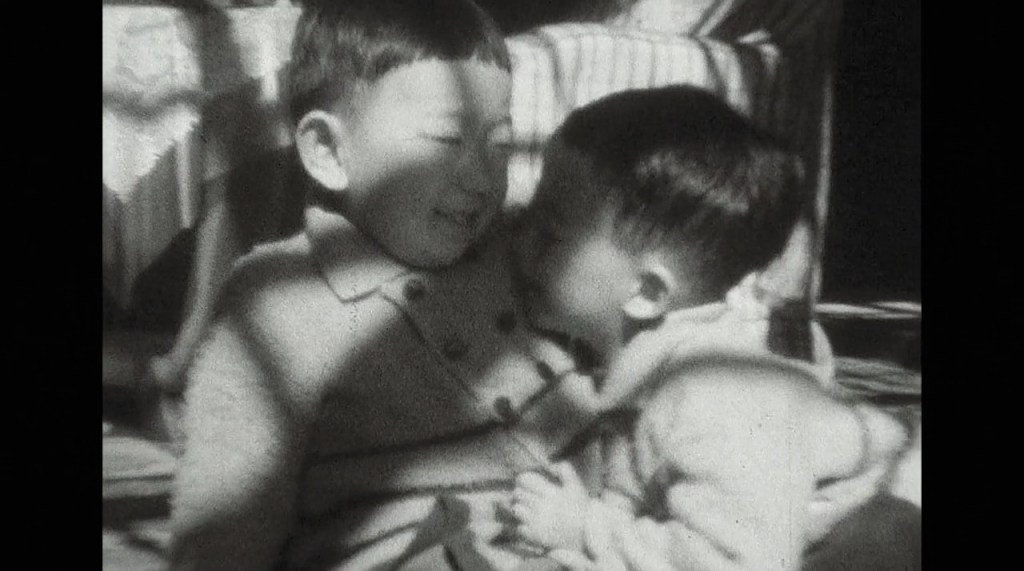
In this film, it’s two brothers, also unnamed, the younger as naïve and clueless as the little boy in The Road. But it’s also a coming-of-age story, because one of the proposed victims who they intend to feast on is a young woman (like us, the older brother says, only different), perhaps the last surviving woman on earth, and do they really want to eat her?

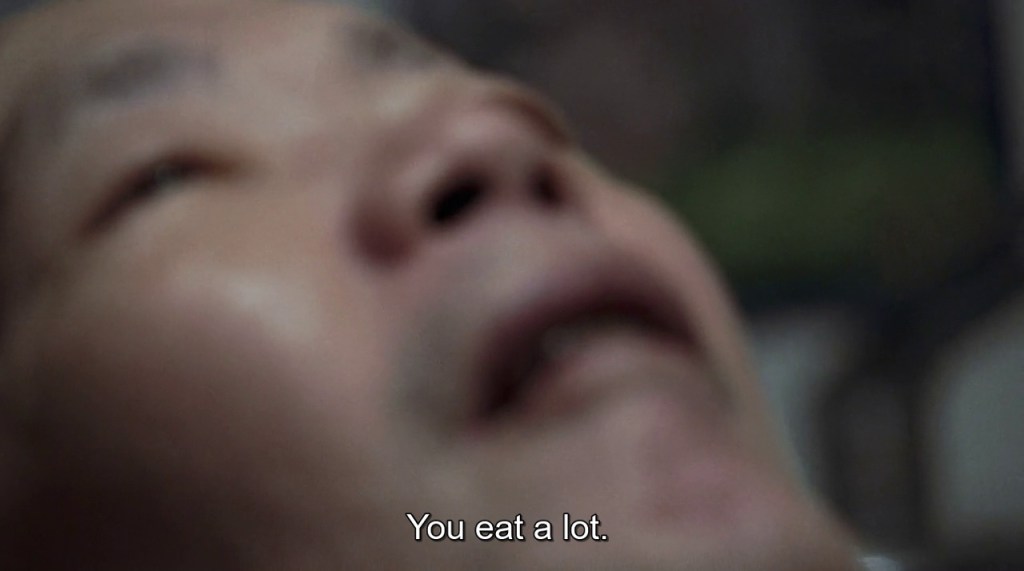
Making the story line more intriguing is the constant presence of the ocean, the source of all life, the original mother, where the young men wait for a father who has long since vanished. The ocean supplies them limited amounts of fish to eat, but in the opening scene, the younger brother smothers a man, cuts and eats pieces of his flesh, only to be admonished by his brother –

“What would father say? I won’t warn you again – NEVER PEOPLE!”

Father may have left them on the beach to “wait it out” but now he is a mythical figure, whose rules override the primal instincts of the unschooled younger boy, who constantly gets in trouble for snacking on his victim. Because, you know, “he’s a man!” But his instinct is to fight, to kill, to eat. He is the carnivorous male, unpolished and uninhibited by social morality; as his brother says “he doesn’t know the difference between eating a fish and eating a human”. This is precisely the point – the young man has no social conditioning – he is not the vicious cannibal of so many horror films; he eats humans because he is hungry, just as a hungry dog or any other animal might.

He is a savage, simian Adam in Eden, following the rules without understanding them, rules passed down by a “father” he scarcely remembers, who may offer a second coming in some indefinable future, and who has bequeathed dietary restrictions that must be followed even though they make little sense.

But then he comes across the young woman, no physical threat but much smarter than both of the brothers. In a piece of blindingly obvious symbolism, she hands the young man an apple, with a smile. She’s also looking for her dad. Aren’t we all?

The boy goes back to his brother, who takes the apple and tells him “don’t eat this stuff, OK? It’ll make you ill”. We’re still referencing Genesis, a fierce version, in which they may eat of anything in the garden (even people) but not of the tree of the knowledge of good and evil. Her fruit actually does make him ill, because he hasn’t eaten fruit for many years. This is the carnivorous virility that Derrida said was the basis of subjectivity, but without community it turns back onto his own gut.

The brothers don’t have names because names don’t mean anything, at least until the “old world” comes back. But she has a name, Molly, and she declares the younger man will be called Joe. Like Adam, she gives names to all the animals. She makes them bury the stiff they have been eating, because, she says, the world can’t survive like this.

She even rigs up a cross for his grave, just as Joe chews the last of the dead man’s flesh.

But she has introduced them to temptation. Also to vegetarianism:

“You can’t eat meat forever. The people you eat – they have people who loved them.”

A beautifully simple argument against eating meat.

She takes his hand and puts it on her breast. Bright eyed and vulnerable, she asks “do you want to eat me?” The double entendre here is far from Biblical.

There may perhaps not be any other women left – Molly says that there was a collective in “the town” – the symbolic civilisation for which both fathers have disappeared while searching for it – but now that is just a myth as well. Well, there is one other woman but she has become “an animal” – growling and threatening. A Lilith reference perhaps? But there are certainly other men, not just the lone men who Joe ambushes and eats, but a more vicious group, with guns. Like The Road, but with a touch of On the Beach.

The trio learn fear, hunger, desire. Molly tells Joe “You don’t have to follow the rules any more.” There’s a menage-a-trois which of course leads to jealousy and we get a serve of Cain and Abel as the brothers brawl. Molly’s father makes a brief appearance, as (spoiler alert) a good meal for their return to the beach, their wild Eden. So now we’re dipping into the New Testament, eating the blood and body of their saviour. Yes, the last humans, like the first humans, have truly eaten from the tree of the knowledge of good and evil.

The film is only 82 minutes, but a lot of reviewers thought that it drags. I didn’t see it that way – the story is low key but the acting is great and the characterisation is quirky and interesting in its peeling back of the sociality we take for granted. I think a lot of critics watched the film expecting a cannibal gore-fest, and that it is not. It’s a low budget film, yet the cinematography is splendid with the scenery of the sea (it’s filmed in Cornwall) quite beautiful. It may be hard to find, but at the time of writing the full film is available on YouTube, with Arabic subtitles. Since the Scottish accents are often impenetrable, that will prove quite useful – if you speak Arabic.

The Beautiful Child: GRETEL AND HANSEL (Osgood Perkins, 2020)

Here’s Horror royalty: the classic “fairy tale” from the Brothers Grimm, directed by Oz Perkins, son of the one and only Anthony Perkins (Norman Bates in Hitchcock’s Psycho). Oz is also an actor – he appeared as the young Norman Bates in Psycho II.

The witch, bloodthirsty and cannibalistic, is in many ways the exemplar of what Barbara Creed calls the monstrous feminine – and her victims are most often children, which is perhaps why children love stories about witches. Some adults dismiss children’s stories as light-weight and simplistic. But kids interpret the world through what they see, and the stories they hear. What kids understand is their own powerlessness – parents and teachers have control, and their youthful grasp of justice can make that seem uncomfortable or even intolerable. The bildungsroman, the coming of age story, is all about finding their power, in the face of seemingly inexorable oppression.

The usual title of this story is Hansel and Gretel, the 1812 Grimm story of the children who are abandoned in the forest and find an enchanted gingerbread house in which lives a cannibalistic witch, who fattens up Hansel for her dinner. The story is an important one in cannibal studies – even Hannibal quotes it from time to time.

Perkins has reversed the title deliberately to make Gretel (Sophia Lillis from It) the older child, a girl on the verge of womanhood, who must unwillingly take responsibility for her little brother Hansel (Sam Leakey in his debut role), see through the deceptions and dangers of adults, and make decisions that can be literally life and death, eater or eaten.

There is a fairy story within the story:

“The beautiful child in her little pink cap”

It tells of a little girl who was saved from a fatal illness by an enchantress, but,

The child was granted second sight. People came to hear what she saw, but did not like what she said.

She had other powers, and could deliver death to anyone, even her own father.

Fairy stories have morals, and the moral of the beautiful child, and Hansel and Gretel, is

Their mother sends them out to offer her services to a local lecher, who takes advantage of a “terrible pestilence” (sounds familiar) and asks the young girl

Furious at Gretel’s refusal to sell her body to help with the finances, the mother chases them out with an axe. Their world, once they are alone, is one of mystery, magic and terror. “The big, bad world opened up in front of us…”

There is plenty of intertextual humour to keep us guessing: Gretel is a sassy American, with strong views on the feudal class system.

Hansel is a cheeky English boy. They are rescued from an ogre by a huntsman, who tells them if they stray from their path, they can expect to meet wolves (a reference to a different cannibal story called “Little Red Riding Hood”.)

They find the gingerbread house, well, at least it smells of cake (and bacon, says Hansel). Inside is a table groaning with an abundance of food. Gifts!

There’s a witch of course, named Holda (Alice Krige, the Borg Queen from Star Trek: First Contact) who is charming and courteous. She plucks a strand of Hansel’s hair as he hoes into dinner, and sniffs it, like Hannibal sniffing Will Graham.

What can I say – she loves children!

But there is much more to this story (both stories). Is she “the beautiful child” of the internal fairy story? She senses that Gretel has second sight and magical powers. In the house, in dreams or in second sight, Gretel sees several children who appear out of mirrors.

Gretel is vegetarian, while Hansel likes his meat; at eight he is already imbued with carnivorous virility.

The witch, Holda, is not impressed, pointing out that “the ox, with his vegetable-made bones pulls the cart and the fat man who sits atop it!” She is dismissive of his carnivorous virility. Of course, we have to wonder, as Gretel does, where all the meat and milk come from, considering there are no animals on the property. Except for human ones. Are our cities any different?

Gretel starts to appreciate her powers, and the abundance they will offer her.

“This is your power. To see what is hidden and to take it. A small mind believes only what it can see. But we know that we are our fate’s own masters, don’t we?”

Hansel remembers Gretel’s lessons:

“You always say there aren’t any gifts in this world. That nothing is given without something taken away.”

To take on her full powers, Gretel realises that she’ll need to lose Hansel, who is a burden. The witch warns that

“he’ll soon come to fear you, as all men should if they’re smart.”

We only see Holda eat once, and when she finishes, she pulls out of her mouth a long lock of blonde hair with a little bow on the end. Well, we guessed what she ate, especially if we ever quaked through a Brothers Grimm story or two.

The witch in psychoanalytic terms is the oral-sadistic mother, and Creed calls her an “implacable enemy of the symbolic order”, because she demonstrates its frailty. Holda at first seems maternal – she offers the lost children food and shelter, but the fact that they can so quickly end up in that food warns us of that frailty – she reminds us that we, too, are edible animals.

Gretel soon finds out where all the food is coming from.

The witch tells her the real story of the beautiful child and of her power. Gretel has achoice – will she take the gift and pay the price? But hey, no spoilers. See the movie to find out what Gretel decides. It’s worth it.

The reviewer on RogerEbert.com called it:

“the kind of low-key gem that horror fans are always looking for but so rarely find—one that is smartly conceived, visually stylish and genuinely creepy at times.”

The story is even more relevant than it was when the movie was made (or the Grimms wrote it down) because of the weird conspiracy theories circulating in the USA about politicians torturing and killing children in the basements of pizza restaurants in order to harness their youthful energies. But leaving aside the magic and the second sight, isn’t the cynical utilisation of the young the basis of advertising, wars and agriculture? Society is built on the exploitation and sometimes the slaughter and consumption of the innocent.

The cinematography of this film is splendid, and the actors are sensational, particularly G&H despite, or perhaps because of, their youth. Overall, a very satisfying reboot of a classic cannibalism story.

Beautiful inside: THE UNDERTAKER AND HIS PALS (T.L.P. Swicegood, 1966)

We all are vaguely aware of our eventual deaths, and some people even take it seriously enough to arrange insurance of other funding for their funerals. But how many of us consider the environmental cost of burying or burning human bodies? Over one million people die every week – all those bodies going into landfill under granite slabs, or adding to the carbon emissions from the crematoria.

Why not eat them? Many of these corpses are still covered in healthy flesh. If human meat is comparable to that of the other animals we choose to eat (apparently somewhere between veal and pork), why not let those who are hungry eat some of the corpses, preferably the ones that are minimally diseased? Is death by starvation less abject than cannibalism?

Most readers will find this unthinkable and assert that they would die rather than eat human flesh, as many did after hearing about the Uruguayan rugby team survivors from Uruguayan Air Force Flight 571 which crashed in the Andes, leaving nothing to eat but frozen passengers. But like most taboos, this one is based on cultural conditioning rather than any rational thought. After all, why is it fine to source meat from a pig who has lived a short and brutal life and suffered an agonising death, but repulsive to eat a person who no longer is capable of pleasure or pain?

That is the question this short film seems to ask.

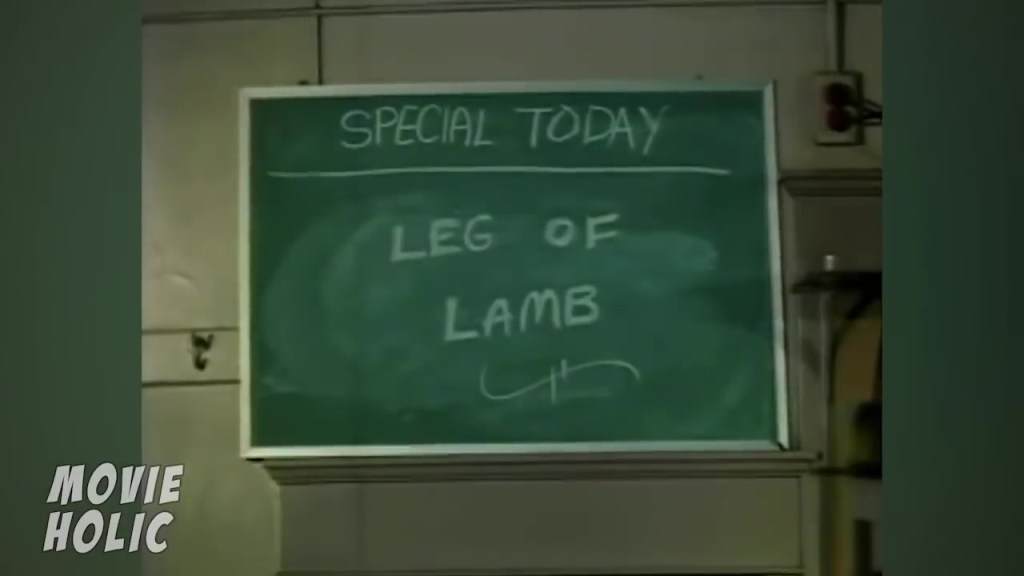
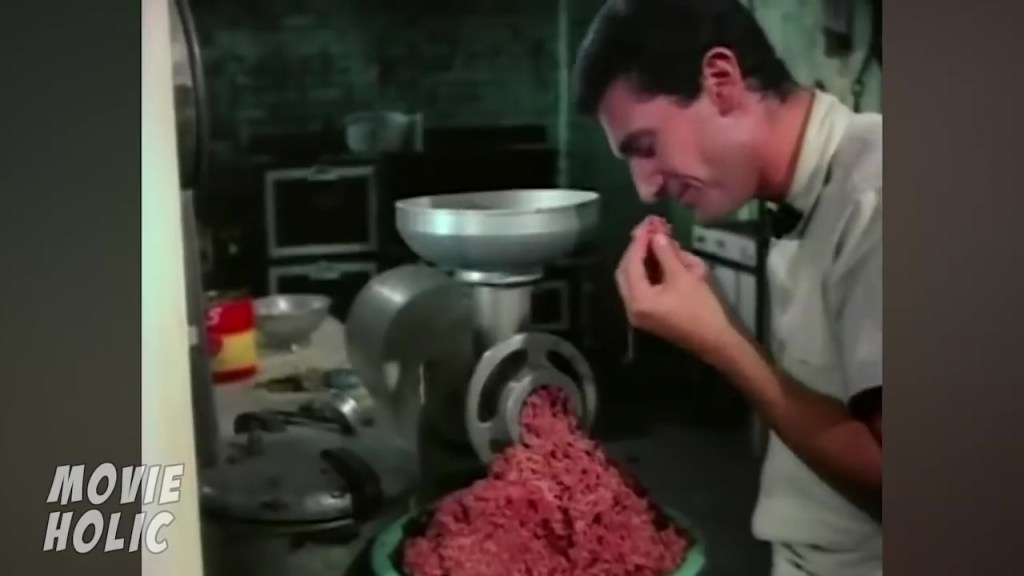
An undertaker and his two friends, who are restaurant owners, go out on the town killing people; the restaurant owners cook parts of the bodies, and the undertaker earns his keep burying the left-overs. The rather thickly ladled humour involves the victims having the names given to the flesh of animals: their first victim is Sally Lamb, and the specialty at their restaurant that day is lamb leg.

Their racket goes awry when a detective, who has a secretary conveniently named Miss Poultry, suspect that something isn’t quite kosher.

Lévi-Strauss wrote in “A Lesson in Wisdom from Mad Cows”

“The link between a meat-based diet and cannibalism (a notion broadened to take on a certain universality) thus has very deep roots in thought…. Indeed, a day may come when the idea that human beings in the past raised and slaughtered living things for food and complacently displayed slabs of their flesh in shop windows will inspire the same revulsion as what travellers in the sixteenth and seventeenth centuries felt about the cannibal meals of American, Oceanian, or African indigenous peoples.”

Acceptance of violent slaughter, particularly the impersonal conveyer-belt killing of modern agriculture, legitimises cannibalism by removing all subjectivity from the victim. The voracious and ever growing desire for meat, together with the fading of the clarity of the naïve dualism of human and animal, leads inexorably to acceptance of the consumption of human meat; thus the boom in cannibal films and television shows. The harvesting methods in this film are repulsive because they are similar to what we pay slaughterhouse workers to do, hidden from our sight.

There’s even pre-slaughter stunning.

With its bad jokes, wooden acting and terrible script, this movie scored a paltry 43% on Rotten Tomatoes, with the only official critic writing “You’ve never heard of this movie. Keep it that way.”

But the full movie (all 63 minutes of it) is on Youtube should you wish to ignore that advice. With its mid-century kitsch and ironic soundtrack, it’s so bad it’s good, if you know what I mean.

Patriarchal civilisation, Derrida tells us, depends on what he calls “carnivorous virility”:

The subject does not want just to master and possess nature actively. In our cultures, he accepts sacrifice and eats flesh. ‘Eating Well’ or the Calculation of the Subject.

The movie makes this abundantly clear in the macho strutting of the killers and the detective on their trail, but also in its choice of female victims. Men are killed violently, but as a struggle for power. Women must be subjugated, terrorised then cut up and eaten. One of the killers uses a chain to destroy a statue of the goddess Aphrodite (the Venus de Milo) in a spa, then kills a woman with the same chain. Yes, it’s symbolism, double-strength. The women are nature, presented in this film as seductive and edible. The men are the symbolic order, at war with nature and controlling her through their carnivorous sacrifice.

As one of the killers asks, his hands full of intestines:

“Isn’t she beautiful inside?”