Hollywood, they say, will eat you alive, and stories of those who try to succeed (and fail) are often accompanied by metaphors of incorporation. If the city doesn’t eat you, the people will, or if they don’t, you’ll end up eating yourself. That’s what happens to Novella (Meggie Maddock) in this powerful movie about a struggling actress who just can’t get a break.
No wonder she develops some nervous habits. The one revealed here is auto-cannibalism. She eats herself.
Novella has lost control of her life. She hasn’t won a part for three years. Intending to be a famous movie star, she instead finds herself auditioning for porn movies to make ends meet, and then comes home to find an eviction notice on her door. Her life is out of control, and she tries to reclaim it by auto-cannibalism—eating her own flesh. An illness, an addiction or an obsession is often described as “all-consuming” and Eat takes this to its logical conclusion.
The film explores the desperation and isolation that is so much a part of modern cultures, and the extreme reactions to the feeling of failure. What better way to explore the darkness inside us than by opening ourselves up and looking, feeling and tasting it? As the movie reminds us,
This is the debut feature from Jimmy Weber (Incubator), and he demonstrates a rare talent for showing people things that really turn their stomachs. This is what horror should do—while so many entries that once caused people to pass out or vomit in cinemas have become stale and unremarkable, people eating their own flesh still manages to make the gorge rise for many otherwise hardened reviewers of gore movies. It takes us into our deepest fears and lets them out to play in the (relatively) safe world of the cinema.
Andy Warhol made an underground movie called Eat in 1964 which featured a man eating a mushroom for 45 minutes. This Eat is a lot more graphic, although the French got here first with Marina de Van’s extraordinary 2002 film In My Skin. In that film, the protagonist feels the same appetite for her own flesh as so many people seem to feel when they smell bacon.
If you’re not a gore hound, you probably may not like this film. The special effects are excruciatingly realistic, and reinforced by sound effects of biting and slurping that offer a sometimes exaggerated realism. But although it is a disturbing film, it is beautifully made and makes its point about the human tendency to consume, like the ouroboros, the very environment that sustains us.
Cannibalism, or any kind of carnivory, is ultimately about control. Humans seek to control nature by killing and eating others—usually other species, but sometimes, even often, other humans. There is no greater control of another than taking their life and converting their flesh into food and then into faeces. But doing it to ourselves? That is more an enquiry, an interrogation of the usually unquestioned human/animal binary. Reddit reports that a guy who calls himself Incrediblyshinyshart served his friends tacos, made from his own amputated leg, just to see what we taste like. A Spanish influencer ate part of her knee which had been removed surgically, just because it was her property and she could (much the same argument people use to justify eating other animals). Then there’s the vegan who made meringues out of his own blood, because, he said, it is,
“the only ethical source of animal products, because I can give my consent to myself in a way that a sheep can’t.”
Once we look inside our skin, that large sensory organ which identifies us to the world and ourselves, we find meat, the same red meat we find inside other mammals. The only difference between the cannibal who consumes his own flesh and the gourmand who eats that of a pig, cow or sheep is one of consent.
So, the buzz for this movie is ‘Ted Lasso goes cannibal’. By that, they don’t imply we will need to sit through any football matches, but that there is going to be a lot of American “can-do” ardour, conflicting with British reticence and melancholy. Also some dark humour, and a whole lot of gore, which some may find objectionable. Consider yourselves warned.
Feed Me is directed by Adam Leader and Richard Oakes (Hosts). XYZ Films released the horror-comedy on October 27 2022 on digital and on demand platforms. Feed Me follows Jed (Christopher Mulvin) whose life is shattered when his wife Olivia (Samantha Loxley) suddenly dies, leaving him feeling guilty. The blurb says:
“Spiralling into an abyss of depression, he finds himself in a bar with a deranged cannibal, Lionel Flack (Neal Ward) who convinces him he can redeem himself through the glorious act of allowing himself to be slowly eaten to death.”
Suicide, usually unassisted, is sadly common in modern society, and besides making the relatives wretched, it is also an enormous inconvenience to the police, medics and trauma-cleaners who have to deal with it. So why not benefit someone – the local cannibal who promises a painless death that will not require housekeeping, because he will eat the resulting mess? Jed moves in with Lionel, whose tiny house is filthy and full of body parts. But Jed is ready, eager to die, and Lionel is tremblingly eager to eat him.
Cannibalism, particularly vorarephilia (the erotic desire to consume or be consumed by another) can be seen as a type of eating disorder, particularly in cases where there are other foods readily available, but if that is the case, so can any form of carnivory. The film starts and finishes with such reflections – Jed’s wife is a beautiful young woman who is convinced she is fat and ugly, and eventually dies from the effects of bulimia – she starves herself and vomits out whatever nourishment she does eat, until her body closes down.
As Jed explains it, her mental illness meant that she “was eaten from the inside out.” Lionel’s solution is that, if Jed is determined to kill himself, he should do it from the outside in.
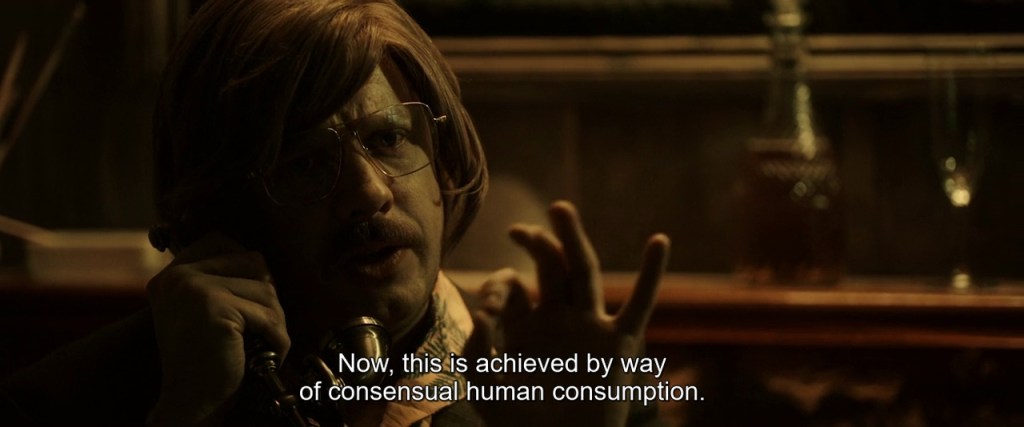
Lionel quotes some fake anthropology – a tribe called the Yiurkun who, he says, live in perpetual happiness,
His offer (and there is a written contract involved) is to eat Jed, quickly and painlessly, so he can join his beloved. Why not, Jed thinks, since Olivia has effectively (in his dreams) eaten his heart?
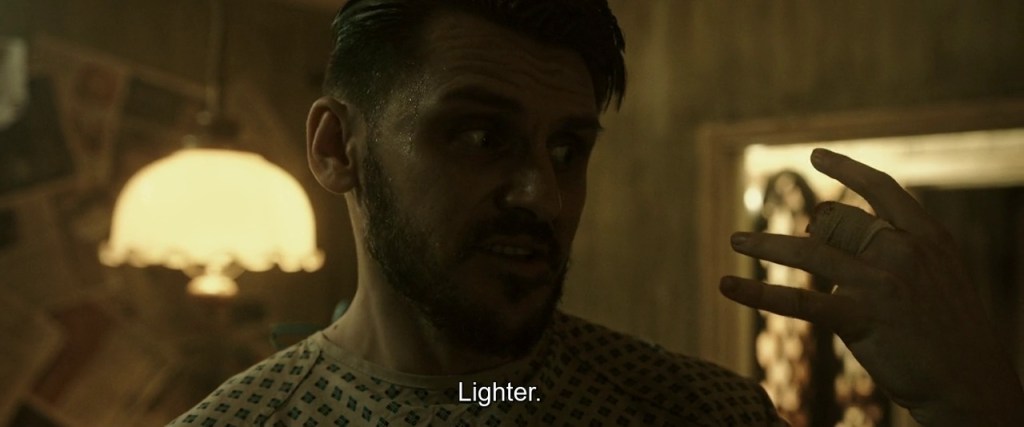
Lionel starts small – local anaesthetic, one finger chopped off with secateurs and carefully cooked, the wound cauterised with a hot clothes iron. “How do you feel?” Lionel asks.
But of course you can’t eat a whole person one finger at a time, and it’s not long before Lionel is removing limbs, but now without anaesthetic, because he gets mad at Jed.
Lionel says he has heard that
“some cultures believe that torturing the animal alive improves the taste and quality of the meat.”
This is not an invention of the director – it’s well known that dogs and cats and other animals are often beaten or burnt or at least made to watch the death of other animals, to make the terror and agony generate adrenalin, which is supposed to add flavour. Astonishingly, Hillary Clinton was accused of doing the same to small children. Other politicians have had the same accusations hurled at them. While these are almost certainly nonsense, it is true that almost every one of the seventy billion land animals humans eat each year will go through extremely painful ordeals, and all of the trillions of sea creatures. Jed is just one more animal in agony.
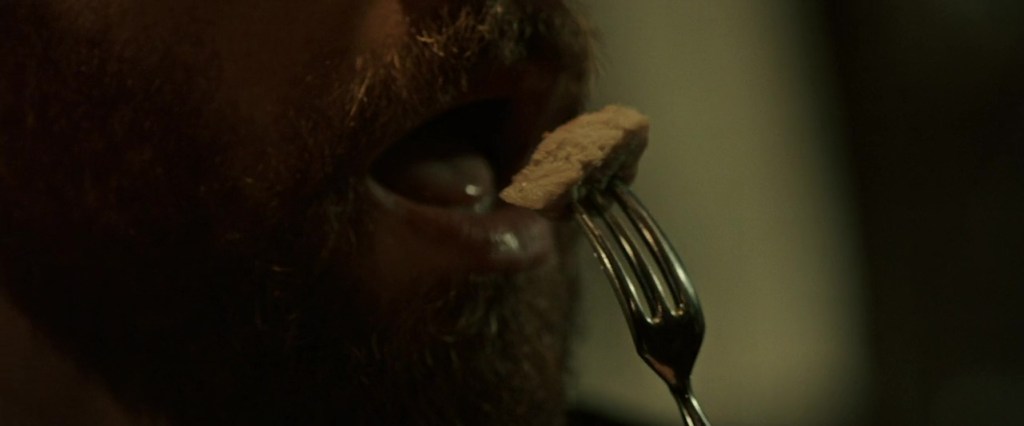
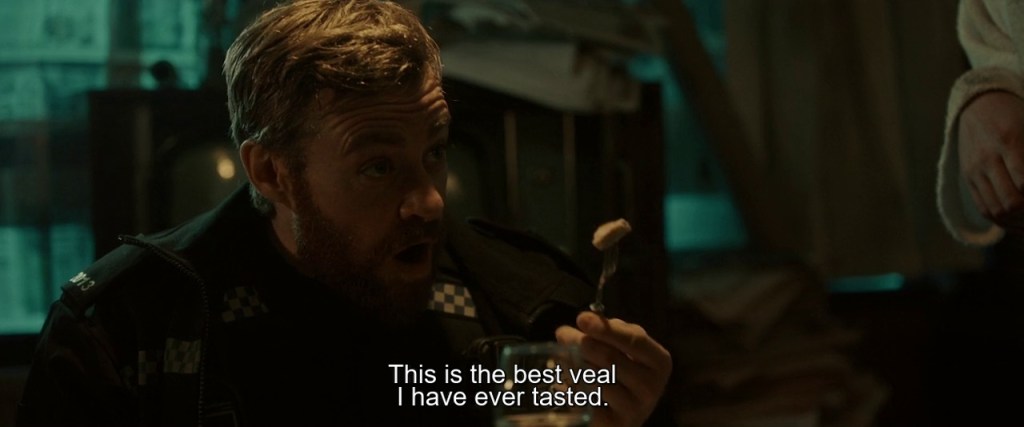
When the neighbour calls police about all the screaming going on, Lionel invites them in and feeds them some of his “mild veal”.
The enjoyment of food depends largely on what we believe about it. The actor playing the cop is probably in fact eating a piece of veal. His character, the cop, believes he is indeed eating veal. The audience, us, suspends disbelief so we can imagine that he is actually eating part of Jed’s leg. This turns the meal from gourmet to horror – a simple change of species, entirely within our imagination. The title, FEED ME, challenges the assumption that food will be prepared and served with our preconceptions catered for – it will be tasty and uncontroversial. In this society, eating a baby cow who wanted to live is praiseworthy; eating a man who wants to die is horrific.
The title reminded me of a foodie show called “Somebody Feed Phil” which sees writer and producer Phil Rosenthal (Everybody Loves Raymond) travelling around the world eating huge dishes of food while adding no weight to his irritatingly slim frame. In a recent episode, Phil lands in Madrid and apologises to a suckling (newborn) pig –
“you’re very cute, but I’m going to eat you.”
Most cannibals, like carnivores everywhere, do not usually have their victim’s permission, and usually do not apologise either, although they may feel some cognitive dissonance, knowing that their meal required the suffering and slaughter of the animal whose flesh is involved. Phil didn’t kill the new-born baby pig, but did apologise for eating him. Jeffrey Dahmer killed seventeen men and boys and also didn’t apologise (until it was far too late). The closest parallel to the plot of this film (the trailer above states it was “inspired by true events”) is the true case of Armin Meiwes, who advertised for a man who wished to be killed and eaten, had dinner and sex with the only genuine respondent, and then killed and ate him. He felt there was no apology needed, since Jorgen Brandes had wanted, indeed demanded, to be eaten. So it is with Lionel, who offers to kill and eat Jed, and then slowly and gradually makes good on his promise.
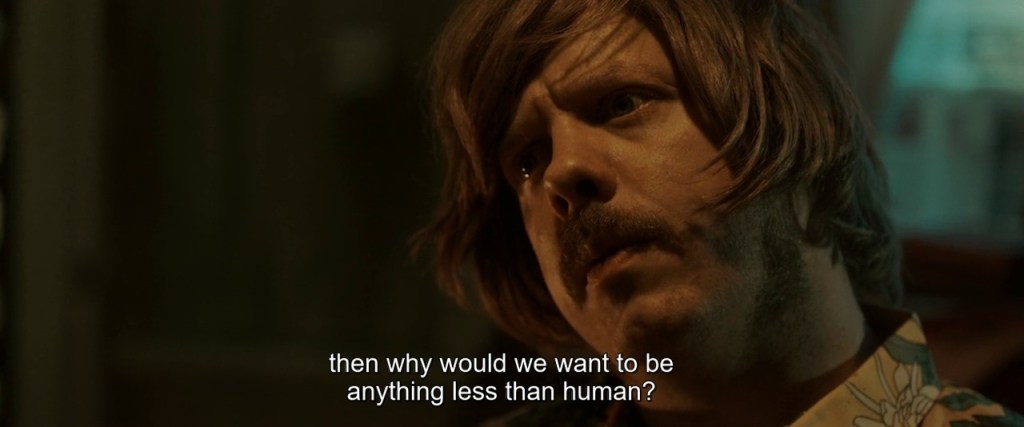
Neal Ward plays Lionel as an over the top, twitchy, verbose American con-man, the kind of man we like to think serial killers and cannibals look like, because that would make them easy to spot. Yet the essence of the real modern cannibal is his (or sometimes her) completely normal and unremarkable appearance – they walk among their peers, unknown and unidentified until their arrest (if they are ever found). Neighbours, for example, praised Meiwes as a nice young man who would mow the lawn for them. Issei Sagawa was so small and apparently innocuous that the young woman he killed and ate had been happy to come to his apartment to read poetry together.
The tagline for this movie is
“You are who you eat…”
The concept is interesting – if you are who/what you eat, do you want to eat pigs or chickens or sheep, all of whom are used, quite unjustly, as common insults (for gluttons, cowards or mindless followers). If you are what you eat, Lionel tells us, you should eat humans.
The anthropologist Marvin Harris wrote in his book Good to Eat: Riddles of Food and Culture that, while humans are clearly not obligate carnivores, “our species-given physiology and digestive processes predispose us to learn to prefer animal foods”. This presents a problem for him, since “strictly speaking, human flesh itself contains the highest-quality protein that one can eat”. Lionel’s pathology stems from his calculating, impeccable logic.
The film is a fascinating study of love, loss, despair, friendship, loneliness and appetite. The gore is perhaps a bit over the top, but no longer unusual in modern films. The acting, despite what other reviewers have said, is great and the story compelling. Neal Ward plays Lionel as both a monster and a clown, a hard role to portray, but he is, in the end, seeking the same as all of us – self-acceptance, love, a validation of his humanity, and a good meal.








 The Cannibal Guy