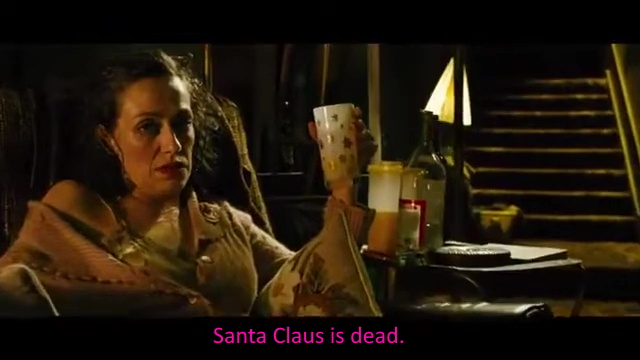
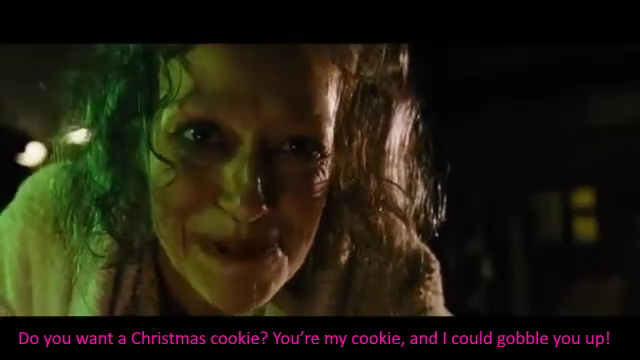
Christmas warning: “THE 12 DEATHS OF CHRISTMAS (MOTHER KRAMPUS)” James Klass, 2017

According to Hollywood, everyone eagerly anticipates Christmas, which must be why incidents of violence flare over the festive season (largely driven by festive booze). Christmas goes for twelve days (they tell me), which covers the New Year mayhem as well, and reportedly involves a lot of odd things like lords leaping and pear trees containing medium sized birds. This film covers the twelve days, but omits French hens and turtle doves, etc, in favour of lots of blood and gore. I reviewed it many years ago, but it seems worth a fresh “bah humbug” as I recover over my keyboard after battling greedy retailers and stressed-out motorists.

“Bah! Humbug” always seems like a pretty good response to the confected cheer of Christmas, particularly to those who do not, for various reasons, celebrate the event or conform to the voracious consumerism that accompanies it. If you are one of the many who is over the Christmas rom-coms and tear-jerkers, you may have already come across the German Christmas demon Krampus, who appeared in a 2015 movie from Michael Dougherty, involving goblins, killer toys, malicious snowmen and a jack-in-the-box that eats a child whole, although he has been punishing naughty children for a lot longer than that, and may date back to pre-Christian folklore.

The cannibal movie reviewed today, though, was originally called The 12 Deaths of Christmas and features a different villain – a Christmas witch named Frau Perchta who, according to legend, steals a child each of the twelve nights of Christmas. The witch is also said to slit open the bellies of disobedient children (not dissimilar to the threats of cannibalism which Andre Chikatilo’s mother used to keep him in line). The film’s name was changed to Mother Krampus for the American audience, many of whom have adopted Krampus as a sort of anti-Santa. Frau Perchta does not have nearly the same fan base.

The Santa Claus dogma is of course about socialisation – children are told that a large stranger will sneak into their houses at night and reward them if they are “good”. What if they are not good? Who will sneak into their house then, and what mayhem will ensue? Krampus was one answer, Frau Perchta another. Then there was Santa’s assistant, Père Fouettard who, in a nod to the suffering energy corporations, hands out lumps of coal to children who are not deemed to have been good, and sometimes whips them too (the name Père Fouettard translates as “Father Whipper”. Following Santa around appears to have been his punishment for engaging in a bit of entrepreneurial cannibalism, in which he and his wife drugged three children, slit their throats, cut them into pieces, and stewed them in a barrel, to be sold as Christmas hams. The taste, allegedly, is almost identical.

But today’s film is not just about stealing the bad children, and perhaps killing them, no, it’s all about the punishment of the wicked being extended to the following generations – a popular theme in the Bible (check out Deuteronomy 5:9 for some unfair shit). Perchta is coming for the children of adults who wronged her.

One of these children, and the protagonist of what passes for the plot, is Amy (Faye Goodwin – Mandy the Doll). Her mum is Vanessa (Claire-Maria Fox of Suicide Club and Bride of Scarecrow), and Vanessa’s dad – Amy’s grandpa – (Tony Manders, from The Young Cannibals) lives outside the village, near a scary forest in Belgrave (the UK one), and asks her to drive him, on Christmas no less (no Ubers I guess) to the Church, where a bunch of locals want to discuss the focal local issue – lots of village children are disappearing. There we finally get to hear the legend of the witch:

“Frau Perchta was a witch, who over Christmas stole the souls of children.”

Dad admits to Vanessa that the peaceful villagers got together to kill an old woman 25 years ago. We, the audience, know the background, through an endless voiceover accompanied by cards at the start of the movie. 12 kids disappeared over the 12 days of Christmas in 1921, and none were found, except for one girl whose mind was gone, and she could only scream “the witch! The witch!”

Then, in 1992, five more kids disappeared, their bodies were found in the forest, and the villagers believed, for reasons far from clear, that a nice old lady was the killer and was in fact Frau Perchta the witch, so they stabbed her and lynched her, as you do if the local constable is on leave, in a backward and primitive town like Belgrave, which apparently hosts the National Space Centre!

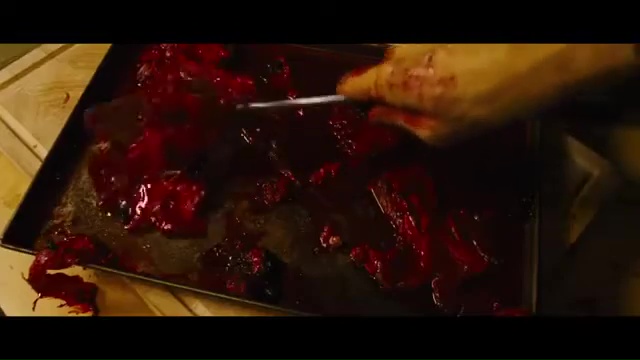
But as she died, she shouted a curse – that Frau Perchta would be back to wreak revenge on them, and their children. So, maybe she wasn’t quite so nice. Yeah, that’s about it for plot – we see (several times) the stringing up of the old woman, we see the risen witch. The witch kills lots of people in creative ways, including one who is cut up and made into a Christmas light show, another whose flesh is pressed into a cookie cutter to make Christmas peoplebread men, while another is trussed up like a Christmas turkey with an apple in her mouth and carved up, and her flesh cooked and fed to her boyfriend, who is Amy’s absentee dad. Then dad has his heart pulled out and eaten (not uncommon in cannibal stories – think Fresh Meat or even Hannibal).

The climax of a horror film (or any action movie) is usually the last ten minutes, in which the story is resolved and the bad guy defeated (until the sequel). This one goes on (and on and on) for about half an hour, presumably to ensure the film is considered a full-length feature, and it resolves nothing much, with a twist at the end that makes no sense at all. But lots of people get killed, and several have parts of them eaten, which is enough to get a mention in this blog, I guess. The plot is thin, the acting is often appalling, the continuity director in some parts seems to have been taken into the forest and eaten. But it’s presented as a low-budget slasher, and that’s what they are often like – they are not dramatic masterworks, but gruesome pantomimes. The idea of one child’s aunt walking him home through the dark forest at night when bodies are turning up everywhere is narratively absurd but, in a panto, we want to anticipate the villain, we want to guess what is going to happen, and yell at the actors to “look behind you!” And the gore, and the fright factors, are quite well done.

The moral of the story, if there is such a thing, is pronounced by a mysterious woman who turns out to be Amy’s grandma, not that it does her much good.

“Taking it into our own hands, playing God. That’s why all this is happening.”

Isn’t that exactly what humans do – play God? Nietzsche told us that God is dead, we killed him, so we have to become God. We play God in so many ways – the Christmas story in essence is about a Jewish family trying to escape one of the many psychopaths who have played God over the centuries. We play God when we nominate ourselves as above nature, more angel than animal, and proceed to destroy our own ecosystem. Who bears the suffering from such follies? The children. Like Frau Perchta, our vicious brutality usually comes back to haunt us, through the generations.

At the time of writing, the full movie (should you wish to bother) is available on YouTube.

BLACK CHRISTMAS (Glen Morgan, 2006)

Black Christmas is the middle film in what is sometimes called the “Black Christmas series” – three films that actually have very little to do with each other, except that they bear the same title, one made in 1974, one in 2006, and one in 2019. The original was made in 1974 and widely panned, but has since been revived as the proverbial “cult classic” and hailed as one of the earliest slasher movies – it was released on the same day as The Texas Chain Saw Massacre, and is considered an influence on the making of the Halloween series (crazy killer, young women, buckets of gore). The remake in 2019 presented a completely different story and character list.

I am reviewing the middle, 2006 movie not because it’s the best of them, but it is the only one featuring CANNIBALISM, which is what this blog is all about. Also because I needed something uplifting to review on Christmas Day, 2022.

The films all involve a group of co-eds (young female college students for those of you who don’t speak American) being slaughtered by a serial killer. The 1974 film was about to be released for television in 1978 but was withdrawn because serial killer Ted Bundy had just murdered two young co-eds sleeping in their sorority house on the campus of Florida State University in Tallahassee. Bundy had started his killing spree in 1974 before being captured in 1975, incarcerated and then escaping, and there is some speculation that the film was based around his brutal murders, and that he in turn, might have been motivated to escape and return to his pathological ways by the imminent TV release of the film. The film may also be partly based on the exploits of Ed Kemper, who killed his family and then a number of co-eds in 1972-73, although his M.O. was to offer them lifts as they hitchhiked which, as we all know (I hope), is a very bad choice of transportation.

But Bundy was not a cannibal to the best of our knowledge, and nor was cannibalism mentioned in the 1974 film. Ed Kemper did admit under truth serum to slicing flesh from the legs of his victims and eating it in a casserole, although he later changed his mind and denied it. So Kemper, who is still locked up the California Medical Facility in Vacaville, may well have been an inspiration for this 2006 version. It is a very loose reimagining of the 1974 film, with the added frisson of child abuse and a bit of paedophilia, as well as incest and cannibalism – the taboos that Freud described as “the two original prohibitions of mankind”. Director Glen Morgan, who wrote several episodes of X-Files and The Twilight Zone reboot, is not skimping on any taboos in this one.

It starts off with a murder of course, then moves swiftly to an asylum for the criminally insane (a nice nod to Hannibal’s residence through all of Red Dragon and most of Silence of the Lambs, and quite a bit of the third season of Hannibal too). Here we come across Santa Claus, as you’d expect in a movie called Black Christmas, and we get the back story on the dude who killed his family many years ago, and is, we expect, going to kill lots more people before this movie drags itself to a gruesome end.

The asylum caterer, a very careless man who lets the high security door get jammed open with a carton of milk, says they are giving him a special Christmas dinner.

“It tastes like chicken, because it’s chicken. It’s the closest we could get to how Mom used to taste.”

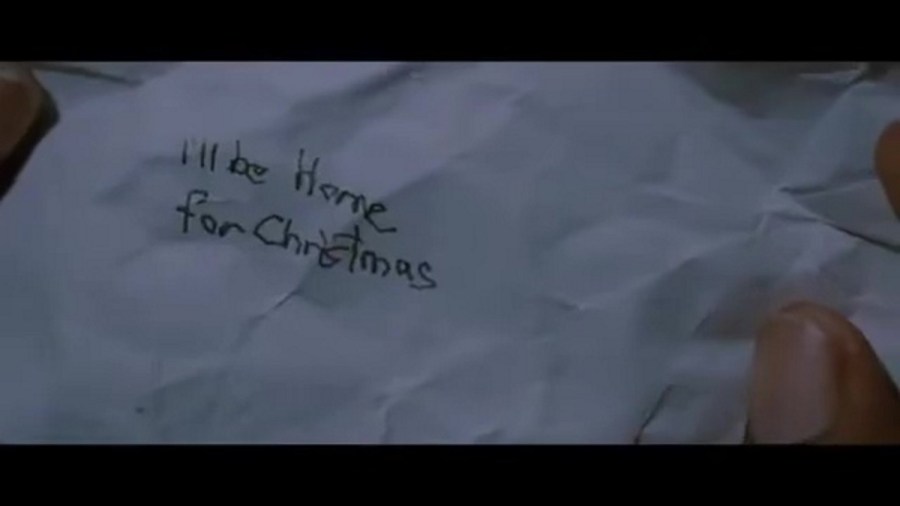
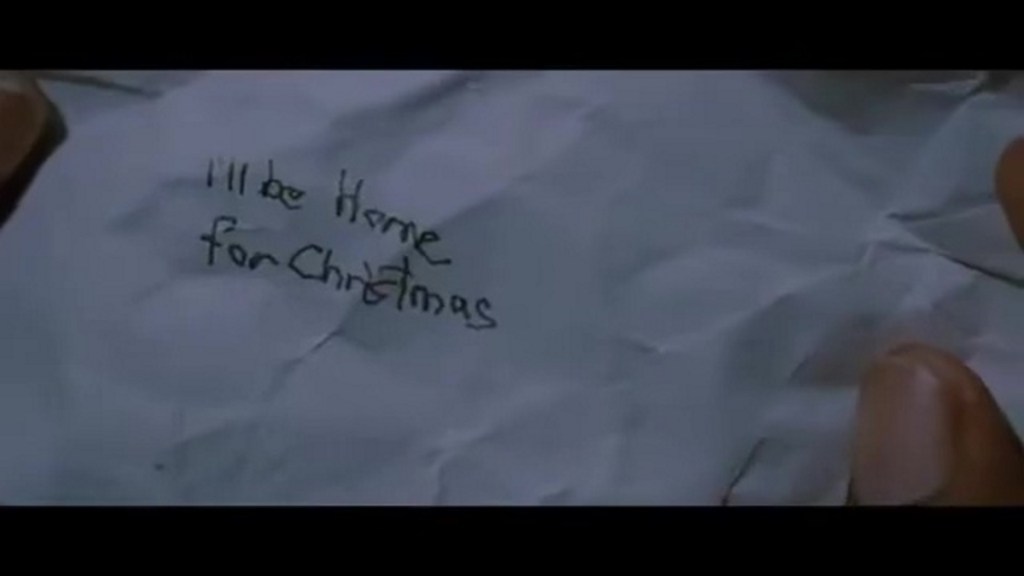
Billy Lenz is clinically insane, so that may explain why he thinks his Mom tasted like chicken (humans are red meat, and most cannibals claim the taste is like pork or veal). Anyway, he scoffs his chicken/Mom substitute through the feed-hole on his door, pockets the candy cane as a handy weapon, and we are told that he tries to escape each year; he wants to go home for Christmas. And the Delta Alpha Kappa co-eds, whose sorority house at Clement University in New Hampshire is Billy’s old house, are not going to enjoy his visit.

Well, we don’t have to sit through all the jump scares, because they are just slasher gore with no one getting eaten (as far as we can see). There are some amusing rants against Christmas though. The girls know the history of the house, and their “Secret Santa” ritual includes someone having to buy a present for Billy each year. It’s a pagan sacrifice to ward off evil spirits on Christmas.

“What Christmas shit in this room resembles anything Christian, huh? It’s all neo-pagan magic. Christmas tree – a magical rite ensuring the return of the crops. The mistletoe is nothing but a conception charm. Fifth century Christians jacked a Roman winter festival – twelve days in December where the nights were long – and the Earth was roamed by the demons of chaos.
And fucking Santa Claus? This fat voyeur that watches you all year long to make sure you live up to his standards of decency, before breaking into your house? And that is different from what Billy did – how?”

So what, we wonder, did Billy do?

“Billy Edward Lenz was born with a rare liver disease that gave him yellow skin. His parents hated each other. The mother hated Billy. He was not the child she always wanted.”

When Billy is five, on Christmas Eve, his mother tells him the Russians shot down Santa.

He then witnesses his mother’s new boyfriend kill Billy’s father, who is the only one who ever loved him. Realising he saw it all, they lock Billy in the basement (did they see Tommy?), where he spends his time rocking (as in, in a rocking chair, not engaging in popular music).

When he is twelve, his mother, frustrated by her new husband who falls asleep mid-coitus, climbs up into the basement, drops her gown and reinstates the original meaning of “rock and roll”, adding incest to insult and injury. Not to mention paedophilia. This show has it all!

So Billy has a sister and a daughter and Mom has a granddaughter and a daughter, and step-dad is still snoring through copulation, so everyone lives happily ever after.

Just kidding – nine years later, Billy has been driven insane by isolation, while his sister/daughter is doted on by his mother, who constantly tells her “you’re my family now”:

Billy escapes from the attic and disfigures his eight-year-old sister by gouging her eye out, and then eating it.

Much of the terminology of love and sex derives from cannibalism. When we tell a child “I could eat you up” or (at a different time and place presumably) perform oral sex on a lover, we use the metaphors of cannibalism.

Billy murders his mother and her sleepy lover, and the cops find him eating cookies made out of his mother’s flesh. There’s a cookie-cutter involved, and a hot oven. Not sure where he got the recipe.

The rest is pretty standard slasher stuff, with some inventive deaths, but at least Billy has qualified as a cannibal, and it’s about time, because we’re 36 minutes into the film by now. If you can’t be bothered watching the whole thing, there is a trailer at the top of this blog that covers a lot of the good bits, plus a whole lot of other stuff that never made it into the movie, apparently filmed at the insistence of the distributor, Dimension Films, run by Bob and Harvey Weinstein, who have, between them, much expertise on matters of horror, family discord, and the abuse of young women.

Look, if you want an entertaining slasher with lots of gore, you might like this. From the point of view of Cannibal Studies, the film is interesting mainly as an example of revenge cannibalism – eating the rude and abusive, like Son or Titus or even Sweeney Todd. Also, horror movies timed to coincide with Christmas are very often based on some aspect of revenge, such as The Twelve Deaths of Christmas, also featuring a cookie-cutter used to make people-bread men. It’s a fascinating genre, in which the audience is offered the opportunity to sympathise with, or at least understand, the act of cannibalism as homicide and anthropophagy justified by grievance.

Not so much with Billy. The sorority sisters are treated the way humans treat animals contingently labelled as “vermin” – they are swarming around his house, and he exterminates them but, significantly, he doesn’t eat them. His Mom and his sister/daughter, though, they’re family, and the only way to keep them with him, restrained, constrained and compliant, is to eat them. It’s Billy’s version of love.

Merry Christmas and Gory in Excelsis to all my readers!

The full movie is available (at the time of writing) on YouTube:

Christmas slasher: “THE 12 DEATHS OF CHRISTMAS (MOTHER KRAMPUS)” James Klass, 2017

In case you are breathing a sigh of relief that Christmas has been and gone, here’s the latest news – it goes for twelve days, and involves a lot of odd things like lords leaping and pear trees containing medium sized birds. This film covers the twelve days, but omits French hens and turtle doves, etc, in favour of lots of blood and gore.

“Bah! Humbug” always seems like a pretty good response to the confected cheer of Christmas, particularly to those who do not, for various reasons, celebrate the event or conform to the voracious consumerism that accompanies it. If you are one of the many who is over the Christmas rom-coms and tear-jerkers, you may have already come across the German Christmas demon Krampus, who appeared in a 2015 movie from Michael Dougherty, involving goblins, killer toys, malicious snowmen and a jack-in-the-box that eats a child whole, although he has been punishing naughty children for a lot longer than that, and may date back to pre-Christian folklore.

The cannibal movie reviewed today, though, was originally called The 12 Deaths of Christmas and features a different villain – a Christmas witch named Frau Perchta who, according to legend, steals a child each of the twelve nights of Christmas. The witch is also said to slit open the bellies of disobedient children (not dissimilar to the threats of cannibalism which Andre Chikatilo’s mother used to keep him in line). The film’s name was changed to Mother Krampus for the American audience, many of whom have adopted Krampus as a sort of anti-Santa. Frau Perchta does not have nearly the same fan base.

The Santa Claus dogma is of course about socialisation – children are told that a large stranger will sneak into their houses at night and reward them if they are “good”. What if they are not good? Who will sneak into their house then, and what mayhem will ensue? Krampus was one answer, Frau Perchta another. Then there was Santa’s assistant, Père Fouettard who, like the Australian Prime Minister, hands out lumps of coal to children who are not deemed to have been good, and sometimes whips them too (the name Père Fouettard translates as “Father Whipper”. Following Santa around appears to have been his punishment for engaging in a bit of entrepreneurial cannibalism, in which he and his wife drugged three children, slit their throats, cut them into pieces, and stewed them in a barrel, to be sold as Christmas hams. The taste, allegedly, is almost identical.

But today’s film is not just about stealing the bad children, and perhaps killing them, no, it’s all about the punishment of the wicked being extended to the following generations – a popular theme in the Bible (check out Deuteronomy 5:9 for some unfair shit). Perchta is coming for the children of adults who wronged her.

One of these children, and the protagonist of what passes for the plot, is Amy (Faye Goodwin – Mandy the Doll). Her mum is Vanessa (Claire-Maria Fox of Suicide Club and Bride of Scarecrow), and Vanessa’s dad – Amy’s grandpa – (Tony Manders, from The Young Cannibals) lives outside the village, near a scary forest in Belgrave (the UK one), and asks her to drive him, on Christmas no less (no Ubers I guess) to the Church, where a bunch of locals want to discuss the focal local issue – lots of village children are disappearing. There we finally get to hear the legend of the witch:

“Frau Perchta was a witch, who over Christmas stole the souls of children.”

Dad admits to Vanessa that the peaceful villagers got together to kill an old woman 25 years ago (in 1992). We, the audience, know the background, through an endless voiceover accompanied by cards at the start of the movie. 12 kids disappeared over the 12 days of Christmas in 1921, and none were found, except for one girl whose mind was gone, and she could only scream “the witch! The witch!”

Then, in 1992, five more kids disappeared, their bodies were found in the forest, and the villagers believed, for reasons far from clear, that a nice old lady was the killer and was in fact Frau Perchta the witch, so they stabbed her and lynched her, as you do if the local constable is on leave, in a backward and primitive town like Belgrave, which apparently hosts the National Space Centre!

But as she died, she shouted a curse – that Frau Perchta would be back to wreak revenge on them, and their children. So, maybe she wasn’t quite so nice. Yeah, that’s about it for plot – we see (several times) the stringing up of the old woman, we see the risen witch. The witch kills lots of people in creative ways, including one who is cut up and made into a Christmas light show, another whose flesh is pressed into a cookie cutter to make Christmas peoplebread men, while another is trussed up like a Christmas turkey with an apple in her mouth and carved up, and her flesh cooked and fed to her boyfriend, who is Amy’s absentee dad. Then dad has his heart pulled out and eaten (not uncommon in cannibal stories – think Fresh Meat or even Hannibal).

The climax of a horror film (or any action movie) is usually the last ten minutes, in which the story is resolved and the bad guy defeated (until the sequel). This one goes on (and on and on) for about half an hour, presumably to ensure the film is considered a full-length feature, and it resolves nothing much, with a twist at the end that makes no sense at all. But lots of people get killed, and several have parts of them eaten, which is enough to get a mention in this blog, I guess. The plot is thin, the acting is often appalling, the continuity director in some parts seems to have been taken into the forest and eaten. But it’s presented as a low-budget slasher, and that’s what they are often like – they are not dramatic masterworks, but gruesome pantomimes. The idea of one child’s aunt walking him home through the dark forest at night when bodies are turning up everywhere is narratively absurd but, in a panto, we want to anticipate the villain, we want to guess what is going to happen, and yell at the actors to “look behind you!” And the gore, and the fright factors, are quite well done.

The moral of the story, if there is such a thing, is pronounced by a mysterious woman who turns out to be Amy’s grandma, not that it does her much good.

“Taking it into our own hands, playing God. That’s why all this is happening.”

Isn’t that exactly what humans do – play God? Nietzsche told us that God is dead, we killed him, so we have to become God. We play God in so many ways – the Christmas story in essence is about a Jewish family trying to escape one of the many psychopaths who have played God over the centuries. We play God when we nominate ourselves as above nature, more angel than animal, and proceed to destroy our own ecosystem. Who bears the suffering from such follies? The children, who are the ultimate examples of what Judith Butler calls “precarious life”. Like Frau Perchta, our vicious brutality usually comes back to haunt us, through the generations.

At the time of writing, the full movie (should you wish to bother) was available on YouTube.