“You are what you eat” – EAT A SWEDE, 2021

The world’s most popular pastime is eating. Plants “eat” carbon dioxide and water and turn it into carbohydrates, which animals then eat. Some animals then eat those animals. The theologian William Ralph Inge described nature as “a conjugation of the verb to eat, in the active and the passive”. Everyone is eating most of the time. When appetite becomes too voracious, we end up eating each other, or being eaten.

The video starts with members of a focus group being told they were trying human flesh.

The video shows Erik Karlsson as an entrepreneur who is trying to persuade investors to back his project to grow human meat for sale in supermarkets, and especially meat that is grown from the cells of Sweden’s national treasure, the actor Alexander Skarsgård. He then tries to persuade Skarsgård to donate some cells, for which he offers a partnership in the company. No dice.

The trailer at the top of this blog links to a website which explains the theory behind the longer clip, which is also available on YouTube: Eat a Swede (which has subtitles) or at the Eat a Swede website. Karlsson tells us that

“In 2050, the global population will reach 10 BILLION. The demand for food is expected to increase by 98%.”

There is no doubt that current meat industries are environmentally unsustainable. Humans slaughter some seventy billion (70,000,000,000) land animals every year for food, and trillions of sea animals. Yet most of the world’s people eat far less meat than Americans or Australians, and biologist E.O. Wilson estimated that for the rest of the world to reach those levels of consumption would require four more planet Earths. Other options for replacing meat include fungus, insects, larvae, etc. But why would we eat maggots (or pigs) when we have flesh from clean-living, environmentally conscious Swedes?

So anyway, meticulous detective work (AKA a quick glance at the website) revealed that this is not in fact a real company, nor are they growing real human flesh in the lab. It’s what they describe as “edutainment” or “mockumentary”. The Swedish Food Federation – an industry organization with about 800 member companies from Arla and Absolut to Oatly and Orkla – wanted to share their knowledge about sustainable food production, and in the process increase the competitive edge for Swedish food. Release a website on sustainable agriculture and you may get a few dozen likes. Make a “mockumentary” on growing human meat and

The people in the focus were actually eating “Swedish tenderloin” cut from the loin of an animal who had no doubt suffered and died at a tender age (as the name seems to imply). Probably a cow, although there is also a cut known as tenderloin from chickens, but for this process, I would think they would choose a cow because, apparently, our flesh tastes like beef, according to some people who have tried it (others say pork from wild pigs).

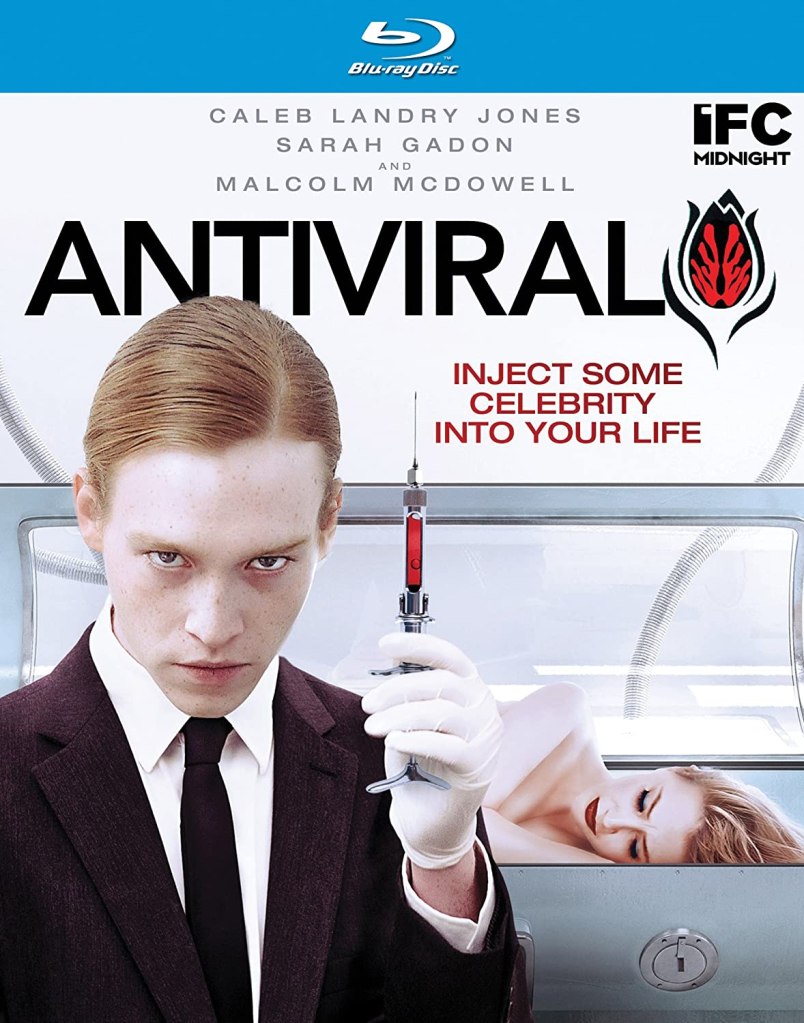
But the technology is already here. It is possible to grow cells in the laboratory, taking cells from an animal (and let us not forget that we ARE animals) and culture them into, well, meat. Clean meat, often called in vitro or lab meat, is meat grown in sterile laboratory conditions from animal cells. It is not plant-based meat, as so many supermarkets now offer, but actual flesh, grown in a nutritional medium, instead of cut from the carcass of a slaughtered animal. The idea is the basis of Brandon Cronenberg’s film Antiviral. While this may be a potential threat to the meat industries if /when it becomes commercially viable, it presents an immediate challenge to our culture of carnivorous virility, the ideology that makes us feel superior to other animals, demi-gods, the sacrificial violence that maintains the abyss between humans and other animals while bolstering the image of masculinity in most cultures.

More relevant to this thesis is the fact that clean meat could be grown from any animal cell. Want to try whale meat? Like to see what dodos or dinosaurs tasted like? Find a readable chain of DNA and contract the lab. And of course, the easiest cells to source are human ones – we hand them over to pathologists and crime scene investigators all the time. If clean meat becomes a reality, there is no reason (other than administrative) to assume we could not grow human steaks, livers or sweetbreads.  And as Erik says:

“It’s the only product where we have consent that it’s fine to eat it. We have a donor – that person has said ‘you can take my cells, you can grow them, and it’s fine with me that you eat them.’”

The artist Diego Rivera claimed in his memoir that human flesh is the most “assimilable” of foods for humans. Most testimonies by actual cannibals attest that human meat is not unique, and tastes similar to veal or pork. Erik says, tongue presumably in cheek, that human meat tastes like crocodile. Which, he says, tastes like – chicken.

“Since they say you are what you eat, why not eat a Swede?”

It is fascinating that polite society finds perfectly acceptable the confinement and torment of billions of animals in wretched conditions until they are slaughtered, yet so many people are shocked and repulsed by the idea of meat from a different animal, Homo sapiens, grown in sterile conditions with no need for branding, castration, confinement, slaughter and disembowelment.

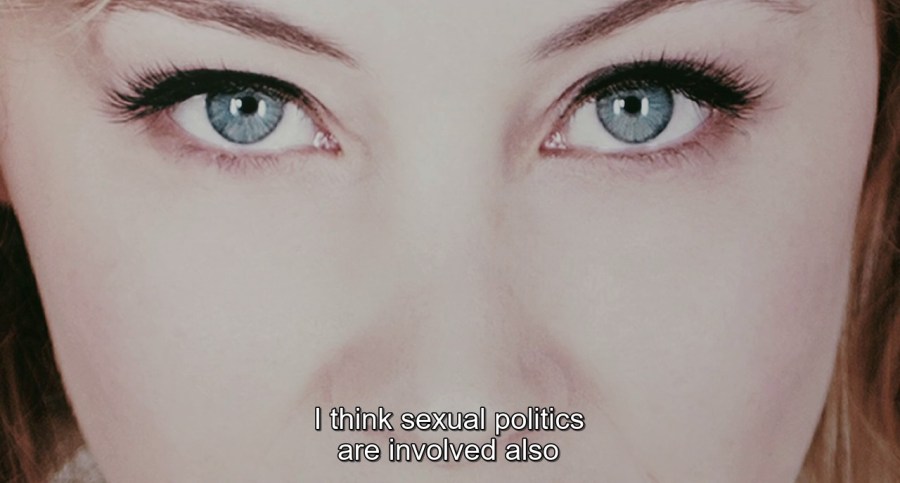
“From the perspective of the virus, the human being is irrelevant” – ANTIVIRAL (Brandon Cronenberg, 2012)

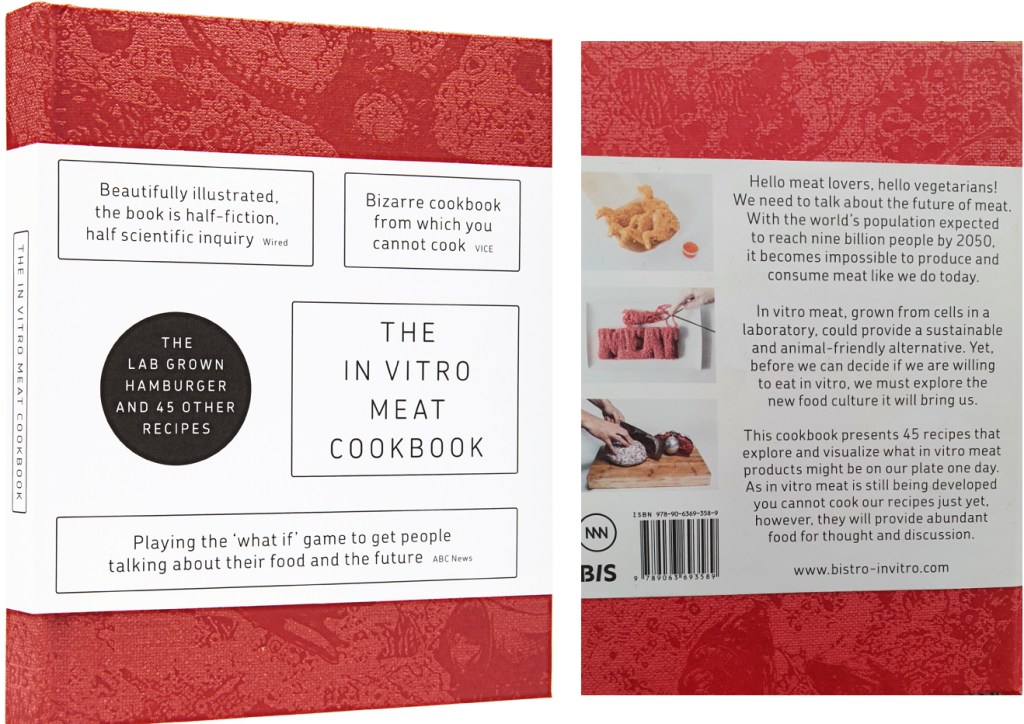
I have in my (admittedly odd) library a title called The In Vitro Meat Cookbook. It has a series of recipes, none of which you can cook yet, because they require as their main ingredient meat grown in the laboratory rather than cut from the quivering corpse of an animal who probably lived her whole life in horrendous conditions. When this lab meat becomes commercially available, it will doubtlessly be great news for the billions of animals who die in terror for our plates each year, but these recipes go beyond the meats you might see at a butcher shop, to such suggested dishes as Dodo Nuggets and Dinosaur Leg and, yes, Celebrity Cubes:

“Forget autographs and posters. Prove that you’re the ultimate fan of a celebrity by eating him or her.”

Pop stars in whiskey glaze. If that isn’t intimate enough, how about “IN VITRO ME”? Yep, it’s grown from your own stem cells, and it’s “best shared with a lover as the ultimate expression of unity”.

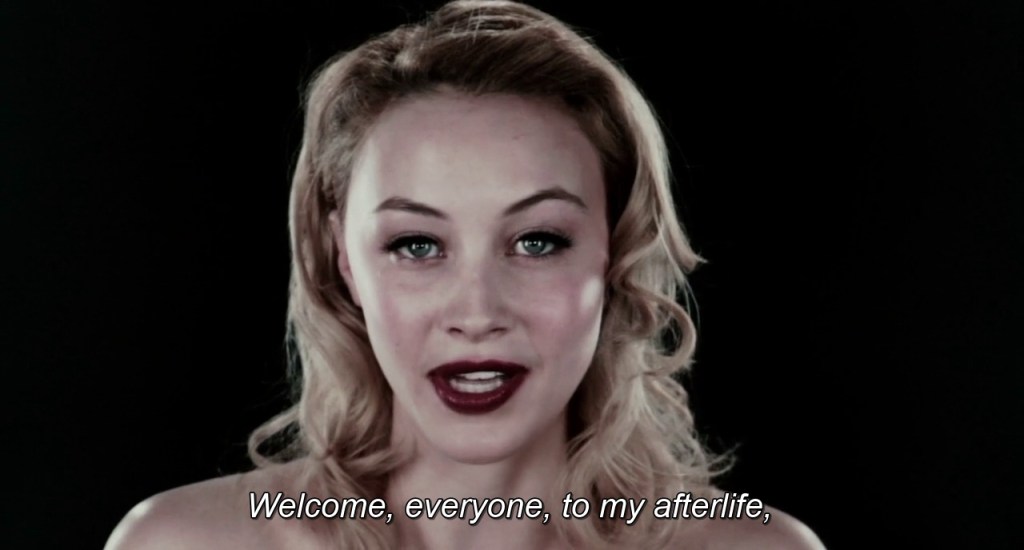
I digress, but it is relevant to this week’s movie. Antiviral is a film even more relevant now than when it was released a decade ago. For a start, the daily news speaks of little else than viruses and antivirals, and when they do turn to other issues, these usually involve celebrities. This film covers both. It is set in an alternative present, where the obsession with celebrities has moved past adulation and stalking (and occasional cannibalism) to a lucrative business – selling their diseases. For a lot of money, you can suffer the same symptoms and weeping, bleeding pustules as your favourite star!

The movie is the first work by Brandon Cronenberg, the son of body-horror pioneer David Cronenberg (The Fly, The Dead Zone, A History of Violence, etc), sometimes known as “the King of Venereal Horror” or “the Baron of Blood”. Quite a legacy to live up to, but Brandon Cronenberg does it brilliantly in this work, which features cannibalism among its panoply of abjection. The imagery is stunning – bleak scenes in monochromes, then a flash of crimson – blood or lipstick. Needles sticking in arms and gums, lumps of meat grown from celebrities and sold to customers desperate for a touch and a taste of their favourite star.

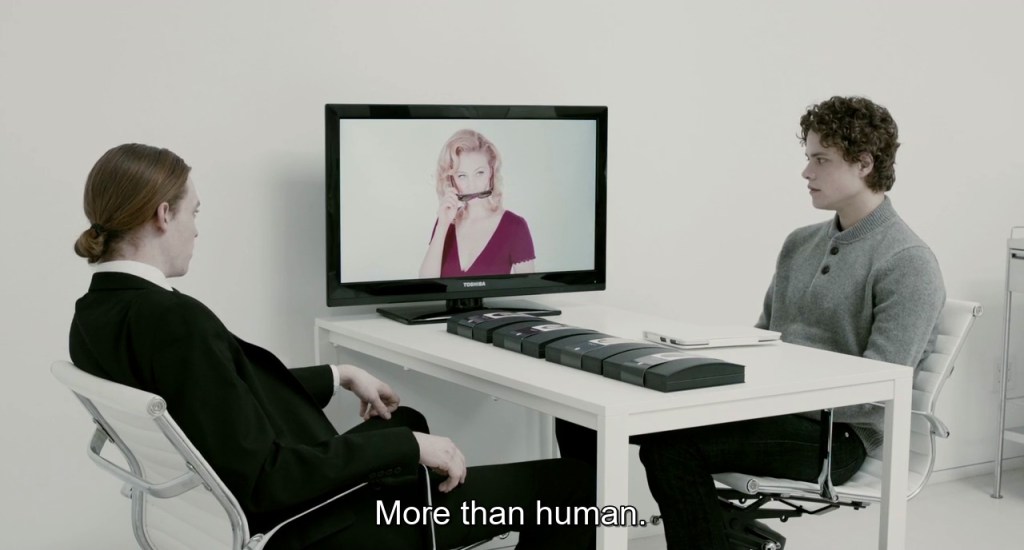
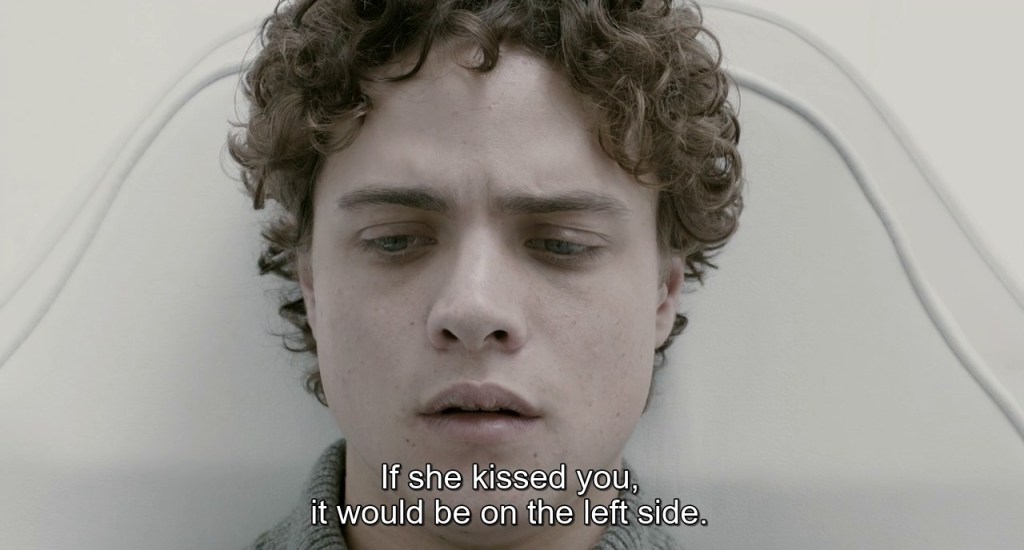
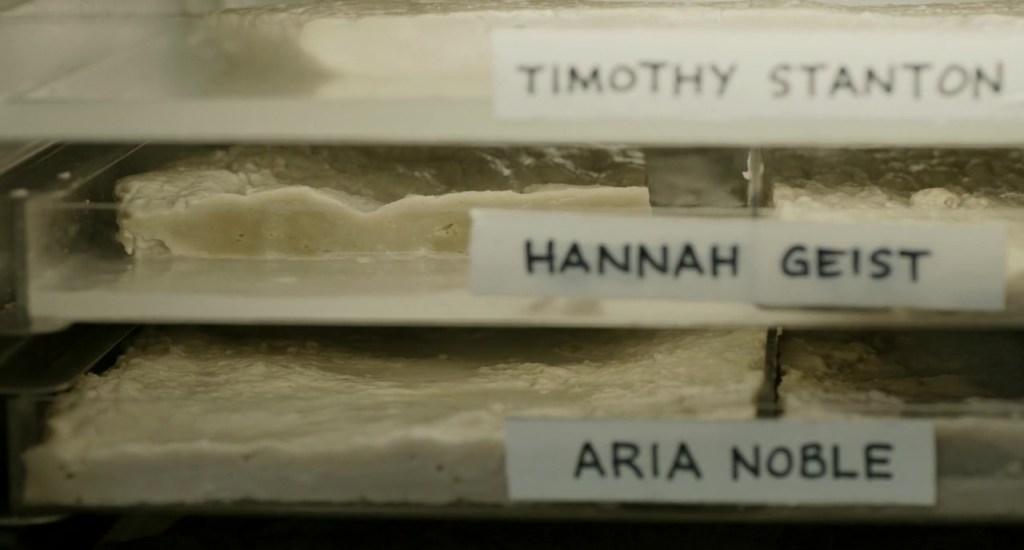
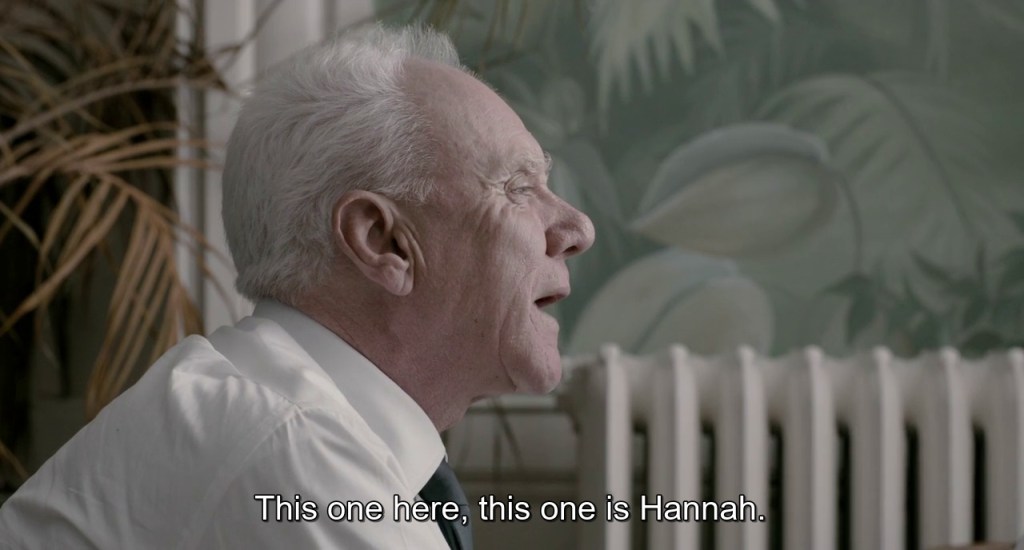
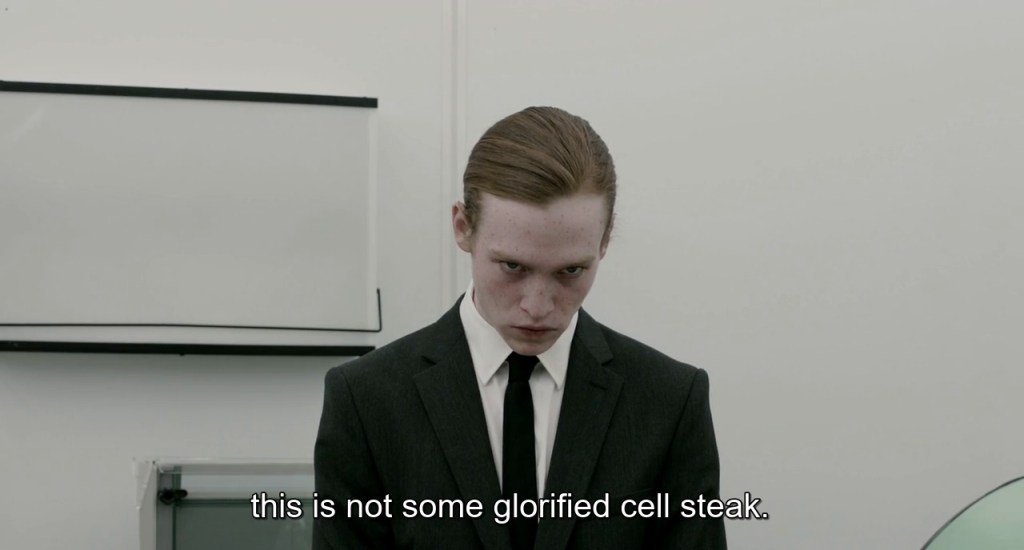
The protagonist of the film is Syd (Caleb Landry Jones from Get Out, Nitram etc), an employee of the Lucas Clinic. Syd sells customers the dream of being close to their favourite celebrity. What does the avid fan do after already seeing all the movies, reading the magazines, collecting the images? In this world, they pay to get the same diseases as the celeb. Syd knows how to sell, he talks a fan into a dose of herpes simplex, collected by his employer from the superstar Hannah Geist, whom he describes as “more than human”. She had the pus-filled blisters on the right of her mouth, so you really want to be infected on the left, because

Syd is a trusted employee of Lucas (where the archivist is played by Lara Jean Chorostecki, who played Freddie Lounds in Hannibal!), but he is ambitious, hoping to sell the virus that is killing Hannah on the black market. He takes some of her blood (Lucas Clinic has exclusive rights to Hannah’s diseases) and infects himself, then waits, taking his temperature, doing things with cotton probes that we all now understand.

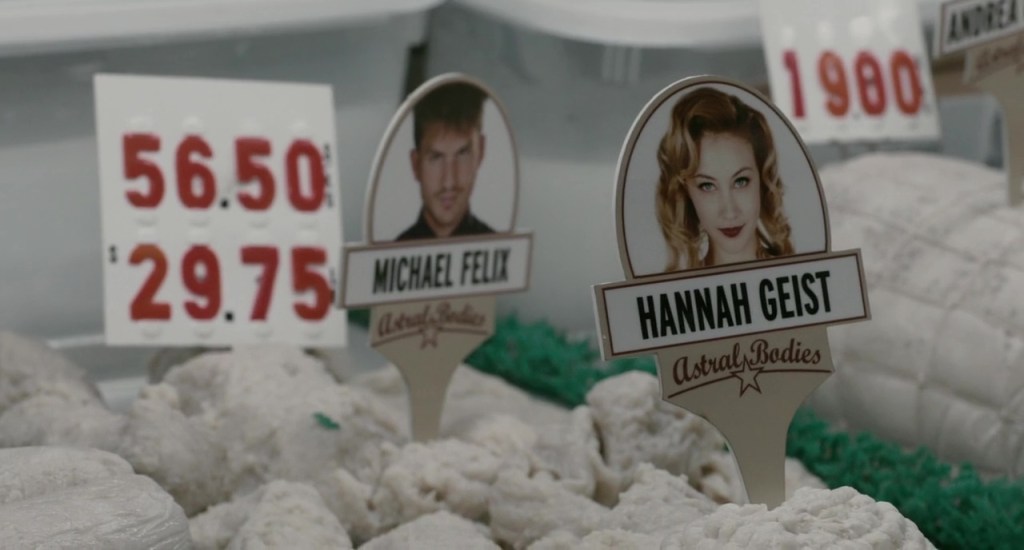
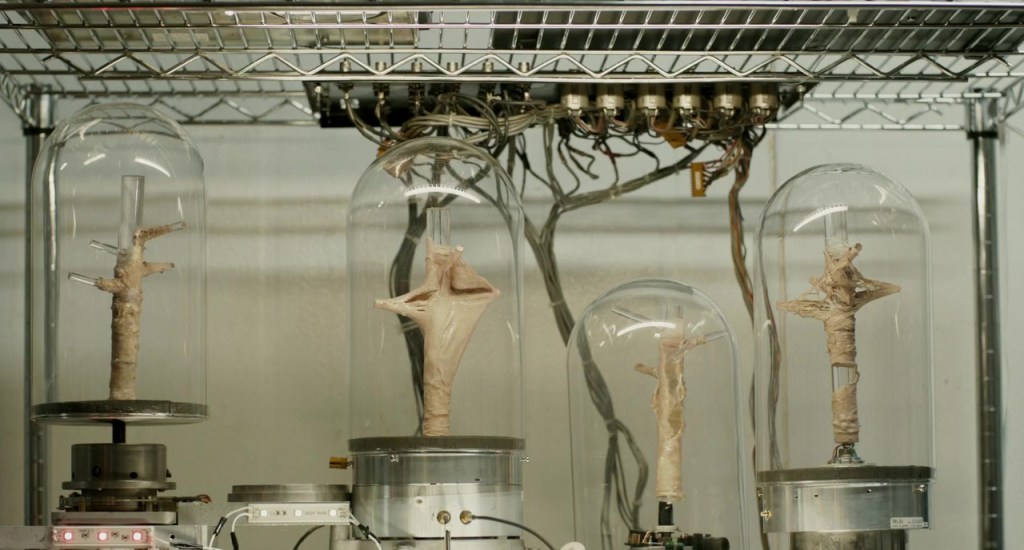
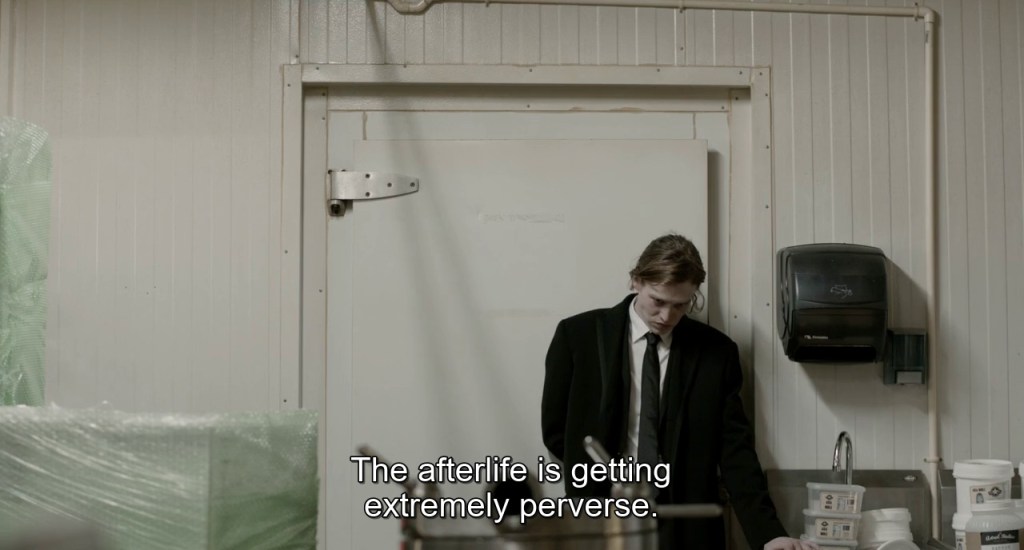
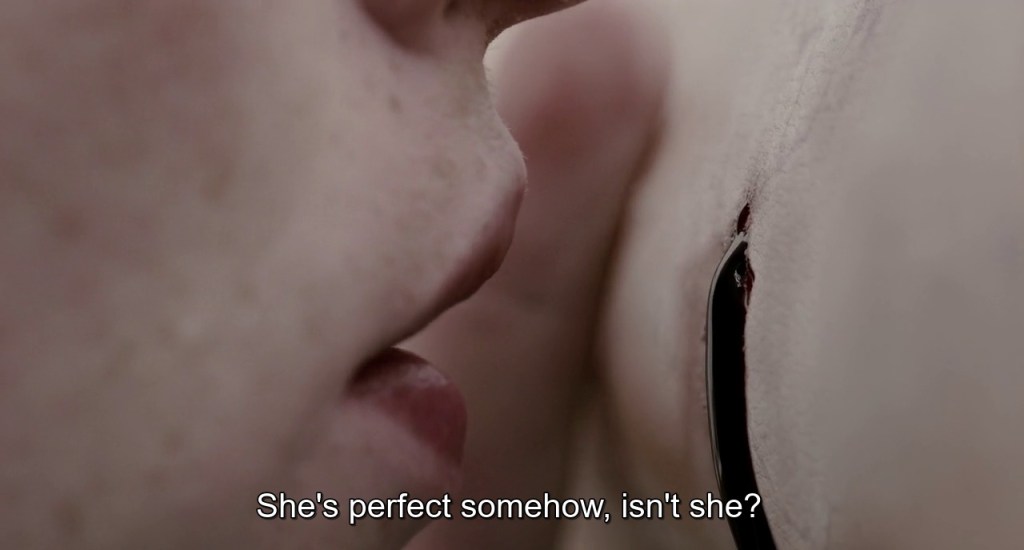
He is hoping to sell the new virus through the specialist butcher Arvid (Joe Pingue), whose business Astral Bodies does a thriving trade in celebrity cell steaks – edible flesh grown from the cells of celebrities.

Syd tells Arvid “I don’t understand how this is not considered cannibalism”. Arvid is more philosophical. What does it mean to be human, he asks – is the human “found in its materials” or is it something more religious, as the law currently tends to assume – a soul perhaps?

“But we’ll see what happens when we go from growing celebrity cell steaks to growing complete celebrity bodies.”

When Hannah’s death is announced, Syd’s diseased blood is suddenly in demand – those who have already eaten Hannah now want to either watch him die the way she did, or buy the virus and die along with her. Syd has to escape the virus coursing through his body, and the various business types who want it.

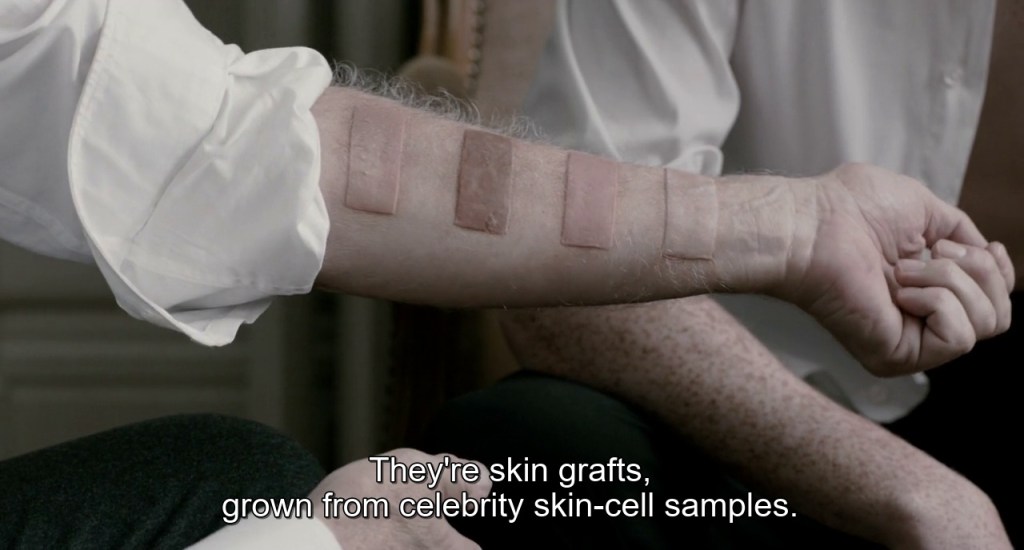
Anything related to a celeb is valuable. Lucas Clinic is even planning to sell ringworms from Hannah’s dog. Or if you don’t want a disease, you can get a skin graft from your favourite celebs, as Hannah’s doctor, Dr Abendroth (played by the magnificent Malcolm McDowell) shows Syd.

What does it mean to “go viral”? This humble blog has gone viral (a very mild, non-toxic one) in that it is viewed thousands of times a month, presumably because wonderful readers like you share it (please?) on social media, or perhaps (socially distanced) word of mouth. But a celebrity who goes viral has his or her impact measured not in the thousands of views but in the millions. Celebrity becomes the message in itself; as the head of Lucas Clinic says, when asked if the current crop of celebs deserve to have the levels of mania surrounding them,

“Anyone who’s famous deserves to be famous. It’s more like a collaboration that we choose to take part in. Celebrities are not people. They’re group hallucinations.”

Hannah’s doctor Abendroth is more metaphysical, musing that

“there is a power, something in the thrall of the collective eye, that can be consumed and appropriated.”

Certainly we devour our celebrities, with the paparazzi as the hunters and the rest of us sitting with a magazine or a tablet and consuming them – think of Marilyn Monroe, Princess Diana, Amy Winehouse, Michael Jackson and many, many more. Unlike most of us mere mortals, the celeb who has gone viral remains consumable after death, perhaps more so. So it is with Hannah.

The marketing of Hannah’s “afterlife” expresses the vulnerability of humans, the paragon of animals, to a virus, a type of genetic code so tiny that we are not even agreed on calling them “alive”.

“From the perspective of the virus, the human being is irrelevant. What matters is the system that allows it to function. Skin cells, nerve cells, the right home for the right disease.”

But no spoilers – go get this one out and watch it (if you’re not the squeamish type) – it is well worth it.

We long for connection. Cronenberg mentioned a moment of inspiration:

“A friend of mine said he was watching Jimmy Kimmell one night and Sarah Michelle Gellar was on the show. She said she was sick and if she sneezed she’d infect the whole audience, and everyone just started cheering.” 

The philosopher Blaise Pascal said that there was, in every human, an “infinite abyss [which] can be filled only with an infinite and immutable object”. He suggested that this infinite and immutable object should be God. Humans are big on eating gods – Dionysus was torn apart and reborn by means of his mother eating his heart, which made her pregnant. Christians eat the Eucharist – the body and blood of Jesus, according to John 6:55-66

“For my flesh is meat indeed, and my blood is drink indeed. He that eateth my flesh, and drinketh my blood, dwelleth in me, and I in him.”

We live vicariously, by eating our gods. But in our culture, the celebrity is god. The viral, consumable, more-than-human celebrity.