
“You draw the line there?”: DOLORES ROACH episodes 7 & 8

The climax. The denouement. The final two episodes of this quite brilliant podcast that became a Broadway show that became a television series about an untrue true crime, and includes podcasts and Broadway shows. If you need to catch up on the earlier episodes, I would suggest watching them, but if you can’t wait, here are my earlier blogs.

Episode 1

Episode 2 & 3

Episode 4

Episode 5

Episode 6

And here is the very brief synopsis.

  • In episode 1, Dolores has just been released from prison after 16 years – she took the fall for her boyfriend, who has since disappeared. She heads back to Washington Heights New York. but it’s all gentrified now, except for Empanada Loca, the shop of her old friend Luis, who offers her a room and sets her up as a masseuse, a skill she learnt in jail.
  • In episodes 2 and 3, Dolores kills the landlord who has been harassing Luis for his overdue rent, which he can’t afford because the neighbourhood is now fancy, and people don’t buy empanadas much. Luis creates a new empanada, MUY LOCO. It is hugely successful, because it contains, yep, human flesh, in this case, the landlord, Mr Pearlman, whose son, Jonah, appears in the shop at the end of episode 3, with two cops behind him.
  • In episode 4, Dolores is shocked to find what Luis has done with the body of the landlord she murdered, and disgusted by the secret contents of the muy loco empanadas—Mr Pearlman. She is particularly horrified when Luis offers Jonah an empanada to try, a muy loco, which she knows is a “mouthful of daddy”. Meanwhile, the local drug dealer, Marcie, has pissed off Dolores, and now she is also in Luis’ fridge, and bits of her are now in the empanadas.
  • In episode 5, Dolores hires a private eye called Ruthie, played by Cyndi Lauper, to trace her ex, who cheated on her and let her take the fall in a drug bust. Ruthie’s motto (or perhaps mission statement) is I NEVER DON’T FIND THEM. But the last thing Dolores wants is for Ruthie to find Mr Pearlman.
  • In episode 6, we see cannibalism as a business. Luis has been clear-eyed about this all along – he gets rid of the annoying landlord, he thoroughly destroys the evidence (in customers’ stomachs) and he makes money from the meat, which is apparently delicious and hugely popular, while saving money by not buying the flesh of other animals from the food-services man, Jeremiah, the only sympathetic character in the story so far.

Not a lot of human flesh being eaten in these final two episodes, because everything is turning to shit, largely due to the impulsive plans of Luis, and the tendency of Dolores to snap the neck of anyone who annoys her. Police are looking for the drug dealer Dolores killed back in episode 4, and threatening to call in the DEA. Luis is still chopping up the bodies of Dolores’ victims to fill his empanadas, but he doesn’t want anyone to find the marijuana he is growing. THAT would be incriminating. Dolores points out that his fridge and apartment are full of chopped up bodies, and asks him the question that defines all ethical discussions.
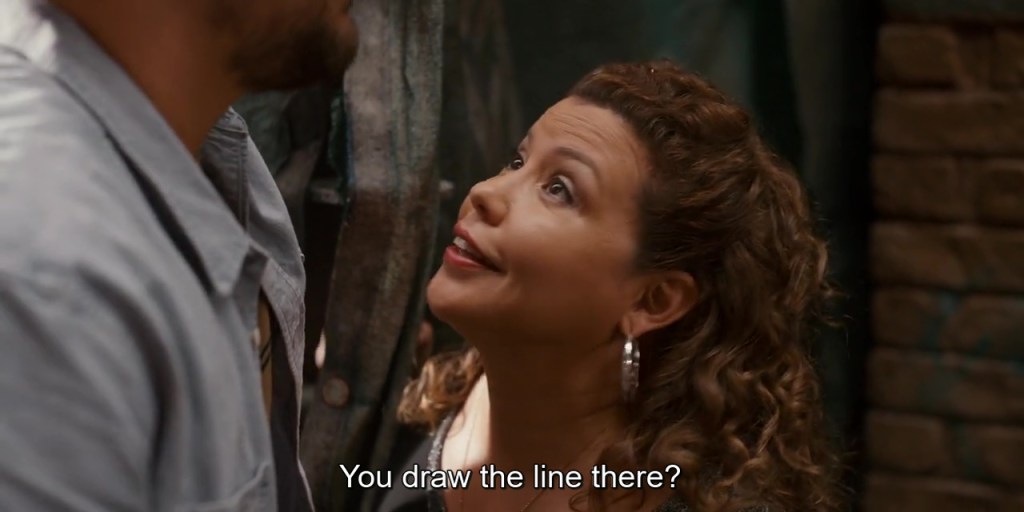
 She’s much more upset about the cannibalism than the increasing number of corpses she is leaving all over the shop. Odd that. Luis sees meat as his business, and Dolores’ steady body count as his (very reasonably priced) supplier. He’s not too fussed about all the killing, as long as he doesn’t have to do it – like customers in a butcher shop. When he finally kills a man, he is upset: “Look what you made me do!”
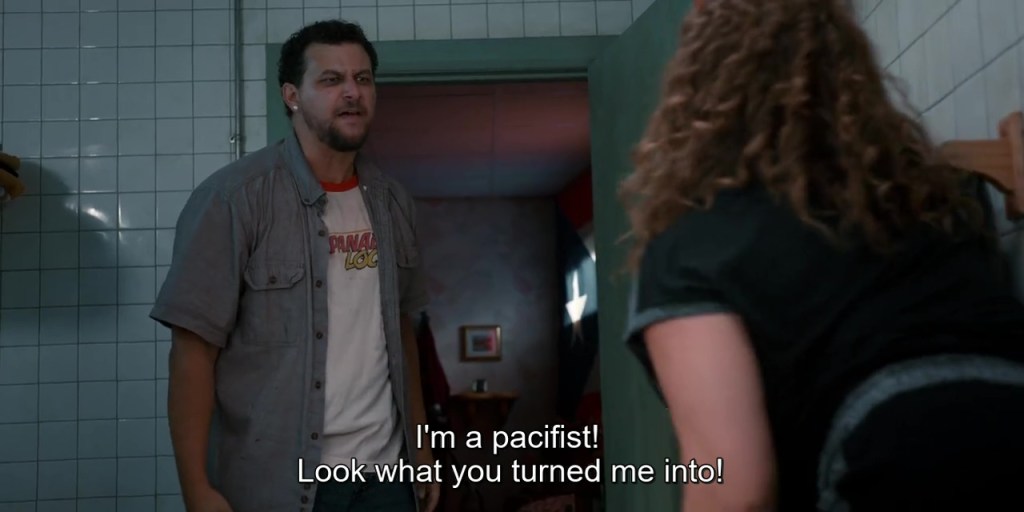
Luis cracks some of the best jokes in this show, in the middle of the street (much to Dolores’ fury) about the “fat fuck” she killed last episode, and how he is going to use the body fat in his pastry.

And some of the worst.
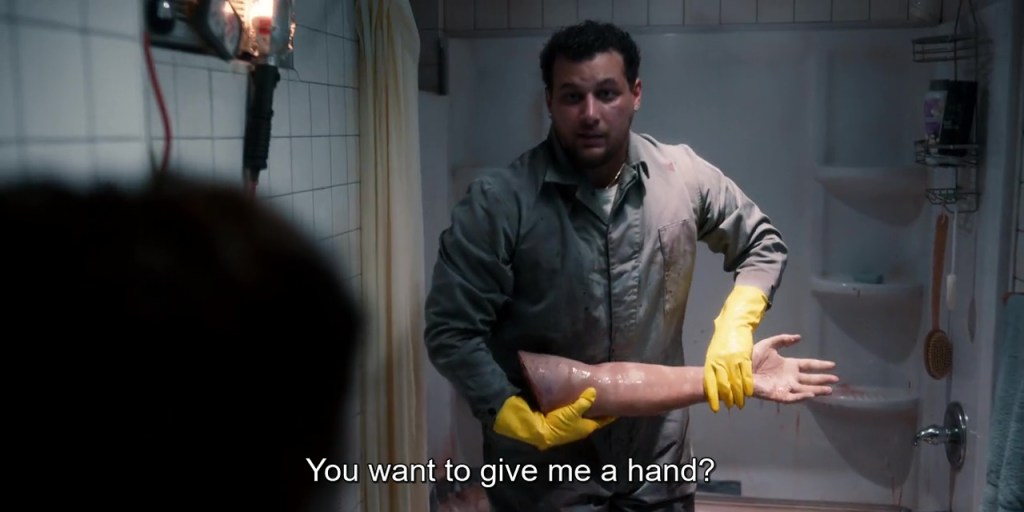
Lots of interesting Freudian things going on here – in earlier episodes, they discussed the difference between edible and Oedipal, and then there’s the whole thing with Luis only wanting to give Dolores cunnilingus, not penetrative sex, even though she has her period. She considers that eating her menstrual blood makes him a cannibal, even though he has been snacking on human empanadas all through the show, so it shouldn’t really be a surprise.

And his pet name is Mami. It’s apparently the Spanish equivalent of “baby” or “darling”, but is also used for, yep, mother. Freud said the two primary taboos are incest and cannibalism, and Luis definitely has an edible complex.

We find out why Luis doesn’t want sex – he fell in love with his father’s girlfriend when he was 12, had sex with her (so now we have another taboo covered) and then tried to castrate himself in punishment. He couldn’t cut through his penis (Meiwes and Brandes found it was much harder than you might think) and poured hot oil on the wound, leaving him horribly disfigured. Yes, Dr Freud, the threat of castration can be as big a motivation for mental illness as you thought.

Dolores just thinks she is a monster. But one of the fascinating things about cannibalism is that unlike other horror movie tropes, they are not supernatural or even particularly superhuman. And they really exist.

“I’m a monster. Worse, I’m real.”

Luis ends up “deep fried, like everybody else” in one of the most dramatic scenes, and Dolores escapes:

She goes looking for the showrunner of the play, a nice piece of postmodern complication as he clearly represents the creator of the show we are watching, Aaron Mark.

He is accused of humanising a serial killer, but hey, Dolores is very human, just like Macbeth and Oedipus and every tragic protagonist in literature. She’s not even a cannibal; in the whole eight episodes, we have not even seen her eat a human empanada! She’s just a misunderstood serial killer.

As she says, you have to draw a line somewhere.

She forces the showrunner to take her to a house where, he says, someone knows the whereabouts of the man who betrayed her and left her to rot in jail. When the door opens, she roars with laughter, and then pounces, but at whom? All we know is that, like Georgina in The Cook, The Thief, she is directing her invective at us, the audience! We may not know where her ex is living. But we do know that cannibalism starts at home.

“He bit my thigh!”: THE HORROR OF DELORES ROACH, episode 5

Intertextuality is a term used to explain the way that similar or related texts influence, reflect, or differ from each other. In the start of this series, we heard the Stanley Holloway song “Sweeney Todd the Barber”, which this series clearly relates to, in that Sweeney would kill his hairdressing clients and send them down a trapdoor to the basement where his partner, Mrs Lovett, would fillet them into meat pies. The 2007 version of Sweeney differed from earlier versions by being a musical (!) and also giving Sweeney a motive—revenge—rather than just being, you know, batshit crazy. Intertexually, Delores turned a lot of this upside down: she was downstairs killing people; Luis was upstairs turning them into empanadas. The serial killer was female instead of male, the pastry cook male instead of female. The victims were not random people who needed a shave, but people who had pissed Delores off.

If you haven’t read my blogs on the first episodes, you might want to do that first. In a nutshell, in episode 1, Delores has just been released from prison after 16 years. She heads back to Washington Heights NY but it’s all gentrified now, except for the Empanada Loca shop of her old friend Luis, who offers her a room and sets her up as a masseuse, a skill she learnt in jail. In episodes 2 and 3, Delores kills the landlord who has been harassing Luis for his overdue rent, which he can’t afford because the neighbourhood is now fancy, and people don’t buy empanadas much. Luis creates a new empanada, MUY LOCO. It is hugely successful, like the chocolates in a recent blog, because it contains, yep, human flesh, in this case, the landlord, Pearlman. Whose son, Jonah, appears in the shop at the end of episode 3, with two cops behind him.

But in episode 4, it turned out Jonah didn’t know his dad is missing, and the cops are just waiting for their empanadas. But Delores is horrified by the idea of cannibalism (although, funnily, not so much the fact that the meat came from the body of the landlord she murdered) and disgusted by the secret contents of the muy loco empanadas—Mr Pearlman. She is particularly horrified when Luis offers Jonah an empanada to try, a muy loco, which she knows is a “mouthful of daddy”. Meanwhile, the local drug dealer, Marcie, has pissed off Delores, and now she is also in Luis’ fridge, and bits of her are in the empanadas.

So the link in the first half of the series was to Sweeney Todd, killing people and putting them in pies. But this story goes back well beyond Sweeney, to a new intertextual link, and the common thread now (besides pies) is revenge! Delores is intent on finding her ex who, she has discovered, set her up to take the fall when the drug police moved in, and who had been cheating on her all around town, including with Marcie. She is determined to put him in an empanada.

For this purpose, she goes looking for a friend of a friend, a Private Investigator called Ruthie, played by the wonderful Cyndi Lauper. Ruthie’s motto (or perhaps mission statement) is the title of this week’s episode:

I NEVER DON’T FIND THEM

Ruthie doesn’t like getting involved in drug issues (too dangerous), and warns Delores not to get her tangled in any such wars.

Ruthie also has a passion for the theatre, and is currently an usher in the Broadway production of Shakespeare’s Titus Andronicus, starring Jamie Lee Curtis. The production was invented for this series, which is a shame, as I would have flown to New York to see that!

Now, this link to Titus merits some unpacking…

Ruthie gives Delores tickets to see Titus Andronicus, which is all about a Roman general, Titus, who kills and cooks his enemy’s sons into a pie, which he then serves to the unwitting mother.

Shakespeare would have been well aware of the many Greek legends of revenge, particularly that of Thyestes, as told in Seneca’s play of the same name. Thyestes unknowingly ate the flesh of his sons, served by his brother, Atreus. Shakespeare used the trope in this, his first tragedy, which was filmed in 1999 as Titus, with Anthony Hopkins in the title role, again serving human flesh to his unsuspecting guests, eight years after winning his Oscar for doing just that as “Hannibal the Cannibal” in The Silence of the Lambs.

There are lots of other nice little touches, like the delivery guy, Jeremiah (named after the Old Testament Prophet of doom) asking why Luis doesn’t buy meat off him any more. “Doesn’t need to”, is what Delores doesn’t dare reply. Jeremiah’s truck has the slogan “SO FRESH, IT BITES YOU BACK”:

Then there’s the drug pusher who works (or worked) for Marcie, or as Delores calls her “cunt face”. Marcie is currently supplying filling for the latest batches of Muy Loco empanadas, but this dude doesn’t know that yet and is enjoying a Marcie empanada.

There’s problems ahead though. Jonah is now actively looking for his dad, who was Delores’ first murder victim. And he has run into Ruthie, who has promised him:

But Delores doesn’t want anyone to find him. She knows where Mr Perlman (and Marcie) are, and when she stumbles into Luis’ bathroom, she certainly finds them!

Delores is painfully aware that she can hardly be judgemental at what Luis has done to her victims.

“Maybe I didn’t chop these people up, but I did this.”

She makes up with Luis, who throws Jonah off the scent by sending a fake message from his father’s phone, and pledging that he will look after her, take the full blame if their crimes ever come out. They finally (five episodes in) head for the bedroom, where Luis performs cunnilingus, about as close as most humans come to cannibalism, and even crosses that line a little when he gets excited and bites her thigh.

Gynophagia, the fetish involving killing, cooking and eating women, is described by psychobiologist Clarence Herrick as a “morbid expression” of the universal desire to hug, often too violently, the object of our affection or desire, an extreme form of the grandmother painfully pinching a grandchild’s cheek or the child hugging to death a favourite kitten. So biting or in extreme cases eating women is perhaps rough love, an extended form of cunnilingus.

The thin red line between eating humans and eating other species has well and truly been crossed by the time Luis finally mounts Delores at the end of this episode.

Cannibalism in HK? Model ABBY CHOI murdered and cooked

On February 24 2023, Hong Kong model Abby Choi was found dead in a rental unit in Hong Kong’s northern Tai Po district. Or at least, some of her; Choi’s corpse was not complete. Her head was missing, to be found by the police, after some analysis, in a cooking pot. The police described the crime scene as a “slaughterhouse”, and they found other parts of her body in the refrigerator.

An electric saw and a meat-grinder that had been used to mince human flesh were found at the crime scene, as well as soup pots containing human tissue.

Police have taken into custody her ex-husband Alex Kwong, his father Kwong Kau and his brother Anthony Kwong. All were charged with murdering model Abby Choi a day earlier. Alex Kwong’s mother, Jenny Li, faces one count of perverting the course of justice. None of the four were granted bail.

The former husband, one of the main suspects in the murder, was arrested the next day at a pier in Tung Chung, on one of the city’s outlying islands, Lantau, while trying to flee with just the clothes on his back, and half a million HK dollars and four million $HK worth of fancy watches.

On Sunday, authorities confirmed that a young woman’s skull believed to be Choi’s had been found in a cooking pot that was seized from the house. Officials believe that a hole on the right rear of the skull is where the fatal blow was struck.

Ms Choi lived at Kadoorie Hill in Ho Man Tin and had been missing since Tuesday (Feb 21). Police discovered two legs in the apartment’s refrigerator, as well as the victim’s ID card, credit cards, and other belongings, according to Police Superintendent Alan Chung. Human tissue was found in pots of soup, while the victim’s torso and hands were not at the scene. Chung said:

“Police also have found that the flat was arranged by cold-blooded killers meticulously. Tools that are used to dismember human bodies were found in the flat, including meat grinders, chainsaws, long raincoats, gloves, and masks.”

According to China Underground, Choi’s former father-in-law had rented the flat, which was almost bare of furniture, as were the two bedrooms. Police found two types of choppers, a hammer, face shields, black raincoats, and a purple handbag that belonged to Choi. The suspects reportedly covered the walls with a sail and wore face shields and raincoats to prevent being bloodstained while dismembering the body. This was clearly not a spur of the moment crime.

 More than 100 police personnel were sent to search the Tseung Kwan O Chinese Permanent Cemetery on Saturday, including a diving team who were deployed to the nearby catchwater.

The motive of the murder has yet to be determined, but it is believed to be a financial dispute between Choi, who was only 28 years old, and her ex-husband’s family, involving around 100 million Hong Kong dollars.

As a model, Choi enjoyed international exposure and was photographed at the Elie Saab Spring Summer 2023 Haute Couture show in Paris, France, as recently as January. She also appeared as the digital cover model for the luxury magazine L’Officiel Monaco and attended this year’s Paris Fashion Week.

Choi, who was also known as a social media influencer, has nearly 100,000 followers on her Instagram account, which features photographs of her posing with various luxury brands in locations from London to Paris and Shanghai and aboard yachts in Hong Kong. In her bio she writes that she’s “embracing every moment in life.”

Choi’s friend Bernard Cheng said she had four children: two sons ages 10 and 3, and two daughters ages 8 and 6; a son and a daughter from her ex-husband, who have been placed in the care of the model’s mother, and two children with her present partner.

The murder case has been adjourned to May.

The news has been greeted with horror in Hong Kong. But social media is already making tasteless comments about cannibalism and cunnilingus.

The comment in the social media posts about HK people “always” cooking their murder victims seems a little hard to swallow (sorry). No one has yet accused the alleged perps of eating the human flesh soup found in the pots, and there is some speculation that they were cooking the flesh just to render it down for disposal, or to stop it decomposing. But if you find pots of soup on a stove, you’d imagine that the most likely explanation would be that they were there for degustation. Everything else about the case uses metaphors of carnivorous virility and factory farming – the flat being a “slaughterhouse”, the grinders and protective equipment, and the motivation for the killing – lots of money.

Except in times of chronic famine, or during the Cultural Revolution, China is not known for many cases of cannibalism, unlike some other countries we could (and often do) name. But the Chinese do make some great cannibal movies, including Herman Yau’s Human Pork Buns and Ebola Syndrome (伊波拉病毒), and Fruit Chan’s Dumplings. Check them out, and then ask yourself, what exactly was planned for those pots?