John Beagles and Graham Ramsay are artists who play with the concept of human exceptionality. They also add a new flavour to the old saying “Art is always a matter of personal taste.”
For two decades, the artists and performers have been making, cooking and sometimes eating black puddings made from their own blood. Ramsay says:
“There is a tang. And it is quite salty too.”
The pair have been collaborating since 1996 and making their “cannibal” sausages since 2004. They call their performance and exhibition a “black pudding self-portrait” or Sanguis Gratia Artis.
John Beagles and Graham Ramsay
They are staging the show again this year. Their meat products are on display in a fridge at the Scottish National Portrait Gallery, and they will be cooking them for a live audience on February 13.
Ramsay, who says he likes a good black pudding, stresses: “We do not usually eat them ourselves, but we have tried them.” He adds that his partner will not be sampling them:
“One of us has quite recently become a vegetarian, and it is not me.”
There are no plans to eat the sausages in Edinburgh. Previous performances have involved some harmless light cannibalism and have attracted some bizarre audiences.
In London back in 2007, Ramsay says, word got out that they would be eating the puddings.
“The performance got a bit of attention in advance; people knew it was happening. So there was a queue of quite gothic people — vampiric characters — outside the gallery and it was a bit weird. There was a kind of feeding frenzy then. As part of the performance, we put slices of the puddings on a silver platter and paraded them through the audience, just to show them, but people started grabbing them. The performance involves us in costume, in the gallery, and we’re basically chopping and frying the pudding, with audience watching.”
The sausages are made with a pint of blood from each man, combined to symbolise nearly thirty years of collaboration.
The process of getting the blood is not easy. They have had to convince nurses to extract small quantities — no more than a syringe at a time — over a long period, and then freeze it. The kind of equipment used by blood transfusion services is tightly controlled, so the artists have to endure sometimes painful extractions, over and over again.
Why do it? Beagles and Ramsay are both respected art academics, teaching at Edinburgh University and Glasgow Art School respectively. Heavily influenced by feminist criticism, they are challenging the old idea of the artist, especially the male artist, as a lone genius separate from the world. They are playing with the idea of self in self-portrait. Their mixed blood represents their joint work.
“We fuse ourselves, but we also use a daft form to present ourselves in. It’s not heroic. We have picked a mundane modest foodstuff to represent us.”
The performance feels different now than it did when they first had their blood extracted. Both men are in their fifties now, and aware of their mortality. “Age starts to creep up on you, waistlines expand, and you become more aware of death and people’s health around you,” Ramsay says.
The artists may not see themselves as heroes, but there is an edginess to their idea, even legally. They debuted their sausages in New York in 2004. Back then there was a lot of angst in America about meat products, mad cow disease and foot and mouth. They had to send their puddings in the post with fake customs descriptions, one batch wrongly labelled as second-hand books.
One the night of their big performance, officials became antsy about health and safety, and security was brought in to stop punters eating the human sausages. Beagles and Ramsay, in a diary of their escapades, called them “anti-cannibalism guards”.
Will they have to find a way to keep their puddings safe from the Edinburgh audience? Perhaps. People are fascinated by cannibalism, even as they claim to be repelled. A few months ago, we reported on a vegan writer and photographer who finally gave in to the demands of his relatives to eat animal products by making meringues from his own blood.
‘There will be cannibalism, and rumours of cannibalism”
Yes, I paraphrased the Book of Matthew. Although not all that many people got eaten, the media was full of cannibal stories, and here are a few of them, sorted by their places of occurrence.
Australia
One of the men imprisoned for the so-called Snowtown murders (which mostly did not take place in the little town of Snowtown) was released. Mark Haydon was charged with assisting the men who did the actual killing and who ate part of one victim’s leg some 25 years earlier.
Brazil
Influencer Israel dos Santos Assis, better known online as Pinguim (Penguin) was arrested for desecrating graves in the cemetery of San Francisco the Count in the Salvador Metropolitan Region, stealing human bones, and using human flesh from the corpses to cook his most popular dish: feijoada, a bean stew usually involved simmering beans with beef or pork. Seems rotting human is a good substitute for pork.
Canada
Robert Pickton, the pig farmer convicted of six counts of second-degree murder (although he was charged with at least twenty others), was attacked by another inmate in prison and died a few weeks later. Pickton allegedly “processed” the meat of his rape and murder victims by feeding them to his pigs and, police said, possibly mixing them up with pork products he sold to his neighbours for their personal consumption.
China
Netflix released a new version of the classic science fiction book 3 Body Problem and ran into a storm of criticism from China for its depictions of the extreme violence of the Cultural Revolution. Although most of the victims of the purges were killed by shooting, live burial, drowning, boiling alive, and disembowelling, there is evidence that several hundred had been cannibalised, as the ultimate in humiliation.
The General who presided over a Cultural Revolution massacre that included cannibalism of those deemed “enemies of the people”, Wei Guoqing, was reburied (or at least his ashes were) with full honours in Beijing’s Babaoshan Revolutionary Cemetery – the resting place of China’s high-ranking leaders and revolutionary heroes. Wei’s name is most strongly linked in the public mind with cannibalism during the massacre period in Guangxi’s Wuxuan and Wuming counties and Nanning city. Researchers have found that at least 137 people were eaten, with thousands participating. “Paying tribute to a legendary gourmet,” wrote one wag on social media.
Cuba
Stories began circulating this year that the extreme food shortages in Cuba were leading to the danger, or actual occurrence, of cannibalism. This was bolstered by reports from 2022 of two hospital workers who had been stealing hearts and fat from human bodies and selling them as mince.
Haiti
Rumours circulated that the natural disasters and gang violence in Haiti was leading to starvation cannibalism. Jimmy Cherizier, a gang leader called Barbecue (“Babekyou” in the local parlance) was known for his penchant for burning people alive, and there was at least one video on Twitter/X of one gang member supposedly “tearing flesh from the leg of a burning corpse and eating it.” Such stories cannot be selfishly maintained by one little country, so of course it was not long before Bill and Hillary Clinton were accused of joining the cannibal feast. To add to the hilarity, Elon Musk posted on his own site, X, that a picture of a man near a fire was evidence of cannibalism, only to have the post removed by his own team for violating community standards. The fact-checking website Snopes pointed out that videos of bodies in Haiti being roasted on spits had previously appeared as accusations against a Nigerian restaurant, and were in fact from a Halloween prank in China in 2018. Still, you know, voodoo and all. Meanwhile, Trump ally Laura Loomer supplied conclusive proof that Haitians were cannibals: apparently, if you Google it, you will see a lot of results. The Prosecution rests its case.
India
India’s top court put a temporary stay on the execution of a man convicted of killing his mother and eating her remains in what is being deemed as the “rarest of rare” cases of cannibalism. Sunil Rama Kuchkoravi of western Maharashtra state’s Kolhapur district was handed a death penalty by a lower court in 2021 for killing his 63-year-old mother in 2017. The High Court in October this year upheld the death sentence against Kuchkoravi, stating that the convict possibly has a “syndrome of pathological cannibalism”. The execution has been delayed until the case is reheard in April 2025.
Israel (and around there)
Francesca Albanese, the U.N. special rapporteur for Palestinian rights, has been condemned for antisemitic rhetoric by the governments of the U.S., France and Germany among others. Albanese, known for accusing Israel of genocide (an odd charge seeing that the population of Gaza has increased in the last twelve months), wrote that the Israeli army was “rotten to the core”. A follower immediately introduced the classic blood libel: “Jews are capable of eating human flesh”, to which Albanese replied along the lines of “not all Jews”. Reassuring to note that a person paid by the taxpayers of the West, who finance the UN, can admit that some Jews are not cannibals!
A Yazidi woman was rescued from Gaza by Israeli troops. She revealed that, after being captured by ISIS in 2014 and forced to be sex slaves, the women were starved and finally fed meat which, they later told her, was from the bodies of a beheaded Yazidi baby, the child of one of the women. They told her:
‘We cooked your one-year-old son that we took from you, and this is what you just ate’.
Indonesia
Police investigated a suspected cannibalism case in West Java Province. The Head of the Criminal Investigation Unit confirmed that a video on social media showed the alleged perpetrator consuming a small portion of the victim’s flesh. He said that police had found 12 body parts of the victim at the crime scene.
Italy
An inmate in the notorious Poggioreale Prison in Naples tore the finger off another inmate and ate it. The Campania Guarantor, Samuele Ciambriello, observed that “it is now clear that the Poggioreale prison needs a structure suitable for hosting inmates suffering from mental disorders.” Seems like a good idea.
Mexico
A podcast called Mexico Unexplained revisited this year the story of Gabriela Rico Jiménez, a 21-year-old model from Mexico who disappeared some 15 years ago, after raging against the machine outside a fancy hotel in Monterrey Nuevo Leon. Ranting about the elites, including oddly the Queens of England and Germany (which is a Republic), she had shouted that “They ate humans! Disgusting!… They smell like human flesh!”
Nigeria
A man accused of being a sorcerer was blamed by villagers of the small town of Kirikiri for the disappearance of several children and elderly people. He was supposed to be “feeding on the flesh of the innocent.” Several claimed to have located the individual on the edge of a forest, wearing clothes “stained with blood” and mumbling mysterious incantations. A group of villagers beat the man and left him for dead.
Russia
Erkinzhon Abdurakhmanov, 47, intended to cure his own heart problems ‘after making a pact with the devil’, he told police. He killed a 65-year-old male pensioner in the Kuyurgazinsky district of Russian region Bashkortostan by striking him three times with an axe, according to reports. He then then cut out the heart and ‘ate the meal’ as he waited at a bus stop. He gave the uneaten remains to a woman also waiting for a bus ‘and asked her to bury it’. He was not arrested, however, until he headed into a liquor store and tried to steal some drinks. Cannibalism is not against the law in Russia, but murder and stealing alcohol is.
Vladimar Putin’s policy of giving pardons to criminals who agreed to fight in Ukraine in lieu of serving their sentences, was honoured in a pardon to a charmer named Denis Gorin, who had been convicted of at least four murders, and had eaten the flesh of his victims.
Another pardon involved Dmitri Malyshev. Malyshev was sentenced to 25 years in prison in 2015 for multiple criminal offences. Ten years ago, he murdered an acquaintance, a Tajik native, and then filmed himself cutting the heart out of the victim and roasting it in a frying pan and eating it. Neighbours seemed uneasy about his imminent return home.
South Africa
On December 26, 2024, eight illegal miners known as zama zamas emerged from Shaft 10 of a mine near Stilfontein, located in Northwest South Africa. They were taken by police, who confirmed that twelve bodies remained trapped beneath the ground, with miners reportedly resorting to eating human flesh due to severe food shortages.
[GRAPHIC CONTENT] Illegal miners have started eating human flesh. That's according to SANCO North West Spokesperson, Mzukisi Jam. The claims were made in Christmas Eve letters sent to the surface claiming that more miners have died. #DStv403#eNCApic.twitter.com/vqDodTXgmZ
Novosibirsk Archpriest Alexander Novopashin became notorious for claiming that Ukrainians are “cannibals”. Although conspiracy theories about cannibals are becoming more common, this particular Archpriest is taken seriously in Russia, and regularly lectures Russian security forces and soldiers.
UK
Marius Gustavson, who called himself “the eunuch maker”, offered a service where he charged men to destroy or remove their testicles, and then charged subscribers to his website to see him perform the operations. The court heard that that there was “clear evidence” of cannibalism and that Gustavson had “cooked testicles for lunch in an artfully arranged salad platter”.
Meanwhile, a candidate from a party called Reform UK was suspended for saying that meat-eaters should “eat other humans” and said humanity should be “obliterated”. Just saying what many are thinking, perhaps.
USA
The cannibal story of the year was the President, Joe Biden, claiming that his uncle had been eaten by cannibals in New Guinea. The leaders of PNG took exception to the stereotyping of their people as cannibals. Apparently, only some of them had been.
Speaking of Presidents, Donald Trump embellished his rhetoric on immigration by pointing out that some of the undocumented people pouring over the border were from insane asylums, and called that “Silence of the Lambs stuff”. Trump had previously claimed that Hannibal Lecter had endorsed his candidacy, which is a bit odd since Hannibal is a fictional character, but by far not the oddest claim in the 2024 election.
In March, a homeless man in Kern County was arrested for picking up the leg of a person who had been killed in a train accident and chowing down on it. California has no laws against cannibalism, but he was charged with “mutilating the body” which is a bit odd, since the train had already done that.
In Utah, which also has no law against cannibalism (Idaho is the only state that does), a law was passed to criminalise the ‘ritual abuse of a child’, which apparently regularly includes making the little ones eat “organic substance or material” (i.e. bits of people) before they are allowed to have their desserts. This in addition to claims that such rituals would sometimes involve eating the children instead.
A keen-eyed traveller pointed out that the road once taken by the Donner Party, which ended up in them getting lost and eating each other, was now signposted with a sign indicating dining was available. Much hilarity ensued on social media.
Conservative political commentator Candace Owens managed to link transexuals, Native Americans and cannibals, all in one sentence. No wonder she is so widely admired.
Much to the relief of the good people of Idaho (the only State in the Union with laws against cannibalism), the law was amended to ensure that giving someone else human flesh to eat was also prohibited. This led, on its long road to farce, to the accusation that bodies were being turned into compost which could be used to grow food for humans to consume. Rather than DNA test all compost, the law confined itself to banning the act of deliberately giving human flesh to another person. The legislator who introduced the bill cited a disturbing case on the show TruTV, which she admitted might have been a prank (it was) in which diners were told they had been eating human flesh, just to whet their appetites perhaps.
Ariana Grande raised some eyebrows when she was asked on a podcast whom she would most like to dine, and named Jeffrey Dahmer. Not sure Dahmer would have agreed – he was more into man-flesh, and there’s not much meat on Ariana anyway.
In April, a man was arrested in Las Vegas for eating a victim’s eyeballs and ears. The victim was pronounced dead. What happens in Vegas stays – internal.
Talking of ears, Mike Tyson, famous for biting the ear of Evander Holyfield in a fight in (where else) las Vegas in 1997, released a line of marijuana gummies shaped like nibbled ears.
Allegations were raised that Gilgo Beach ‘serial killer’ Rex Heuermann’s family was involved in the murders, which took place near the remote beach town of Gilgo in Suffolk County, New York from the 1990s to 2011. His daughter, who likes to paint the odd Satanic scene including body parts and cannibal feasts, was accused of being involved in his depredations. Homicide experts said that was insane, a word that gets tossed around a lot in cannibal stories. Heuermann was charged with a seventh murder last week.
On October 9, a woman in Kentucky, Torilena May Fields, was arrested after a dismembered body was found behind a home in Northern Kentucky and cooked human body parts were found in the oven. The body, and its parts, turned out to have been her mother. She was also charged with cruelty in that she “intentionally tortured and killed a domestic dog.”. A contractor found the dismembered body of the mother, and told police the perp had been “casting spells.” Her bail was set at $1.5 million. Her next court appearance is set for March 10, 2025 in Robertson County. Some people just give cannibalism a bad name.
Another Kentucky woman, a former youth counsellor, was arrested for allegedly discussing cannibalism and other hobbies with a convicted murderer.
In Oklahoma, Kevin Ray Underwood was executed by lethal injection in December (on his 45th birthday, the press gleefully informed us) for killing a ten-year-old girl in a “cannibalistic fantasy.” The man admitted to luring the girl into his apartment and beating her over the head with a cutting board before suffocating and sexually assaulting her. He told investigators that he nearly beheaded her in his bathtub before abandoning his plans to eat her. So not really a cannibalism story, but near enough.
International
Citizen of the world, Donald Duck, appeared on the interview show Hot Ones on the Internet (which is global), where guests eat chicken wings with hot sauce. Turns out Donald is a vegan though, preferring cauliflower, and since ducks aren’t chickens, the controversy that ensued over whether he was (or would have been) a cannibal by partaking of chicken was just silly.
HAPPY NEW YEAR, and may your worst problems be mild gastro-oesophageal reflux.
December 1, the date on which I am writing this blog, is the birthday of perhaps the most famous living cannibal, the German named Armin Meiwes. He became famous around the globe when he was arrested in December 2002 for killing and eating a willing volunteer he had met on the Internet in 2001, a man named Bernd-Jürgen Brandes, who had helped sever and cook his own penis before being finished off and filleted by Meiwes. Movies have been made based on the events, from reenactments like Dora’s Cannibal to fantasies like Weisz’s Grimm Love. Songs have been written about him and sensationalised retellings haunt our documentaries, often inexplicably comparing him to Hannibal Lecter.
Meiwes was born in Essen in 1961, and was raised by his stern and controlling mother after his father and half-brother moved out, not unlike the story of Ed Gein, who tried to resurrect his severe and hard-hearted mother by killing and eating the genitals of local women in Plainfield Wisconsin. Armin Meiwes, hopelessly devoted to his late mother as he brooded in his thirty-room house, sometimes dressing in her clothes and impersonating her voice, was not dissimilar to Norman Bates in Hitchcock’s film Psycho, which was based on the Gein murders. Many have tried to pin his later conduct on his childhood feelings of abandonment and helplessness although, if that were the case, we would expect millions of similar cases around the world. Maybe there are, but they don’t get caught?
At any rate, young Meiwes developed a taste for cannibalism (sometimes called vorarephilia) from reading fairy tales, particularly the Grimm Brothers’ Hansel and Gretel, in which abandoned children almost get eaten by a witch. The witch, we might note, was the only adult to show them any affection, even though her ulterior motives were clear, at least to the children who were reading the story. The Grimms wrote their fairy tales near Rotenburg, where Meiwes killed and butchered his friend. You may also remember (at least, Fannibals will) that Hannibal Lecter referred to this fairy-tale when he was serving up dinner to Abel Gideon; Gideon’s own leg, smoked in candy apples and thyme, glazed, and served on a sugar cane quill.
Meiwes fantasy of eating and incorporating a brother culminated in 2001 in him advertising on a fetish website called The Cannibal Café for “a well-built 18 to 30-year-old to be slaughtered and then consumed”. The only reply that seemed sincere, indeed eager, was from Brandes, who was not really well-built or 18-30, but fitted the bill because he was determined to be eaten.
They got together and, after getting to know each other (which included slicing off Brandes’ penis and cooking it), Meiwes left his friend to bleed out in the bath, and then proceeded to butcher his carcass and eat the meat, in a variety of cuts, over several months.
In case there are still a few psychologists and journalists who haven’t yet pontificated on Meiwes and Brandes, this week we consider a 2023 UK Channel 5 documentary called The Cannibal Next Door, directed by Calum Farmer. This is quite a good reenactment of the events, although like many others, it relies too heavily on brooding, portentous music and opinions from experts, all of whom are universally repulsed by the cannibalism, a repulsion that Meiwes and many of his correspondents clearly did not share.
“It had broken humanity’s last great taboo.”
Trigger warning: the real Meiwes (seeing it’s his birthday): This website claims it has actual leaked stills from Meiwes’ video. If you don’t like pictures of chopped up humans, maybe skip the link. They look fake to me, but this Reddit reader swears they are real.
Meiwes is still in jail in Germany, not for cannibalism, which is still not a crime, but for murder, which is absurd since Brandes wanted to die, and was in fact obsessed with being slaughtered and eaten. If anything, Meiwes is guilty of assisting a suicide. There was no law in Germany against eating a human.
We know so much about the case because Meiwes was very open in describing what happened, even videotaping the whole process of slaughtering and butchering. The jury in his case watched this video, and reportedly turned quite green, but it seems likely that they would have also done so had they been made to watch some of the horror clips of cruelty and killing in abattoirs that are abundant on YouTube. His lawyer argued:
“We say it is neither murder or manslaughter, but killing on demand. My client is not a monster.”
As it was clearly not murder and there was no law against eating a corpse, Meiwes was sentenced for manslaughter and given an 8½ year sentence. Public outrage resulted in a retrial which then found him guilty of murder, on the devious premise that Brandes had been mentally incapacitated by depression, and therefore open for manipulation by his killer. He was sentenced to life, which in Germany requires a minimum of fifteen years imprisonment. Meiwes has already served more than that.
Meiwes believed that he did nothing wrong. It seems that the only thing he can see as a moral failing is not the fact that he ate human meat, but that he ate any meat; he subsequently became an environmentalist and a vegetarian, both of which would obviate eating any flesh, including human. His simple claim in his defence was that, unlike pigs, sheep, cows, chickens and other animals, here was a willing victim who consented to, indeed demanded, his own slaughter and consumption. Is it not clearly more ethical to eat an animal who wants to be eaten, whatever the species, than one who does not?
Cannibalism is defined by our good friends at Wikipedia as:
“the act of consuming another individual of the same species as food.”
Most dictionaries like to put “human” in there somewhere, but that is just another manifestation of anthropocentrism, a species-wide narcissism that believes everything is just about us. The same ideology also insists that human flesh is somehow different to that of other animals, and human suffering somehow more intense, or at least more important.
Now, we know that corn cobs cannot grow arms and legs and barbecue each other or indeed anyone of another species. As far as we know, they also cannot suffer, as pain is an evolutionary response to danger, and only useful to animals, who can seek to avoid that danger. The concept of corn cobs tormenting and killing other vegetables is absurd.
But that is exactly what humans do, confining, tormenting and slaughtering some eighty billion sentient land animals every year, and several trillion sea animals. We draw the line, usually at other humans, sometimes at dogs and cats in Ohio, but that line is arbitrary and can shift without much impetus.
If corn cobs could eat each other, they probably would. The objectification of the other, human or nonhuman, and the intensity of the slaughterhouse we have built in this world, sees that line between carnivore and cannibal increasingly porous, as we have seen in the hundreds of examples in this blog.
“…as long as human beings will go on shedding the blood of animals, there will never be any peace. There is only one little step from killing animals to creating gas chambers a la Hitler and concentration camps a la Stalin . . . all such deeds are done in the name of ‘social justice’. There will be no justice as long as man will stand with a knife or with a gun and destroy those who are weaker than he is.” Isaac Bashevis Singer, foreword to ‘Vegetarianism, a Way of Life’, by Dudley Giehl
As a general rule, I am not a big fan of “mockumentaries” – if you’re making stuff up, then why not just describe it as fiction? And if you are a channel like Animal Planet which makes factual documentaries about (real) fauna and flora for its seventy million viewers, it seems at least deceptive if not actively fraudulent to start showing made up stuff as if it is a “documentary”. This is not the first time they’ve done it; they had previously tried to make us believe they had found evidence of dragons and mermaids. So an untrue ‘true-crime’ documentary about a fake cannibal locked up for supposed cannibalism which was actually carried out by an extinct species of hobbits seemed pretty tame to the Ethics Department of Animal Planet I guess.
I should concede that some of the classics of cannibal texts are mockumentaries or “found footage” inventions. Many of the Italian ‘cannibal boom” films attempted to appear as factual records, particularly the classic Cannibal Holocaust, for which the director, Ruggero Deodata, secreted away the actors to make it appear they had been killed, then had to produce them in court to avoid facing homicide charges. More recently, District Nine, Ghoul and Long Pigs have all made somewhat desultory attempts to persuade us that we were watching the actual killing and eating of humans by humans.
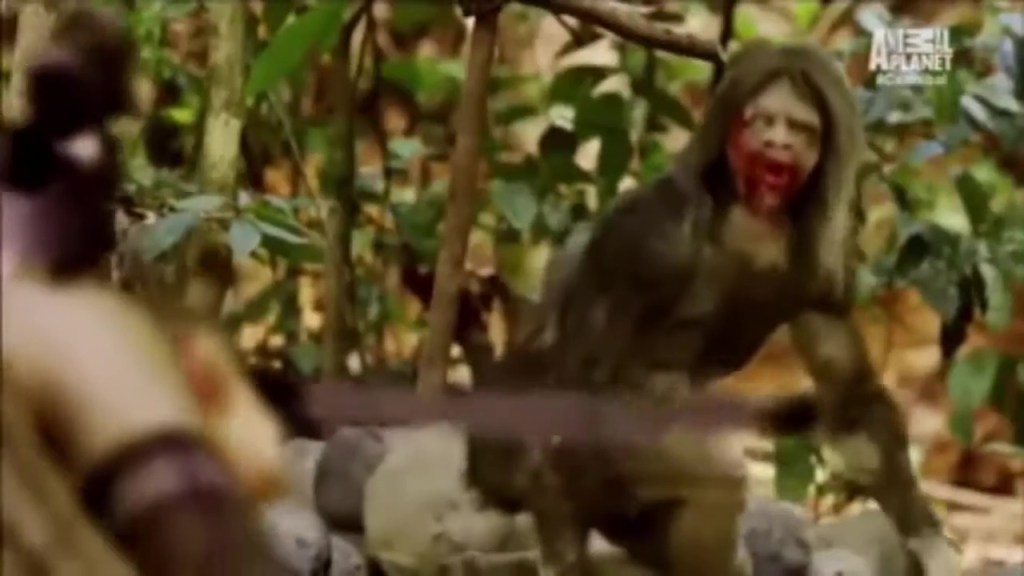
In this week’s offering, The Cannibal in The Jungle, the director Simon George presents a feature-length ‘true-crime’ special about an American scientist accused of murdering and consuming the remains of his fellow explorers while on an expedition in 1970s Indonesia. The murder/cannibalism case is told through interviews with an Australian anthropologist Richard Hoernboeck (played by Scottish actor Jim Sturgeon with a broad Australian accent), who says he found evidence of a tribe of very small hominids which he calls hobbits, and subsequently chose to investigate the murder/cannibalism case, 25 years after it happened. He tells us that in 1977, an American ornithologist was convicted of killing and cannibalising two colleagues in the jungles of Indonesia while on a quest to study eagles, as well as hoping to find a supposedly extinct owl. Instead, Dr Timothy Darrow, branded ‘The American Cannibal’ by the press during his trial for murder and cannibalism, claimed in his (unsuccessful) defence that they had been attacked by a lost species of early humans. These hobbits, he said, were responsible for the murder and consumption of his friends. Nobody believed him. Cannibalism is easier to believe than hobbits.
In fact, the remains of a species matching Darrow’s description were found in those jungles of Indonesia in 2003 by an anthropologist from Wollongong University, although his name was Mike Morwood (a hobbit name if ever I heard one). In what is now regarded as one of the most important anthropological finds ever, a team of scientists discovered the bones of an entirely new species of human, one that stood only 43 inches or 110cm tall. Homo floresiensis (popularly called Flores Man or more popularly Hobbits) lived on the island for perhaps over a million years before going extinct. Some recent research suggests that a tribe of the hominins known as Homo erectus became isolated on this remote Indonesian island, perhaps a million years ago, and evolved a dramatically smaller body size.
But did they really go extinct? An indigenous tribe on the Indonesian island of Flores, where the remains of the ‘hobbits’ were discovered, have their own accounts of little wild men that climb trees and walk on two legs. They also describe them as cannibals. And according to their legends, they may never have died out at all. This story claims to follow Hoernboeck’s expedition into the jungle of Flores, Indonesia, seeking to discover if hobbits still exist, whether Timothy Darrow’s ill-fated expedition really encountered the supposedly extinct creatures, and if the ‘American Cannibal’ was therefore innocent of the crimes for which he was convicted more than three decades previously.
The local people of the island, the Lio, claim that the hobbits were around until very recently, and may still be hiding out in the forest. In the fake doco, they are shown suggesting that they would kidnap and eat children, although being a different species to Homo sapiens, I suppose this would not technically be cannibalism.
The program is ingeniously done. Hoernboeck, the modern-day anthropologist, shows purportedly real video of his interviews with the imprisoned Darrow (played by Richard Brake, who was in Game of Thrones and Hannibal Rising, so there’s a giveaway for the alert horror fan), and his expedition to trace the journey on which Darrow supposedly found the hobbits. Interspersed with this, we are shown what we are told is a reenactment of the original expedition by Darrow and his friends/victims. The implication is that we can believe the rest is real, because they told us what was staged. We move to the present to see the anthropologist tracking down Darrow’s tape recorder which contains the taped call of the hobbits, then eventually the actual film taken by Darrow that proved his innocence but, alas, not until after he died in the brutal Kerobokan prison.
With a modicum of willing suspension of disbelief, it’s actually pretty convincing, and quite sad, unless we keep reminding ourselves that the whole thing is a fake. Those who watched it when it first came out, unless they recognised the Night King or the war criminal who ate Hannibal’s sister, did not discover that it was all fictional until the very end, when there is a (very) short statement. Most viewers probably wouldn’t even have noticed it.
What I found interesting is the depiction of the totally credible outrage of the Indonesian authorities, furious that an American would eat the Indonesian guide. Yet when the Flores locals are shown talking about the hobbits capturing and eating their children, there is inaction. Nature is red in tooth and claw! Animals eat each other, and eat people if they can, so if some unidentified ape ate your child, well, that’s unfortunate. But anthropocentric ideology denies our animality, so for a human to eat a human still manages to shock. The false binary of human/animal has led science to tie knots in the language, with some calling the hobbits “ape-men” and one learned anthropologist, Gregory Forth, calling his book about them Between Ape and Human. Like this documentary, the idea of a lacuna between apes and humans is fictional. We are a species of great ape, and our DNA is 98.8% identical to chimps.
Dr. Darrow’s supposed cannibalism was more horrific than nature’s mundane bloodbaths, not because he was genetically similar to the victim, but because he was a post-doctoral scientist, a ‘civilised’ man. If either party to slaughter, the one wielding or the one enduring the blade, can be defined as ‘animal’, all bets are off. The cannibals we consider in this blog are simply better than most people at dehumanising, objectifying the other.
The full movie is available, at the time of writing, at Daily Motion.
Even the poster didn’t try to persuade people that it was true.
“crying, why are ppl actually believing this … y’all believe anything”
That is certainly true. You may recall an almost identical campaign a few years back which claimed that Anne Hathaway had left evidence of cannibalism in a house she sold in 2013. This turned out to have been a “sociological study.”
Oprah has a history of media interviews in which she discusses food. Recently, she extolled the idea of using medications for losing weight, revealing that she has been using such drugs. Who can say that a high protein, low carb diet based on the cuisine of Dr Hannibal Lecter might not prove effective? Have you ever met a fat cannibal?
In 2008, Oprah went on a three week “vegan cleanse”. At the end of that brief period, she wrote
“At the end of the 21 days, I could not declare myself vegan or even vegetarian. But I am, for sure, more mindful of my choices. I’m eating a far more plant-based diet.”
Maybe giving up meat for health, environmental or ethical reasons could go beyond just avoiding human flesh, for everyone’s health?
If you read this blog, and I hope you do, you might remember a movie we reviewed recently called Wendigo. It was about the mythical creature from Algonquin legends, the spirit who takes over humans and turns them into voracious cannibals whose feeding frenzy makes them grow larger and, consequently, hungrier. The Wendigo is usually represented by the stag or at least the antlers of a stag; thus the title of this week’s film, Antlers, which fronts another Wendigo, although this time a rather less complex creature.
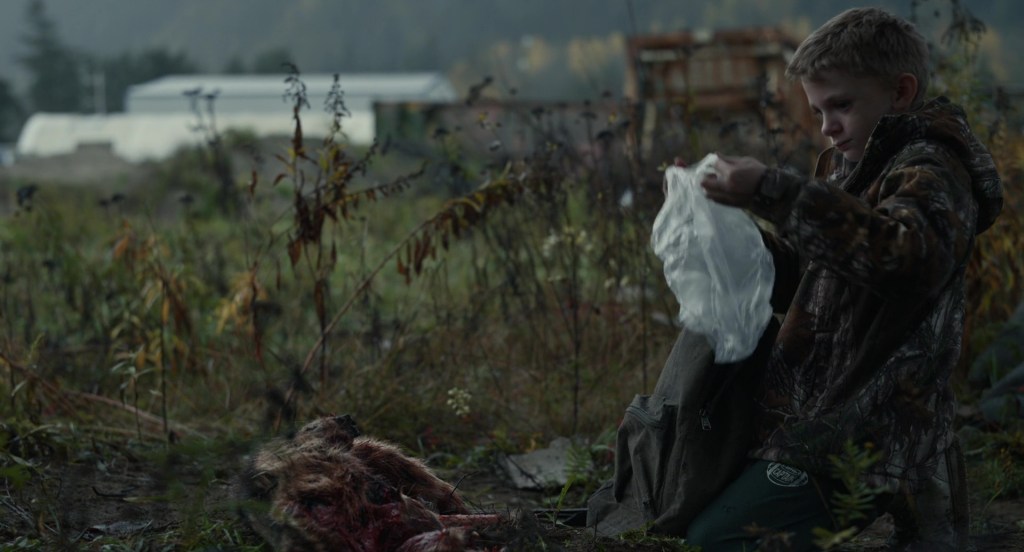
Directed and co-written by Scott Cooper (Crazy Heart, Black Mass) the film is produced by Guillermo del Toro, who has already won three Academy Awards for his imaginative grotesqueries. Del Toro’s films exhibit his fascination with fairy tales and mythology and the monstrous, in which he finds poetic beauty. The cast is outstanding, led by Keri Russell (Grimm Love, The Americans) as Julia, a teacher in rural Oregon who wants to help a young boy in her class named Lucas (Jeremy T. Thomas) who, she suspects, is suffering parental abuse. She thinks this because he is drawing gruesome pictures of creatures with huge antlers, and collecting roadkill.
Jeffrey Dahmer’s dad used to take him out on road trips to find roadkill to dissect, but there was nothing wrong with him, was there? Well, OK, but anyway, he wasn’t being abused, and nor is Lucas (except by the usual school bully).
Lucas’ dad was using an abandoned mine to cook methamphetamine, disturbing the quiet of the place, releasing who knows what has been hiding in there? Yep, but it’s not a balrog (also usually shown with horns), it’s a wendigo. And it has infected both the dad and the little brother. Dad is now very loud, very violent creature with a lack of hair (bit like Gollum, but more excitable) who need to be fed raw meat every day. No smart cracks about Oregonians, please. But Julia is an outsider herself – she fled to California as a young woman to escape her abusive father, and is wracked with guilt about leaving her brother Paul (Jesse Plemons – Friday Night Lights and Breaking Bad) behind. He is now sheriff of the town, where he does exciting things like evict poor people from their humble homes. She thinks he resents her, and we think so too – why wouldn’t he? He tells her he spent his entire life praying she’d come back. But now, whenever he comes near her, she flinches as she flashes back to her father abusing her as a child.
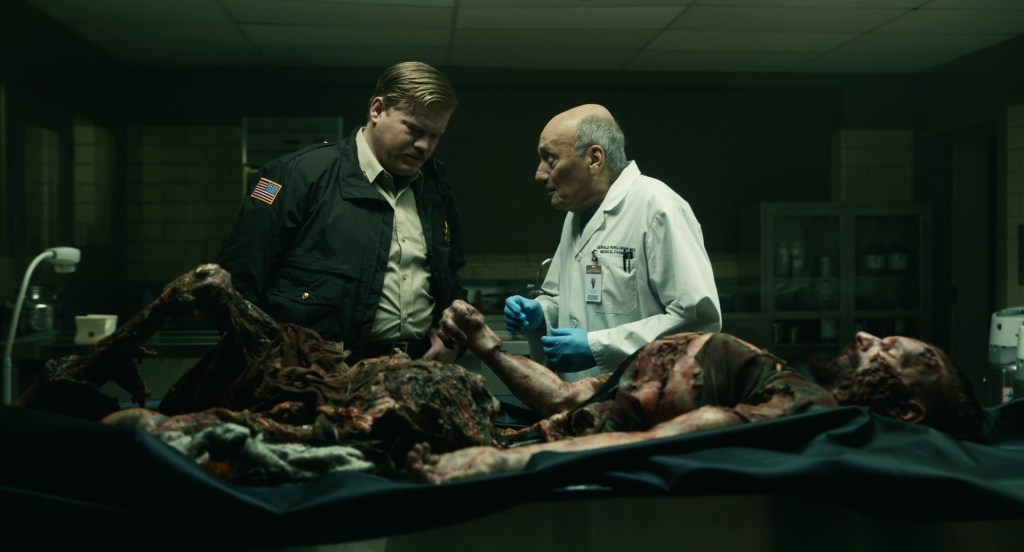
Paul goes into the woods to retrieve half a human body that someone has reported, and takes it to the coroner, who tells him the mutilation shows teeth marks – and they are human teeth. Almost halfway into the movie, and we finally have some cannibalism going on! Paul finds the other half of the dude (the dad’s former business partner) in the mine where they were cooking the meth. Also some mysterious antlers!
From there on, people start getting eaten – the stern school principal, the school bully who has been picking on Lucas (monsters can also be instruments of justice). It doesn’t work well for dad either; after he is finished enjoying the school principal, the real monster, now in the shape of a skeletal beast looking similar to the creature fought in the Alien films (but with antlers), sacrifices his body (the reference to the crucifixion is clear), then bursts out of his mouth, leaving him a charred, flayed wreck.
Lucas is carried off to the hospital, where he is diagnosed as dehydrated, malnourished, and deeply psychotic. Well, no wonder!
Warren, the previous Sheriff, is a local Native American, and explains to them that Lucas’ drawings, as well as the antler found in the mine, depicts the Wendigo,
“…a diabolical wickedness that devours mankind… known to be eternally starving but feasting makes them hungrier, and weaker. Those who are unfortunate enough to encounter one can only kill it when it’s in its weakened state. And only by extinguishing its beating heart, forcing it to search for another host. But it makes sense you see – our ancestral spirits never died. They were here long before we were here, and they’ll be here long after we’re gone. But now they’re angry.”
They find the missing school bully, who has been “eaten in half”, but Paul tells Julia he still cannot believe in a mythical nature spirit. He requires a conversion experience – maybe his deputy getting pin-cushioned and eaten, and then him getting comprehensively monstered? That leaves it up to Julia to take on the Wendigo. Being a teacher, she remembers the bit about it being weakened when eating, and the bit about extinguishing its beating heart. Using some impressive combat techniques that she probably learnt in The Americans, Julia rather easily beats the big beast, but then has a new problem – the Wendigo spirit is now in Aiden, Lucas’ little brother. Does Julia have the heart to kill and tear the beating heart out of an eight-year-old boy who looks like he just needs a meal and a bath? And do it while she is being watched by his big brother, Lucas?
Spoiler alert: you bet she does!
But as we watch the happy ending, Lucas now living with Julia and Paul, we see Paul begin to cough and spit out black foam – the first symptom of becoming a Wendigo (or this version of it.) As Jeffrey Jerome Cohen told us in his “Seven Theses” on monster culture, the monster never really dies or goes away; it just comes back in different clothes, or different skin. No matter how many times Ripley killed the Alien, it kept coming back, sometimes in the shape of its progeny (a reversal of the Beowulf story, where killing the monster arouses his mother’s wrath).
There are several versions of the Wendigo story. In Supernatural, the Wendigo only ate people every 23 years, an extreme version of the paleo diet. In Fear Itself, the Wendigo takes over anyone who is weak and hungry and fills them with rage, while in Lone Ranger, it appeared an outlaw in the Old West, who could only be killed with a silver bullet for some reason. The common thread is insatiable and voracious appetite, a hunger that destroys without thought for sustainability. In Bones and All, that hunger begins young and gets stronger as they grow older. Perhaps the classic of Wendigo literature is the film Ravenous, in which becoming a Wendigo gives not just superhuman strength but close to invulnerability, or at least the ability to heal any wounds by eating more people. And, of course, a voracious hunger.
The film starts with a warning. This is read in Ojibwe, one of the Indigenous languages of the Algonquin people, whose lands stretch from present-day Ontario in eastern Canada all the way into Montana. This is the language in which the mythology of the Wendigo was developed. The English translation scrolls up the screen:
The film is brilliantly acted, beautifully filmed and directed, but could have made more of a point of the environmental message with which it started, rather than just hurtling into the special effects and gore. The Wendigo is well presented, if a little sparse (we hardly see those antlers), but the connection between the greed of humans and the monstrous revenge of nature is left hanging. There have been five great extinction events found in fossil records. The SIXTH MASS EXTINCTION is happening as we speak. Extinctions have occurred at over 1,000 times the background extinction rate since 1900, and the rate is increasing, a result of human activity (or ecocide), driven by population growth and overconsumption of the earth’s natural resources. In late 2021, WWF Germany suggested that over a million species could go extinct within a decade in the “largest mass extinction event since the end of the dinosaur age.”
Humanity has waged war on nature since we came down from the proverbial trees, but particularly since the agricultural revolution some 12,000 years ago, when we decided nature could be dominated rather than placated. Fossil fuel combustion, the selective breeding of billions of other animals for food or clothing, the capture of wild animals for entertainment – these are all manifestations of the war on nature, motivated by a Wendigo-like hunger which can never be satiated. It’s a war that we cannot win, without destroying ourselves in the process – nature never goes away, but, like the Wendigo, comes back in another (angrier) skin – floods, droughts, climate change, etc. We have, as the Ojibwe warning says, pillaged the land and awakened a Malevolent Spirit. Like any organism evolving by natural selection, we can adapt or die. Our only advantage over other species is that we could, if we had the sense, decide which to choose.
A man was arrested on Friday March 22 in Kern County (north of Los Angeles in the San Joaquin Valley) and charged with the “removal of human remains from other than a cemetary” (sic) according to the Sheriff’s office.
Construction workers in Wasco reported seeing the man near the Amtrak station.
“I’m not sure from where, but he walked this way and he was waving a person’s leg. And he started chewing on it over there, he was biting it and he was hitting it against the wall and everything.”
It seems a pedestrian (unidentified so far, some reports say male, others female) was killed by a train on Friday morning near 7th and G streets in Wasco. According to eyewitnesses, a man was subsequently seen eating a human leg that had been torn off in the accident.
The video shows the man in a red hoodie and black pants bending over something. He turns around and laughs at the person taking the video and then walks away. Shortly afterwards, the video shows the police responding and the man waving the leg at the officers.
A voice can be heard on the video saying, “He’s eating that shit!” in English and then in Spanish. Most of the news reports edit out the parts where it looks like he might be eating the leg.
Other news footage from KERO-TV showed what appeared to be bloodstains on the sidewalk at the scene of the incident. Some reports say he was charged with mutilating the body, supporting claims that he had consumed some of the limb.
The sheriff’s office later confirmed that they had arrested the man and identified him as 27-year-old Resendo Tellez. He was charged with six offences including possession of controlled substance paraphernalia.
Social media commentary varied from reflecting on drugs, homelessness and poverty to accusations of demonic possession and culture war accusations against California liberals allowing a “breakdown of societal norms”. One headline stated, “Cannibals Are Alive and Well in Newsom’s California.”
JUST IN: California man arrested for allegedly eating a severed leg that he took from a pedestrian who was struck by a train.
The incident happened in Wasco, California.
According to police, 27-year-old Resendo Tellez removed a leg from an Amtrak Station.
News footage of the story often contains warnings of “distressing material” and in most cases blur the leg when showing the video. Is there something weird about all this shock and horror?
If the same person had not been hit by a train, it would have been perfectly normal to show that person’s leg in a program on, say, beach holidays. On a porn site, the leg would have been the least of what we might have seen. Yet once detached from the torso, a human limb becomes so abject it must be blurred, and even then, warnings issued. The reason seems to be that we are terrified to admit our animality. We can go to a supermarket and push a trolley around containing the leg of a cow or a lamb, with the overt understanding that we will be eating it later, just as Tellez allegedly did with what he identified as a piece of meat lying on the ground. Yet because it is a human body part, it becomes obscene, repulsive, horrifying, because it reminds us that we, too, are mortal, edible animals, made of meat.
Peter Jackson is a New Zealander, and the fourth-highest-grossing film director of all time, behind only Spielberg, Cameron and the Russo brothers. He is best known for The Lord of the Rings and The Hobbit trilogies, as well as movies like King Kong and the documentary The Beatles: Get Back.
But we all have to start somewhere, and Jackson’s first feature was Bad Taste, a splatter comedy which took years to make as it began life self-funded and only later received a grant from the NZ Film Commission. Many of Jackson’s friends acted and worked on it for no charge. Shooting was mostly done on weekends since Jackson was then working full-time for a newspaper in Wellington, the NZ capital.
Bad Taste is about aliens who plan to capture humans for food. They take over a (fictional) NZ town called Kaihoro (which means something like “fast food” in Maori) and butcher all the residents.
“There’s no glowing fingers on these bastards. We’ve got a bunch of extra-terrestrial psychopaths on our hands.”
It turns out that they are not just hungry but entrepreneurs from the “Crumbs Crunchy Delights” company, and need to collect human flesh for the home planet market, and get it there before competing alien corporations.
“I am certain that when the Homo sapiens taste takes the galaxy by storm, as it will, Crumbs Crunchy Delights will be back at the top”
They are disguised as humans until they drop the pretence and, luckily for us, they speak English to each other to reveal their plans. Their plans are foiled by a team of agents from the Astro Investigation and Defence Service (AIDS) entering the town to take down the invaders.
The action sequences are actually very well done, long before Jackson had access to special effects studios, with choreographed fight sequences and buckets of gore and brains and other body parts. Jackson took two roles, a nerdy scientist who is a member of the government agents, and a leader of the aliens, including a famous scene in which he fights himself on top of a cliff.
The film is most famous for its unapologetic gore, including half-eaten bodies, heads coming off, and brains leaking out of skulls. The brave Kiwis mow the aliens down in an interminable gun-fight, which culminates in Derek (Jackson) killing the alien leader, Lord Crumb, by jumping on him from the floor above while wielding a chainsaw, a favourite of cannibal films, cutting the alien’s body in half and disappearing inside the corpse. The film was banned in Queensland briefly, which did wonders for its publicity; the video release proudly proclaimed on the cover “Banned in Queensland”.
But is it cannibalism? It is after all a completely alien species from another world eating humans, or at least trying to. So not strictly cannibalism, but humans being eaten by aliens dressed as humans is a popular narrative in science fiction texts (see for example Under The Skin), and raises some interesting questions. Anthropocentric humanism maintains that we are somehow on a higher level than “animals”, even though we are animals, a species of Hominidae (Great Apes). Because of this ontological division, bolstered in past centuries by religious beliefs about humans being made in the image of the divine, we tend to judge other animals as possessions, inferior beings to whom we can do as we wish, so we kill them, skin them, shear them, eat them, experiment on them, race them, and so on. Not just other animals; the colonisers of Africa, South America and other parts of the world felt the same way about the indigenous peoples who lived in the areas they coveted, and so they were conquered, enslaved, converted or simply exterminated.
What if travellers from another planet, considering themselves far superior to us (not an entirely unreasonable proposition if they have conquered deep space travel), decide to colonise, exploit or even eat us? If we could take them to the Galactic High Court, the learned judges might rule that the aliens were simply doing to us what we do to billions of other earthlings each year. As John Harris wrote:
Suppose that tomorrow a group of beings from another planet were to land on Earth, beings who considered themselves as superior to you as you feel yourself to be to other animals. Would they have the right to treat you as you treat the animals you breed, keep and kill for food?
Bad Taste is well made, entertaining and, if you are not worried by lots of gore and brains, very watchable. It debuted at the Cannes Film Festival in May 1987, which is not bad for a first movie, a splatter comedy, made on a shoestring. It currently has 71% “fresh” rating on Rotten Tomatoes, which is far better than many far better financed films. A number of critics made great sport of the title, saying that “bad taste” described the film well, but that was deliberate, a clever combination that tells the audience that it is bad taste cinema (may leave a bad taste in your mouth) and that human meat tastes bad, which according to all the cannibals who have testified about it, is simply not true. We taste somewhere between veal and pork, and would certainly be very popular in galactic fast-food joints.
Simone (a bravura performance by 17-year-old Désirée Nosbusch) is a teenage fan obsessed with a pop singer known only as “R.” That obsession takes over her life – she drops out of school, waits outside the post office for a week for a reply to her letter, which will never come because his fan mail goes straight to the tip. She climbs to the top of the church steeple in her town of Ulm (it’s actually the tallest steeple in the world) and thinks about jumping off, splattering herself all over the town square, but with a letter to R in her pocket, so he will hear of her at last.
Nosbusch as Simone offers a fascinating glimpse of the modern cannibal – she looks and acts normal (for an angst-ridden teen) but underneath are irresistible currents of passion and voracious appetite for her idol. She attacks the postal worker who disappoints her by not having a letter for her, she attacks her father for turning off the TV show on which R is performing. The walls of her room are covered in pictures of R. The film shows parallel imagery to her obsessive love; images of Nazi salutes – the same obsessive love that led Germany and the world into catastrophe a few decades previously.
The word “fan” comes from “fanatic”. The fanatic believes he or she has found the answer, the one who knows us, cares for us. She feels that R, who has never heard of her, knows her inside out. And she will know him, inside out.
She drops out of school and hitchhikes to Munich, where R’s shows are recorded, being accosted on her way by a range of toxic men, but of course the worst of them is the one she is so desperate to meet. She sleeps in unlocked cars while she waits outside the studio, so frantic that, when she finally meets him, she faints.
R seems concerned and kind, invites her to his show, where he appears as a mannequin surrounded by store mannequins – a bald wig symbolically obscuring the divide between human and inhuman, life and death.
He takes Simone back to the apartment of a friend who has gone to the US for a year, where she finally achieves the intimacy she has craved. Nobody knows they are there, so anything can (and does) happen.
But R is a superstar – he is not interested in the meeting of the souls that she imagines will happen, and afterwards tells her he has to go back to his work, tries to fob her off with vague promises of future meetings. He tells her to leave the keys on her way out.
Simone wants to own him and his love, but he just wanted her young body. As he leaves, she picks up a figurine of the goddess Diana, the Huntress, and she then hunts him, killing him with a blow to the head.
Once he is dead, he is hers at last, to do with as she wishes. The imagery switches to that of a Christ, broken and crucified, and she cradles him in her lap like an erotic Pietà.
She sees a freezer, and she sees an electric knife.
R’s blood is, as the Bible says, his life, and she laps it up from the floor and from her knife.
When R is neatly packed in the freezer, Simone faints, but next day we see pots boiling on the stove, his foot being basted with his juices.
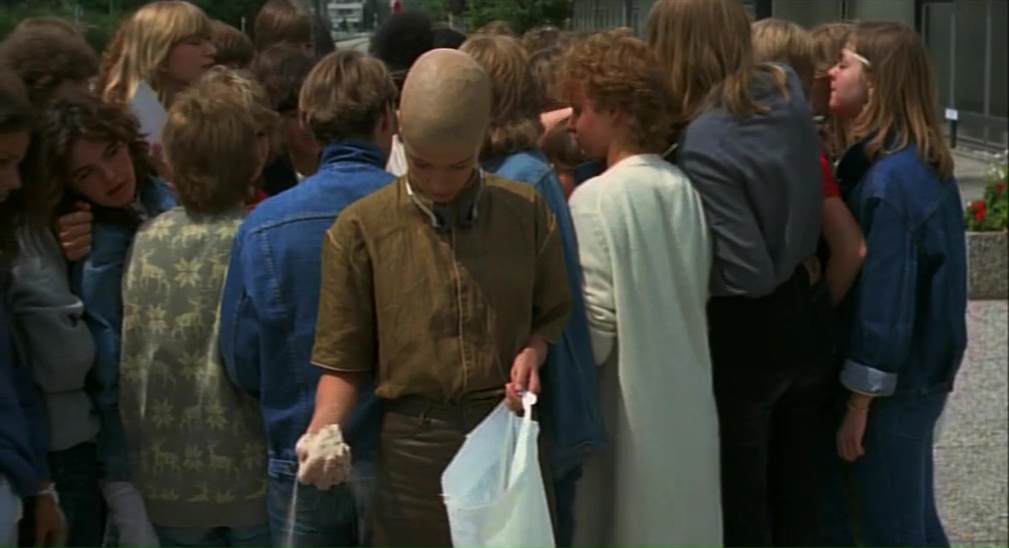
She eats him over a few weeks, then grinds his bones to dust and takes the dust back to the TV studio; pouring it out at the place she met him.
Her revenge involves ceremonial murder and cannibalism, to ensure he will always stay with her, and inside her. Leaving for home, her head shaved so she looks like one of the mannequins from his performance, she promises her parents to return to school.
She sits with them and watches the news – R’s disappearance weeks ago remains a mystery. But she knows where he is.
“I missed my period. I’m four weeks late. I will bring you into the world. We will be happy. I know you love me. And me too: I love you.”
He is inside her, and so is his seed. Like Christian mythology, R will be reborn, but this time totally dependent on her, loving only her.
The film did not garner a lot of interest or decent reviews, but has picked up a bit of a cult following in the years since. It is an excellent study of the monstrous-feminine, a figure often found in cannibal narratives, particularly around revenge and love. Mariana Enriquez’s recent collection of stories called The Dangers of Smoking in Bed has a similar story called “Meat”, in which two similarly obsessed fans dig up a dead pop idol and eat his rotting corpse. Well worth a read if, perhaps, not during mealtime.
Fuelled by a minimalist synth soundtrack from Rheingold and stunning photography, Der Fan is an engrossing and fascinating study of love, not in its sentimental, romantic form, but as possession, greed, rage and cannibalism. Much of lovemaking is expressed orally, through kissing, fellatio, cunnilingus, and licking or sucking and sometimes chewing of various body parts. Simone has taken this to its logical extreme. R is inside her, and so is an embryonic version of him, which she promises to love as she had hoped to love its father. It’s resurrection through transubstantiation.
































 The Cannibal Guy