Cannibalism News 2024: Putin pardons more cannibals

Another Russian convicted of murder and cannibalism has been pardoned by Vladimir Putin after fighting in the Ukraine.

Denis Gorin (Денис Горин), from the city of Aniva, Sakhalin region, was recruited into a private military company after signing a contract with the Russian Ministry of Defence. He is known to have been convicted three times for murdering at least four people between 2003 and 2022. He and his brother were also convicted of eating the remains of his victims. Gorin killed his victims, then washed and refrigerated the remains. After his last conviction in 2018, Gorin was sentenced to 22 years in prison.

However, at least seventeen convicted murderers have been pardoned by the Russian President since 2022 for agreeing to serve in the war on Ukraine. A neighbour of Gorin, Dmitry Vladimirovich, said that Gorin was now free and had been admitted to a military hospital in the eastern Russian city of Yuzhno-Sakhalinsk due to a moderate injury. The neighbour added that the victims’ relatives are likely to arrange a lynching.

“He’s basically free, pardoned, and half his sentence has been wiped out. But I don’t think he’ll stay free for long. His victims’ relatives remember everything.”

The first murder was in 2003.

“At the trial, he admitted that they ate the murdered man; he was their acquaintance. They killed him because they were drunk, and then the elder brother, Evgeniy (he had already tasted human flesh by that time), tried to force his wife to eat it. Then – his younger brother, Denis. According to Denis, he refused, but his brother threatened to kill him too. Then he started eating.”

After that first murder, Gorin was sentenced to ten years imprisonment, but released after seven years due to “exemplary behaviour”. Gorin returned to Aniva where he stabbed to death the brother of another prisoner with whom he was in the pre-trial detention centre. After the murder, according to the case file, he “decided to remember the past, namely, to cut off the meat from [the victim] and subsequently eat it.”

In 2011, Denis Gorin and his brother killed a man and hid his body on the banks of the Lyutoga River, and at the beginning of 2012 they committed another murder, according to the regional prosecutor’s office. This was proven five years later. In 2018, the court sentenced Denis Gorin to 22 years of imprisonment in a special regime colony for the last three murders. The neighbour reported that:

“This came up by chance; they also tried to kill one local while they were drunk, but they couldn’t. When they were detained, (I was present), they opened the refrigerator, and it was filled to the brim with human meat! He told us right there how he cut meat from the legs of the dead, looked at the biceps to see if there was meat there. They showed the hole where the remains were buried – there were 12 people there. Not three, as stated in the verdict! And among the skeletons there was a very small one – some girl was killed. But we couldn’t prove it in court.”

In 2023, Putin pardoned him. Pro-Kremlin media has ignored the news of the cannibal’s pardon. Nevertheless, it appears sporadically on social networks and instant messengers.

“Maniacs are real. His brother was killed while still in prison, and this brother didn’t even serve five years, but is already free. Maybe he’ll be patient for a year, and then he’ll start killing again.”

A photo on Gorin’s social media profile on Odnoklassniki – a Russian social media platform shows him wearing a military uniform with the letter Z emblazoned on the sleeve, a pro-war symbol for conflicts in Ukraine and abroad widely used in Russia.

Another man, Nikolai Ogolobyak, a self-confessed Satanist, was convicted of ritual murders, and sentenced to 20 years in prison in 2019 for murdering four teenagers and then consuming their remains. The 33-year-old man was reportedly pardoned by the Russian president for fighting in Ukraine.

This blog reported on another jailed cannibal, Yegor Komarovwho was purportedly released to fight in Ukraine in 2022. 

Russia’s Defence Ministry and the Wagner mercenary group have recruited heavily from Russian prisons to the notorious “Storm Z” unit of convicts, to bolster their manpower in Ukraine, promising convicts a pardon in exchange for military service. Several of these pardoned convicts have reportedly committed new crimes after returning from Ukraine. And returned soldiers do tend to come home undernourished and voraciously hungry.

THE HUNGER GAMES: Ballad of Songbirds and Snakes [and Cannibals] (Francis Lawrence, 2023)

The Hunger Games began as trilogy of novels by American author Suzanne Collins (2008-2010). The prequel, The Ballad of Songbirds and Snakes, was released in 2020. The first three were adapted into four films (annually from 2012-15), all of which set various box office records. The first film, The Hunger Games (2012), recorded for biggest opening day and biggest opening weekend for an original IP. In 2023, the prequel to the trilogy, titled The Ballad of Songbirds and Snakes, was released as a film.

The Hunger Games is a post-apocalyptic dystopia set in Panem, a North American country consisting of the wealthy Capitol and 13 districts in varying states of poverty, punished for rebelling against the Capitol. Every year, children from the first 12 districts are selected via lottery to participate in a compulsory, televised battle to the death called The Hunger Games. The name Panem derives from the Latin phrase Panem et circenses, which literally translates into “bread and circuses”, the ideology used by the Roman emperors to distract the citizens from their daily struggles and the obscene indulgence of the elites. One of the highlights of the Roman circuses was the gladiators, who would fight to the death, as a popular form of entertainment.

There are not really any rules to the Hunger Games (except kill everyone else) but cannibalism is frowned on, as the audience find it a bit gross. Compared to just, you know, chopping people up. Titus (named after one of the crazier Roman Emperors) kills combatants in the 66th Games by tearing out their throats and eating their organs; he is killed in an avalanche, presumably created by the organisers because of his threat to their ratings. Like many cannibals, he is dismissed as just plumb crazy.

The Ballad of Songbirds and Snakes is a prequel, starting 64 years before the Hunger Games, during the ‘Dark Days’ which led up to the failed rebellion in Panem. How, it wonders, did we get this way? Well, cannibalism of course is part of the answer. In the novel, the narrator says:

“…the siege had reduced the Capitol to cannibalism and despair.”

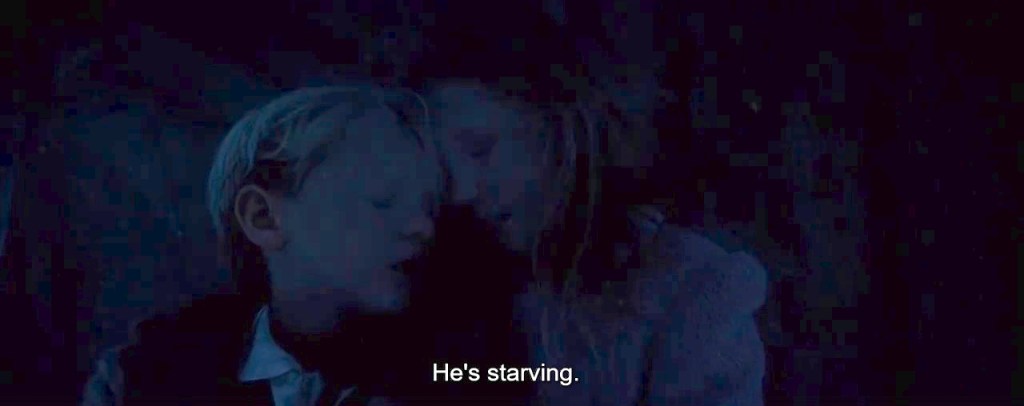
But this is a movie, and you know the golden rule: show don’t tell. So the opening reveals two children, a young Coriolanus and his cousin Tigris, running through the snowy streets of the Capitol during the rebellion, hunting for food. A man appears with a cleaver and chops the arm from the corpse of a woman.

“Why is doing that?” asks the boy. Tigris replies simply:

So, the scene is set for the rise of Coriolanus Snow, who eventually becomes the ruthless President of Panem (played by Tom Blyth in this film, and later the incomparable Donald Sutherland). To him, the ends justifies the means, and what ends are more important than staying alive, even if it requires killing and sometimes eating people? It’s the human condition, particularly in post-apocalyptic dystopias. That’s entertainment!

“See how quickly we become predator? See how quickly civilisation disappears?”

“Every cannibal wants to be a director”: LONG PIGS (Nathan Hynes, Chris Power)

Long Pigs is a 2007 “found footage” movie, in which two desperate filmmakers come across a cannibal, ask him if they can document his eating habits, and then are shocked when he starts killing people and eating them. It is presented as a documentary, with all the usual warnings about graphic scenes etc.

Bit silly, and found footage has rather been done to death, but it has some interesting ideas, particularly the sympathetic approach to the main character, even as he commits his crimes. Look, it seems to say, everyone needs a hobby and, to this cannibal, killing and eating people is no more ethically questionable than hunting or fishing. Stalk, catch, kill (as quickly and painlessly as possible) and then enjoy. He does his best to keep the movie interesting, with a patter of jokes, historical facts and philosophical observations as he slices and dices.

The cannibal is played by Anthony Alviano (Headcase, A Matter of Justice), and he presents the cannibal, also called Anthony, as a boy-next-door persona, one who kills and guts people. Like a farmer of animals, he starts the film explaining that it’s bad to frighten the victims, not for ethical reasons, but because the adrenaline ruins the taste of the meat. The filming starts as he drives around looking for a “certain kind of woman”, because he wants to make “long pig stew”. “Long pig” is a term supposedly used in the Pacific region before colonisation to designate human meat, although that definition is widely contested. Anyway, Anthony is looking for “marbled meat”, so he searches for a sex worker (traditionally victims who are not exhaustively looked for by police) who is, let’s say, of a heavy build.

“People who eat stew make perfect stew. It sounds obvious. Yeah, she looks like she eats well.”

As she smiles at the camera, he sneaks up behind with a sledgehammer and cracks her skull, resulting in the cameraman vomiting (which is actually rather more gross than the murder). They ask Anthony if gets a sexual thrill from killing women, but he dismisses this, in the same way a slaughterhouse worker might deny any pleasure in killing a different species of mammal.

“I’m not a freak or anything like that. This is all culinary, this is hard work!”

“Any hunter would recognise this position. We got the corpse hanging by the ankles. The first thing I’m gonna do here is make a little incision and tie off the anus. That’s to stop contamination from the feces. You would do that whether it was a deer carcass or a cow or a person… Absolutely necessary for health reasons.”

He cooks a stew from a portion of her thigh, then after dinner goes off to brawl in an ice-hockey game, an arena that seems the very essence of carnivorous virility.

Afterwards, he cooks ribs on a barbecue, assuring the viewers that there are “no animal by-products” used – just soymilk. And a woman’s ribs, of course, thus reinforcing the anthropocentric mythology of the human as not really animal, even though he has just butchered one in the same way as any other animal prepared for human consumption. He quotes the Arawak word barbaca, the grill on which human meat was supposedly cooked, according to explorers like Hans Staden and Jean de Léry, which became the Spanish word barbacoa, and eventually morphed into English as barbecue. Staden’s narratives were later illustrated by Theodor de Bry in his 1592 book Americae Tertia Pars, and the film sneaks in a quick peek at that glimpse of sixteenth century sensationalism.

There’s a lot of moral philosophy interwoven in the scenes of murder and gastronomy. Anthony the cannibal and his friend try to persuade the filmmakers to try some of the ribs, saying, it’s dead, and therefore cannot suffer, whereas we eat live vegetables, and “broccoli feels pain! Did you know that?” This is precisely the argument tossed at vegans by carnists, but in this case, it demonstrates the contention of the nutritionist Herbert M. Shelton:

The cannibal goes out and hunts, pursues and kills another man and proceeds to cook and eat him precisely as he would any other game. There is not a single argument nor a single fact that can be offered in favor of flesh eating that cannot be offered with equal strength, in favor of cannibalism.

Anthony works as a valet in a fancy restaurant, parking cars for rude people, and if you follow the lore of Hannibal Lecter, you will know that rude people are prime targets of cannibals. They park the car of a particularly rude man, take down his address from his licence and, next day, shoot him and load him in their car trunk. Unfortunately, they have a flat tyre and have to head to a pig farm for help, where they witness pigs being slaughtered and prepared for sale, in identical ways to Anthony’s own processes, but with rather better technology, and, oh yes, totally legally.

Most of the film is a spoof on cooking shows, which regularly have smiling chefs, or hopeful chefs, preparing lumps of animal flesh, hoping to win prizes. Anthony shows, in high-speed motion accompanied by the music of the Sugarplum Fairy, exactly how he prepares a body, stripping it and dismembering it until all that is left is two feet (still in socks) and the long femurs. He demonstrates how to get rid of the bones, cutting them up and putting them in a kiln at 2600 degrees – he even uses the line “these are some we prepared earlier.” This is a cooking show for cannibals.

Anthony is a typical modern cognate cannibal; as he says, people expect Hannibal Lecter, so “no one is going to suspect the valet”. This gives him the invisibility that we saw in cases like Jeffrey Dahmer. He loves his old mother who is in a nursing home, and is bewildered by a doctor’s request to do a post mortem analysis brain when she dies, a sophisticated update of cannibalism. He sadly tells the filmmakers that she has Alzheimer’s, but we eventually find that she died of Creutzfeldt-Jakob spongiform encephalopathy, a human version of mad-cow disease, probably from eating human meat that he fed her. He also admits to eating a five-year-old girl called Ashley, because people prefer meat from young animals, but was subsequently perturbed by the extensive police searches, and now avoids playgrounds and schools: “It’s like a supermarket, man.” As New Year celebrations explode outside, he comes to realise the filmmakers are going to release the movie, which will detail all his criminal history, and goes to get his sledgehammer. The rest, as Shakespeare says, is silence.

Anthony has a philosophy that rejects anthropocentrism and sees nothing wrong with cannibalism, or at least nothing that does not apply to any other meat. It’s a cannibalistic rejection of what Richard Ryder and later Peter Singer called “speciesism”.

“It’s only human beings that are so arrogant that they believe they are better than every other kind of animal out there. Worms don’t think about, you know, oh my god, why did mama worm get eaten by a fish; fish eats the worm and that’s that, it’s completely accepted by the worm, and the fish, and small fish gets eaten by the big fish, and if it was so wrong to eat it, then why would it taste so good?”

At the end, he is in jail, but he has published a cookbook. His cooking show has finally paid off.

This is a low-budget film, but is a lot better than might be expected. The creators were lucky enough to secure the services of Chris Bridges, the special effects artist whose credits include the Dawn of the Dead remake, Saw III & IV, 300 and Star Trek Discovery. Unless they actually killed and dismembered people, the result is spectacularly authentic. Anthony Alviano is brilliant in the role, which was written with him in mind.

The full movie (although slashed drastically from 81 minutes to 56 minutes) can, at the time of writing, be seen at https://youtube.com/watch?v=vnGXBRkxXuo.

The most famous Australian (non)cannibal: KATHERINE KNIGHT

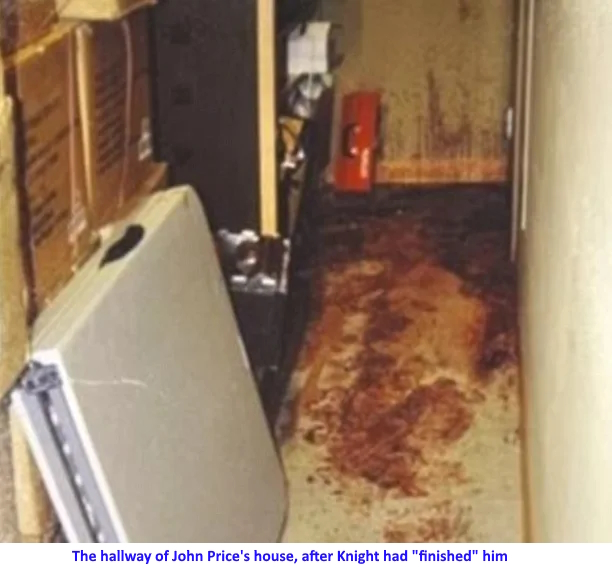
In the year 2000, 44-year-old slaughterhouse worker Katherine Knight had a night of passion with her partner, John Price, then stabbed him 37 times, professionally skinned him, hung his hide on a meat hook over the lounge room door, decapitated him, butchered his corpse and cooked parts of him. She served up his meat with baked potato, carrot, pumpkin, beetroot, zucchini, cabbage, squash and gravy in neat settings at the dinner table, putting beside each plate place-names for Price’s children. Another meal was tossed into the backyard; it appears she intended to eat it but couldn’t do so. The police arrived before Price’s children so, as far as we know, none of him was consumed (by humans anyway).

Knight pleaded guilty to murder and the judge ordered that her papers be marked “never to be released.” An appeal was quickly denied, and she is still serving her life sentence at Silverwater Women’s Correctional Centre in Sydney.

Shoreline Entertainment planned to make a film of the incident based on Peter Lalor’s book Blood Stain, but so far it has not surfaced.

It appears that Knight was NOT a cannibal, despite one of the favourite media labels about her being “Kathy the Cannibal”. Other reports called her “The Woman Hannibal Lecter”, a comparison that makes no sense at all, since Hannibal did not use 37 strokes to kill people, definitely did eat parts of them, and did not (as Knight did) take a cocktail of sleeping tablets afterwards while lying in bed with the mutilated corpse.

Darren O’Sullivan, whose documentary is linked at the top of this blog, commented,

 “this is possibly the most horrific thing I have ever discovered”.

Although the series is called “Real Twisted Tales”, I suspect O’Sullivan must have led a sheltered life. Knight was a slaughterhouse worker, recognised for her skills in knife work. She grew up in the NSW town of Aberdeen, where everyone in her family and most of the town were employed in the abattoir. Her job, from a young age, was to kill and cut up animals. She did to John Price what she was trained to do to other animals – slaughter them, cut them up, cook them. She did try to feed bits to his children, which is what farmers did in the UK (feeding cattle bone-meal to cattle), an act of cannibalism which led to Mad Cow Disease. But there is little evidence that she herself ate any of him.

The documentary above states that Katherine Knight is “one of the most evil people in the world”, because she was found sane enough to stand trial. But really, what she did was what she was paid to do every day, just to a different species than those who usually suffered and died under her hand.

Superstitious anthropocentric beliefs put humans on a tier somewhere between angels and animals, but really we are a species of Great Ape, closely related to the chimpanzee. Rationally speaking, there really is only a thin red line between killing and eating any species of animal.

“You draw the line there?”: DOLORES ROACH episodes 7 & 8

The climax. The denouement. The final two episodes of this quite brilliant podcast that became a Broadway show that became a television series about an untrue true crime, and includes podcasts and Broadway shows. If you need to catch up on the earlier episodes, I would suggest watching them, but if you can’t wait, here are my earlier blogs.

Episode 1

Episode 2 & 3

Episode 4

Episode 5

Episode 6

And here is the very brief synopsis.

  • In episode 1, Dolores has just been released from prison after 16 years – she took the fall for her boyfriend, who has since disappeared. She heads back to Washington Heights New York. but it’s all gentrified now, except for Empanada Loca, the shop of her old friend Luis, who offers her a room and sets her up as a masseuse, a skill she learnt in jail.
  • In episodes 2 and 3, Dolores kills the landlord who has been harassing Luis for his overdue rent, which he can’t afford because the neighbourhood is now fancy, and people don’t buy empanadas much. Luis creates a new empanada, MUY LOCO. It is hugely successful, because it contains, yep, human flesh, in this case, the landlord, Mr Pearlman, whose son, Jonah, appears in the shop at the end of episode 3, with two cops behind him.
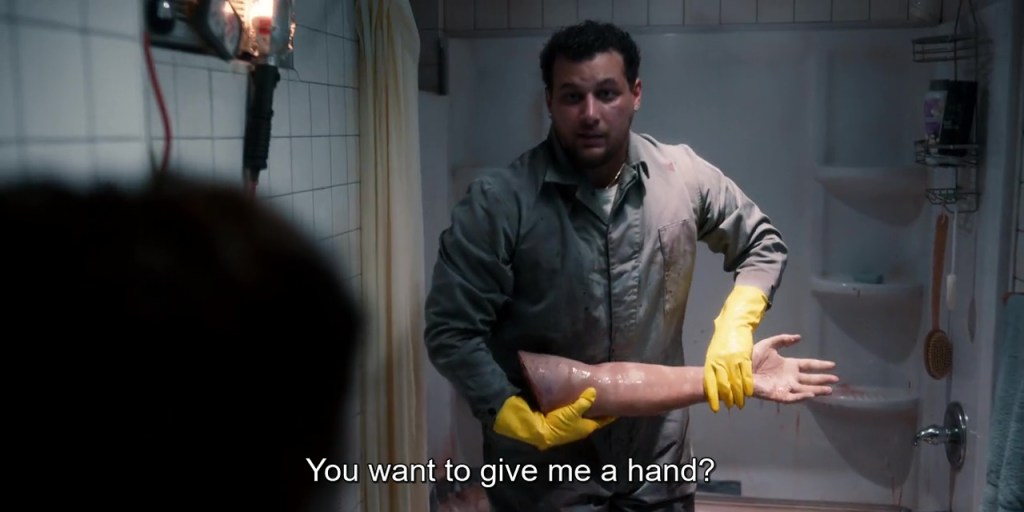
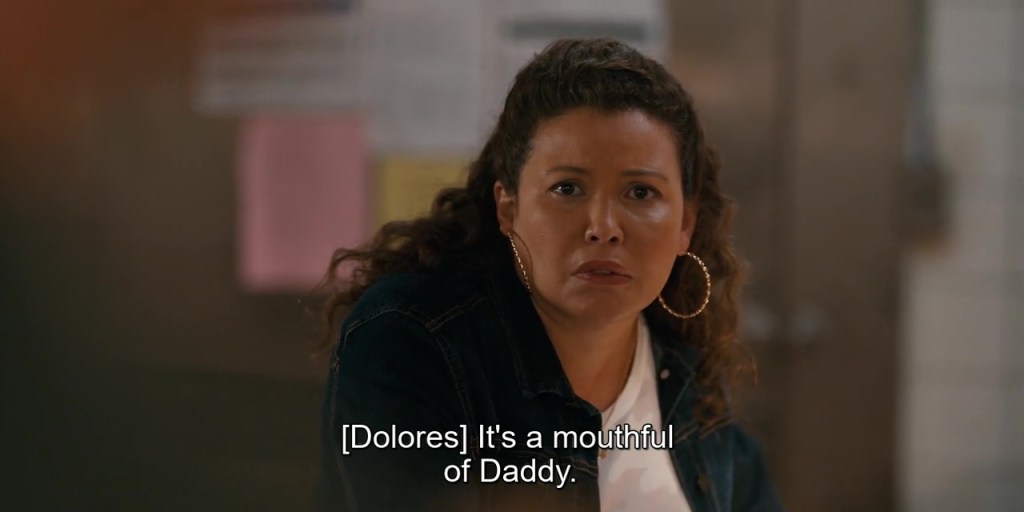
  • In episode 4, Dolores is shocked to find what Luis has done with the body of the landlord she murdered, and disgusted by the secret contents of the muy loco empanadas—Mr Pearlman. She is particularly horrified when Luis offers Jonah an empanada to try, a muy loco, which she knows is a “mouthful of daddy”. Meanwhile, the local drug dealer, Marcie, has pissed off Dolores, and now she is also in Luis’ fridge, and bits of her are now in the empanadas.
  • In episode 5, Dolores hires a private eye called Ruthie, played by Cyndi Lauper, to trace her ex, who cheated on her and let her take the fall in a drug bust. Ruthie’s motto (or perhaps mission statement) is I NEVER DON’T FIND THEM. But the last thing Dolores wants is for Ruthie to find Mr Pearlman.
  • In episode 6, we see cannibalism as a business. Luis has been clear-eyed about this all along – he gets rid of the annoying landlord, he thoroughly destroys the evidence (in customers’ stomachs) and he makes money from the meat, which is apparently delicious and hugely popular, while saving money by not buying the flesh of other animals from the food-services man, Jeremiah, the only sympathetic character in the story so far.

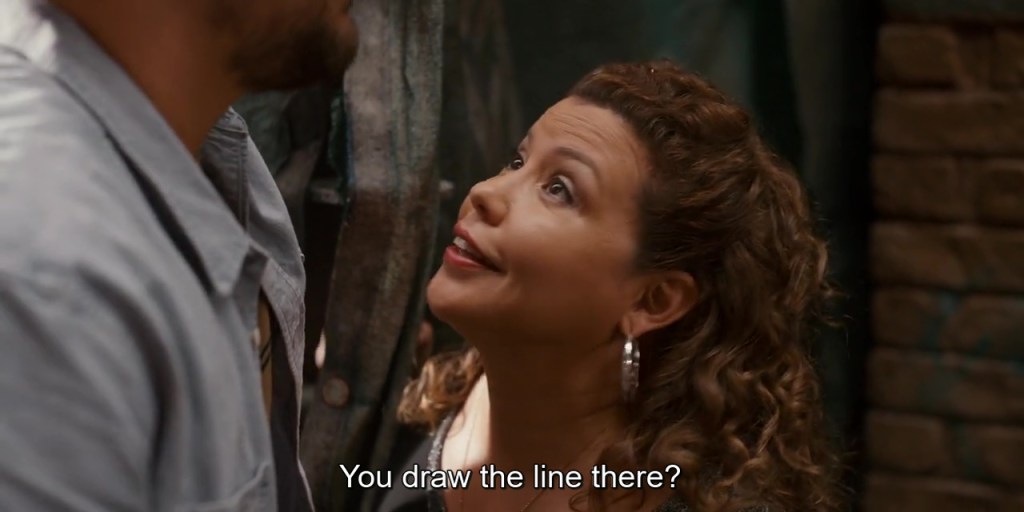
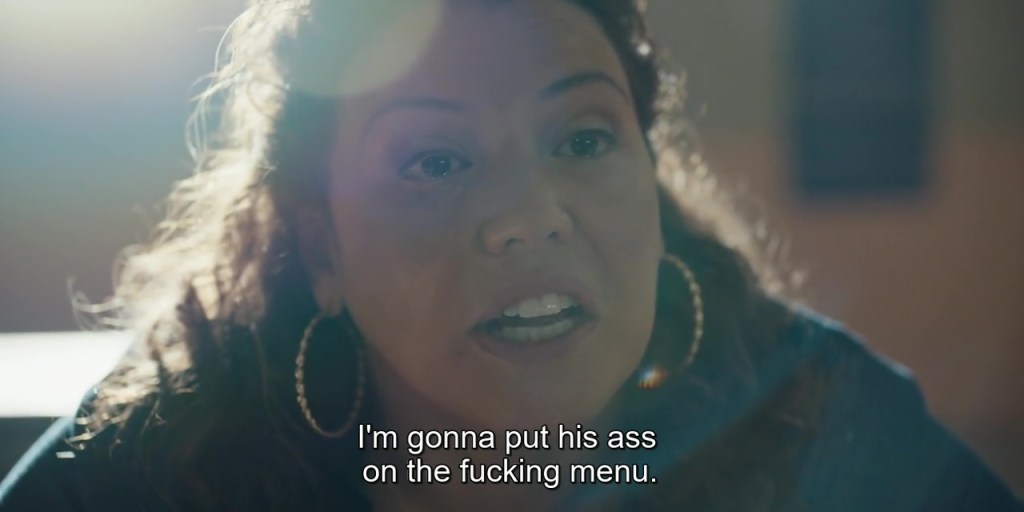
Not a lot of human flesh being eaten in these final two episodes, because everything is turning to shit, largely due to the impulsive plans of Luis, and the tendency of Dolores to snap the neck of anyone who annoys her. Police are looking for the drug dealer Dolores killed back in episode 4, and threatening to call in the DEA. Luis is still chopping up the bodies of Dolores’ victims to fill his empanadas, but he doesn’t want anyone to find the marijuana he is growing. THAT would be incriminating. Dolores points out that his fridge and apartment are full of chopped up bodies, and asks him the question that defines all ethical discussions.

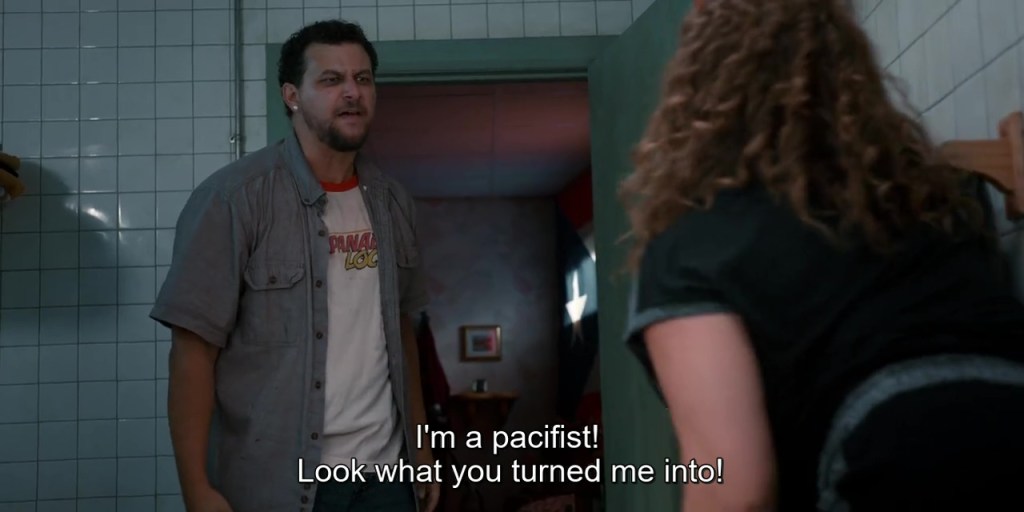
 She’s much more upset about the cannibalism than the increasing number of corpses she is leaving all over the shop. Odd that. Luis sees meat as his business, and Dolores’ steady body count as his (very reasonably priced) supplier. He’s not too fussed about all the killing, as long as he doesn’t have to do it – like customers in a butcher shop. When he finally kills a man, he is upset: “Look what you made me do!”

Luis cracks some of the best jokes in this show, in the middle of the street (much to Dolores’ fury) about the “fat fuck” she killed last episode, and how he is going to use the body fat in his pastry.

And some of the worst.

Lots of interesting Freudian things going on here – in earlier episodes, they discussed the difference between edible and Oedipal, and then there’s the whole thing with Luis only wanting to give Dolores cunnilingus, not penetrative sex, even though she has her period. She considers that eating her menstrual blood makes him a cannibal, even though he has been snacking on human empanadas all through the show, so it shouldn’t really be a surprise.

And his pet name is Mami. It’s apparently the Spanish equivalent of “baby” or “darling”, but is also used for, yep, mother. Freud said the two primary taboos are incest and cannibalism, and Luis definitely has an edible complex.

We find out why Luis doesn’t want sex – he fell in love with his father’s girlfriend when he was 12, had sex with her (so now we have another taboo covered) and then tried to castrate himself in punishment. He couldn’t cut through his penis (Meiwes and Brandes found it was much harder than you might think) and poured hot oil on the wound, leaving him horribly disfigured. Yes, Dr Freud, the threat of castration can be as big a motivation for mental illness as you thought.

Dolores just thinks she is a monster. But one of the fascinating things about cannibalism is that unlike other horror movie tropes, they are not supernatural or even particularly superhuman. And they really exist.

“I’m a monster. Worse, I’m real.”

Luis ends up “deep fried, like everybody else” in one of the most dramatic scenes, and Dolores escapes:

She goes looking for the showrunner of the play, a nice piece of postmodern complication as he clearly represents the creator of the show we are watching, Aaron Mark.

He is accused of humanising a serial killer, but hey, Dolores is very human, just like Macbeth and Oedipus and every tragic protagonist in literature. She’s not even a cannibal; in the whole eight episodes, we have not even seen her eat a human empanada! She’s just a misunderstood serial killer.

As she says, you have to draw a line somewhere.

She forces the showrunner to take her to a house where, he says, someone knows the whereabouts of the man who betrayed her and left her to rot in jail. When the door opens, she roars with laughter, and then pounces, but at whom? All we know is that, like Georgina in The Cook, The Thief, she is directing her invective at us, the audience! We may not know where her ex is living. But we do know that cannibalism starts at home.

“Do not contaminate my meat!”: DELORES ROACH episode 6

Delores is still killing people, Luis is still chopping them up to fill his empanadas. It’s becoming an industry, but Delores still gets queasy, and not real happy about the killings, but she’s much more upset about the cannibalism. Odd that.

If you haven’t read my blogs on the earlier episodes, here is a brief summary. In episode 1, Delores has just been released from prison after 16 years – she took the fall for her boyfriend, who has since disappeared. She heads back to Washington Heights New York. but it’s all gentrified now, except for Empanada Loca, the shop of her old friend Luis, who offers her a room and sets her up as a masseuse, a skill she learnt in jail. In episodes 2 and 3, Delores kills the landlord who has been harassing Luis for his overdue rent, which he can’t afford because the neighbourhood is now fancy, and people don’t buy empanadas much. Luis creates a new empanada, MUY LOCO. It is hugely successful, because it contains, yep, human flesh, in this case, the landlord, Mr Pearlman, whose son, Jonah, appears in the shop at the end of episode 3, with two cops behind him. In episode 4, Delores is shocked to find what Luis has done with the body of the landlord she murdered, and disgusted by the secret contents of the muy loco empanadas—Mr Pearlman. She is particularly horrified when Luis offers Jonah an empanada to try, a muy loco, which she knows is a “mouthful of daddy”. Meanwhile, the local drug dealer, Marcie, has pissed off Delores, and now she is also in Luis’ fridge, and bits of her are now in the empanadas.

In episode 5, Delores hires a private eye called Ruthie, played by the wonderful Cyndi Lauper, to trace her ex, who cheated on her and let her take the fall in a drug bust. Ruthie’s motto (or perhaps mission statement) is I NEVER DON’T FIND THEM. But the last thing Delores wants is for Ruthie to find Mr Pearlman.

In this episode, number 6, we see cannibalism as a business. Luis has been clear-eyed about this all along – he gets rid of the annoying landlord, he thoroughly destroys the evidence (in customers’ stomachs) and he makes money from the meat, which is apparently delicious and hugely popular, while saving money by not buying the flesh of other animals from the food-services man, Jeremiah, the only sympathetic character in the story so far. It’s a win-win-win for Luis.

But now Delores has two more victims for him – the drug dealer, Hector, who has an allergic reaction to her massage oil, and Ruthie, who sees what is going on. Delores has “doubled the body count”.

Luis is pretty happy about the situation. “Mami’s been busy” he says, as he finds the bodies.

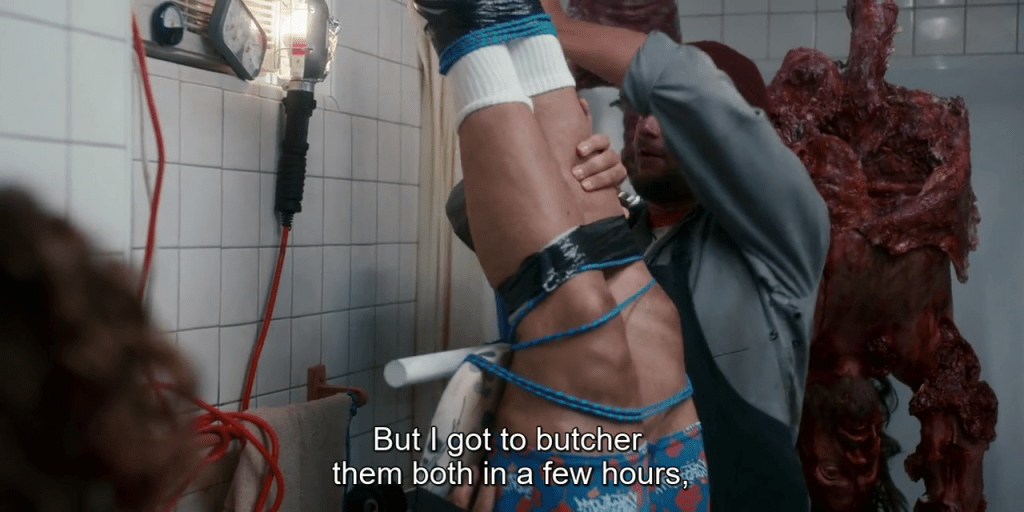
We finally get to see Luis’ artistry. He needs to butcher both bodies before they start to decompose, reproaching Delores:

“You could have spread these two out. Cause this is going to be, like, a challenge, even for me!”

We see him slit Hector’s throat in graphic detail, exactly as happens millions of times a week to other animals in abattoirs, fisheries and farms. But Delores, who was OK killing them, gets pretty nauseous at the sight of blood; apparently there are eight quarts (7.6 litres) in a body the size of Hector, Luis tells her, and we see it gurgling down the drain.

He orders Delores to leave, because he’s a conscientious butcher, telling her,

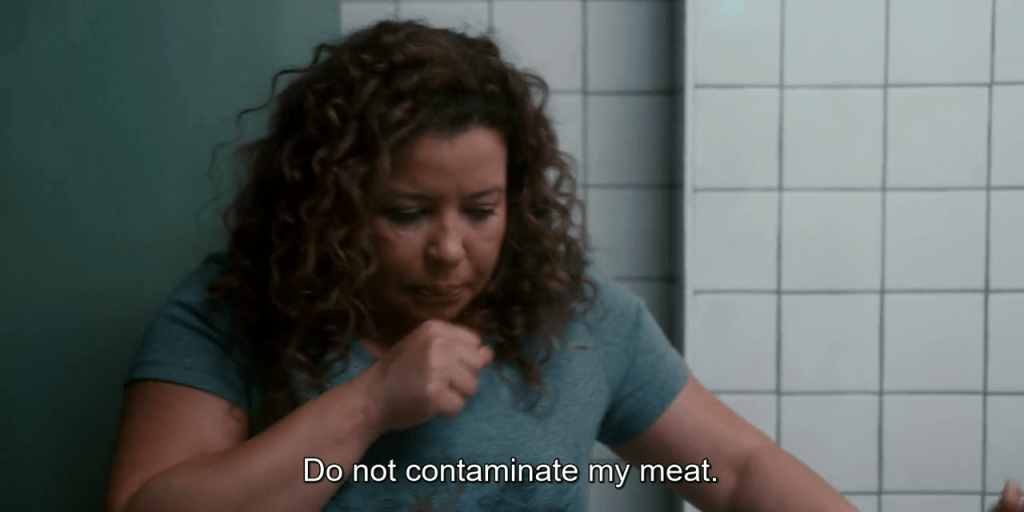
“This is a food prep space, OK? Do not contaminate my meat!”

She runs into Jeremiah (actually, her runs into her), the nice, normal food services delivery man, who tells her he knows what’s going on.

“You’re not back here a week, before the landlord goes missing. Food services like mine are getting squeezed out.”

Jeremiah isn’t interested in her conscience or her legal position, he has people to whom he owes money, and he’d like them disappeared too, please.

This is modern commodity capitalism. Everything, everyone, is assessed by monetary value, everything, everyone, is a commodity. To Luis, the victims are just meat to be butchered and sold in empanadas, to Jeremiah, they are creditors who are making his life difficult. For both, they are just ‘livestock’.

The basic precept of capitalism, as film critic Robin Wood warns in his paper “Return of the Repressed” is that “people have the right to live off other people”. In Washington Heights, thanks to the ready temper of Delores Roach, that is exactly what they are doing.

“It’s a mouthful of daddy”: DELORES ROACH episode 4

This is such a great show. I was going to blog a couple of episodes at a time, but there is so much content in the short episodes that I had to do this one, the fourth, in splendid isolation. Also, I’m uploading it on father’s day (in Australia and probably some other places), and having a character eat some of his father just seems so pertinent!

If you haven’t read my blogs on the first episodes, you might want to do that first. In a nutshell, in episode 1, Delores has just been released from prison after 16 years. She heads back to Washington Heights NY but it’s all gentrified now, except for the Empanada Loca shop of her old friend Luis, who offers her a room and sets her up as a masseuse, a skill she learnt in jail.

In episodes 2 and 3, Delores kills the landlord who has been harassing Luis for his overdue rent, which he can’t afford because the neighbourhood is now fancy, and people don’t buy empanadas much. Luis creates a new empanada, MUY LOCO. It is hugely successful, like the chocolates in last week’s blog, because it contains, yep, human flesh, in this case, the landlord. Whose son, Jonah, appears in the shop at the end of episode 3, with two cops behind him.

All caught up, and now we’re at episode 4. It turns out Jonah does not know his dad is missing, and the cops are just waiting for their empanadas. But Delores does not want to go back to jail, having just got out after sixteen years, so you might think that finding Luis destroying (or actually cooking and selling) the evidence should be good news, but (call her old fashioned) she is horrified by the idea of cannibalism (although, funnily, not so much the murder she committed) and disgusted by the secret contents of the muy loco empanadas.

This dissonance between getting rid of the evidence of her rather serious crime and disgust at the fact that the evidence is being fed to an enthusiastic clientele is aggravated when Luis offers Jonah an empanada to try, a muy loco, reminding us of the lyrics of the old Stanley Holloway song about Sweeney Todd, on whom this story is based:

“For many a poor orphan lad
The first square meal he ever had
Was a hot meat pie made out of his dad
From Sweeney Todd the Barber”

Luis tells Jonah “the meat’s locally sourced” which is particularly true for him. Jonah loves the taste, asks if the meat is duck.

No, it’s no duck. We hear Delores’ thoughts:

Furious at Luis for feeding the landlord to his son, Delores takes the rest of the meat and sets fire to it, putting the muy loco off the menu. Luis is furious, and cannot see what the problem is, and then comes one of the great double entendres of the cannibal genre –

Luis barks at her:

“Hey, it’s edible! Like the Greek myth.”

Now we’re getting to the meat of the cannibalism debate!

Quick refresher: Oedipus was a mythological figure depicted in the play Oedipus Rex written by Sophocles some 2500 years ago. Oedipus became king of Thebes after unwittingly fulfilling a prophecy that he would kill his father, Laius (the previous king), and marry his mother, Jocasta (whom Oedipus took as his queen). It was more a case of mistaken identity and road rage than some deep psychosexual drive, but Sigmund Freud used it as the basis of what he called the Oedipus complex. This referred to a child’s sexual desire for the opposite-sex parent and hatred for the same-sex parent which, if not reconciled, leads to neurosis. Freud wrote that,

“It is the fate of all of us, perhaps, to direct our first sexual impulse towards our mother and our first hatred and our first murderous wish against our father. Our dreams convince us that this is so.”

Oedipus didn’t eat his father, but Freud believed that cannibalism is a foundation of the human unconscious. He asserted that cannibalism is one of the two original prohibitions of humankind, the other being incest. Freud’s conception was that the origin of human civilisation was an act of incestuous patricide and cannibalism by a group of pre-sapien savages, which became the origin of cooperative civilisation. In Totem and Taboo, he speculated that a prehuman group of brothers in a “primal horde” had come to resent their father’s monopolisation of the tribe’s females (common among primates) and conspired to kill the father and take their mothers and sisters for themselves. “Cannibal savages as they were, it goes without saying that they devoured their victim as well”. A later wave of remorse led these conspirators to create “out of their filial sense of guilt the two fundamental taboos of totemism”, the proscription of cannibalism and incest. This father/son guilt, he argued, corresponds with the Oedipus complex, which he called “the nuclear complex of the neuroses”.

So Jonah, like Oedipus has unwittingly eaten human flesh, the flesh of his father, not knowing what it was. If Luis had said it was duck, he would have believed him, and accepted that contentedly, because social conventions say we can eat ducks, but not dads. Yet the taste is so close that he couldn’t tell the difference. And since his dad was already dead, was this worse than deliberately killing a living, sentient duck?

Meanwhile, the local drug dealer, Marcie, accuses Delores of selling drugs and stealing her customers, because of the long queues of people waiting for muy loco empanadas. Delores tries to persuade her she is running a massage business and takes her downstairs for a massage, where Marcie starts to vandalise her room looking for drugs, and mocks her for protecting her old boyfriend, revealing that he cheated on her and eventually turned her in to the DEA to save his own hide. They fight, and Marcie becomes the new supply for the next batch of muy locos.

Delores is determined to find the cheating boyfriend. When she does, she promises,

Cannibalism news July 2023: Two men arrested for eating partially-cremated human flesh

Two men in Odisha (eastern India, formerly known as Orissa) have been arrested and accused of cannibalism after locals found them eating half-burnt flesh from the body of a woman who was being cremated at a funeral in Mayurbhanj, Odisha. 

The incident happened in a tribal village called Bandhasahi. The accused were identified as Sundar Mohan Singh, 58, and Narendra Singh, 25, both from Dantuni village. The deceased woman was identified as Madhusmita Singh, 25, who had died in the Bandhasahi village hospital. The family took her body to the cremation ground and performed the last rites. In Hinduism, the preferred way of disposing of the dead is Antyeṣṭi (अन्त्येष्टि), a composite Sanskrit word of antya and iṣṭi, meaning “final sacrifice.”

The two men, who were said to be drunk, were overseeing the proper burning of the body. As the cremation progressed, the body had been burnt almost entirely to ashes, except for a single unburnt piece of flesh. Mohan and Narendra claimed that it wouldn’t burn unless it was cut into smaller pieces and then thrown back into the fire.

Lobo Singh, the grandfather of the deceased girl, watched the men pull the unburnt flesh out of the fire. Narendra proceeded to divide it into three pieces, with Mohan tossing two pieces back into the flames. However, Lobo Singh said he witnessed Mohan concealing the remaining piece in his left hand, He questioned Mohan about this, to which Mohan casually replied that he would discard it later.

The woman’s uncle said that, when he asked them what they would do with the flesh, one of the accused, Sundar Mohan Singh, replied, “You don’t know about witchcraft.” After around 10 minutes, he announced that he would eat the piece of flesh. Before the others could do anything, Mohan put the piece in his mouth and began chewing it; he also offered a portion of flesh to Narendra, who also commenced eating it. 

The villagers caught and beat the accused duo, tied them up in rugs, and informed the local police. Both accused admitted committing the crime, claiming that they had consumed the flesh in an inebriated condition. They were charged under section 297 of the Indian Penal Code. Senior police officer Sanjay Kumar Parida stated that the accused were arrested based on the complaints of the villagers, but no trace of human flesh was found on them. Further investigation into the case continues.

This sort of phantasy, that eating human flesh will give the eater special powers, is not uncommon in Cannibal Studies texts; essentialist speculations that some part of the ‘donor’ remains imbued – such as the courage embodied in the brave enemy’s heart or strength in his or her limbs. Brigid Brophy, one of the seminal voices in the animal justice movement, called this “the primitive superstition that eating the flesh of bulls endows you with the strength of the bull”. Even Freud seemed to have subscribed to such thoughts, claiming in Totem and Taboo that the birth of civilisation occurred when a group of young prehumans came to resent their father’s monopolisation of the tribe’s females (common among primates) and rose up, killing the father to take their mothers and sisters for themselves. “Cannibal savages as they were, it goes without saying that they devoured their victim as well” and, Freud added, as well as the protein they ingested from the fresh meat, the brothers would each have “acquired a portion of his strength”. Freud went on to speculate  that their sense of remorse created the first ethical basis for civilisation, which seems rather far-fetched, and there is no evidence that the Singhs, even when they sober up, will be creating a new form of civilisation in Odisha. Although, to counter my obvious scepticism, there are reports that Armin Meiwes, currently in prison in Germany, allegedly claimed that, after he ate his bilingual lover in 2001, his own English improved considerably. We absorb the nutrition of our food, why should cannibals not absorb the strength, spirit and experiences of their victims?

The Orissa Post called the incident “extremely rare”, but this blog has reported on similar incidents in the past. In Assam in 2022, another inebriated man found edible flesh within the cremation flames.

In 2019, The Global Report on Food Crises estimated that there were some 135 million “acutely food-insecure people in crisis or worse”, including 17 million acutely malnourished children under 5 years old. The changing climate, or future pandemics, could easily double that number, leading to what the head of the UN’s food relief agency warned could be “a famine of biblical proportions”. Globally, over a million people die each (normal) week, many of them still covered in healthy flesh; if human meat is similar to that of other animals, why not let those who are starving eat some of the corpses, at least those who are minimally diseased? Is an agonising death by starvation less abject than eating human meat? And if, as most societies (not including Hindus) seem to believe, it’s OK to eat animals, and humans are animals (a species of Great Ape), then from carnivory to cannibalism is only a very thin red line.

Criminals becoming “real cannibals” in Ukraine?

In October 2022, thecannibalguy blog reported on the news that Russia has been boosting the number of soldiers fighting in Ukraine by recruiting within its worst maximum-security prisons, including enlisting a convicted cannibal.

The cannibal, Yegor Komarov, had been the subject of an earlier blog in December 2021. He had been arrested for murder in the town of Sortavala (near the Finnish border) after a headless body fell from his car. Komarov admitted to being a cannibal and confessed to stabbing and killing another man in a St Petersburg park the previous year for the sole purpose of tasting human flesh, adding that he had sliced off the victim’s tongue and fried it in butter.

The recruiters of this motley army of murderers, rapists (and at least one cannibal), all of who are promised freedom if they survive six months of war, is a mercenary force called The Wagner Group. It had first been deployed to the Ukraine back in 2014 to help pro-Russian separatists battle Ukrainian forces.

Yevgeny Prigozhin, an oligarch known as “Putin’s chef” because he rose from being a restaurateur and caterer for the Kremlin, is the leader of the Wagner Group. Many of Mr Prigozhin’s companies are currently under US sanctions for what it calls his “malign political and economic influence around the globe”. 

Prigozhin originally denied any connection with the Wagner Group, but now a new video has surfaced (at the top of this page) where he shows how his mercenaries are trained before being sent in as the shock troops of the Russian war to occupy Ukraine.

In the video, Prigozhin speaks about so-called “elite” fighters from a special training base in the village of Molkino in the Krasnodar region of southern Russia:

This is a supplementary training base for our fighters…. Here experienced fighters are given additional training in their specialties. So they raise young eagles there, and here they make real cannibals.

These prisoners from the worst Russian prisons are considered disposable, sent into the front lines in Ukraine as cannon fodder. According to the Ukrainian President, after the fighting around the Soledar salt mines in January 2023,

“Thousands of their people were lost: the whole land near Soledar is covered with the corpses of the occupiers and scars from the strikes. This is what madness looks like.”

Commanders of the brutal mercenary group are reportedly castrating their own soldiers who try to surrender or retreat. In an intercepted call in December 2022, US intelligence said that they learned a member of the Wagner Group was castrated for either trying to retreat or surrender. The intercepted call heard a Russian soldier say, “The Wagnerians caught him and cut his fucking balls off” but the video tape was not released.

We have no reports yet about the fate of the recruited cannibal, Yegor Komarov, nor do we know if he is finding ‘gainful’ employment teaching other recruits how to be “real cannibals”.

We do know that cannibalism is a recurring event in Russian and Ukrainian history, particularly in the last hundred years. Russia’s worst serial killer was a cannibal named Andrei Chikatilo, who was convicted of killing fifty-two women and children between 1978 and 1990, although he had confessed to many more. Chikatilo blamed his cannibalism fetish on the story his mother had told him about his brother being taken and eaten by the neighbours in the 1930s, during the Holodomor.

The “Holodomor” (literally “murder by starvation”) was an event that took place in the Ukraine in 1932-3, during which the population was deliberately decimated by Stalin’s collectivisation of the farms and seizure of food stores. As starvation set in, corpses began to disappear, and the government response was simply to put up signs saying, “Eating dead children is barbarism”.

Not so in war, apparently. What exactly Yevgeny Prigozhin meant by turning his soldiers into “real cannibals” is not clear. But in view of his total disregard for their welfare, we have to wonder how well Prigozhin feeds his soldiers. Or, as Putin’s chef, does he simply give them a recipe book?

Young Leatherface: THE SAWYER MASSACRE (Steve Merlo, 2022)

This full-length feature was released on YouTube on 21 October 2022. It is a “fan film” – you’ve heard of fan fiction, where people like Fannibals extend the stories they love into new avenues (often erotic ones). Well, this team made a whole tribute movie to the cannibalism classic, The Texas Chain Saw Massacre.

The Texas Chain Saw Massacre (TCSM) came out almost fifty years ago, and was named by Total Film as number one of the fifty greatest horror movies of all time, as well as being the one that began the boom in slasher movies.

The Sawyer Massacre is the brainchild of Steve Merlo, a Canadian Musician from Kelowna British Columbia, who also wrote the score. Merlo described the original TCSM as “the first film to truly give him nightmares”. He financed the production through crowd-funding site Indiegogo, and somehow produced a film at least as well made and arguably better written and acted than the other sequels and reboots that have come out in the past several decades.

Presented as a prequel to the original TCSM, the film is set during the Vietnam War, as America fed half a million young soldiers into a futile conflict, thousands of whom did not come home alive. The pointless violence of that war and the battles between young counter-culture demonstrators and Establishment law enforcement is reflected in the gore that this film so generously doles out. The original TCSM was set in the Nixon years as the “silent majority” was taking control, the hippie dream having died at Altamont, in the streets of Chicago and on the campus of Kent State. This is a prequel, so it’s set a bit earlier – LBJ is in the White House and America still thinks its invincible military can defeat the Viet Cong. The young people who blunder into the wilds of Texas are not looking for gravestones as in the original movie, they are looking for themselves, seeking enlightenment and adventure. Jimmy has gone away with his friends to seek redemption for a family tragedy for which he blames himself, another family is looking for a camping site where they can get away from it all, and they certainly do. They inevitably end up on the point of the same knives, meat-hooks, and chainsaws as in the original. Some things remain constant, regardless of politics. And of course, movies like this always start off with a decrepit, run-down gas station.

If you’re not familiar with the TCSM, there is a review at this site, but basically it involves a lot of young city folks blundering in to an inhospitable part of Texas, where a family of killers, formerly abattoir workers, now ply their trade by slaughtering passing visitors and selling their meat to other tourists. In other words, they have done what business coaches always tell us to do – they have diversified. They are still killing animals for food, but now a different species – Homo sapiens. The original film did not go much into explanations, but the characters are there – Leatherface, the hitchhiker, even grandpa, who is rather more sprightly in this version.

In fact, the characterisation is far better in this one than the original, in which few characters lived long enough to have a back-story. And this Leatherface, with his range of masks for any occasion (including, shall we say, love interest) is much more a real person, showing not just the expected psychotic rage but fear, disappointment and even lust.

I’m trying to avoid any spoilers because the film is meant to be seen – it is available on YouTube in its entirety. If you loved the original TCSM, I think you’ll love this one too – for a film made on a tiny budget, it feels well made – the cinematography, direction, scenery, special effects, even the acting (which was pretty woeful in some of the sequels) is spot on. The feeling of claustrophobia inside the house is palpable and dials up the suspense – watching the film requires some restraint to avoid yelling at the victims to get the hell out of there – in that sense, it’s like the old pantomimes. The film also works well as a prequel – it feels like you could finish it, have a strong drink, and move straight into watching the original TCSM without losing any continuity, a tribute to the esteem in which the director holds the original.

 Steve Merlo also has a YouTube session in which he comments on the making of the film and explains some of the questions you may have, but [spoiler alert] don’t watch it until you’ve seen the movie at least once.

The full movie is currently available to watch at https://www.youtube.com/watch?v=a-GssBcG5fk