Eat the imperialists: HOW TASTY WAS MY LITTLE FRENCHMAN (Como Era Gostoso o Meu Francês) – Nelson Pereira dos Santos, 1971

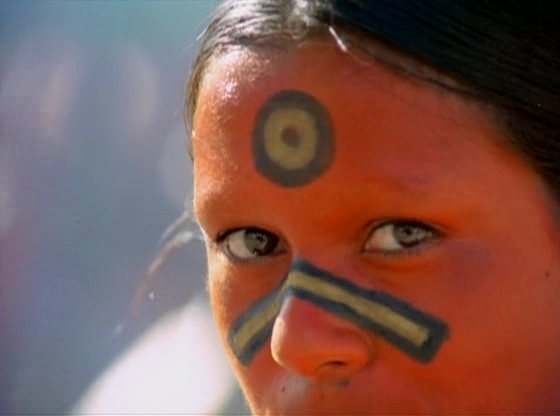
Let’s get this out of the way – there is nudity. Lots of it and throughout the movie. Well, it’s set in pre-colonial Brazil, and the Indigenous peoples did not bother with a lot of clothes, so it’s historically accurate. To ensure authenticity, the actors and the crew were all naked, so that nudity would become natural. If that bothers you, please read the blog but skip the movie.

While it was refreshingly authentic, the nudity was also a problem. First, because the authenticity is somewhat diminished, as The New York Times critic pointed out, by the fact that the natives are “middle-class white Brazilians… stripped down and reddened up for the occasion”. Secondly, the film was refused entry to the Cannes Film Festival because of all the swinging dicks. In Brazil, the censors were eventually persuaded that the natives indeed did walk around naked, but remained vehemently opposed to the nude Frenchman, a telling comment on the racist distinction that the film was intending to expose.

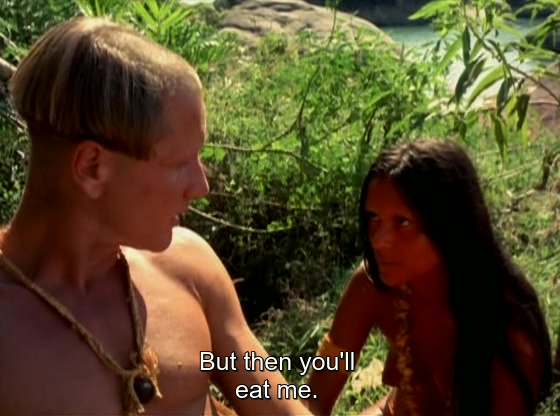
So, the plot in a nutshell: the French and the Portuguese are fighting to control the rich lands of South America. Each has allied with local tribes who are at constant war with each other, often involving (so the European narrative goes) capturing and eating each other’s warriors.  The Tupinambás are allied with the French, while the Tupiniquins are allied with the Portuguese. The Frenchman of the title escapes his own command, is captured by the Portuguese, and is then captured by the Tupinambás, who are allies of the French, but believe him to be Portuguese, so intend to eat him. Got all that? – there will be a test.

Tupi custom involved bringing the captive into the community, feeding and homing him, and even finding him a wife, then eventually killing him in a ceremony that will allow them to capture his essence, bravery, speed, and so on.

This wide-spread belief about the Tupi comes from a European who was captured but then escaped in 1554, came back to Europe and wrote a book. His name was Hans Staden, and he was actually a German who was trying to get to India. But since it was the French who were invading South America at the time, the director changed his nationality.

De Bry’s engravings of Tupi cannibalism were “eaten up” by the Europeans.

Tupi cannibalism has a whole literature explaining it or denying it – William Arens claimed the ‘evidence’ was mostly based on Staden’s account, which contained several contradictions, and had been continually retold as if it had happened to new re-tellers. Other anthropologists such as Rene Girard explained Tupi cannibalism as a seamless explanation for the way culture and religion have evolved. The universal violence of the human species is redirected toward the outsider, who is taken into the tribe, but remains foreign enough to be killed as a scapegoat, to release the social pressure that would lead to endless internal revenge feuds. For many, Jesus became the ultimate scapegoat under this theory, even to the extent of insisting that his followers eat and drink wine and bread transubstantiated into his “blood and body” in the Eucharist ritual.

For my flesh is meat indeed, and my blood is drink indeed.

John 6:55

The Brazilian anthropologist Eduardo Viveiros de Castro proposed a ‘post-structural anthropology’ in his book Cannibal Metaphysics. De Castro sought to ‘decolonise’ anthropology by challenging the increasingly familiar view that it was ‘exoticist and primitivist from birth’, denying that cannibalism even existed, and so transferred the conquered peoples from the cannibalistic villains of the West into mere fictions of colonialism. Arguing that the ‘Other’ is just like us is to deny any separate identity and to return the focus of anthropology to that which interests us: ourselves. Rather than deny the existence of cannibalism, which allows a reclassification of the Amerindian peoples as like the colonialists, de Castro examines the details of Tupinamba cannibalism, which was ‘a very elaborate system for the capture, execution, and ceremonial consumption of their enemies’. This alternative view of Amerindian culture rejects the automatic assumption of the repugnance of cannibalism, which serves to either confront it or deny its existence.

Well, that’s pretty much where this film planned to go. Pereira dos Santos challenges the Eurocentric perspective which insists on a superior civilisation overcoming a primitive one. It is true that Tupi civilisation was destroyed by the slavery, smallpox and slaughter of the Portuguese who, the film tells us at the end, also wiped out their allies the Tupiniquins. The Tupi peoples are now a remnant, confined to small areas and currently being decimated by COVID-19.

But the chief, in the killing ceremony which promises the Frenchman’s body parts to his relatives (his wife will get his neck), tells the story as a mirror image:

“I am here to kill you. Because your people have killed many of ours, and eaten them.”

So the film asks: who were/are the cannibals? It does not fully succeed in telling this story, because the audience gets involved with the Frenchman’s story, instead of his captors. Pereira dos Santos lamented that the public:

“…identified with the French, with the coloniser. All spectators lamented the death of the hero. They did not understand that the hero was the indigenous, not the white, so much were they influenced by the adventures of John Wayne.”

Nonetheless, the binary of the colonised and the powerless occupied victims is so deeply embedded in our cultural stories that it is refreshing to see this mirror image version, where the indigenous win the battle, if not the war.
“I wonder who the real cannibals are” CANNIBAL HOLOCAUST (Deodato, 1980)

This movie is a big deal, in cannibal studies.

When you hear terms like “video nasties” or “grindhouse”, Cannibal Holocaust tends to be high on the list of titles mentioned. The film’s violence was extreme in 1980, although it has certainly been exceeded since then, with the “benefit” of CGI special effects. The scenes of death and cannibalism were enough to get the director, Ruggero Deodata, arrested for suspected murder, as he had arranged for the actors to go underground to give the impression that, just maybe, he had gone for the ultimate in cinéma vérité: a snuff movie. Where the film remains at the cutting edge (sorry) of extreme cinema even today was in its presentation of authentic animal cruelty, in the midst of fictional human deaths. For this it was widely condemned, even by those who otherwise enjoyed the film, and it was banned in several countries, including Italy and Australia. The best part of the film is probably Riz Ortolani’s stunning soundtrack. But in the end, I must grudgingly say that Cannibal Holocaust is a film more relevant than ever – because it is a direct indictment of “fake news”.

Pic-00001.jpg

At a time when news stories were increasingly becoming sensationalist beat-ups, and the American failure in the Vietnam war was still being blamed on the ubiquitous media coverage of the gruesome results of that conflict, Deodato is asking the question: “what can we believe”? Or, as the protagonist of the film, anthropologist Harold Monroe (Robert Kerman) asks in the last few frames

“I wonder who the real cannibals are?”

Pic-00008.jpg

This is the question that every cannibal film or TV show asks, in its own way. Hannibal Lecter denies he is a cannibal in season 3 of Hannibal (I’ll get to it in a couple of months) when he tells a victim, whose leg they are both eating:

“This isn’t cannibalism, Abel. It’s only cannibalism if we’re equals”.

Cannibalism is about power and appetite. Those we accuse of cannibalism, in this case the indigenous peoples of the Amazon, were in all probability never cannibals. The imperialists who came in search of gold, like Columbus, or oil or timber or news footage were the real consumers – of humans who had been transformed into commodities and resources. Cannibal Holocaust asks us to think about what, in the panorama of abuse, death and torture that surrounds us, is real?

Pic-00022.jpg

This wasn’t the first Italian cannibal film: that was Man From Deep River. It wasn’t even Deodato’s first cannibal film, which was Last Cannibal World (Ultimo Mondo Cannibale). He had gratuitous animal cruelty in that one too. But Cannibal Holocaust asked new questions about the media in which it was made, about the motivations of the documentary, and about what Deodato himself was doing.

Pic-00033.jpg

The film is told from the viewpoint of an anthropologist, Monroe, who is asked to go to the Amazon, to the area frequented by cannibal tribes and known as the “Green Inferno” (a name that spawned a tribute movie 33 years later). His mission is to find out what happened to four young American film-makers who disappeared there without a trace. Well, guess who came to dinner?

Pic-00039.jpg

The first half of the film is Monroe negotiating with the locals, watching a rape and murder, helping eat an adulterer, shooting several natives, and finding and recovering the cans of film that have survived the whole sordid adventure. And yes, making friends, but not enjoying dinner with the cannibals.

Pic-00043.jpg

The second half of the film purports to show that recovered film, which a television network wants to show uncut to the public to sensationalise their deaths. This part is often referred to as the forerunner of the “found footage” movies that became enormously popular later with Blair Witch Project. In fact, Punishment Park (Watkins, 1971) was probably the first found footage film, claiming that its story of anti-war protesters being dumped (and filmed) in the California desert is actual newsreel. But in that period, what was genuine newsreel footage was on television every night, and showed dead American soldiers, burning Vietnamese civilians, and Kent State University students being gunned down by the National Guard. The difference between real and fake news was becoming opaque, years before the time of Trump (in fact, when he was still busy avoiding the draft). Deodato said he believed a lot of the news reports of Red Brigade terrorism in Italy had been staged for the cameras. In any case, even in unvarnished reporting, the framing of the camera and choice of which shots to use make the concept of real, impartial news unattainable.


Who were the cannibals? The ones depicted as real savage cannibals in Cannibal Holocaust were described by Francesca Ciardi, who played Faye, one of the lost American filmmakers, as:

…perhaps the sweetest people I have ever met. The cannibals were just local people. They put wigs on them but in real life they were very clean people: they worked in offices and they wore well-pressed shirts”.

The most controversial legacy of this film is the appalling animal cruelty. Deodato juxtaposes brutal violence on humans (rape, murder, cannibalism) through special effects, while filming live and in gory detail the killing of a coatimundi, a giant turtle, a monkey (whose brains are eaten while still alive), a tarantula, a snake and a pig. When their guide gets bitten by that snake, we get “live action” of them chopping up the snake, then chopping off the man’s leg. The team make sure the camera is rolling before wielding the machete.

Pic-00055.jpg

What is he trying to achieve through this collision of fake human and actual animal deaths? Is it simply to try to extend the illusion that, just perhaps, these shaky images were indeed real footage, and the actors were dead? Well that didn’t last past his murder trial, where he had to produce them in the court in order to be exonerated.

Critic and media academic Calum Waddell points out that this movie shows vile and debased behaviour on both sides – the ‘savage’ natives and the ‘civilised’ Westerners. But the Americans are punished for it – they are eventually killed and eaten for their troubles. The natives? A few get shot or burned, but there is no judgement. Waddell calls this a “fascist perspective”, because white people shouldn’t act like this, and so get punished, but the “savages” – well, that’s just the way they are. We can’t expect better of them, and in fact the Americans, when they first land, young, strong and white, are the picture of gung-ho adventurers, seemingly invincible. Then they regress into savagery, as they trek deeper into the green inferno.

Pic-00057.jpg

They (the savages) are cannibals by nature, and we (the civilised) risk becoming like them. The civilised whites lose their humanity as they enter the inhuman world of the cannibals, just as American troops in Vietnam lost theirs as they became enmeshed in that jungle war and started to massacre villagers. The film crew set fire to the native village so they can film an imaginary war between tribes. They capture a young girl and rape her just for fun, then film her body, impaled on a stake for losing her virginity.

Pic-00085.jpg

Cannibal Holocaust documents the loss of belief in the inevitable progress of humanity, usually told through the invincibility of white privilege.

Pic-00093.jpg

The Americans film everything, even their own death at the hands of the infuriated natives. The interlopers act as imperialists always have, but now they get eaten for it.

Pic-00099.jpg

To complicate the question of truth or simulation, we are shown a series of clips that the Americans are said to have recorded earlier in their careers, which we are told were staged for the cameras. These were clips of actual executions and abuses that Deodata presents here as fake news, created to be sensationalist newsreels.

Pic-00046.jpg

So now we have Deodato playing with our heads: real human executions are presented as fake, while fake rape and killing is presented as real. Real animal abuse, insisted upon by the director, is accompanied by gallons of human gore and agony which we know is fake.  Monroe is told: “Today people want sensationalism.”

Pic-00061.jpg
The subtitles did not use spell-checking

Yet the roller-coaster of fact and fake does not really work. Did Deodato really expect people to file out of the cinema (when it was finally shown after years of censorship) scratching their heads and saying “those guys really did get eaten! Damn shame.” The scenes of actual vicious killings of animals seem meant to drive home the point that, just maybe, the deaths of the young Americans are real too. But, as Waddell points out, the coatimundi is killed in the first half, which is unequivocally a fictional presentation (or at best re-enactment) of the expedition to find the lost tapes. So that creature’s death is totally gratuitous.

Pic-00014.jpg

Or is it? Deodato seems to be saying: don’t swallow anything you see on screen.

Here’s the thing. Real atrocities go on, but usually in the dark, or behind walls, at least not near any cameras. The Americans catch and chop us a giant turtle who continues to move as his head is removed and he is disembowelled.

Pic-00051.jpg

We can be squeamish at the death of that beautiful turtle – Faye is filmed throwing up as they chop the animal’s head off, but then we see her biting into the cooked meat soon afterwards.

Pic-00053.jpg

The turtle died totally unnecessarily for the sake of a cheap movie shot. We can also be sickened by the scenes of rapes and murders of humans, which are fake, but look pretty real. But every moment, as we reach for the remote and gratefully turn off the movie, real atrocities are continuing everywhere, in wars and domestic abuse and abattoirs and laboratories. Real animals quiver in their death throes, millions of them every second, while we turn our faces away from the dying turtle. We are not filming those abuses, but very often we are paying for them, through our taxes or our shopping. Like Faye, the cruelty repels and nauseates us, but the appetite makes us forget. This film, perhaps, helps us to remember.

Pic-00118.jpg

If you like my blog, please feel free to recommend it (with discretion) to friends on social media.
If you have any questions or comments, you can use the tag, or email me  on cannibalstudies@gmail.com.