
Cities are locked down, citizens are trying to escape from a deadly virus, food is rationed, rumours abound of dark government plots to kill off sections of the population. No, it’s not a COVID-19 movie but a speculative fiction film from over fifty years ago. From the trailer (above):
“Mankind destroyed what made most of the world liveable. Nature – wounded, diseased, and enraged – took revenge on her murderers. She cut off their food supply, and then waited, while they consumed each other.”
Yes, it’s a cannibal film based on a cannibal book, and its premise is the human war against nature, the way victory inevitably turns into defeat, and then perhaps extinction. The book it was based on, The Death of Grass by John Christopher, came out in 1956, which makes it quite prescient, and a bit of a shame more people didn’t read it back then, when carbon dioxide levels were 314 parts per million, compared to today’s 422ppm. Here’s a quote from that book:
“…he could no longer believe that there would be any last-minute reprieve for mankind. First China, and then the rest of Asia, and now Europe. The others would fall in their turn, incredulous, it might be, to the end. Nature was wiping a cloth across the slate of human history, leaving it empty for the pathetic scrawls of those few who, here and there over the face of the globe, would survive.”
Those who did take it seriously were film-makers like Ray Milland, who made Panic in Year Zero! in 1962 with a very similar plot, and this one, No Blade of Grass, an adaptation of Christopher’s book made by the acclaimed American actor turned director Cornell Wilde, whose 1965 film The Naked Prey was in many ways a forerunner of the Italian “Cannibal Boom” films of the 1970s and 1980s.

The film, set in the UK, starts with scenes of environmental destruction, as did its more famous American rival Soylent Green three years later. Soylent Green specifically nominated global warming as the cause of the collapse of the food system, due to the human population peaking in a way Thomas Malthus might have found terrifying.

In No Blade of Grass, it’s a virus sweeping the globe (right up to date, again); this one is killing all the grasses, including wheat, oats, barley, rye and rice, the food staples, without which the human species (and many other animals) will starve. We’re already getting a taste of this, as discussed in last week’s blog, with the blockade of Ukraine, the grains from which make up a majority of the food supplies for some of the poorer countries.


Of course, that is ‘over there’ and while we can feel sorry for the starving masses, we also have remote controls so we can turn off the sad news and enjoy our dinners. Just so, in this film we get unsubtle examples of starving children, interposed with rich, entitled, white British folks scoffing their roast beef and looking superior as they hear the news from overseas where, we are told, 600 million people have died of starvation, and the Chinese government is using nerve gas to kill 300 million of their own citizens to keep the state from total anarchy. The news continues:
“In the countries which no longer have any form of government, there are reports of widespread cannibalism.”
But even the comfortably bourgeois patriarch John Custance (Nigel Davenport) is making plans, in his light-hearted, Pythonesque way, to take his family up to visit his brother in the country. Do come along, old boy, he tells his daughter’s boyfriend, a scientist who has insider knowledge of what’s going to happen, because:

Anarchy breaks out in London and major cities. Fighting their way out of London, John and his family adopt the savagery of the collapsing society, robbing and killing those who stand in their way.

The car is stopped and John is knocked unconscious, while his wife (Jean Wallace, Cornel Wilde’s wife and frequent collaborator) and daughter (Lynne Frederick, later to be the last of the many wives of Peter Sellers) are raped. This rape scene, not the famine and cannibalism, turned out to be the controversial part of the movie, since Lynne Frederick was only 15 at the time. Nevertheless, Michael never loses his eyepatch or his cool or his alpha masculinity, while the women mostly do what they are told, and their hair remains perfectly coiffed.
A short-wave radio news bulletin reports:
“All the evidence indicates that France, Germany, Italy, in fact all of Western Europe along with a major part of Asia, South America and Africa have ceased to exist as part of the civilised world. In the midst of complete anarchy, and mass starvation, the horrors of cannibalism are already widespread.”
Only America and Canada are left, in the words of the US President, to “survive and preserve… the heritage of man’s greatness.”
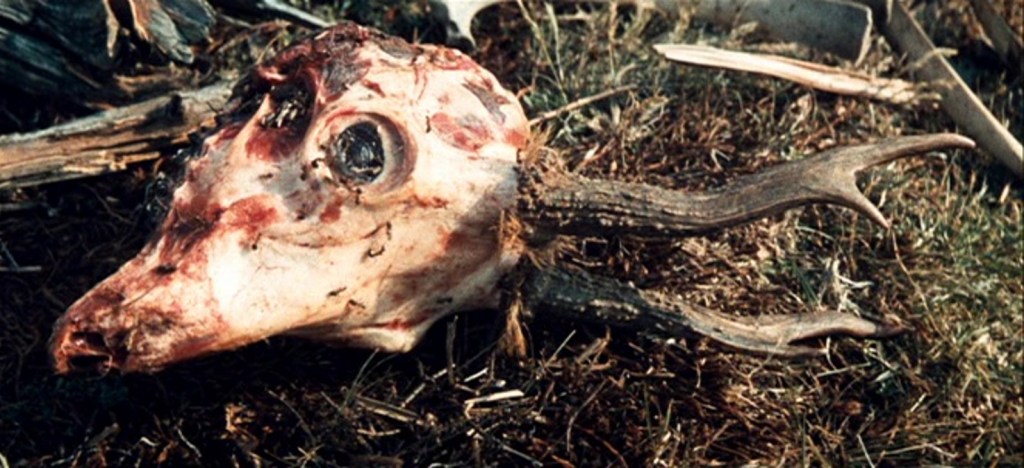
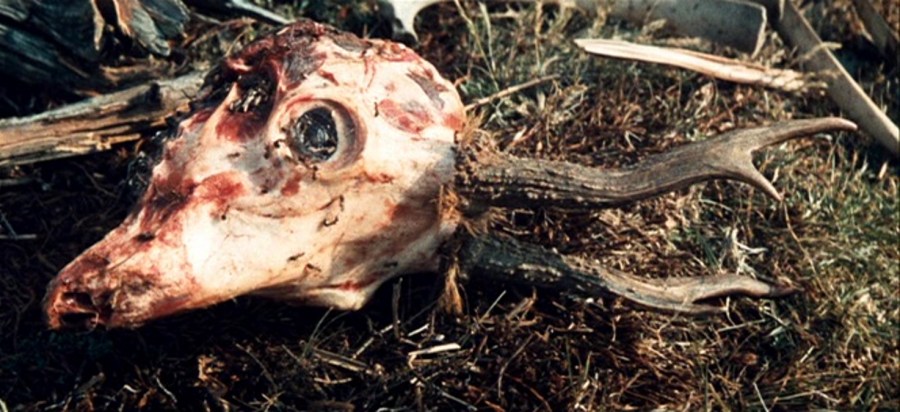
When they finally arrive at John’s brother’s farm after a battle with a bikie gang that seems to owe more to the early Western than to science fiction, they have collected a whole lot of salt-of-the-earth farmers, whom the brother is not pleased to see, as he doesn’t want to feed them. The final showdown is therefore a modern iteration of Cain and Abel – the battle of the brothers.

The really odd thing about this cannibal film is that, while we witness the descent of civilised British gentlefolk into savagery, we never see any actual cannibalism. We hear a lot about it occurring in other countries, and speculation about it being about to happen at home, but the British seem to find each other particularly unappetising.
Cornell Wilde was an activist director, intent on convincing his audiences that the world was going pear-shaped in a hurry, and he was not big on subtlety. Unfortunately, the audience expects not just social commentary but also entertainment, and despite a lot of shooting and explosions and murders and rapes, the film suffered from some wooden dialogue and irritating flash-forwards which extinguished any suspense. The film received a desultory score of just 40% on Rotten Tomatoes.

No Blade of Grass is over fifty years old, which doesn’t excuse but partly explains the overt sexism, classism and racism that it addresses while also often seeming to endorse. Yet the film’s environmental theme is even more current today than it was on its release fifty years ago. Pollution is killing off agriculture, the water is contaminated and unfit for drinking, animals are dying out everywhere. The two little boys in the car even mention global warming, years before most of us had heard of it.
When COVID hit in 2020, people queued for food and water and guns and (most urgently) toilet paper, and there was much talk of famine, the breakdown of social order and, inevitably, the rise of cannibalism, just as we see in this film (although being British, they never discuss or seemingly require toilet paper). With no grains and no domesticated animals, people naturally turn to the only available meat, that which grows on the ape called Homo sapiens. But fifty years on, we don’t seem to have learnt anything from such speculations.
The film ends with a narrator announcing:
“This motion picture is not a documentary; but it could be.”
Indeed.


 The Cannibal Guy