Cannibal influencer arrested in Brazil

If you by any chance have watched any of the videos of the influencer Israel dos Santos Assis, better known online as Pinguim (Penguin), you may not have guessed that anything controversial was being shown. The Brazilian, from São Francisco do Conde, a city in the metropolitan area of ​​Salvador in Bahiahad, had been gaining more and more followers on social media over the months before his arrest on July 23 2024, when he was apprehended after being caught desecrating graves in the cemetery of San Francisco the Count, in the Salvador Metropolitan Region, and stealing human bones.

Not just bones. The 22-year-old influencer used human flesh from the corpses to cook his most popular dish: feijoada, a bean stew usually involved simmering beans with beef or pork. Both of which have been reported as tasting very similar to human flesh.

One of Pinguim’s videos, which went viral on social media, explained the secrets of adding meat to beans — and how to get the most out of the final dish.

“Treat and throw it in the beans. But you can’t eat it, no, you just chew it and then throw it away. You don’t swallow it, you just chew it and throw it away, you just taste it, it’s sweet.”

The remains were not only for use in his recipes. After being arrested, Israel led the local police to a mangrove swamp where he had hidden numerous bags of bones. He had been sending these to Salvador, the state capital, to be used in satanic rituals.

The suspect was caught after families of buried people reported that graves had been violated and several bones had been stolen.

Pinguim made a video confession to police which was later released to the media. He reported that he had spent hours at the cemetery to see which graves were the most recent; those with the freshest human flesh. He told police he had fried a piece of a person’s leg and seasoned it with lemon and vinegar before chewing on it.

Local reports say he told police that he stole the body parts to order, in exchange for a payment equivalent to about $US50 from three people who wanted to use the bones as part of a black magic ceremony. He used the money to buy shoes and sandwiches, as well as getting his hair cut.

Surprisingly, Pinguim was released on bail pending an ongoing investigation into charges of desecrating a tomb. His lawyer, Luan Santos, told local media his client suffered from mental health issues and was taking anti-depressants. He added that he would be demanding psychiatric tests to ascertain whether the accused was fully aware of what he was doing.

Pinguim’s social media accounts have been deleted.

Brazil has always been a fascinating area for students of cannibalism. One of the most famous tribes was the Tupinamba, who captured a German soldier and explorer named Hans Staden in the sixteenth century. He claimed to have witnessed their cannibalistic rituals and did very nicely from his subsequent writings, illustrated by the graphic woodcuts of Theodor de Bry. As a result, the Portuguese came to save the ‘savages’ from their sins, and through enslavement, assimilation, extermination and the introduction of Smallpox, managed to wipe them out completely.

The classic cannibalism film How Tasty Was My Little Frenchman (Como Era Gostoso o Meu Francês) is set in this period of imperial invasion, and tries to give a new perspective on the way colonialism used cannibalism as its pretext.

More recently, modern Brazilians have been involved in some of the more interesting cannibalism stories that have graced our news cycles, including the “Cartel” who sold pastries made from human flesh to unwitting customers, and the Brazilian who was arrested in Lisbon for eating a man who had tried to help him. Like most cannibalism films, the ones set in Brazil vary between seeing it as something savages naturally do, such as Emanuelle and the Cannibals, and those that see it as typifying the exploitation of the poor by the rich, such as The Cannibal Club.

The Brazilian anthropologist Eduardo Viveiros de Castro proposed a ‘post-structural anthropology’ in his book Cannibal Metaphysics. De Castro sought to ‘decolonise’ anthropology by challenging the increasingly familiar view that it was ‘exoticist and primitivist from birth’, denying that cannibalism even existed, and so transferred the conquered peoples from the cannibalistic villains of the West into mere fictions of colonialism. This alternative view of Amerindian culture rejects the automatic assumption of the repugnance of cannibalism, which serves to either confront it or deny its existence. Accepting those parts of colonial culture that are useful (they speak Portuguese for example) can be seen as a form of reverse, cultural cannibalism.

But Pinguim demonstrates that even Brazilians have not fully embraced this philosophy, particularly when it involves digging up their relatives.

There is a video showing Pinguim confessing to cooking human bodies. More interesting if you speak Portuguese though.

Is Oprah a cannibal?

Well, apparently not.

The claim has been doing the rounds since a silly post on X in February (now archived).

The claim was made in response to an online request for people to share their fave Oprah moment “in honor of Oprah Winfrey’s 70th birthday”.

The post managed to gain some serious attention:

Even the poster didn’t try to persuade people that it was true.

“crying, why are ppl actually believing this … y’all believe anything”

That is certainly true. You may recall an almost identical campaign a few years back which claimed that Anne Hathaway had left evidence of cannibalism in a house she sold in 2013. This turned out to have been a “sociological study.”

Oprah has a history of media interviews in which she discusses food. Recently, she extolled the idea of using medications for losing weight, revealing that she has been using such drugs. Who can say that a high protein, low carb diet based on the cuisine of Dr Hannibal Lecter might not prove effective? Have you ever met a fat cannibal?

In 2008, Oprah went on a three week “vegan cleanse”. At the end of that brief period, she wrote

“At the end of the 21 days, I could not declare myself vegan or even vegetarian. But I am, for sure, more mindful of my choices. I’m eating a far more plant-based diet.”

Maybe giving up meat for health, environmental or ethical reasons could go beyond just avoiding human flesh, for everyone’s health?

Cannibal pig farmer savagely attacked in prison; not expected to survive

Police in Quebec report that convicted serial killer Robert Pickton is in a medically induced coma and on life support after being attacked by another inmate in prison.

The Canadian pig farmer was convicted of six counts of second-degree murder and sentenced to life in prison with the maximum parole ineligibility period of 25 years in 2007. He was also charged with the murders of 21 other women, but those counts were stayed. In total, investigators found DNA from 33 women — many of them Indigenous sex workers who had vanished from Vancouver’s downtown eastside in the 1990s and early 2000s — at Pickton’s Port Coquitlam pig farm. Pickton also once allegedly bragged to an undercover police officer that he had killed as many as 49 women, and wanted one more to make an even 50.

Pickton allegedly “processed” the meat of his rape and murder victims by feeding them to his pigs and, police said, possibly mixing them up with pork products he sold to his neighbours for their personal consumption. This puts him in the category of entrepreneurial cannibal, selling human products (directly or via porcine digestive tracts) to ‘innocent’ cannibals who bought his products; in the league of Sweeney Todd and Delores Roach.

Whether he fed human flesh to his pigs, his neighbours or himself, the revulsion and fascination in the media, which focussed on the possible cannibalism more than the torture and murder, sheds some light on the fragility of the thin red line between humans and (other) animals. The pigs had reportedly eaten humans and then been eaten by humans, with human meat incorporated into their flesh through digestion, plus possibly a more direct route to cannibalism via the sale of the meat, masquerading as pork. The headlines concentrated on the suffering of the dyspeptic neighbours who may have eaten (and probably enjoyed) the flesh, although it is obvious that their indigestion was far less painful than the torture endured by Pickton’s victims.

In February 2024, Alberta comedy group Danger Cats had their Vancouver, Edmonton and Ottawa performances cancelled after widespread backlash over T-shirts they made showing Pickton grinning and holding a slice of bacon with the caption “Pickton Farms, over 50 flavours of hookery smoked bacon.”

Sources told Radio-Canada on Tuesday that Pickton, 74, was clinging to life following what Correctional Service Canada (CSC) confirmed was a “major assault” on Sunday at the maximum-security Port-Cartier Institution, about 450 kilometres northeast of Quebec City. Pickton was in a segregated intervention unit at the maximum-security prison when he was speared in the head with a broken broom handle on Sunday evening, May 19, 2024.

Chief Marilyn Slett with the Heiltsuk Tribal Council in Bella Bella, B.C., said that discussion about Pickton’s assault has revived painful memories for the families of the victims and Indigenous people. Tammy Lynn Papin, the sister of one of Pickton’s victims, told CBC News that she felt relieved and happy when she heard that the serial killer had been attacked in prison.

“I said, ‘Good for him, he deserved it.’ I don’t wish any harm on anybody but — karma, you know?”

The movie The Farm may perhaps be based on the news reports about Robert Pickton. In the film, tourists are captured, caged, bred, slaughtered and sold as food. Which is what Pickton, the pig farmer, did to pigs for a living, and to humans for diversion. He ‘processed’ the captured women, in the same way that he ‘processed’ the pigs on his farm. Another movie called The Hermit is about to be released starring Lou Ferrigno (The Incredible Hulk) as a cannibalistic pig farmer, making human jerky for a living.

It’s what humans do to billions of farmed animals every year.

PETA (People for the Ethical Treatment of Animals) summed this up with a billboard campaign in 2004 showing a young woman and a pig, with a caption saying, “Neither of us is meat”. Bruce Friedrich, director of PETA’s campaign, responded to the predictable outrage by observing that,

“Canadians who are shocked at the thought that they may have eaten human flesh should think about the fact that there appears not to be a difference in taste between pig flesh and human flesh. A corpse is a corpse, whether it formerly belonged to a pig, a cow, a chicken, or a human.”

“Eunuch Maker” jailed for life – he cooked testicles for lunch

The mastermind of a “grisly and gruesome” extreme body modification network who streamed mutilations on his “eunuch maker” website has been jailed for life, with a minimum term of 22 years.

Marius Gustavson, 46, was accused of being the “arch manipulator” of vulnerable victims and purportedly took part in at least 29 procedures, which were “little short of human butchery”, the Old Bailey in London heard.

The “large-scale, dangerous and extremely disturbing” four-year enterprise included castrations, the use of clamps to crush testicles, penis removals, the freezing of limbs and administering electric shocks to a 16-year-old boy, procedures which were streamed on Gustavson’s website.

The “busy and lucrative” business earned more than £300,000 from its global base of 22,841 paying subscribers between 2017 and 2021.

Gustavson, who had previously admitted charges including conspiracy to commit grievous bodily harm, appeared for sentence via video link alongside six other men who had all admitted their involvement. The charges relate to thirteen victims who are under police guard.

Judge Mark Lucraft, the recorder of London and most senior judge at the Old Bailey, said as he announced the sentence:

“Gustavson, you are very much the mastermind behind this grisly and gruesome enterprise. The business you set up was one that was both busy and lucrative. As with all the others involved, you have no medical qualifications. The footage uploaded was extremely explicit and made available to paying subscribers no doubt so they could watch it for their sexual gratification […] Like-minded individuals were recruited by you, Gustavson, to assist in what became a large-scale, dangerous, and extremely disturbing enterprise.”

The prosecutor, Caroline Carberry KC, told the three-day sentencing hearing that there was “clear evidence” of cannibalism and that Gustavson, who had two previous fraud convictions in Norway, had “cooked testicles for lunch in an artfully arranged salad platter”. He also kept numerous body parts as “trophies” in a fridge at his home in Harringay, north London and offered to sell the severed penis of one of his victims for hundreds of pounds. Penisectomy, the removal of the penis and emasculation of the subject, is a popular topic in cannibalism texts, signifying the loss of the dominance of the virile carnivore, eaten by others who are closer to nature, more adventurous in their carnivory, and so more savage. Think of Lenzi’s film Cannibal Ferox, where we have not one but two penisectomies, one by the white invader and the other by the enraged natives.

The court heard the procedures were carried out in “amateur and dangerous” ways with kitchen knives, surgical scalpels and farm or slaughterhouse implements designed to be used on slave animals, leaving victims in agony and often needing medical attention.

The judge said, “They are permanent and irreversible procedures and will have a long-term, lifetime effect on the ability of the victim to carry out their day-to-day activities.”

Gustavson’s film-production techniques seemed to have become more professional as the number of procedures increased. The videos were uploaded to the website and subscribers were offered varying levels of membership from “free” to “VIP”, which cost £100, the court heard.

The scale of the operation run by Gustavson, a Norwegian national, and others was “without precedent”, Carberry said, adding that it was “impossible to know” the full scale of the offending.

The court previously heard that the procedures are linked to a subculture where men become “nullos”, short for nulloplasty or genital nullification, by having their penis and testicles removed. More details are available on the Queerdoc site.

In a video of one incident, which was played in court, one of the group’s victims was branded with the letters “EM”, for eunuch maker, on the back of his calf. The man later complained to police about Gustavson and his “circle of acolytes”, leading to the investigation and arrests in London, Scotland and South Wales. In his victim impact statement, the branded man described Gustavson as a “lunatic” running a “slick, professional website”.

The other six defendants admitted conspiracy to commit grievous bodily harm. The judge ruled that “I am entirely satisfied that the motivation of all those involved were a mix of sexual gratification as well as financial reward.”

Gustavson pleaded guilty to conspiring to commit grievous bodily harm, five counts of grievous bodily harm with intent, making and distributing an indecent photograph of a child, and possession of criminal property.

Peter Wates, 67, of Purley, Surrey, a retired former member of the Royal Society of Chemistry, was sentenced to 12 years in prison. Forensic officers found a scrotum and two penile shafts inside a tub of butter marked with the instruction “do not defrost” at his home address.

Janus Atkin, 38, of Newport, Gwent, who had been completing a veterinary course, was jailed for 12 years.

Ion Ciucur, 30, of Gretna, Scotland, received five years and eight months’ imprisonment, and Stefan Scharf, 61, of no fixed address, was sentenced to four and a half years in jail.

David Carruthers, 61, and Ashley Williams, 32, of Newport, Gwent, were jailed for 11 years and four years, six months respectively.

This was not just a business venture, but an expression of nullo ideology. In January, three men were sentenced after admitting causing grievous bodily harm to Gustavson.

Damien Byrnes, 36, from north London, was jailed for five years for removing Gustavson’s penis with a kitchen knife on video at his home on 18 February 2017. Jacob Crimi-Appleby, 23, from Epsom in Surrey, was jailed for three years and eight months for freezing Gustavson’s leg leading to the need for it to be amputated in February 2019. Nathan Arnold, 48, from South Kensington, west London, received a two-year suspended sentence for the partial removal of Gustavson’s nipple with a scalpel in the summer of 2019.

In mitigation, defence barrister Rashvinderjeet Panesar said the breakdown of Gustavson’s marriage was the “trigger” for his offending.

 “He had a desire to be the architect of his own body. His modification led him to feelings of empowerment. It appears at face value to be something that’s become an addiction for him.”

Kate Mulholland, from the Crown Prosecution Service, said, “Whilst the victims in this case all seemingly consented to surgeries and amputations, the victim who bravely reported his assault to the police expressed serious regret regarding his procedure and the lasting impact it has had upon him. This clearly emphasises why such practices are unlawful.”

Detective Inspector Amanda Greig, from the Metropolitan Police’s specialist crime command, thanked the victims for their bravery, adding, “I would like to highlight the excellent work of the Met’s investigation team, who have examined thousands of hours of horrific material seized from the suspects. Their diligence and professionalism have ensured no one else will suffer at the hands of these men.”

The Met said a search of Gustavson’s flat had uncovered boxes of medical needles and syringes, local anaesthetic packs, surgical tools, a wooden chopping board and a mallet, a body board with leg and arm restraints attached, disposable skin staplers, and numerous medical procedure videos.

Body modifications are not unusual; we see men and women proudly displaying tattoos and piercings in public now, although within living memory they were considered only for sailors and members of criminal gangs. Nor is it new; from about 1550 CE to the late 19th century, young boys were castrated, often quite brutally, before puberty, simply to ensure that their voices would not deepen, and they would become “castrati”, with the lung capacity and muscular strength of an adult male, and the vocal range of a prepubescent boy. Before that, since pre-Biblical times, young boys (and in many places girls) have undergone genital mutilations as part of religious or cultural rituals.

News stories about cases like the Eunuch Maker tend to start with warnings to sensitive readers that they may find the details disturbing. But there is also an intriguing ethical question that is largely ignored in all the coverage.

When the issue of modification and mutilation is related to other species, it bizarrely becomes innocuous. Companion animals are usually desexed to ensure they remain docile. Farmed animals such as bulls and boars are routinely castrated when babies, usually without any anaesthetics, so that their taste is not affected by puberty, which gives the meat an unpleasant “taint”. Like most anthropocentric ethics, whatever we choose to do to “animals” is functional, advantageous (to humans only), and considered unremarkable and inculpable, while doing the same things to humans, even consenting ones, is considered (to quote the Judge) “grisly and gruesome”. The exact same baffling and discombobulating shift of perspective happens when portraying the difference between the eating of animal “meat” and human “flesh”. Gustavson ate the flesh of the human animals he castrated, the difference being they had asked for the operation. If one occurrence is repulsive, surely so is the other?

The website is no longer available, but this is what it looked like:

Cannibalism news: LAS VEGAS MAN ACCUSED OF EATING VICTIM’S EYEBALL AND EAR

A 31-year-old man is in custody on suspicion of killing a man and eating parts of the victim’s face last weekend at East Charleston Boulevard and 3rd Street Las Vegas.

The Las Vegas Metropolitan Police Department released this report:

Police advised that the alleged perp, Colin Czech, had “biological matter in his hair, mouth, and on his clothing.” “Biological matter” is a euphemism for blood, flesh and other bodily substances.

Czech reportedly claimed the victim had attacked him. Police said the victim, identified as Kenneth Brown, was bleeding from head wounds and one of his eyes was missing. He was transported to the hospital, where a doctor pronounced him deceased.

During an interview, Czech allegedly said he was homeless and had been awake for several days because something was “possessing him.” Reports say Czech told detectives he “used his teeth to eat the victim’s eyeballs and ears.”

Police booked Czech into the Clark County Detention Center in absentia on a charge of open murder. Clark County District Attorney Steve Wolfson said it was one of the most unusual cases he has ever seen in more than 40 years as a defence attorney and prosecutor. He says the competency of the defendant will no doubt be addressed, adding “It is not uncommon for some of these cases to take years. Sometimes people never become competent.”

Czech was set to appear in court on Monday, April 29, but was hospitalised. In his eventual court appearance, he appeared dazed and uncomprehending.

Eating faces is not unknown in the annals of Cannibal Studies. In 2012, Rudy Eugene, “the Causeway Cannibal”, bit off the face off a homeless man in Miami, Florida before being shot to death by Miami police. In Wales in 2014, Matthew Williams lured a young woman back to his hotel room and began eating her face, apparently under the influence of amphetamines. Williams had been released from prison just two weeks before the killing and was described by police officers as “demonic”. Again in Florida in 2016, Austin Harrouff killed a couple he didn’t know and chewed off a victim’s face. He was found not guilty by reason of insanity.

Why all the faces? There is not much flesh on a face, yet it is considered a delicacy in some cultures. In the movie Eye without a Face, the protagonist watches on a hacked computer camera as a woman prepares a Persian dish called kale pache, literally “head and hooves”. It’s usually from a sheep, but whose head is it this time? Is she a cannibal serial killer? No spoilers here – you’ll have to watch it to find out.

Meanwhile, back in California, the man this blog reported on a few weeks back who found a human leg on the street in Bakersfield and started chewing on it has been sentenced to one year in jail in a Kern County courtroom. With good behaviour (and eating all his veggies?) he could be out in a lot less than that.
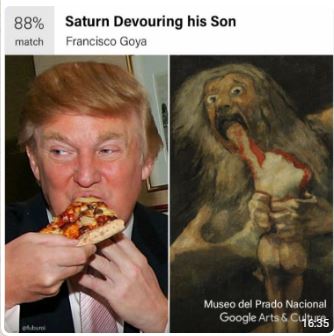
Under the dominant ideology of anthropocentrism or “speciesism”, buying the head or leg of a sheep for consumption is considered perfectly legal, if a bit quirky (or repulsive to some), yet eating a human face is headline material. But is there really that huge a difference between two species of mammals?

Mike Tyson’s edible ears

Mike Tyson, sometimes called “The Baddest Man on the Planet”, is nonetheless regarded as one of the greatest heavyweight boxers of all time. He was the world heavyweight champion from 1987 to 1990. After a spell in prison from 1992-95 for raping a young woman, Tyson made a comeback, and briefly held the championship again in 1996.

In 1997, Tyson fought Evander Holyfield at the Las Vegas MGM Grand Garden Arena in a fight that grossed $100 million. Tyson famously bit off a piece of Holyfield’s ear, which was later found on the floor of the ring. When he subsequently bit Holyfield’s other ear, he was disqualified, the first time in over fifty years a heavyweight fight had ended in disqualification. Tyson’s boxing licence was revoked by the Nevada State Athletic Commission and he was fined $3 million. Tyson claimed he was angry because Holyfield had been headbutting him without suffering any penalties for that.

In an interview with Fox News in 2013, Tyson was asked about his history, his fights, his religion, and becoming a vegan, a claim he had made on the Ellen DeGeneres show. He admitted to eating chicken occasionally, but said he never ate red meat.

“None at all, no way! I would be very sick if I ate red meat. That’s probably why I was so crazy before.”

Now, we are forced to admit that Tyson cannot really be called a cannibal since he did not swallow the piece of Holyfield’s ear. But he did make that significant connection between eating meat of other animals and biting (and almost eating) human meat. Had he been a vegan in 1997, he probably would not have aimed for that ear, unless it was an ear of corn.

The notoriety of that fight night has followed Tyson ever since, and now he is making money from it. He has created a cannabis company called Tyson 2.0 and is selling edibles in the shape of nibbled ears. Flavours include black eye berry, sour apple punch and watermelon (none of the products claim to taste like Evander Holyfield). The edibles are available from the company’s online store and have been sighted in dispensaries in New York. His website calls it “undisputed hemp.” No pun is out of bounds in the worlds of hemp or cannibalism.

In March 2024, Tyson announced he will be fighting YouTuber-turned-boxer Jake Paul in a bout that will be shown live on Netflix later this year. No doubt many people will be watching his teeth as closely as his gloves.

California Cannibalism: man arrested after reportedly eating a severed human leg

A man was arrested on Friday March 22 in Kern County (north of Los Angeles in the San Joaquin Valley) and charged with the “removal of human remains from other than a cemetary” (sic) according to the Sheriff’s office.

Construction workers in Wasco reported seeing the man near the Amtrak station.

“I’m not sure from where, but he walked this way and he was waving a person’s leg. And he started chewing on it over there, he was biting it and he was hitting it against the wall and everything.”

It seems a pedestrian (unidentified so far, some reports say male, others female) was killed by a train on Friday morning near 7th and G streets in Wasco. According to eyewitnesses, a man was subsequently seen eating a human leg that had been torn off in the accident.

The video shows the man in a red hoodie and black pants bending over something. He turns around and laughs at the person taking the video and then walks away. Shortly afterwards, the video shows the police responding and the man waving the leg at the officers.

A voice can be heard on the video saying, “He’s eating that shit!” in English and then in Spanish. Most of the news reports edit out the parts where it looks like he might be eating the leg.

Other news footage from KERO-TV showed what appeared to be bloodstains on the sidewalk at the scene of the incident. Some reports say he was charged with mutilating the body, supporting claims that he had consumed some of the limb.

The sheriff’s office later confirmed that they had arrested the man and identified him as 27-year-old Resendo Tellez. He was charged with six offences including possession of controlled substance paraphernalia.

Social media commentary varied from reflecting on drugs, homelessness and poverty to accusations of demonic possession and culture war accusations against California liberals allowing a “breakdown of societal norms”. One headline stated, “Cannibals Are Alive and Well in Newsom’s California.”

News footage of the story often contains warnings of “distressing material” and in most cases blur the leg when showing the video. Is there something weird about all this shock and horror?

If the same person had not been hit by a train, it would have been perfectly normal to show that person’s leg in a program on, say, beach holidays. On a porn site, the leg would have been the least of what we might have seen. Yet once detached from the torso, a human limb becomes so abject it must be blurred, and even then, warnings issued. The reason seems to be that we are terrified to admit our animality. We can go to a supermarket and push a trolley around containing the leg of a cow or a lamb, with the overt understanding that we will be eating it later, just as Tellez allegedly did with what he identified as a piece of meat lying on the ground. Yet because it is a human body part, it becomes obscene, repulsive, horrifying, because it reminds us that we, too, are mortal, edible animals, made of meat.

Criminals, rapists and cannibals: Donald Trump and the immigrants

Way back in 2015, when first campaigning for the presidency, Donald Trump announced he would build a wall on the border with Mexico to keep out:

“…people that have lots of problems. They’re bringing drugs. They’re bringing crime. They’re rapists. And some, I assume, are good people.”

That seems quite tame now, doesn’t it? Warning about rapists have lost their power, especially given Trump’s own personal legal struggles regarding sexual assault. 

So he has turned, dear reader, to our fave subject. Speaking on Right Side Broadcasting Network from Mar-a-Lago, a resort that relies heavily on immigrant labour, he upped the ante on border crossers by calling them cannibals released from mental institutions.

“They’re rough people, in many cases from jails, prisons, from mental institutions, insane asylums. You know insane asylums. That’s ‘Silence of the Lambs’ stuff. Hannibal Lecter, anybody know Hannibal Lecter?”  

This is not the first time that Trump has quoted Hannibal. At a rally in Iowa in October 3023, he also spoke of people from insane asylums sneaking into the country, and again quoted Hannibal. He added a rather strange endorsement.

“Hannibal Lecter, how great an actor was he? You know why I like him? Because he said on television on one of the – ‘I love Donald Trump.’ So I love him. I love him. I love him. He said that a long time ago and once he said that he was in my camp, I was in his camp. I don’t care if he was the worst actor, I’d say he was great to me.”

Hannibal Lecter is, of course, not in a position to comment on politics as he is a fictional character born in the mind and the novels of Thomas Harris and born again, we might say, in the films of those books in which Hannibal was played by Brian Cox and then by Anthony Hopkins. Then, in a third coming, Hannibal was rebooted as a Gen-X queer icon in the TV series Hannibal, played by Mads Mikkelsen.

Which of these Hannibals loves, or loved, Donald Trump?

Mads Mikkelsen told CBS News in 2016 that though he could “definitely laugh at some of the stuff [Trump] says, he can also go, ‘Oh my God, did he say that?’ I think he’s a fresh wind for some people.”

Brian Cox called Trump “such a fucking asshole” and “so full of shit.” So Trump is probably not quoting him.

Hopkins, who was born in Wales and became a U.S. citizen in 2000, told The Guardian that he doesn’t care for Trump and explained that he doesn’t vote anyway, because he doesn’t “trust anyone.”

“We’ve never got it right, human beings. We are all a mess, and we’re very early in our evolution.”

Nietzsche wrote of an Übermensch, a super-man who was as superior to ordinary people as they feel themselves to be to pigs. Hannibal clearly sees himself in this role. The mantra of the Übermensch is “Adapt, evolve, become”. But, as Charles Darwin would tell you (if he had not himself become extinct), evolution does not describe a ‘great chain of being’, an evolutionary ladder toward perfection. It is simply about best fitting a niche, surviving a hostile environment while competitors become extinct. The art of evolution is to out-run, out-fight, out-eat the other – to be the last one standing. And the only one eating. Perhaps eating the loser. As Frederick Chilton tells us, “Cannibalism is an act of dominance.”

Early humans seem to have practised cannibalism (according to some palaeontologists), although it may have been more for ritual purposes than for the protein. But in the modern age, protein is king, or at least those who eat the most protein consider themselves therefore superior to nature, and to other humans. Meat is a fetish, an addiction, a way of declaring human, particularly male, supremacy. We confine, torment and slaughter around 80 billion land animals each year (that’s 80,000,000,000) to feed this fetish.

But supremacism does not depend on species – those of another race, another origin, another gender, another age-group may all be dehumanised, objectified like farmed animals, and cannibalism is famously the accusation used to dehumanise colonised people, giving invaders the excuse to enslave or exterminate them. Trump dehumanises immigrants by accusations of cannibalism, just as his political opponents dehumanise him. When American comedian Jon Stewart was asked in 2017 by Late Show host Stephen Colbert to say something nice about then President Donald Trump, he hesitated and eventually blurted, “He’s not a cannibal”. Colbert followed this up a year later suggesting Trump eats human flesh, but only “it’s very well done with some ketchup”.

Consuming the appropriated assets of those considered foreign or inferior is standard operating procedure in human history. In the absence of now largely abandoned concepts of (some) humans being semi-divine creatures, created in the “image of God”, what is to stop the actual consumption of those on the next rung down? As the huge population of humanity consumes the environment, leading to climate change and famine, could cannibalism be the next phase of human evolution?

As anthropologist Harold Monroe asks in Cannibal Holocaust, “I wonder who the real cannibals are?”  

And as Hannibal said,

“It’s only cannibalism if we’re equals.”

Meat is meat: THE MAD BUTCHER (Guido Zurli,1971)

Some months ago, I reviewed a film called Auntie Lee’s Meat Pies, in which I asked readers “What’s in your pie?” This film, The Mad Butcher (Lo strangolatore di Vienna), asks a far more profound question: “What’s in your sausage?” In each case, a better pronoun might have been “who”.

Guido Zurli was an Italian director but this film was made in English, set in Vienna and starred the wonderful, larger-than-life Hollywood actor Victor Buono, who plays the “Mad Butcher” of the title. In the USA, it was released as Meat is Meat, a better title IMHO – describing cannibals as “mad” is such a lazy approach, an intellectual shrug of avoidance. And to the butcher of this film, meat really is… just meat.

Otto (Buono) is dedicated to his calling – cutting up and selling animal flesh, and to him, the women he kills and minces are just that – meat. Otto has anger issues, which caused him to be confined to an asylum for three years, after slapping a customer with a piece of liver. But now he is being released, with an official certificate allowing him to say, “I’m not crazy now.”

His wife, who had had him committed (to save him going to jail, she claims) wants him to come home with her, worried about what the neighbours will say, but he wants to move into his butcher store where, he tells anyone who will listen, he is “the best butcher in Vienna”.

While throwing from his window the rubbish left by his wife’s brother who was running the store in his absence, Otto sees a neighbour as she showers, in silhouette. She looks, well, edible to him.

His wife catches him staring at the neighbour and, during the resulting row, he strangles her. At first horrified, he realises that there is only one way to get rid of the evidence. After that, he has to dispose of a sex worker brought home by the brother-in-law, and then the brother-in-law, who he has spent much of the film calling a “pig”. Well, he is a very popular butcher, the best in Vienna, and after all, as he opines, “I need this meat.”

But then, when he manages to abduct the neighbour (she of the long showers with the lights on and the blinds open), he has to deal with the American protagonist – a journalist who inexplicably is allowed to hang out with the police and investigate their cases. Otto rips off her clothes (there’s a lot of that sort of thing) and promises her

“I’m not just the best BUTCHER in Vienna!”

As the logline says, in one of those double-entendres that haunt cannibal movies, “His sausage was a cut above the others!

This is more black comedy than traditional horror – Otto relishes turning his customers into innocent cannibals. They, in turn, rave about his sausages, lining up to buy them from his push-cart in the park.

When his activities are disclosed, the police chief, who has been happily eating other animals all movie, is suddenly smitten by a serious bout of nausea.

“Those sausages that I ate! They were made of human flesh!”

The innocent cannibal theme has been popular since Sweeney Todd, who first appeared on film in 1928. Forty years earlier, Jack the Ripper had terrified the citizens of the heaving metropolis of London, brimming with workers drawn to the dark Satanic mills, driven into town by the centralisation of agriculture and the promise of gainful employment. Social cohesion seemed to be failing (isn’t it always?) and the cannibal was the figure who best represented the city as voracious beast. Henry James described London as “an ogress who devours human flesh to keep herself alive to do her tremendous work”. The “savage” of foreign climes who had so thrillingly filled the imaginative accounts of the colonial explorers had come home personfied as their own city, and the unknown faces dwelling within it were chief suspects. This was reflected in H.G. Wells’ first novel, The Time Machine, in which the proletariat, thousands of years in the future, have evolved into a highly technological cannibalistic tribe who feed off the soft, effete gentle people who are all that remain of the bourgeoisie.

Sweeney Todd took this to a new level, showing that even a “gentleman”, an apparently respectable member of society, could kill people. But Sweeney is never shown eating anyone; it is his customers, or the customers of his girlfriend who owns a pie-shop, who enjoy (immensely) the flesh of his victims. This could be done for revenge, as in the later, Tim Burton version of Sweeney, or for profit, particularly in times of shortage, such as Ulli Lomel’s Tenderness of Wolves concerning the German serial killer and cannibal Fritz Haarmann, who supplied meat of many species, particularly human, to his unwitting and grateful neighbours.

The outer limits of the world were still full of cannibalistic savages, but now they were in the same country – Texas Chain Saw Massacre featured a bunch of rednecks who captured tourists and fed them to other tourists (as well as catering to the extended family of course). But we were more worried about the cannibal in our midst, driven by the spectre of Ed Gein, an unassuming if eccentric man who dug up graves and used the bodies for ornaments, graduating into killing people and possibly feeding their flesh to neighbours as venison, an accurate term for animals hunted down for food and fun. A later version was Farmer Vincent in Motel Hell who collected tourists to serve in his motel, quoting his motto “meat’s meat and a man’s gotta eat!). Another slightly less light-hearted group of entrepreneurial cannibals like Vincent were the merry animal liberationists who farmed, milked, slaughtered and sold the flesh of those observed eating animals (to others who pay to eat animals) in The Farm.

Other films from all around the world feature butchers profitably selling human flesh for human consumption: The Butchers, Ebola Syndrome (from Hong Kong), Delicatessen from France, The Green Butchers from Denmark, and Barbaque (Some Like it Rare), also from France. In most of these films, the flesh of humans is found to be irresistibly delicious, until its provenance is discovered (although in Barbaque, only flesh from vegans has that special something). This is also the theme of Sweeney Todd even in the latest personification, The Horror of Delores Roach, in which New Yorkers line up around the block to buy the most delicious empanadas, unaware they are made of the chef’s landlord. Hitchcock had explored the same territory in 1959 with his episode called Specialty of the House, in which members of an exclusive men’s club crave the specialty “lamb Armistran”, which turns out to be the flesh of patrons who had enquired too deeply into the methods of the chef. Just so in this film, The Mad Butcher, which was the subject of this blog before I embarked on one of my legendary tangents.

Hannibal Lecter, untypically, did not eat humans because they were irresistibly delicious, but because they were another species of edible mammals, inferior to Hannibal the Übermensch and those few he considered his equals, no more or less acceptable morally and gustatorily than any other meat animal. Hannibal found amusement watching his guests enjoy his cooking, not because of the type of the meat, but because of his gastronomical skills. Hannibal’s meals were just as delicious whether filled with human, cow, pig, sheep, or anyone else. It’s the preparation, what Claude Lévi-Strauss called “the cultural transformation of the raw”. Hannibal refined the rude into delicious concoctions. Otto feels the same way about refining annoying people through the artistry of his butchery.

“Let me explain. Animals tear meat. Butchers carve.”

Rotten Tomatoes gives this film a solid 42%, based on the wordless review of one critic. I think as cannibal films go it would be forgettable, except for the amazing performance of the great Victor Buono, who turns it into a melodrama, or even a pantomime. It is, whatever its critical failings, very watchable and a lot of fun, and for those who are interested in such things, there is no gore but lots of meat, and lots of dresses being ripped from female bodies. To the protagonist, Otto, sex is one more appetite, like hunger, easily satisfied by violence, and not to be denied by the stultifying conventions of society.

If you speak Italian, the full movie can, at the time of writing, be seen at: https://ok.ru/video/1511628212842

“…CANNIBALISTIC URGES” – Man on trial for brutal murder of four Idaho University students

A forensic psychiatrist has told Newsweek that the man charged in connection with the slayings of four University of Idaho students in November 2022 had battled with “cannibalistic urges.

Bryan Kohberger, a 28-year-old Ph.D. student and teaching assistant in the Department of Criminal Justice and Criminology at Washington State University, was arrested at his parents’ home in Albrightsville, Pennsylvania.

Kohberger is accused of breaking into a rental house in Moscow, Idaho, and fatally stabbing Kaylee Goncalves, Madison Mogen, Xana Kernodle and Ethan Chapin in the early morning hours on November 13.

Reports have surfaced divulging that Kohberger follows a strict vegan diet and has reportedly struggled with heroin addiction in the past.

Forensic psychiatrist Carole Lieberman told Newsweek that Kohberger’s “obsessive-compulsive eating habits” indicate he was afraid he would become addicted to meat if he ate it.

“He was not only vegan, he refused to eat off of pots or plates that had had meat on them. Psychologically, this represents his struggle against his cannibalistic urges. He was afraid that if he let himself go to taste meat once, he would become addicted to it—like he had become to heroin—and start killing and eating people.”

A relative told the New York Post last week that Kohberger’s dietary restrictions were “very, very weird” and that he seemed “very OCD,” referring to obsessive-compulsive disorder.

The woman, who asked not to be named, but said she was previously married into Kohberger’s family, said:

“It was above and beyond being vegan. His aunt and uncle had to buy new pots and pans because he would not eat from anything that had ever had meat cooked in them.”

Casey Arntz, who was friends with Kohberger in middle and high school, said in a video posted on TikTok that he had been “a heavy heroin user” in high school. Kohberger’s struggles with drug addiction continued into his college years, a friend from Northampton Community College told Fox News. Criminal profiler John Kelly told Fox News,

“This kind of person has this volcanic rage inside that’s going to explode on is victim of choice.”

Lieberman told Newsweek that Kohberger had probably studied criminology both to “calm the demons inside him that were telling him to kill” but also to “learn how to commit the perfect crime.”

It is possible that he had been in touch with the so-called BTK killer, Dennis Rader, whose serial killings in Wichita were the subject of a book by his supervisor, Katherine Ramsland.

Kohlberger may have corresponded with Rader (a lot of criminology students do) but we don’t know that yet. We have to wonder if Rader would have told him about working in the meat department of a Wichita IGA a few years before his murder spree began.  

Kohberger has been held without bond in Pennsylvania since his arrest. He will be tried in Idaho, the state in which the crimes took place, the only state in the US with a law against cannibalism, although no such charges have been laid against Kohberger.

His next court appearance will be June 26.

Kohlberger’s obsession with meat reflects a lot of issues considered in Cannibal Studies. Firstly, the question of human meat: there really is no significant difference between the meat of humans and other large mammals such as cows, pigs or sheep. Hannibal Lecter takes delight in feeding human meat to his guests, such as the flesh of the flautist of the Baltimore Philharmonic, whose Board members subsequently enjoy the meal immensely in the book and film Red Dragon, thus becoming innocent cannibals. Incidentally, being the Baltimore flautist seems to be a rocky road – their principal flautist Emily Skala, was fired in 2021 for spreading misinformation about the safety of coronavirus vaccines, the efficacy of face masks and the outcome of the 2020 presidential election, relieved of her post, but not eaten.

But the point is that once meat is prepared (cooked, seasoned, presented) it is very hard to tell its provenance. Cannibals who have been asked have mostly compared it to pork or veal, with Armin Meiwes telling an interviewer

“It would have made no difference in somebody else had tasted it; he wouldn’t have questioned the meat…. During preparation, it is not as dark, but bright and fresh as pork, and tastes so very close to pork.”

Kohlberger’s belief that he might like human flesh if he tried any meat at all therefore has some logic to it. Since Charles Darwin’s writings overthrew the special status of humans as closer to angels than animals, anthropocentrism has been amended to offer a story of humans as the culmination of evolution and thereby continues, rather less successfully, to obscure human animality. Should such beliefs falter, as happens repeatedly in many cases of contemporary cannibalism, it becomes a very short step from eating other animals to eating the human one.

But why should he become addicted to any meat? Well, we know Kohlberger has an addictive personality, shown by his very heavy usage of heroin. But we’re not talking drugs of addiction but lumps of protein, aren’t we? Well, there are plenty of studies about that. Marta Zaraska, for example, wrote in her book Meathooked that meat is highly addictive on several fronts – genetic, cultural, historic and commercial, and coined the term “meathooked” for the incongruous compulsion to eat meat despite the pangs of cognitive dissonance – the repressed feeling of guilt when considering oneself an animal-lover while also paying big corporations to kill them. Then there is the mythology of the Wendigo, a creature from Algonquin legend who starts off as a human but becomes a being who can only live on human flesh, which makes him grow bigger and at the same time hungrier. If you believe in Wendigos, then the slippery slope from carnivore to cannibal seems reasonably clear.

This leads us to the issue of Kohlberger’s apparently very strict veganism. Most people seem to believe (or want to believe) that vegans are fanatics, obsessed with animal welfare (or environment or their own health) who therefore compulsively avoid meat. But in fact most vegans I know would wash a pot well after a relative had cooked meat, but are unlikely to throw it out as irretrievably ruined, as Kohlberger purportedly did. Veganism is an ethical system that attempts to minimise harm to sentient animals, which includes humans (yes, Virginia, we are animals). If there is a slippery slope from the flesh of other animals to the flesh of Homo sapiens, then the vegan is furthest from the edge of that slope. If Kohlberger did kill those students (and at this stage it’s only alleged), then he is no vegan, even if he didn’t sample them on the way out.