
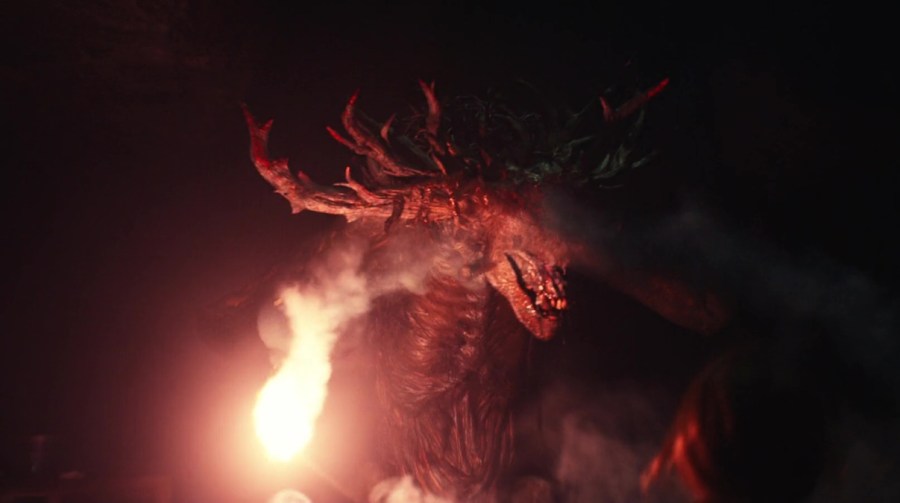
If you read this blog, and I hope you do, you might remember a movie we reviewed recently called Wendigo. It was about the mythical creature from Algonquin legends, the spirit who takes over humans and turns them into voracious cannibals whose feeding frenzy makes them grow larger and, consequently, hungrier. The Wendigo is usually represented by the stag or at least the antlers of a stag; thus the title of this week’s film, Antlers, which fronts another Wendigo, although this time a rather less complex creature.
Directed and co-written by Scott Cooper (Crazy Heart, Black Mass) the film is produced by Guillermo del Toro, who has already won three Academy Awards for his imaginative grotesqueries. Del Toro’s films exhibit his fascination with fairy tales and mythology and the monstrous, in which he finds poetic beauty. The cast is outstanding, led by Keri Russell (Grimm Love, The Americans) as Julia, a teacher in rural Oregon who wants to help a young boy in her class named Lucas (Jeremy T. Thomas) who, she suspects, is suffering parental abuse. She thinks this because he is drawing gruesome pictures of creatures with huge antlers, and collecting roadkill.

Jeffrey Dahmer’s dad used to take him out on road trips to find roadkill to dissect, but there was nothing wrong with him, was there? Well, OK, but anyway, he wasn’t being abused, and nor is Lucas (except by the usual school bully).
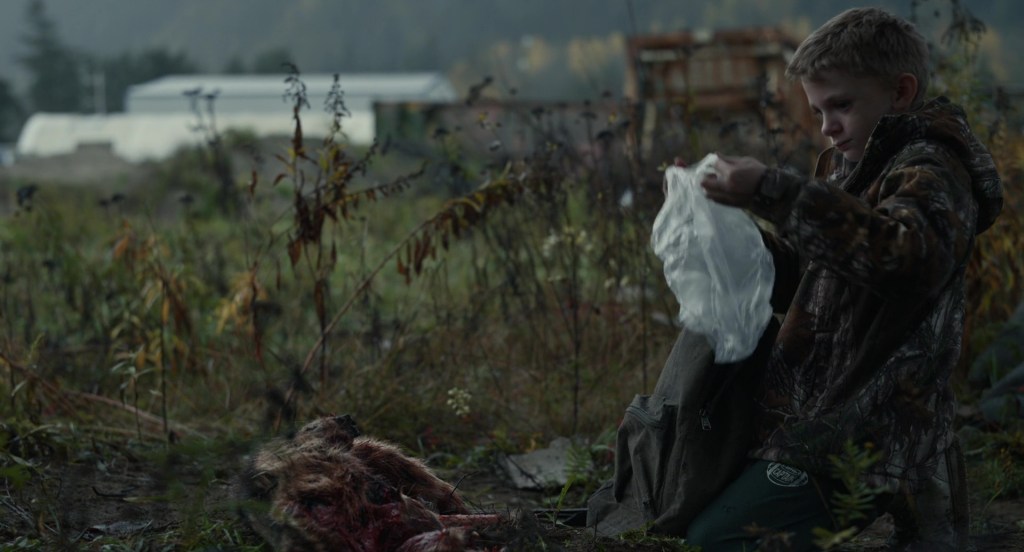
Lucas’ dad was using an abandoned mine to cook methamphetamine, disturbing the quiet of the place, releasing who knows what has been hiding in there? Yep, but it’s not a balrog (also usually shown with horns), it’s a wendigo. And it has infected both the dad and the little brother. Dad is now very loud, very violent creature with a lack of hair (bit like Gollum, but more excitable) who need to be fed raw meat every day. No smart cracks about Oregonians, please. But Julia is an outsider herself – she fled to California as a young woman to escape her abusive father, and is wracked with guilt about leaving her brother Paul (Jesse Plemons – Friday Night Lights and Breaking Bad) behind. He is now sheriff of the town, where he does exciting things like evict poor people from their humble homes. She thinks he resents her, and we think so too – why wouldn’t he? He tells her he spent his entire life praying she’d come back. But now, whenever he comes near her, she flinches as she flashes back to her father abusing her as a child.
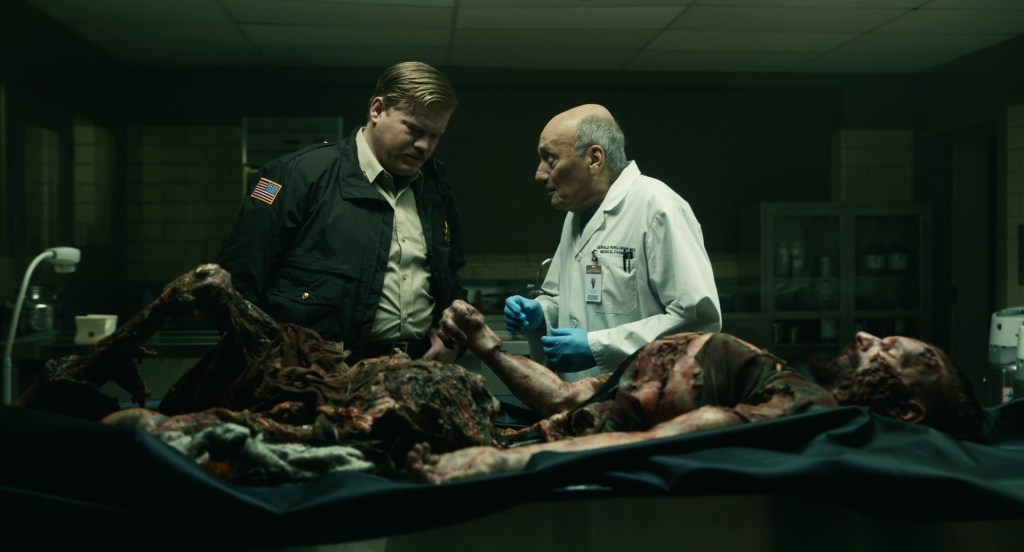
Paul goes into the woods to retrieve half a human body that someone has reported, and takes it to the coroner, who tells him the mutilation shows teeth marks – and they are human teeth. Almost halfway into the movie, and we finally have some cannibalism going on! Paul finds the other half of the dude (the dad’s former business partner) in the mine where they were cooking the meth. Also some mysterious antlers!
From there on, people start getting eaten – the stern school principal, the school bully who has been picking on Lucas (monsters can also be instruments of justice). It doesn’t work well for dad either; after he is finished enjoying the school principal, the real monster, now in the shape of a skeletal beast looking similar to the creature fought in the Alien films (but with antlers), sacrifices his body (the reference to the crucifixion is clear), then bursts out of his mouth, leaving him a charred, flayed wreck.

Lucas is carried off to the hospital, where he is diagnosed as dehydrated, malnourished, and deeply psychotic. Well, no wonder!
Warren, the previous Sheriff, is a local Native American, and explains to them that Lucas’ drawings, as well as the antler found in the mine, depicts the Wendigo,
“…a diabolical wickedness that devours mankind… known to be eternally starving but feasting makes them hungrier, and weaker. Those who are unfortunate enough to encounter one can only kill it when it’s in its weakened state. And only by extinguishing its beating heart, forcing it to search for another host. But it makes sense you see – our ancestral spirits never died. They were here long before we were here, and they’ll be here long after we’re gone. But now they’re angry.”

They find the missing school bully, who has been “eaten in half”, but Paul tells Julia he still cannot believe in a mythical nature spirit. He requires a conversion experience – maybe his deputy getting pin-cushioned and eaten, and then him getting comprehensively monstered? That leaves it up to Julia to take on the Wendigo. Being a teacher, she remembers the bit about it being weakened when eating, and the bit about extinguishing its beating heart. Using some impressive combat techniques that she probably learnt in The Americans, Julia rather easily beats the big beast, but then has a new problem – the Wendigo spirit is now in Aiden, Lucas’ little brother. Does Julia have the heart to kill and tear the beating heart out of an eight-year-old boy who looks like he just needs a meal and a bath? And do it while she is being watched by his big brother, Lucas?

Spoiler alert: you bet she does!

But as we watch the happy ending, Lucas now living with Julia and Paul, we see Paul begin to cough and spit out black foam – the first symptom of becoming a Wendigo (or this version of it.) As Jeffrey Jerome Cohen told us in his “Seven Theses” on monster culture, the monster never really dies or goes away; it just comes back in different clothes, or different skin. No matter how many times Ripley killed the Alien, it kept coming back, sometimes in the shape of its progeny (a reversal of the Beowulf story, where killing the monster arouses his mother’s wrath).
There are several versions of the Wendigo story. In Supernatural, the Wendigo only ate people every 23 years, an extreme version of the paleo diet. In Fear Itself, the Wendigo takes over anyone who is weak and hungry and fills them with rage, while in Lone Ranger, it appeared an outlaw in the Old West, who could only be killed with a silver bullet for some reason. The common thread is insatiable and voracious appetite, a hunger that destroys without thought for sustainability. In Bones and All, that hunger begins young and gets stronger as they grow older. Perhaps the classic of Wendigo literature is the film Ravenous, in which becoming a Wendigo gives not just superhuman strength but close to invulnerability, or at least the ability to heal any wounds by eating more people. And, of course, a voracious hunger.
The film starts with a warning. This is read in Ojibwe, one of the Indigenous languages of the Algonquin people, whose lands stretch from present-day Ontario in eastern Canada all the way into Montana. This is the language in which the mythology of the Wendigo was developed. The English translation scrolls up the screen:

The film is brilliantly acted, beautifully filmed and directed, but could have made more of a point of the environmental message with which it started, rather than just hurtling into the special effects and gore. The Wendigo is well presented, if a little sparse (we hardly see those antlers), but the connection between the greed of humans and the monstrous revenge of nature is left hanging. There have been five great extinction events found in fossil records. The SIXTH MASS EXTINCTION is happening as we speak. Extinctions have occurred at over 1,000 times the background extinction rate since 1900, and the rate is increasing, a result of human activity (or ecocide), driven by population growth and overconsumption of the earth’s natural resources. In late 2021, WWF Germany suggested that over a million species could go extinct within a decade in the “largest mass extinction event since the end of the dinosaur age.”
Humanity has waged war on nature since we came down from the proverbial trees, but particularly since the agricultural revolution some 12,000 years ago, when we decided nature could be dominated rather than placated. Fossil fuel combustion, the selective breeding of billions of other animals for food or clothing, the capture of wild animals for entertainment – these are all manifestations of the war on nature, motivated by a Wendigo-like hunger which can never be satiated. It’s a war that we cannot win, without destroying ourselves in the process – nature never goes away, but, like the Wendigo, comes back in another (angrier) skin – floods, droughts, climate change, etc. We have, as the Ojibwe warning says, pillaged the land and awakened a Malevolent Spirit. Like any organism evolving by natural selection, we can adapt or die. Our only advantage over other species is that we could, if we had the sense, decide which to choose.


 The Cannibal Guy