Australian boxer Nikita Tszyu has revealed that he became a “cannibal” as he prepared to fight Lulzim Ismaili this month (August 2025). The boxer said he needed to be at his very best to win over his unbeaten opponent, and hoped that his new diet would boost his training.
Tszyu revealed that his change in nutritional sources was all thanks to his wife, Nikita Bedwell. The couple welcomed their first child earlier this month, named Curiosity after the NASA Mars Rover, and the birth allowed Tszyu to change his diet.
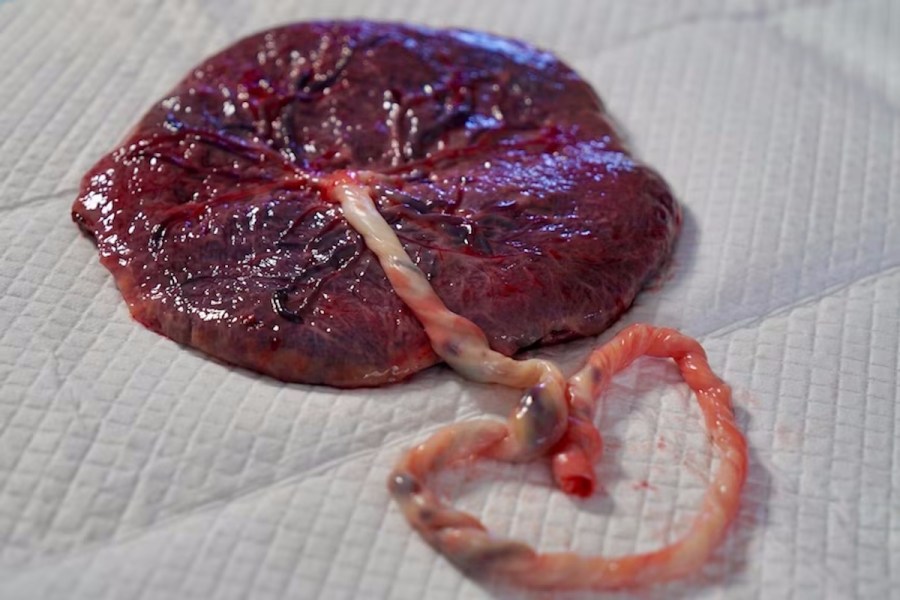
The Australian boxer is eating his wife’s placenta in capsule form as part of his training program, and feels like he is benefitting from the change in diet. He told a Sydney radio station:
“we freeze-dried her placenta and I’ve been supplementing on her placenta recently… in tablet form”
Does that make him a cannibal? Well, he thinks so. He added:
“I’ve technically become a cannibal. It’s actually like a superpower. I’ve done tests with my sparring – days where I’ve had it and days where I haven’t – and it feels like I got all this crazy amount of energy”
If you’re not convinced by that, he told the interviewers he is also including breast milk in his diet. Asked if he had tried it, he replied: “I have, I have… and it’s delicious as well!”
Consuming placentas is a growing trend in America, with mothers usually consuming them as part of their postpartum recovery. The practice dates back to Chinese medicine, though studies are yet to confirm that there are benefits to eating them.
The bout on August 20 was subtitled (based on Tszyu’s nickname):
THE BUTCHER IS BACK
So, is cannibalism the next big thing in athletic enhancements? Well, Tszyu knocked Ismaili, who was previously unbeaten, to the mat in just over one minute. The shaken opponent sat on his stool and refused to leave his corner, throwing in the towel before round two commenced.
Athletes often boast of eating meat to improve their fitness and stamina, although there are also plenty of vegan ones who swear that dropping meat and milk makes them faster, stronger and more alert. But if there is any truth in the meat myth, then I suppose we need to consider the words of Anthropologist Marvin Harris, who stated in his book Good to Eat: Riddles of Food Culture that, while humans are clearly not obligate carnivores,
“our species-given physiology and digestive processes predispose us to learn to prefer animal foods… strictly speaking, human flesh itself contains the highest-quality protein that one can eat”
There’s one to chew on, next time you enter the ring.
Way back in 2015, when first campaigning for the presidency, Donald Trump announced he would build a wall on the border with Mexico to keep out:
“…people that have lots of problems. They’re bringing drugs. They’re bringing crime. They’re rapists. And some, I assume, are good people.”
That seems quite tame now, doesn’t it? Warning about rapists have lost their power, especially given Trump’s own personal legal struggles regarding sexual assault.
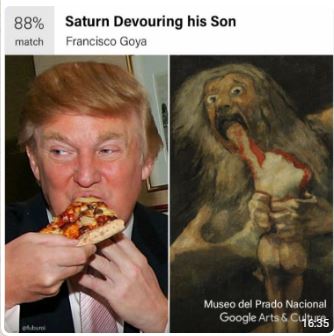
So he has turned, dear reader, to our fave subject. Speaking on Right Side Broadcasting Network from Mar-a-Lago, a resort that relies heavily on immigrant labour, he upped the ante on border crossers by calling them cannibals released from mental institutions.
“They’re rough people, in many cases from jails, prisons, from mental institutions, insane asylums. You know insane asylums. That’s ‘Silence of the Lambs’ stuff. Hannibal Lecter, anybody know Hannibal Lecter?”
This is not the first time that Trump has quoted Hannibal. At a rally in Iowa in October 3023, he also spoke of people from insane asylums sneaking into the country, and again quoted Hannibal. He added a rather strange endorsement.
Trump on Hannibal Lecter: You know why I like him? Because he said on television “I love Donald Trump” so I love him pic.twitter.com/1jYyXKFkjI
“Hannibal Lecter, how great an actor was he? You know why I like him? Because he said on television on one of the – ‘I love Donald Trump.’ So I love him. I love him. I love him. He said that a long time ago and once he said that he was in my camp, I was in his camp. I don’t care if he was the worst actor, I’d say he was great to me.”
Hannibal Lecter is, of course, not in a position to comment on politics as he is a fictional character born in the mind and the novels of Thomas Harris and born again, we might say, in the films of those books in which Hannibal was played by Brian Cox and then by Anthony Hopkins. Then, in a third coming, Hannibal was rebooted as a Gen-X queer icon in the TV series Hannibal, played by Mads Mikkelsen.
Which of these Hannibals loves, or loved, Donald Trump?
Mads Mikkelsen told CBS News in 2016 that though he could “definitely laugh at some of the stuff [Trump] says, he can also go, ‘Oh my God, did he say that?’ I think he’s a fresh wind for some people.”
Hopkins, who was born in Wales and became a U.S. citizen in 2000, told The Guardian that he doesn’t care for Trump and explained that he doesn’t vote anyway, because he doesn’t “trust anyone.”
“We’ve never got it right, human beings. We are all a mess, and we’re very early in our evolution.”
Nietzsche wrote of an Übermensch, a super-man who was as superior to ordinary people as they feel themselves to be to pigs. Hannibal clearly sees himself in this role. The mantra of the Übermensch is “Adapt, evolve, become”. But, as Charles Darwin would tell you (if he had not himself become extinct), evolution does not describe a ‘great chain of being’, an evolutionary ladder toward perfection. It is simply about best fitting a niche, surviving a hostile environment while competitors become extinct. The art of evolution is to out-run, out-fight, out-eat the other – to be the last one standing. And the only one eating. Perhaps eating the loser. As Frederick Chilton tells us, “Cannibalism is an act of dominance.”
Early humans seem to have practised cannibalism (according to some palaeontologists), although it may have been more for ritual purposes than for the protein. But in the modern age, protein is king, or at least those who eat the most protein consider themselves therefore superior to nature, and to other humans. Meat is a fetish, an addiction, a way of declaring human, particularly male, supremacy. We confine, torment and slaughter around 80 billion land animals each year (that’s 80,000,000,000) to feed this fetish.
But supremacism does not depend on species – those of another race, another origin, another gender, another age-group may all be dehumanised, objectified like farmed animals, and cannibalism is famously the accusation used to dehumanise colonised people, giving invaders the excuse to enslave or exterminate them. Trump dehumanises immigrants by accusations of cannibalism, just as his political opponents dehumanise him. When American comedian Jon Stewart was asked in 2017 by Late Show host Stephen Colbert to say something nice about then President Donald Trump, he hesitated and eventually blurted, “He’s not a cannibal”. Colbert followed this up a year later suggesting Trump eats human flesh, but only “it’s very well done with some ketchup”.
Consuming the appropriated assets of those considered foreign or inferior is standard operating procedure in human history. In the absence of now largely abandoned concepts of (some) humans being semi-divine creatures, created in the “image of God”, what is to stop the actual consumption of those on the next rung down? As the huge population of humanity consumes the environment, leading to climate change and famine, could cannibalism be the next phase of human evolution?
As anthropologist Harold Monroe asks in Cannibal Holocaust, “I wonder who the real cannibals are?”
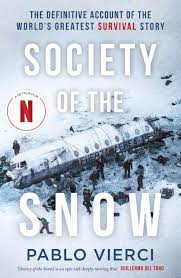
Society of the Snow is a new account of the 1972 Andes plane crash. It is an adaptation of Pablo Vierci‘s book of the same name,which included detailed accounts of all sixteen survivors, many of whom Vierci had known from his earliest years.
The twist here (not really a spoiler as they keep presaging it) is that the narrator of the film is one of those who were not among the sixteen.
Uruguayan Air Force flight 571, chartered to transport the “Old Christians” rugby team to Santiago, Chile, crashed into a glacier in the heart of the Andes. Of the 45 passengers on board, only 16 survived for the 72 days before they were rescued. Trapped in one of the most inaccessible and hostile environments on the planet, they had to choose cannibalism to stay alive. In this blog, we are most interested in the debate that led to the decision to eat their friends and crew, but the whole story of their pursuit of survival goes beyond what they ate and is equally fascinating.
We see a group of very devout young people, laughing and joking as they organise the trip to Chile, horsing around as the plane gets most of the way over the Andes, and then their reactions as the plane just does not reach the required altitude.
After a week without food, their urine turning black from lack of protein, they start exploring their very limited options. One group believe they will be rescued, even though their plane is painted white and they are in one of the biggest snowfields in the world. But most of them start to think about the only realistic way to survive, particularly after they find a portable radio and hear that the search for them has been called off.
The film has some interesting discussions regarding the ethics of cannibalism.
“What’ll happen to us? Will God forgive us?” “He’ll understand we’re doing everything we can to survive.”
Roberto, the medical student who has been trying to keep the injured alive, explains what happens to the body without food – it dries up, starts to absorb the organs. There is reference to the “God of the Mountains”, a different being to the one in the city. Arturo, one of the wounded, has a fascinating soliloquy about this God:
“That God tells me what to do back home, but not what to do out here…. I believe in another God. In the God that Roberto has in his head when he treats my wounds. In the God that Nando has in his legs when he keeps walking no matter what. I believe in Daniel’s hands when he cuts the meat, and Fito when he gives it to us, without saying which of our friends it belonged to. So we can eat it, without having to remember the life in their eyes.”
They discuss the legality and the practicality of cutting up bodies, the similarity to organ donation, but of course without consent. So that inspires them to make a pledge.
And so they begin to eat. There are scenes of skeletons being picked clean as the three Strauch cousins offer to cut up the bodies in an area that is hidden from the plane, “to keep the ones who eat from losing their minds”.
What the film glosses over is the Catholicism that permeates much of Latino culture. While they make the point that the bodies are now “just meat”, they do not look for the parallels of their cannibalism to the Eucharist, the eating and drinking of the wafer and wine in church which is supposed to transubstantiate into the blood and body of Christ. It is a theme explored in more detail in the earlier film, as well as in the memoirs of the survivors.
“Drawing life from the bodies of their dead friends was like drawing spiritual strength from the body of Christ when they took Communion” (Parrado & Rause 2006. Miracle in the Andes: 72 Days on the Mountain and My Long Trek Home, p.117.)
They quote to each other Matthew 26:26: “Take and eat, this is my body.” (Canessa & Vierci 2016. I Had to Survive: How a Plane Crash In The Andes Inspired My Calling to Save Lives, p.27).
I suspect this might have been considered a bit too close to the bone (apologies for the pun) for the Spanish speaking audience to whom the film is mainly addressed. Or else they wanted to appeal to a wider audience than just the Catholics. Or perhaps a bit of both.
The story is best known in print for Piers Paul Read’s 1974 book Alive: The Story of the Andes Survivors, which was turned into the film Alive in 1993 by Frank Marshall. Since then, several of the survivors have written their own accounts, to set straight some of the alleged inaccuracies in Alive, but none are as well known. Outside of the Hannibal story and perhaps Soylent Green, Alive is the film most people seem to recall when they hear I have written a thesis on cannibalism.
Alive had a few problems that this film nicely avoids. For one thing, it was very Hollywood, or “Anglo” as the politically aware like to say. It starred American actors who did not look like they were starving, even when they were fondly reminiscing and lusting for the food they missed, which seemed to be mainly pizza. Society of the Snow has Uruguayan and Argentinean actors speaking in Spanish, and makeup and special effects have improved markedly in the thirty years between the films, so they look hungry, and their wounds look ghastly. It is a more authentic look at the situation in which a group of deeply religious young men could decide to eat their dead fellow passengers and friends, who conveniently lay around them, preserved in the snow.
The film closed the 80th Venice International Film Festival in an ‘Out of Competition’ slot. It was theatrically released in Uruguay on 13 December 2023, in Spain on 15 December 2023, and in the US on 22 December 2023, before streaming on Netflix in January 2024.
Society of the Snow received positive reviews. At the 96th Academy Awards, it was nominated for the Best International Feature Film, representing Spain, and Best Makeup and Hairstyling.
Society of the Snow is arguably a better movie than Alive, although at two hours forty minutes, I thought a bit more editing might have been useful. Still, sitting through that 160 minutes gave a miniscule sense of the despair of sitting in a wrecked plane in freezing conditions for 72 days, so we cannot complain!
But I was sorry to see them drop the cannibalism/communion issue, even though there is a hint in the final scene where the survivors sit around a dinner table like the Disciples at the Last Supper, their dead friends being the bread of life, transubstantiated from sacred to edible, the reverse of what is supposed to happen to the church wafer. Whether you consider this a cannibal movie or an epic of survival (and yes, there is controversy raging about that), exploring why people do or don’t eat each other is endless fascinating, and the question of cannibalising the body of Christ is, or should be, at the heart of this story.
I don’t usually put warnings about graphic images in my blogs; I figure if you are reading a blog called “thecannibalguy.com” that you are probably not expecting unicorns and fairies. But this short clip has its own trigger warning, so I’ll just reproduce it here.
Vegans are often told by caring or sanctimonious friends and relatives that they need animal protein or they will get sick and die. This can be a bit wearisome, particularly for long-term vegans. Now here’s a novel solution.
Jamie Lee Curtis Taete (I wonder who his parents’ favourite film star was?) has been vegan or vegetarian for almost 20 years (and clearly has not died yet). After years of carnivorous peer-pressure, he’s decided to consume animal products from what he calls the only truly ethical source: himself.
Jamie seeks advice from “Blood for Food” activist, Laura Schälchli, about her recipes, which are made with blood from other animals. He follows her recipe for blood meringues, substituting his own blood for whatever unfortunate animal is usually slaughtered and bled.
And eats the results.
He starts by whisking the blood, because blood tends to clot, which even he describes as “disgusting”. But,
“I find the thought of it less gross than if I were eating the blood of an animal.”
Jamie is perhaps using shorthand, or forgetting that we are all animals?
The protein albumin comprises about fifty percent of human blood plasma, and is similar to egg whites, so the obvious choice for Jamie was to make a meringue, which is usually made from the whites of chicken eggs or, far less often, in the recipe he has chosen, the blood of goats or cows.
“I was expecting a sugary bowl of gore, but this looks like it could be real food.”
So look, autocannibalism is not an appetising prospect, but most vegans would say the same about dishes made from the organs, muscles or blood of an animal who was unwillingly slaughtered for the purpose.
“I think I probably enjoyed this more than if I had made it using animal blood, because there was no death involved. I am really the only ethical source of animal products, because I can give my consent to myself in a way that a sheep can’t.”
Here are some of the comments from YouTube:
Some suggested that Jamie would end up a cannibal, a common thread through the literature – if you eat human flesh (or blood I guess), you will become addicted, because we are somehow irresistible. It is absolute nonsense of course. Others felt like it had made the point: eating any animal product, including from the ape known as Homo sapiens, is a bit disgusting. I have seen people flinch as they pull a piece of meat out of the fridge and pour out the blood that pools under it.
As Jamie says, if you must eat animal protein, use the nearest animal, and the only one that is able to consent, although the occasional cannibal like Armin Meiwes manages to find a willing third party to sate his cannibalistic desires. Remember the scene from The Restaurant at the End of the Universe, when the “dish of the day” offers them his shoulder to eat, braised in a little white wine sauce, saying “naturally mine, sir, nobody else’s in mine to offer!”









 The Cannibal Guy