Spanish influencer “practiced cannibalism”: eats part of her own knee

Cannibalism is usually defined as eating the flesh of another animal of the same species. In the case of humans, this of course means eating the flesh of another human. But sometimes people eat their own flesh. Is this still cannibalism, and is there anything wrong with it?

The answers usually given seem to be yes and yes. I agree that eating your own flesh is, by definition, a form of cannibalism, but I really cannot see what all the fuss is about. What about people that chew their fingernails, called onychophagia, or (oww!) their cuticles? Or perhaps more extreme is the fashion of eating placentas after childbirth – some women take them home and cook them, or there are companies that offer to sterilise and morcelise placentas and make pills from them. There is not, unfortunately, universal agreement on the supposed health benefits.

British social anthropologist Alfred Gell reported that in the 1970s he was conducting fieldwork among the Umeda people of West Sepik in Papua New Guinea, when he accidentally cut his finger and, as people often do, put it in his mouth to suck the wound. The locals were horrified and considered him a cannibal:

“the shocked countenances and expressions of disgust evinced by my Umeda companions told me soon enough…”

If Gell was thought a cannibal for sucking his own blood, what would the Umeda think of Spanish ‘influencer’ Paula Gonu, who announced that she ate some cartilage that was removed from her knee during surgery? In an interview with the Club 113 podcast, Gonu, who had opted for local anaesthesia, spoke of watching the doctor operate on her knee in real-time on a screen. After the doctor finished the procedure, the influencer said he asked her if she wanted to keep the part of her meniscus that he had removed. Gonu said yes and the doctor put the piece of cartilage in a small bottle filled with preservative.

Gonu explained that she had to undergo surgery to remove her meniscus (cartilage in the knee joint) following an injury. A week after the surgery, Gonu decided she wanted to eat the cartilage.

“I was talking with the boyfriend I had at the time, and I told him, ‘I want to eat it. It’s mine and I have to reinsert it into my body’. He asked, ‘But why do you want to eat it?’ I answered, ‘Why not? It’s not going to hurt me.’ So, then I made a Bolognese sauce, I added it in, and I ate it.”

Gonu previously shared the story in a viral TikTok last November, which has been viewed more than 4.3 million times, with the caption: “It didn’t give me super powers.” However, after Gonu retold the story on the Club 113 podcast, it entered the news cycle again.

Spanish media was quick to trumpet Gonu’s cannibalism. “Paula Gonu practiced cannibalism: She ate her own meniscus,” read one headline. Another headline from November, when the influencer originally shared the story, stated: “The rich eat meniscus.”

One Twitter user  called it “Bizarre”. This was one of the more moderate comments.

Autocannibalism or autosarcophagy is in a sense universal, in that we all consume dead cells from our tongue and cheeks all the time. But autocannibalism is not always voluntary. The Hungarian noblewoman Erzsébet Báthory (the one who allegedly used to bathe in the blood of virgins in the early 17th century) is supposed to have forced some of her servants to eat their own flesh. In 1934, Claude Neal, a 23-year-old African-American, was brutally lynched by a group of white men who had stormed the county jail in Brewton, Alabama where he was being held after confessing to the murder of a 20-year-old white woman in Greenwood, Florida. One member of the mob told an NAACP investigator that during the lynching, which lasted ten-to-twelve hours, the men cut off Neal’s penis and testicles and forced him to eat them. Other incidents of coerced autocannibalism were reported in the years following the 1991 Haitian coup d’état. and in the 1990s, young people in Sudan were forced to eat their own ears.

As for the other kind, voluntary autocannibalism, there are many cases documented, well before Paula Gonu thought of the idea. A recent one was the case of Incrediblyshinyshart who told Vice that he had served his friends tacos, made from his own amputated leg.

So Gonu’s idea was far from original. But nor is there much wrong with it. Cannibalism is frowned upon when it involves disturbing a corpse, and definitely disapproved when it involves killing someone as prey. But Gonu did none of that – she merely ate a part of herself, with her own full consent, instead of throwing it away. You could almost say she was into recycling.

“This thirst is consuming me”: CRONOS (Guillermo del Toro, 1993)

Cronos is the first feature film of Guillermo del Toro, better known for his later mind-bending fantasies Pan’s Labyrinth and The Shape of Water. Del Toro was originally chosen by Peter Jackson to direct The Hobbit trilogy, but couldn’t do it, due to extended delays. So he’s a top tier director, an auteur, as the French say. He was only 29 when he made Cronos, yet it has been hailed as one of the greatest horror films and one of the best Spanish language films, and has a rating of 91% “fresh” on Rotten Tomatoes. Empire Magazine called it a “unique, terrifying mini-masterpiece.”

At this point I need to admit that it is less a cannibal film than a vampire one. Now I have nothing against vampires, some of my best friends are vampires (probably), but a cannibal should really be alive rather than undead, IMHO. This one is so good, though, that I’m giving it a run on the cannibal blog. Apologies to the cannibal purists.

There is also a link to #cannibalism, because the undertaker (yes, even immortals sometimes need undertakers) is Tito (Daniel Giménez Cacho), in a prequel role for the great cannibal movie We Are What We Are, in which he was the coroner who found a finger in the dad’s stomach. You’d have to watch it – it’s worth it.

Anyway. Gothic movies usually start off a few centuries in the past, because old magic is just – better. This one has a 14th century alchemist inventing a device which looks like a Faberge egg with claws. The device sticks its claws into whomever happens to pick it up and an insect inside (species yet to be determined) injects something (IDK – vitamin C? Testosterone?) which makes the person immortal. Centuries later – in the present – an earthquake reveals the dead alchemist. Well, he was immortal, but the earthquake caused a stake to pierce his heart, which is not ideal if you’re a vampire (or anyone else really). The egg is in a statue of an archangel, which is the first of a string of religious symbols (hey, it’s Spanish, OK?)

The statue ends up with antique dealer, Jesús Gris (played by the wonderful Federico Luppi who was one of Guillermo del Toro ‘s favourite actors and was also in The Devil’s Backbone and Pan’s Labyrinth). Gris and his granddaughter Aurora (Tamara Shanath) extract the egg, wind it up and it plunges its stingers into him.

There’s some blood and pain, sure, but he finds he is getting younger, and heals much faster. You laugh a little, you cry a little, but then there’s another problem – he develops a longing for human blood.

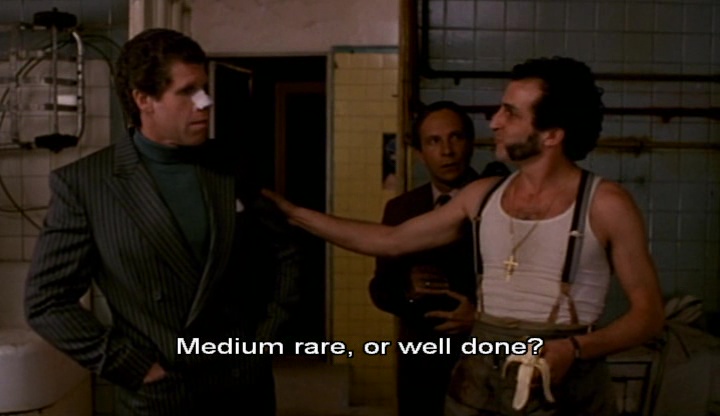
There’s also a dying businessman (Claudio Brook, The Exterminating Angel and several other films of Luis Bunuel) who really wants the Cronos Device. His American nephew (Ron Perlman, Hellboy and Sons of Anarchy) is brought in to seek out the device by any means necessary (some of which are quite nasty). He puts up with his uncle, because he is named in the will, but wait, if uncle is immortal…

What would you do to defeat death, to live forever?

As Roger Ebert observed, there are some real religious issues explored here – the battle of good and evil, love (for Gris’ wife and granddaughter) being more powerful than greed, and particularly the unshakeable belief in divine afterlife. What happens to that hope if you never die? And what if that extended life requires eating flesh and drinking blood? Would you risk hell to avoid going to heaven? When little Aurora cuts her hand, Jesus has to decide if his thirst is really worth drinking his granddaughter’s blood.

Of course, that assumes that drinking blood is somehow essentially evil. Tell that to a mosquito.

Jesus Gris is, like any good vampire, likely to start smoking ominously if he finds himself in the sunshine. But can his goodness overcome the vamp issues? Well he dies and comes back to life, reborn in a glowing white skin, he takes many savage beatings, saying that he can handle the pain, then he smashes the egg, declaring

Jesus Gris – translates to English as “the Grey Jesus”. He is the suffering servant, who died and came back to life. There is a lot of that in Spanish films, but this one has an added twist:

Yes, he wants blood. Could that be a backhander to the Church? Religion can motivate good deeds, or suck the blood of the devotees. The Eucharist is all about transubstantiation – the wine and wafer are believed (by some) to be literally the blood and body of Christ. Hannibal is full of it, particularly the resurrection of Mason Verger and his attempt to eat Hannibal. It’s the eternal paradox.

Cronos won the grand prize in the Critics’ Week at the 1993 Cannes Film Festival, and nine Mexican Academy Awards, including best picture and director. It has an enviable 91% “fresh” on the Rotten Tomatoes website. The Criterion Blu-ray edition is available at Amazon. The soundtrack is superb, by the acclaimed Mexican composer Javier Álvarez. Highly recommended.

NEXT WEEK: One of the most controversial cannibal films of all time: Joe D’Amato’s Antropophagus.