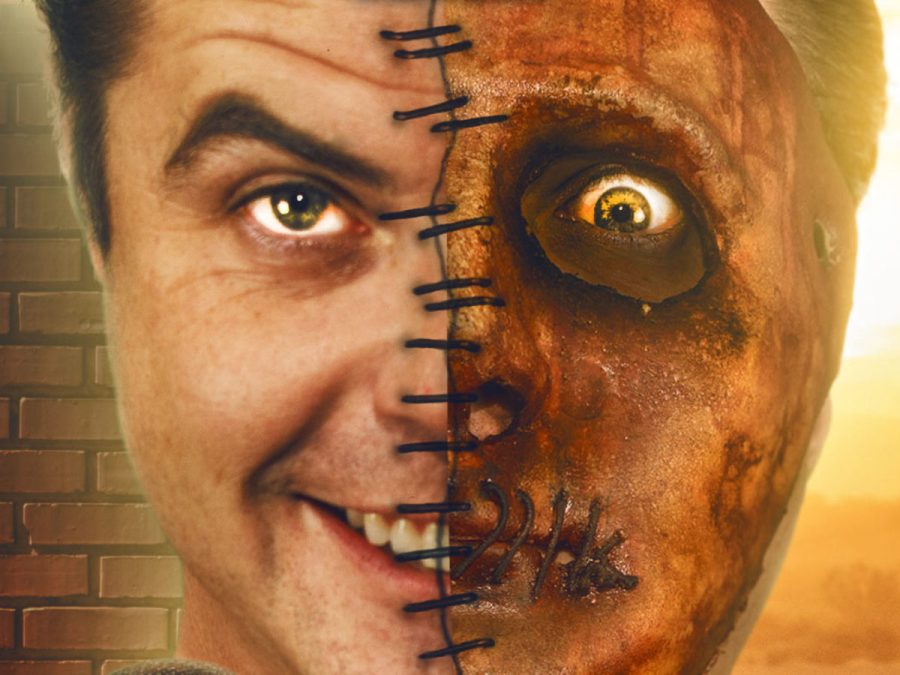
“Bone appétit”: Cannibal Comedian (Sean Haitz, 2023)

Quick question: have you ever thought about changing your life – what you do, where you go, with whom you interact? Most people have.

This film, Cannibal Comedian, is both a comedy and a gorefest, but it asks a serious question: are we confined by who we are, what we do, what we eat? Just stating an identity can get you into all sorts of trouble: try saying “I’m a vegan” in a butcher shop, or “I’m a liberal” in Wyoming, or “I’m a Zionist” on a trendy college campus.
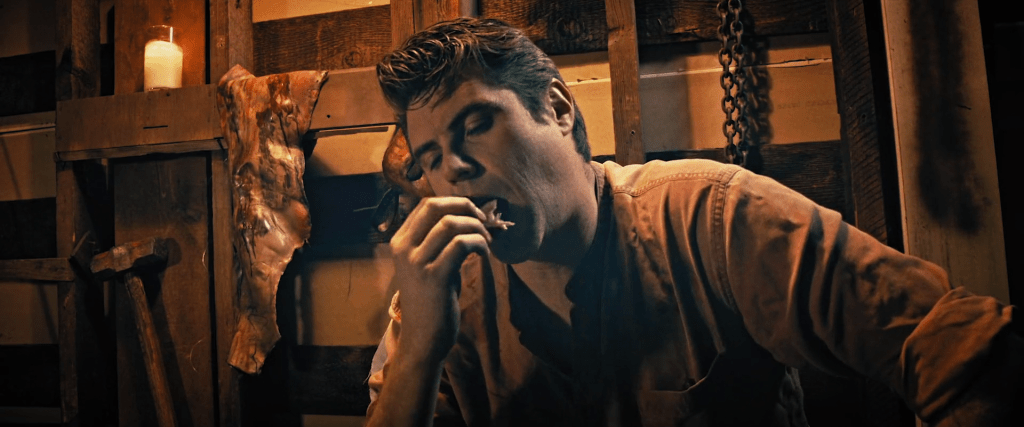
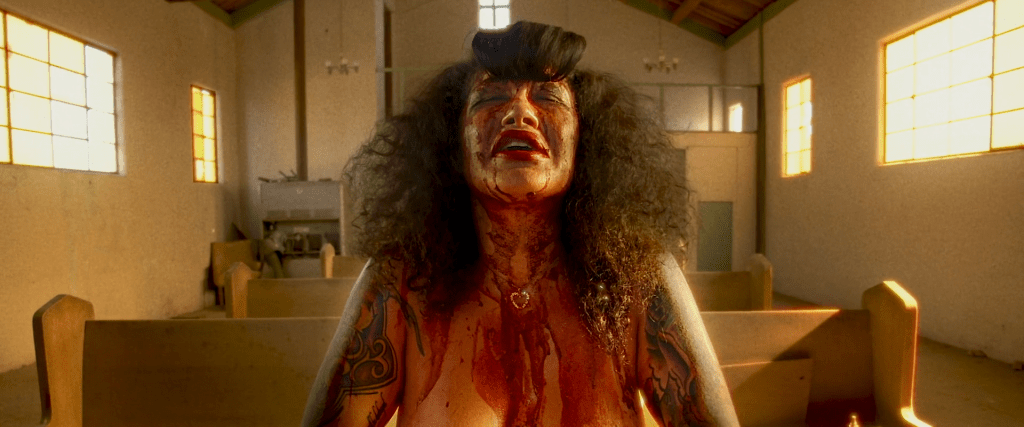
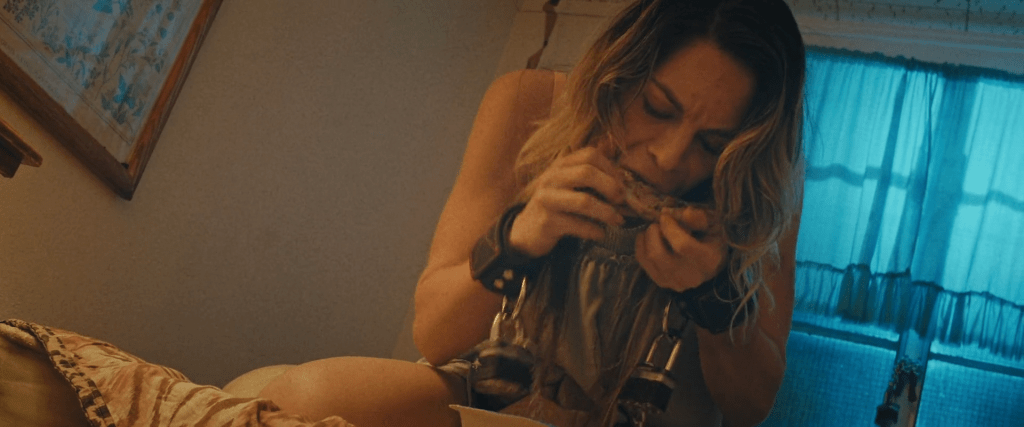
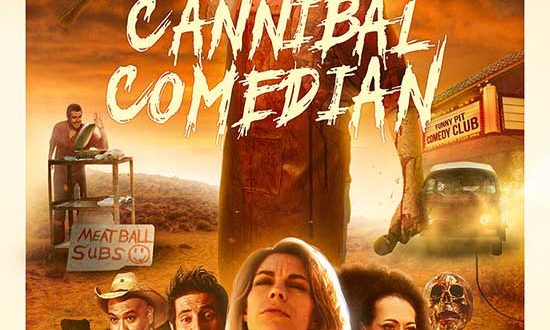
Charlie (Aaron Prager) is a desert-based cannibal, charming in a Ted Bundy sort of way, who chops up his victims and sells them as meatballs on the roadside, often killing and grinding up his customers to make the next batch of subs, cheered on by his very strange meatball-loving customer Eleanor (Mis Sadistic).
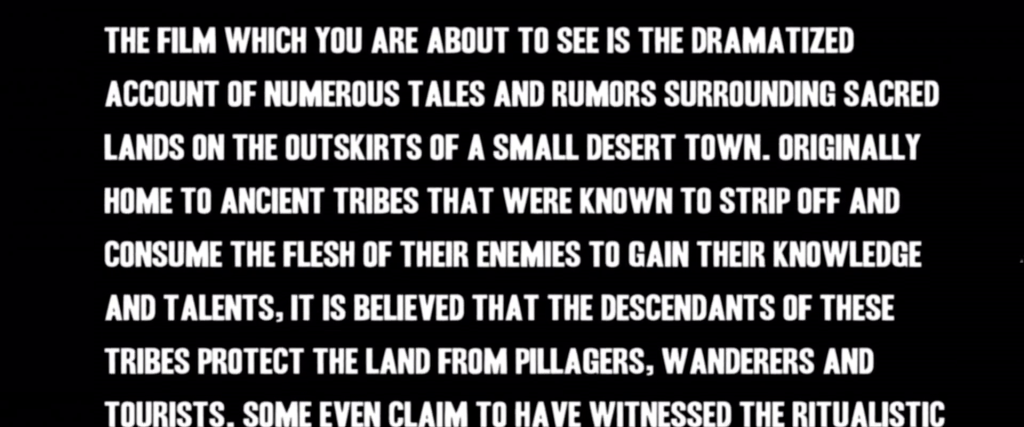
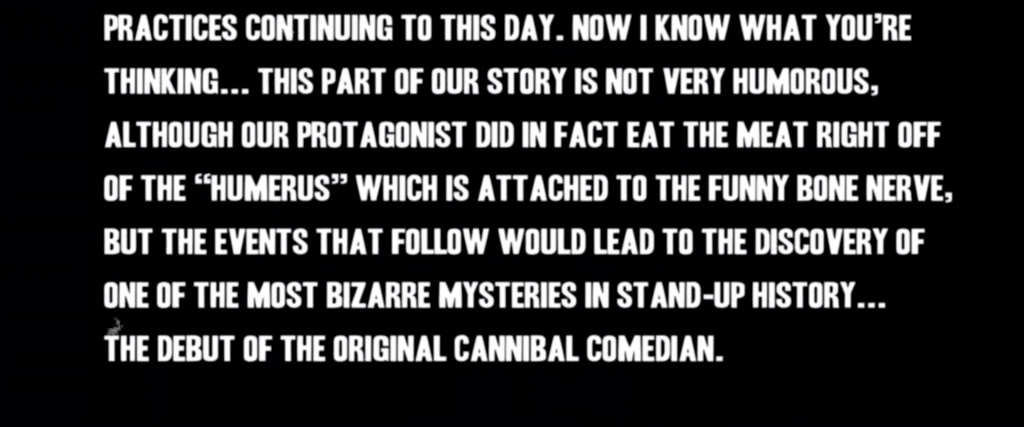
The desert cannibal is a trope explored originally in The Texas Chain Saw Massacre andThe Hills Have Eyes. A half-hearted attempt to tie it into cannibal mythology makes for some absurd opening cards.
In the desert, morality is optional and belonging to your community is everything – the Sheriff and Eleanor know exactly what Charlie is doing, and eagerly await his mince, but outsiders are fair game (there’s a pun for you, Charlie!)

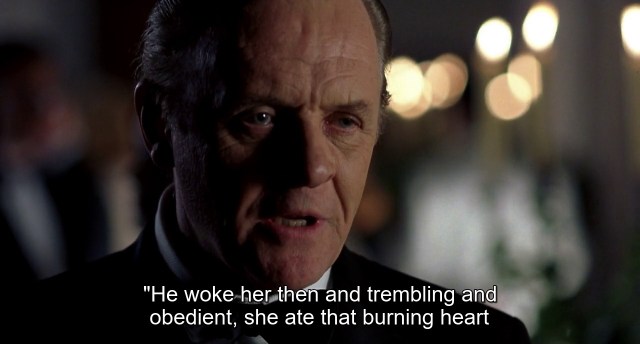
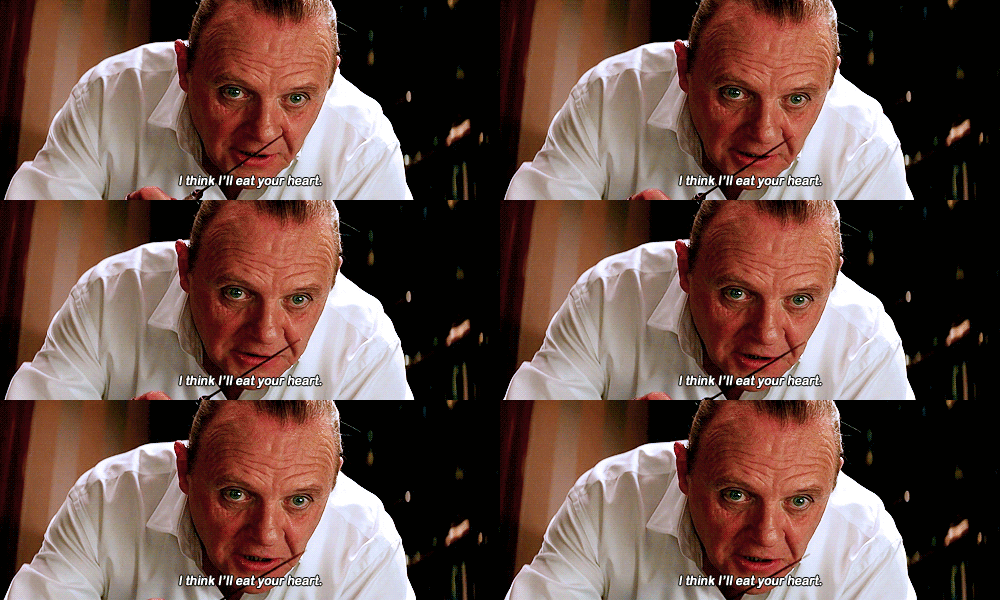
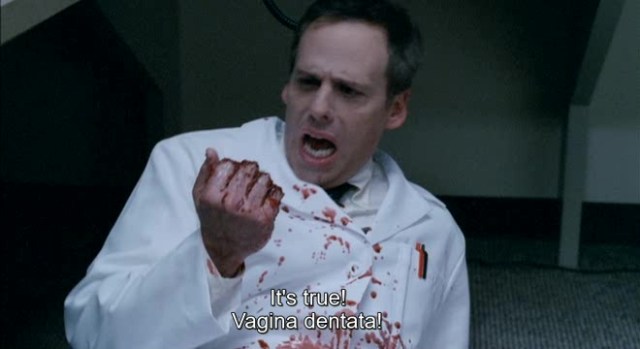
But Charlie wants to break out of being restricted to one identity and become what we all sometimes daydream about: a standup comedian. It makes sense – there is a lot of comedy in cannibal films – think of Hannibal’s line “I’m having an old friend for dinner”. Or Auntie Lee’s Meat Pies, where a seductive succubus named Coral leads a horny guy to bed, saying “I can’t wait to have you inside me”. Or the wonderful TV series The Horror of Delores Roach, in which the strong eating the weak is defined as “That’s just like Darwin and shit, man”. When Charlie captures carefree hippie singer Chrystal (Austin Judd), she becomes his audience and his muse, since she is a real entertainer. She encourages him to follow his dream, hoping he won’t be eating her as the after-show supper.
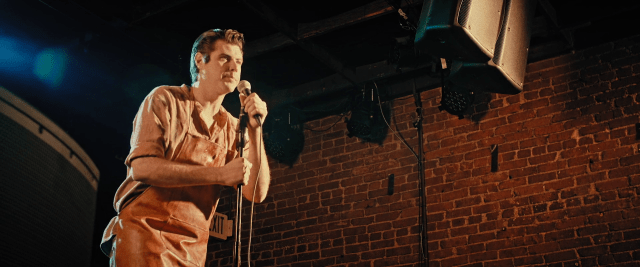
Charlie overcomes his nervousness and finally (halfway through the film!) appears on stage at a standup club called the Funny Pit, in front of the mandatory brick wall, dressed in his butcher apron and covered in blood from a couple of stoners who had tried to rob his house. The audience like the outfit and the cannibal jokes, and his career takes off.  Some examples of his dad/cannibal jokes:

“What do you get when you put a sixty-year-old woman in a motorised wheelchair?”
“Fast food.”

“She was starting to get a little moody and I asked her ‘what’s eating ya?’and she said ‘You are!’”

“Beauty only runs skin deep… it’s what’s on the inside that counts.”

“When I put him through the meat grinder, that’s when I knew he was a well grounded individual.”

“I started to eat plant-based – I only eat vegans now. Which tastes like annoying.”

But Charlie soon finds that hecklers can disrupt his whole routine. Any weakness and the predator becomes the prey. But Charlie has his own method of dealing with hecklers.
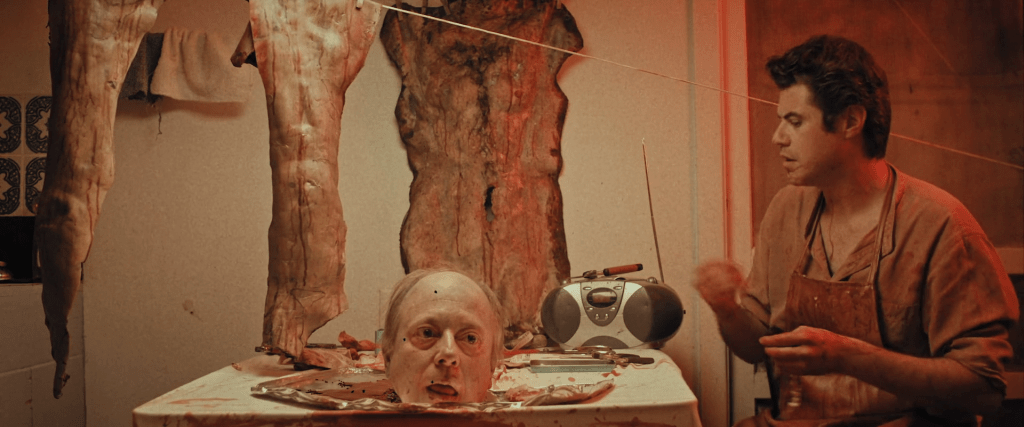
When Charlie finds out that the owner of the Funny Pit, Carrey (Robert Dunne), is not letting him perform because he wants to steal Charlie’s act for himself, the shit (and various other bodily fluids) really hits the fan. When Carrey asks if Charlie is planning to eat him, Charlie replies:

“I don’t eat rotten people”

And when Carrey asks Charlie to PLEASE stop with the cannibal jokes, Charlie replies:

“You know, being a cannibal, you think it’s a joke? You know, this is my life!”

There are a few intertextual references to cannibal films such as Charlie dressing like Leatherface from The Texas Chain Saw Massacre.
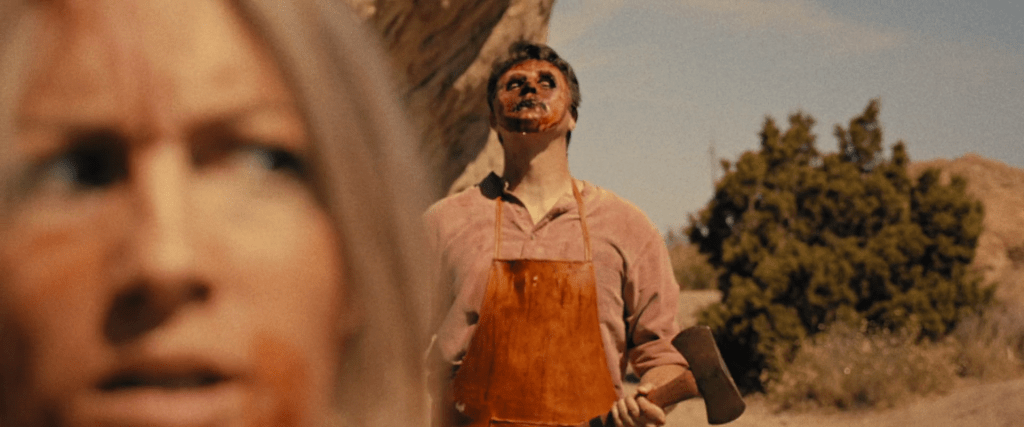
There are no major plot twists, in fact there isn’t much of a plot (or a budget apparently). So when his long-suffering captive and audience Chrystal finally knocks him down and escapes, she tells him:

“We both share that hunger for the spotlight.”

Chrystal is also a cannibal now, since human meat is all Charlie fed her, and she has kept herself alive by encouraging Charlie to workshop his act instead of eating her. She thus becomes both a cannibal and a comedian, sating her hunger for the spotlight, just as he did.

The most interesting question from the film is Charlie’s status as a cannibal. How did he decide to eat people? Is it the spirit of the wild places, the shortage of other food sources in rural areas, or was he born that way? When he shouts, “this is my life!” he implies there was no other choice for him. Chrystal is forced into cannibalism by hunger, but seems to see nothing particularly wrong with it, as long as it does not apply to her own body. Neither she nor Charlie seem to see anything particularly wrong with eating humans, as opposed to other animals.
Fun fact: AFTER I wrote this blog, I found that PETA was using a similar pun, Bone voyage, in a post about travelling with dogs. Maybe they saw this movie. After all, they listed four cannibal films in their “Top 10 Movies That Make You Go Meatless”!
Revenge cannibalism: LAST HOUSE ON THE LEFT (Wes Craven, 1972)

“Revenge is a dish best served cold”

Don Corleone said it in The Godfather, as did  Khan Noonien Singh in Star Trek II: The Wrath of Khan, but the saying goes back at least 100 years before that. It doesn’t seem to apply so much in cannibalism movies though, because if you’re really mad at someone, I suppose you’d want him to be warm and watching as you devour him, like Hannibal eating Abel Gideon, after feeding him oysters and acorns and sweet wine to improve his taste. Or Titus feeding Tamora, the queen of the Goths, a pie made of her own sons.

Revenge cannibalism is an exquisite form of retribution, going beyond murder to total destruction of the enemies (or his loved ones), incorporation of their essence, and conversion of their physicality into your excrement. Dante’s Inferno (Canto 33) depicts Count Ugolino in hell, gnawing eternally on the head of Archbishop Ruggieri, the man who had walled him up in a cell with his sons, whom he had eventually cannibalised. Perhaps the earliest narratives of revenge cannibalism appear in Greek legends, particularly that of Thyestes, who was fed the flesh of his sons by his pissed-off brother.

I’m adding this old classic film to the catalogue of cannibal texts as there is some human flesh eaten in anger, although it is not the main course of the film (puns are so hard to avoid in cannibalism blogs). The film starts with a couple of young girls heading to a rock concert, being abducted on the way, raped and murdered. If you are sensitive to such things (I hope most people are) or traumatised by recent news events, you may wish to give this film a miss.

I had forgotten about this movie until the Supernova Festival in which over 260 young people were abducted, raped and murdered, with a savagery reminiscent of that which befalls Mari and Phyllis in this week’s film. The barbaric slaughter of some 1,400 Israelis on October 7 2023 was followed by the IDF’s massive revenge, the extent of which shocked some of the world and impressed the rest. “Well, what would you do?” many online commentators asked.

Well, what would you do if, like the parents of one of the girls, you offered a warm welcome and overnight accommodation to some travellers who, you later discovered, were a gang of escaped criminals who had raped and murdered your child? The film answers that with a shotgun, a chainsaw, and an electric booby-trap.

Not what the UN would call a “proportionate response” (whatever that means), but many in the audience cheered at each gruesome death when it finally made it into cinemas (not until 2004 in Australia). Oh yes, one other form of killing that qualifies this otherwise simple slasher as a cannibal film—the girl’s mother, Estelle, pretends to seduce one of the gang members, then bites off his penis and swallows it.

The film critic Robin Wood spoke of what he called “the return of the repressed”. We repress our animal instincts to live in community, but beneath that veneer of respectability and normative morality lies “the monster”, the one we take out to exercise in the comparative safety of the cinema screen. Horror films such as this one depict the overcoming of repression, the shedding of the façade of respectability, in both the escaped psychopaths and then the vengeful parents, who shed their polite decorum to slash and kill. Craven shows the same thing in his later movie The Hills Have Eyes. Films from the seventies routinely explored a moral equivalence, a Vietnam War era pacifism that assumed any violence was equally appalling. Cannibal Holocaust, made at the end of that decade, sums up this view of the cycle of violence and the moral degeneracy of revenge when the anthropologist asks, “I wonder who the real cannibals are?” Later films from more cynical times tended to depict the killer or cannibal as either an irredeemable monster or a heroic figure, taking on bankrupt social imperatives. Right and wrong has come back into fashion but divides the viewers, depending on what their social media bubble tells them.

The film starts with a statement that it is a true story, which I guess used to be all the fashion—think Punishment Park, Cannibal Holocaust and the Blair Witch Project. The good old days, when truth was optional… oh forget I even started that sentence.

Anyway, this film wasn’t a true story, it was a remake of Ingmar Bergman’s 1960 film The Virgin Spring, in which a father takes merciless vengeance of a group that has raped and murdered his daughter. That was in turn based on a mediaeval Swedish ballad called “Töres döttrar i Wänge” (“Per Tyrsson’s daughters in Vänge”) in which the vengeful father discovers that the rapists he has just killed were actually his sons, sent off by him into the cruel world.

But it was Wes Craven’s film that introduced a bit of cannibalism into the revenge recipe. Wes Craven is best known for the Nightmare on Elm Street franchise and the first films of the Scream franchise. Last House on the Left was his first feature film, and he had such low expectations of its success that he felt he could be as outrageous as he liked and no one would ever hear about it, particularly his conservative family. But it did a lot better than he expected, to the extent that,

“I literally had people who would no longer leave their children alone with me. Or people that would, when they found out I had directed the film, say “That was the most despicable thing I had ever seen,” and walk out of the room.”

Audience members would get into fistfights, have heart attacks, and in many cases invaded the projection room to slash the film. Well, consider yourself warned.

Craven decided he would avoid horror, but was a complete failure at his attempts at more socially acceptable work. He had become known as the master of the slasher, leading him to another revenge cannibalism film in 1977 which became a cult classic, The Hills Have Eyes, in which a group of mutant cannibals kidnap, rape and slaughter (and eat) a ‘normal’ American family, who then inflict massive retaliation on them, adopting their savagery and raising the stakes.

In early 2023, a viral video seemed to show a couple of hunters gloating over a lion they had killed, and then being attacked and eaten by another lion, supposedly the dead lion’s brother.

Well, what would you do?

What’s your favourite cannibal movie?

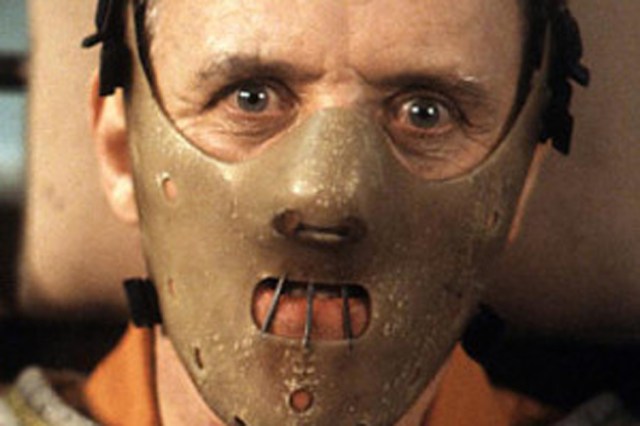
Of all the (sometimes) wonderful cannibal movies and shows I have reviewed in this blog, my personal favourite is still The Silence of the Lambs with Anthony Hopkins as Hannibal the Cannibal. It was the first film I reviewed on this blog (does that mean I liked the others less each time? Not at all), and interestingly, it does not actually feature any cannibalism, although we hear a lot about it.

Fun fact!

So I was pretty chuffed to find that The Silence of the Lambs is the favourite horror movie of the State of Utah, according to the Horrornews.net website. They used information from Rotten Tomatoes and Google Trends, and partnered with Mindnet Analytics, to analyse how interest in horror movies varied in each US state and the District of Columbia (DC). The results are presented on their website:

Best Horror Movies: Which Does Each US State Love Most?

This survey covers all horror, whereas in this blog we concentrate on the cannibal, so please let us know your favourite cannibal film (or TV show, but if it’s a series, your favourite episode) either in the comments at the bottom of the page (after a few suggestions) or at cannibalstudies@gmail.com. I’ll let you know the results.

“The lucky ones died first” THE HILLS HAVE EYES (Wes Craven, 1977)

The Hills Have Eyes has become a cult classic of the American horror film genre, as well as an important part of the cannibal studies canon.  The film follows the Carters, a suburban family targeted by a family of cannibal savages after becoming stranded in the Nevada desert.

hillshaveeyes.jpg

Wes Craven’s directorial debut was The Last House on the Left (1972), an American version of Ingmar Bergman’s The Virgin Spring (Swedish: Jungfrukällan), a movie that shocked (at least in 1960) with its themes of rape, torture and murder. Craven became known as a “Master of Horror”, and went on to make such classics as A Nightmare on Elm Street (1984) and Scream (1996).

Other influences on this film include John Ford’s The Grapes of Wrath (1940) and Tobe Hooper’s The Texas Chain Saw Massacre (1974). Like The Last House on the Left before it, the film also drew influence from the work of European masters such as François Truffaut and Luis Buñuel.

Wes Craven liked to find inspiration in the classics, and there’s nothing wrong with that. They say there are only seven or so archetypal stories in literature, and all the others are variations on a theme. So, The Hills Have Eyes is based on the legend of cannibal Sawney Bean, a story that Craven saw as illustrating the fine line between civilized and savage. Bean was believed (and how do we ever sift the fiction from the fact in cannibal stories?) to be the patriarch of a 48-person incestuous Scottish clan which murdered and cannibalised more than one thousand men, women and children in the 16th century. When the King and his soldiers finally caught up with the family, according to the Complete Newgate Calendar,

“The men had their hands and legs severed from their bodies; by which amputations they bled to death in some hours. The wife, daughters and grandchildren, having been made spectators of this just punishment inflicted on the men, were afterwards burnt to death in three several fires.”

Just like the Sawney Bean legend, the violence of the cannibal family in this film is matched by the ferocity of their victims. Unlike Texas Chain Saw, where escape by the “final girl” is victory enough, this movie ends with the “last boy” (as it were) savagely stabbing the last cannibal, and continuing to do so long after he is dead, watched by the “final girl” who is an abused and therefore redeemable member of the cannibal clan. The end of the film is not a fade to black but a fade to red.

vlcsnap-00022.jpg

vlcsnap-00016.jpg

Craven saw this treatment of the Bean clan by supposedly civilised people as paralleling the clan’s own savagery, and illustrated the point graphically in this film.

Chain Saw and Hills showed a slice of American life that doesn’t usually make it on to the screen – the “flyover states” where industry and agriculture have closed up shop, and the air force use the “empty” desert for nuclear testing. The remnants of the population, mutated by the radiation (the gas station dude’s baby, who became the cannibal patriarch, was at birth “twenty pounds and hairy as a monkey”), survive in the economic wasteland by doing whatever they can. In Hills, as in Chain Saw, they do it by capturing “civilised” folk who blunder into their killing fields. The survivors of the American Dream have become depraved cannibals, not just eating their victims, but first raping and tormenting them. In both movies, there is what, in his excellent review, Bloody Disgusting’s Zachary Paul called an archetypal “gas station of doom”, a final point of no return. They, and you the viewer, have been warned.

1

vlcsnap-00001.jpg

As a classic horror film, it is actually quite dull in large sections. This is not a fault of the production so much as the budget: the whole thing was made for peanuts and shot on 16mm film, on cameras that were borrowed from a Californian pornographer. There was not a lot of spare cash for gore, so the episodes of violence are extreme, but short. The sudden jolts of music make up for the missing build-ups.

The symbolism of the film is unsubtle. The cannibals are freaks and monsters, although remarkably technology-savvy:

vlcsnap-00003.jpg

This slideshow requires JavaScript.

vlcsnap-00007.jpg

The family of victims are the tough patriarch, a former cop, who cannot save them and is crucified by the cannibals, the virgin daughter who is raped by them, and a baby who is stolen and almost (until they changed the script) eaten (they describe her as “a young Thanksgiving turkey”).

vlcsnap-00002.jpg

vlcsnap-00010.jpg

vlcsnap-00008.jpg

But by the end, both families have descended into mindless brutality.

vlcsnap-00036.jpg

vlcsnap-00030.jpg

A sequel was made by Craven in 1984 called The Hills Have Eyes Part II. Although the villains were allegedly cannibals, there is no cannibalism in it, so I won’t be wasting our time on it in this blog, particularly as it managed a score of ZERO on Rotten Tomatoes, which is quite a feat.

Both films were remade in 2006 and 2007, and we’ll get to those, eventually.

The Hills Have Eyes was part of the “new wave” of horror that arose in the 1970s. Other notable directors who made up this new wave were Tobe Hooper, George Romero, David Cronenberg, John Carpenter and Brian De Palma. Horror had moved away from outsiders (monsters, aliens, vampires, etc) to humans, usually the victims of pervasive social dysfunction and degeneracy. Cannibalism was getting closer to where we live – our species. Later films would move the cannibal into our cities, and then finally into our homes.

Our voracious appetites continue to turn inward.

Poster.jpg