Trick or meat: SECTOR 36 (Aditya Nimbalkar, 2024)

Children wandering door to door, sometimes unsupervised, is often likely to end in tears. In this film Sector 36, immigrant parents, struggling to survive, have not the time to keep a watchful eye on the kids, resulting in sexual abuse, murder, organ trafficking, and cannibalism.

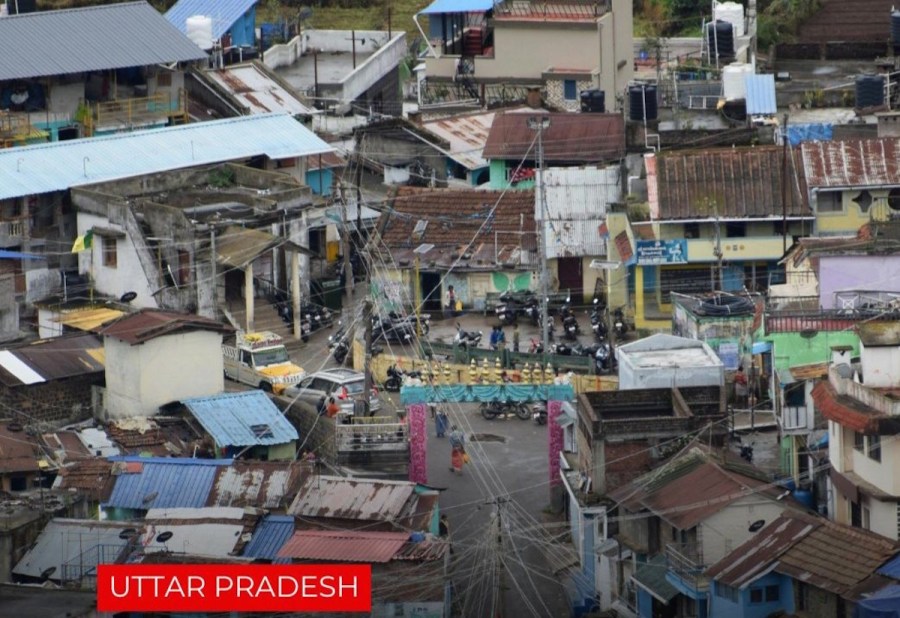
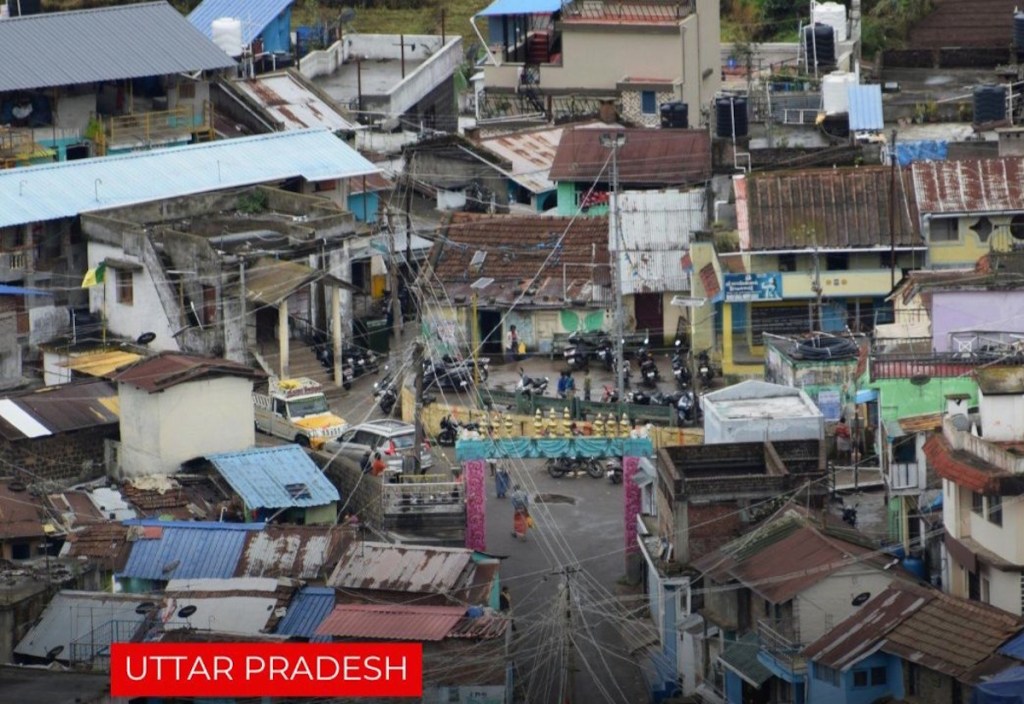
The words “inspired by true events” allow for all sorts of poetic licence, offering the fascination of actual criminality without the need to prove the veracity of each scene. This one is fairly close to the facts, being based on the 2006 Noida serial murders, in which over thirty children disappeared from a town in Uttar Pradesh in northern India. Evidence was presented, in the trial of the two alleged perpetrators, that the children had been sexually abused and murdered, had their organs sold to traffickers, and in some cases were eaten. The charges included abduction, rape, murder, criminal conspiracy and trafficking. The two men involved, a rich man and his servant, were found guilty of murder in 2009 and sentenced to death but were later (2023) acquitted of all charges against them due to insufficient and largely circumstantial evidence, despite the servant’s recorded confessions, which included admissions of cannibalism.

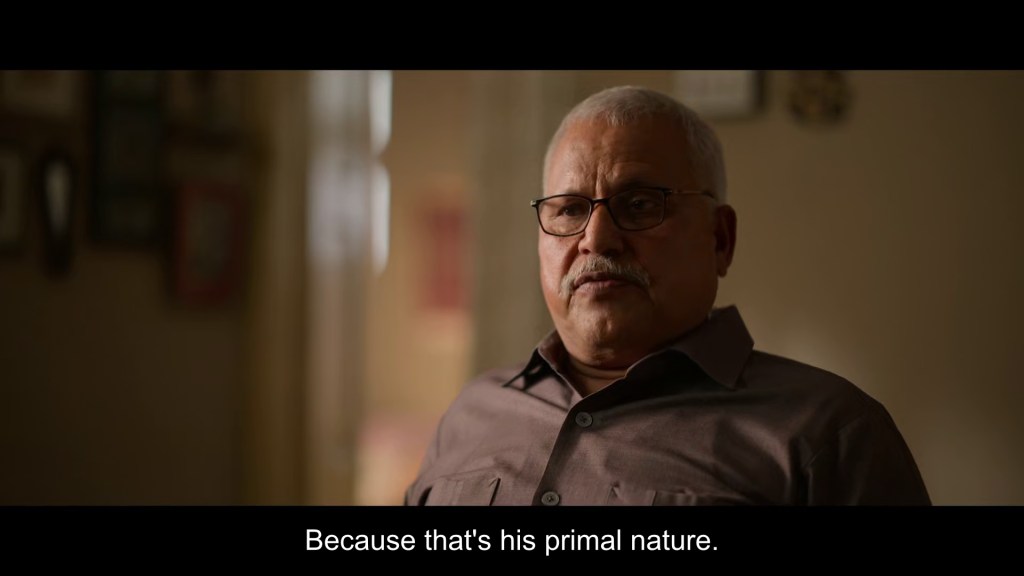
Before the acquittals, the BBC released a documentary called The Slumdog Cannibal, which tried to examine the motivations of the servant who had admitted to the crimes. The legal position becomes a lot more complicated once convictions are quashed, so in the two-hour Netflix special Sector 36, the original names have been changed, and various details are embellished for dramatic effect. The twists and turns of the plot at the end are completely fictitious. But the direction is sure and never intrusive, the plot is taut and engrossing, and the acting excellent, from the smallest victim to the extraordinary interactions of the two main characters, Prem and Ram.

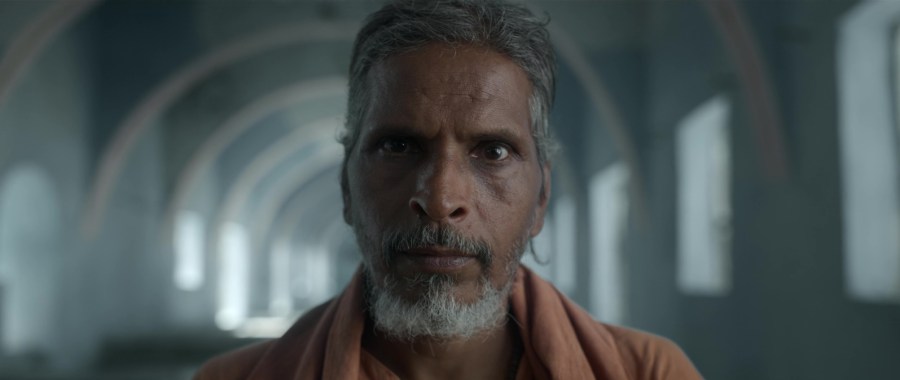
We start by meeting the hungry servant, in this case called Prem Singh (played by Vikrant Massey), who is looking after the house of his boss, Balbir Singh Bassi (Akash Khurana). He calls his family, tenderly tells his wife he loves her, and then goes off to a storeroom where he starts chopping up a dead woman.

We then we meet a policeman, Ram Charan Pandey (played by Deepak Dobriyal) who is also a loving family man, driving his daughter to school on his scooter, but he turns out to be corrupt and lazy at work, not bothering to investigate the reports of the many small children who have gone missing in the town. They’ll turn up, he tells the distraught parents. He believes it too, until Prem tries to abduct his daughter. Then he takes the cases seriously, only to be hindered and suspended by his superior officer who is a friend or perhaps employee of the rich man, Bassi. When the father of one of the abducted girls appears at Bassi’s house screaming about murder and rape, Bassi reveals that the father was the girl’s pimp.

But then, a child from a wealthy family is taken, a nationwide manhunt is launched, and the child is found almost immediately. One cop tells his colleagues that while Gandhi freed the country, the picture of Gandhi’s face on Indian banknotes will free this rich child. Eventually, Ram’s new superior officer reinstates him and lets him arrest Prem, but only because he wants his temporary posting in Delhi to become permanent.

Is everyone corrupt in this story? The theme, stated at the beginning, is Isaac Newton’s third law of thermodynamic: for every action there is an equal and opposite reaction, which has become in social interactions a “system”. The system means that when a crook gives Pandey a box of cash, he is allowed to leave, while others who have no funds are beaten up and incarcerated. When a rotting child’s hand is found in a sewer, Pandey declares it is a monkey’s paw and gives a reward to the boy who found it.

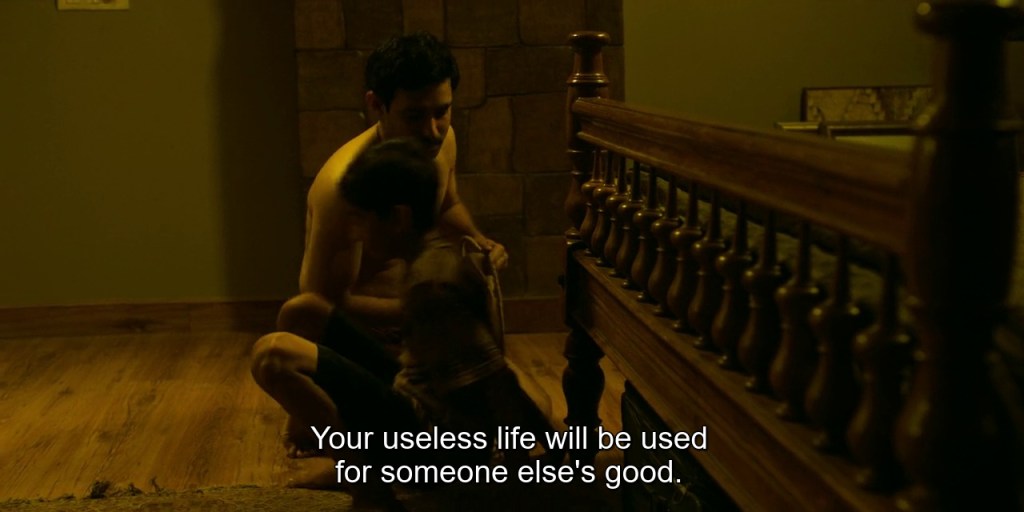
This boy is then captured by Prem who has his own system, capturing little kids to be abused and then slaughtered for their flesh and organs. Prem tells the boy that the police will forget about him after a few days, and even his parents will eventually just replace him. But someone else, someone rich and worthy, will live longer through the appropriation of his organs.

Why, we wonder, is he like this? We have a flashback to Prem’s early life – he is working in his uncle’s butcher shop, chopping up goats and “servicing” his uncle, who enjoys raping little boys. We see him fight back, killing the uncle and then chopping him up, presumably getting rid of the evidence by bundling it up with the goat flesh, and eating his uncle’s liver, raw.

I cut that fucker up and fed him to the dogs. Had a few pieces myself!

As an adult, he has no scruples doing the same thing to kids (human ones), for his own pleasure and profit. Ram, the policeman, arrests Prem who immediately confesses, boasts, that he kidnaps kids, rapes them, chops them up after killing them, eats some of the meat, disposes of the rest, and sells their organs. His “business” involved all the missing children that the police have been ignoring. He tells the police,

Sir, the thing is that after killing Uncle, I got a taste for human flesh. I used to crave it. I needed it every couple of months…. I avoided it for a year, I tried to quit. But that craving wouldn’t go away.

He admits to abducting Ram’s daughter, but says it was an accident. He just didn’t know her father was a cop. Ram asks, “what’s the difference between them and my child?” Prem is outraged – there is no comparison, the kids he kidnapped and slaughtered were nobodies, who would never amount to anything.

While Prem is a bit naïve (one might say stupid), his question is real. No one cares about the sheep, goats or chickens that he chopped up in his Uncle’s shop as a child, nor would they be able to tell the difference if he added Uncle to the mince. Prem’s argument that he became addicted to human flesh is just an excuse – those who have tried the meat of humans report it is hard to distinguish from veal or pork. But poverty, homelessness and alienation is real, and if we can utterly disregard the moral value of any sentient being, we can do the same to those humans who seem, to criminals and authorities alike, outside our scope of care. Those whose lives don’t matter become disposable, and ultimately edible.

Accused Nithari cannibal serial killers go free: “THE SLUMDOG CANNIBALS”

The 2006 Nithari serial murders case was alleged to have taken place in the house of businessman Moninder Singh Pandher in Noida near Nithari village, Uttar Pradesh, India between 2005 and 2006. Moninder Singh was convicted in two out of the five cases against him, while his servant Surinder Koli, accused of assisting him or possibly instigating the killings, was convicted in 10 out of the 16 cases against him.

Koli admitted to killing six children and a 20-year-old woman referred to as “Payal” after sexually assaulting them. He later confessed to eating their livers and other parts of their bodies. Both men were sentenced to death, Koli ten times, but eventually, in October 2023, after some 2,000 hearings, Allahabad High Court acquitted them both, citing lack of evidence.

Despite being from a family of Hindu vegetarians, Koli was from the Dalit, the Untouchable caste, who are considered subhuman by much of society, marginalised, excluded, with their human rights routinely violated. They survive by doing the jobs no one else wants. From 14, Koli worked as a butcher’s assistant, learning to slaughter and dismember large mammals, which seems to have been a useful skill later in his life. He apparently developed a taste for meat at this time.

In 2005, Koli became a servant to Pandher, where he witnessed some pretty lively parties involving Pandher’s friends and visiting sex workers. In March that year, a little girl went missing in Nithari, and a couple of weeks later it happened again. Between 2005-06, a child went missing in Nithari every six weeks on average.

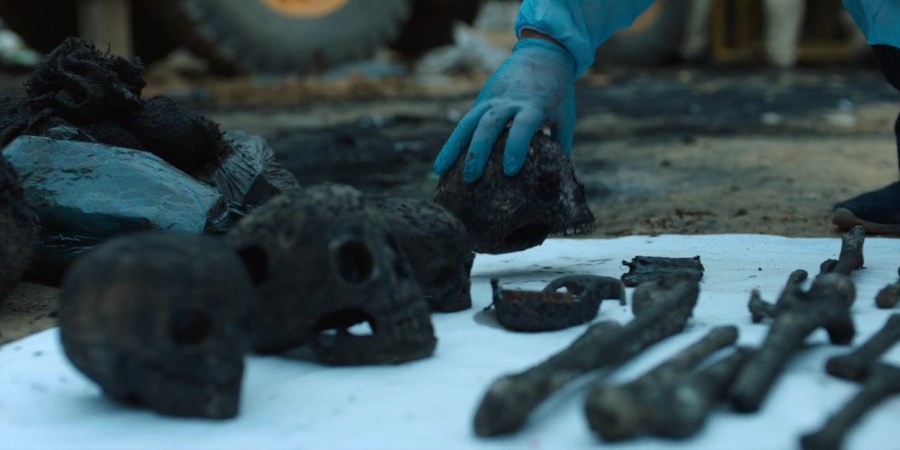
Police told parents they had probably run away (although the youngest was three years old) and would return by themselves. Frustrated by police inaction, parents and local residents in December 2006 organised the excavation of the reeking drains behind Pandher’s house where they found bags of bones, which proved to the hands and legs of small children. Skulls were found on the other side of the house. Police arrested the two men, and found some of the children’s belongings in the house. Police put the number of child victims at more than 31. Locals rioted outside the house, claiming that the police were corrupt and had concealed evidence of crimes involving rich people; the father of one girl alleged that the police had threatened and harassed him.

They demanded that the local police force be replaced by the Federal Government agency, the Central Bureau of Investigation. In 2007, six police were suspended for incompetence and the CBI filed sixteen cases against the two men involving abduction, rape, murder, criminal conspiracy and trafficking.

The CBI investigated the case, which by now was surrounded by accusations that tried to explain the disappearances – an organ transplant racket, or a child pornography ring. Pandher’s laptop was found to contain images of naked children, but they turned out to be his grandchildren. The logistics of harvesting and selling organs of small children turned out to be almost certainly insurmountable. Extensive psychological evaluations found that Koli was obsessed with young girls aged 5-7, while Pandher had a thing for 18-19 year old sex workers (one victim was twenty, the rest were children). Koli admitted on tape to luring the little girls into the house, strangling them and having sex with them before killing them, then cutting up their corpses and eating body parts. The way he dismembered them was similar to what he would have learned as a butcher’s assistant when he was a teenager. Yet investigators found that he had behaved entirely normally with his own children back in his home village, where his wife and family lived.

On 12 February 2009, both the accused—Moninder Singh Pandher and his domestic servant Surinder Koli—were found guilty of the 8 February 2005 murder of Rimpa Haldar, 14, by a special sessions court in Ghaziabad. This verdict embarrassed the CBI, as they had earlier given a clean bill of health to Pandher in all their charge-sheets. Both were given the death sentence. Other victims were identified, including:

  • On 4 May 2010, Koli was found guilty of the 25 October 2006 murder of Arti Prasad, 7, and given a second death sentence eight days later.
  • On 27 September 2010, Koli was found guilty of the 10 April 2006 murder of Rachna Lal, 9, and given a third death sentence the following day.
  • On 22 December 2010, Koli was found guilty of the June 2006 murder of Deepali Sarkar, 12, and given a fourth death sentence.
  • On 24 December 2012, Koli was found guilty of the 4 June 2005 murder of Chhoti Kavita, 5, and given a fifth death sentence.

On 16 October 2023, 17 years after the crimes first came to light, Koli and Pandher were acquitted of all charges against them due to insufficient and largely circumstantial evidence, despite the recorded confessions of Koli. The parents were naturally shattered.

It seems likely that between the animalisation of lower caste humans and the sacralisation of certain species of cattle in India, some people are unable to discern any line between humans (except for their kin) and other large mammals.

“Moninder used to have call-girls coming home all the time. Seeing them, I wanted to have sex as well. Slowly, these feelings turned into my wanting to murder and eat them. A girl from Sector 30 called Dimple was passing in front of the house. I called her inside. I then strangled her with her chunni. When she was unconscious, I tried to have sex with her but failed. So I killed her. I wanted to eat her. So I took her body into the bathroom upstairs. I got a knife from the kitchen and cut her body into little pieces. I then cooked a piece of her arm and chest and ate it.”

Koli later denied any involvement in the murders, saying that the CBI made him “remember” names and details to frame him, as they were protecting rich men who were raping and killing girls and selling their organs (a high-tech form of cannibalism). Pandher is now free; Koli remains in jail. The victims’ families continue suffering, even as some of them were given houses and cash settlements. When money talks, nothing and no one is off the menu.

The BBC released a documentary on the case called The Slumdog Cannibal in 2012. This was after the initial trials, but before the several appeals. The documentary, which concentrates on the background and motivations of Surinder Koli, can be watched (at the time of writing) on YouTube.

Is “true crime” really “true”? INDIAN PREDATOR: DIARY OF A SERIAL KILLER (Netflix, September 2022)

The world is so full of misinformation, disinformation and straight-out lies that it is not surprising that audiences crave some truth, and podcasts and documentaries investigating “true crimes” have become enormously popular.

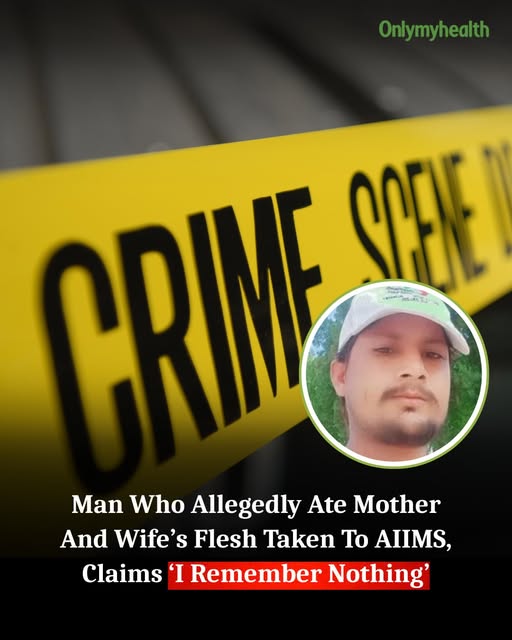
The first series of Indian Predator, “The Butcher of Delhi” was screened earlier this year, and this new one, “Diary of a Serial Killer” involves a confessed cannibal, so of course The Cannibal Guy had to take a look. But did he kill all those people, and even if he did, did he also eat their brains? Truth is often the first victim of cannibalism.

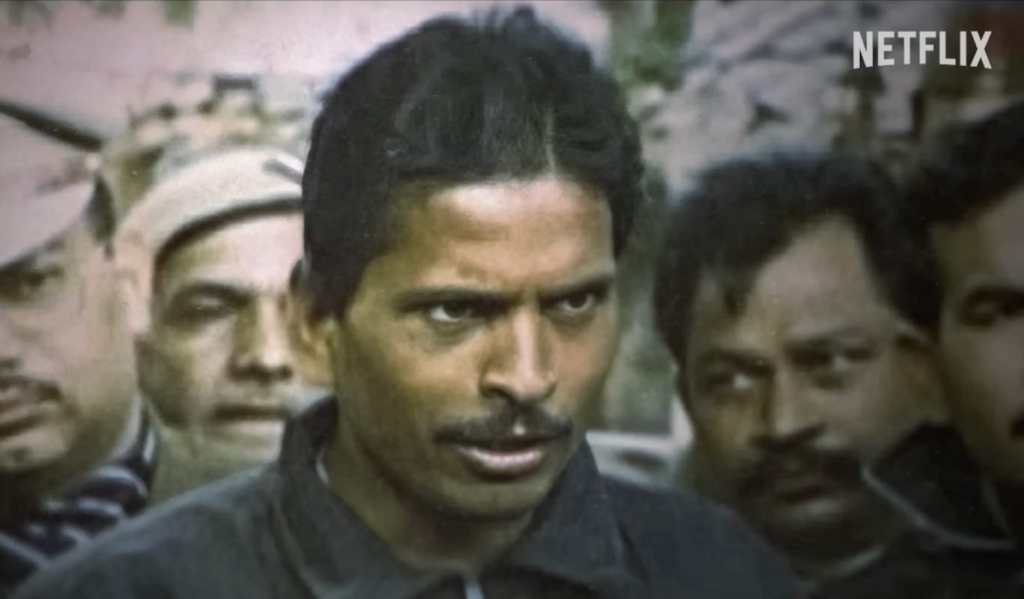
Raja Kolander, real name Ram Niranjan, the husband of a local politician, was suspected of murdering a journalist in Allahabad in 2000. Dhirendra Singh was a reporter with a Hindi daily newspaper called Aaj, and his body was mutilated and discarded in a river and a jungle. His head and genitals had been removed.

Police tracked the journalist’s phone records and found a call to the suspect, Raja Kolander. Kolander and his brother-in-law were arrested, beaten up, and finally confessed to the murder of the journalist. The police claimed that the murder was to stop Singh reporting on their car-theft business. But during the subsequent investigation, officers found Kolander’s diary, which listed some fourteen victims in total, including that journalist.

Although he was arrested in 2001, Kolander was not charged with the murder for a decade. During his trial in 2012, the police testified that he had admitted to cannibalism, and to burying fourteen skulls in his home. Kolander, his brother-in-law and his wife were all given life sentences for three murders, although he has appealed those convictions. Claims of cannibalism were never proven, nor were the other eleven murders, and some of those interviewed say that a few of those so-called “victims” are still wandering around. There is also mention made that the “mining mafia” had it in for Dhirendra Singh for exposing some of their corrupt practices, but this is not really explored further in the documentary. We are told, however, that Uttar Pradesh is ranked top in number of murders in all of India.

The first episode interviews the police and family of the journalist, and presents fairly damning evidence of murder. But then, some of it is just silly, such as the chief investigator saying that criminals “stutter when faced with the police.”

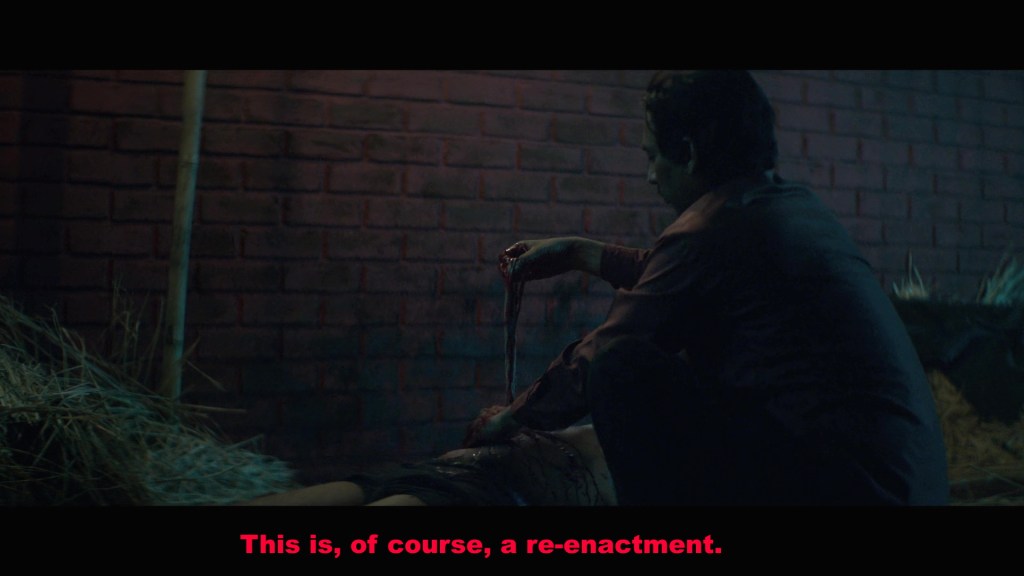
The evidence against Kolander is presented as it was laid out by the police, and the events shown in the documentary are just recreations of the official version, with actors playing the main characters. How legit those are is a good question, as there are several mentions of duress during the police interrogation.

The police claim that Kolander was motivated by power, and sought to acquire it by cannibalism. One victim was from the Lala sub-caste. They are considered smart, even cunning, and often accused of taking advantage of the poor. The police claim that Kolander believed he could imbibe this cleverness through cannibalism, and so this victim was killed and Kolander then removed his brain:

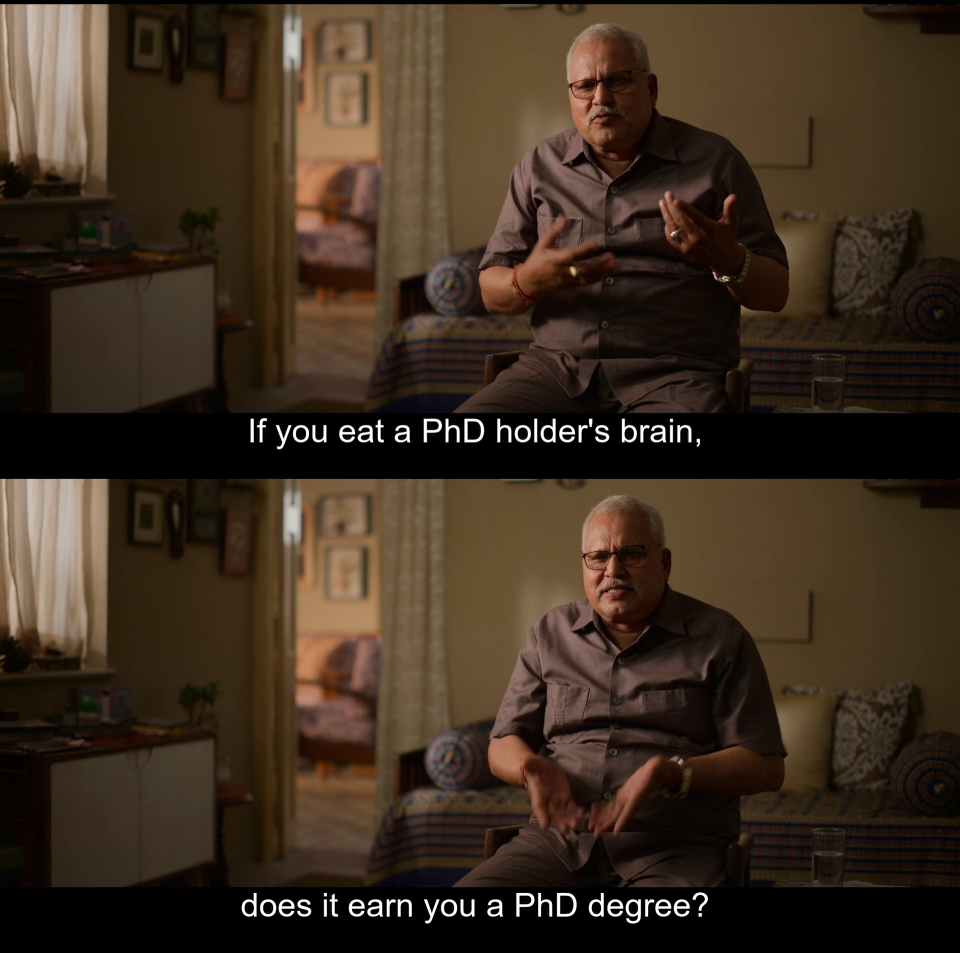
Then drank it as a stew. Another victim claimed to be a hypnotist, and so his brain was consumed in the hope of gaining that skill. As the investigator asks

A question to which I, for one, urgently need an answer.

Kolander then allegedly cut open a Brahmin, a member of a caste known to eat well, to see if they have larger intestines than other people. He then had to cut open a lower caste person to compare. The results were apparently disappointing. We are all equal, at least in the width of our intestines.

The second and third episodes interview Kolander in jail, another decade after the trial. He maintains that he is innocent of the murders that took place some twenty years before. He insists that he is a victim of trial by media.

The question of why his supposed thirteen other crimes went without investigation until a respected journalist was killed sheds some interesting light on the social and caste divisions in Indian society. Like Albert Fish, who in 1920s New York preferred to kill and eat black children since he knew the police would not work too hard to look for them, the racist attitudes in India to other classes, religions, and communities seem to have resulted in not much work being done on finding the earlier victims.

But Kolander himself comes from a caste which is largely impoverished, and the times were ripe for revolt by the subaltern castes – there were dacoits (bandits) roaming the countryside, and lower castes were fighting to be represented in government of all levels. It is clear that Kolander’s caste, the Kol, were considered by the upper castes to be primitive savages, recently driven from the jungles by deforestation into the life of subsistence farming, but retaining their savage traditions. It was inconceivable to them that a person from this background could own two cars, as the police claimed.

Kolander insists that he is a highly spiritual Hindu, not concerned with worldly power, and even claims to be a vegetarian, which would make eating brains tricky, although others (including his daughter) cast doubt on that. But it is certainly true that the colonial story has embraced accusations of cannibalism since Columbus – those who are poor and deprived must be savages, eaters of human flesh. Nothing they do is therefore surprising, and anything they are accused of is probably true.

Is this “true crime” documentary true? It’s impossible to know. But there are lot of holes in the story, including the fact that police brutality seems to be a standard interrogation technique, the fact that it took a decade to bring him to trial and, after another decade, his conviction (for three murders, not fourteen) is still to be decided. Also, the charges of cannibalism, which kind of make this newsworthy, were never proven in a court of law. Kolander, with some justification, says that his case was tried not in court but in the media, which published pretty much any sensational story they could dream up.

Cannibalism is perhaps the perfect exemplar of the uncanny – Freud wrote that we are most disquieted by the familiar suddenly becoming strange (remember Jeffrey Dahmer’s step-mother Shari saying he was “a nice, kind boy”) and things that should be hidden instead being revealed (e.g. the Brahmin’s intestines). But the impossibility of determining the truth is in itself uncanny, even more disquieting because our certainties about truth and lies are torn apart. A few cannibals sit down and tell their stories (Dahmer did, and so did Meiwes and Sagawa), but often the cannibal either disappears into the night like Jack the Ripper or suicides like Chase or is executed like Chikatilo. Seeing the bodies, or what’s left of them, but never knowing what or who happened to them is uncanny, and even more so when, like Kolander, the apparent cannibal denies all culpability.